
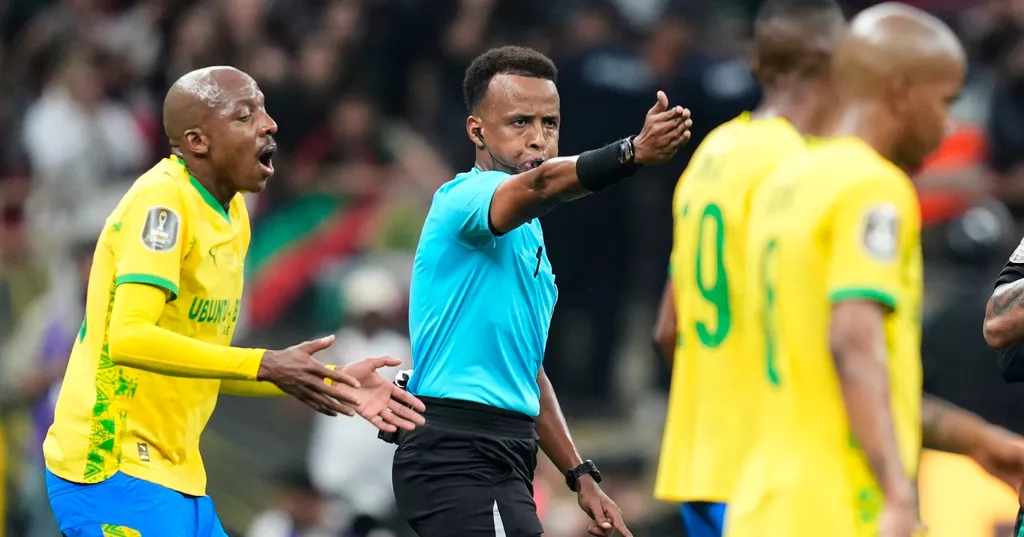
A Somali referee who was set to become the first official from his country to work at a FIFA World Cup has been denied entry to the United States, forcing FIFA to remove him from the tournament just days before it begins.
Omar Artan, widely regarded as one of Africa’s leading referees, had been selected for the World Cup and was expected to join fellow match officials at a training camp in Miami ahead of Thursday’s opening game.
However, U.S. Customs and Border Protection (CBP) said Artan was refused entry upon arrival at Miami International Airport on Saturday because of unspecified “vetting concerns.”
The decision came despite Artan having received a valid U.S. visa last week through the Somali Embassy in Kenya.
Artan, who was named Africa’s best male referee in 2025, was set to make history as the first Somali referee to officiate at a World Cup. His selection had been announced by FIFA two months ago.
The move has drawn attention because it is highly unusual for a FIFA-appointed match official to be denied entry to a World Cup host country.
In a statement, CBP said the Somali national underwent an additional inspection, which it described as a routine procedure used to verify information and determine admissibility.
“Following inspection, the traveler, a referee for the FIFA World Cup, was determined to be inadmissible due to vetting concerns and was denied entry,” the agency said.
CBP added that all travelers entering the United States, including World Cup players, coaches and staff, are subject to inspection and screening.
Somalia’s Ministry of Youth and Sports said it had not been informed of the specific reason behind the decision. The country’s embassy in Washington is reportedly working through diplomatic channels to resolve the issue and allow Artan to participate in the tournament.
The incident comes amid broader concerns over U.S. immigration restrictions. Somalia was among several countries affected by stricter travel measures introduced under President Donald Trump’s administration, raising fears that fans, players and officials from those nations could face difficulties entering the United States despite holding valid visas.
Isse Aden Abshir, a senior adviser to Somalia’s sports ministry and a former national team captain, suggested that Artan’s case may be linked to wider screening policies rather than any allegation against him.
FIFA said it had no role in immigration decisions and had been informed by U.S. authorities that Artan’s status would not change in time for the tournament.
“As a result, he will not be able to train and officiate at the World Cup,” FIFA said.
The governing body noted that, as with previous tournaments, the host government has the final authority over visa approvals and entry into the country.
Artan expressed disappointment but remained optimistic about his future.
“Despite the circumstances, I am in a positive mood and focused on the next challenges in my refereeing career,” he said in a statement released by FIFA. He thanked FIFA and the Confederation of African Football for their support and wished his fellow referees success at the tournament.
Artan recently officiated the second leg of the African Champions League final, one of the continent’s biggest club football matches.
In a recent television interview, he spoke about the challenges of pursuing a refereeing career in conflict-affected Somalia, including navigating security risks and occasional explosions in the capital, Mogadishu.
He described World Cup selection as a lifelong goal and said he was proud to represent Somalia on football’s biggest stage.
That dream has now been put on hold, at least for this tournament.