Three Chinese astronauts returned to Earth on Friday after their trip home was postponed for more than a week due to damage sustained by their original return capsule, likely caused by space debris.
According to China’s Manned Space Agency, the crew left the Shenzhou-20 spacecraft in orbit and instead traveled back aboard Shenzhou-21, which had recently delivered a new three-member team to the Tiangong space station. Their planned return was canceled after inspectors found small cracks in a window on Shenzhou-20, indicating it had probably been struck by debris.
The astronauts had spent six months aboard the station and were supposed to return on Nov. 5, four days after the new crew arrived. Their mission was extended by nine days, bringing their total time in orbit to 204 days — the longest stay by any astronaut on China’s space station to date.
It remains unclear whether switching capsules will alter the timeline for upcoming missions. The agency confirmed that Shenzhou-22 will be launched but did not provide a date.
Mission commander Chen Dong said he felt relieved after landing, describing the journey as both a valuable training experience and a genuine challenge. “Human space exploration is never easy,” he said. “It’s full of obstacles — which is exactly why we pursue it.”
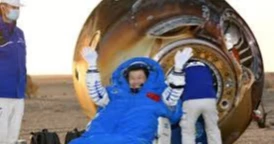
The return capsule floated down under a red-and-white parachute and touched down in the Gobi Desert in northern China late Friday afternoon, kicking up a cloud of dust. About half an hour later, the astronauts were carried from the capsule and placed in chairs before being transported across the desert in orange vehicles.
Space debris remains a growing hazard, with millions of fragments orbiting Earth at high speed and posing serious risks to spacecraft, satellites, and astronauts.
The three astronauts, who launched in April, continued conducting experiments alongside the new crew during the delay and remained in good condition, the space agency said earlier this week.
Also returning to Earth were four mice that unexpectedly spent extra time in orbit after arriving on Shenzhou-21 two weeks earlier. Scientists are studying how microgravity and confinement affect small mammals, hoping to develop technology to breed and monitor animals in space. Researchers said the mice adapted quickly, eating, drinking, and sleeping normally, and will now undergo further examination at a hospital.
China’s space program, overseen by the military, is a major source of national pride. State broadcaster CCTV aired the landing live, with a Chinese flag planted near the touchdown site.
China has made rapid progress in space exploration — building the Tiangong station, deploying a rover to Mars, and planning to send astronauts to the moon by 2030. Tiangong, which first hosted a crew in 2021, is smaller than the 25-year-old International Space Station, from which China was excluded due to U.S. national security concerns.
The ISS has experienced its own delays, including a 2024 Boeing capsule mission that kept two NASA astronauts in space for nine months instead of one week.