Baltic Sea
Germany’s stranded humpback whale likely survived only days after failed rescue attempt
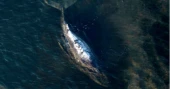
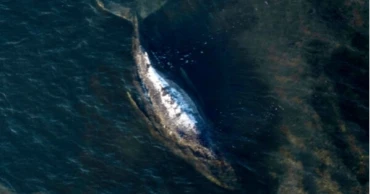
A humpback whale that had captured public attention across Germany likely survived only about five days after a controversial rescue operation failed to return it safely to the Atlantic Ocean, officials said Friday.
The whale, widely nicknamed “Timmy” and “Hope” by German media, was found dead on May 14 near the small Danish island of Anholt in the Kattegat strait between Denmark and Sweden, which links the Baltic Sea to the North Sea.
Its discovery brought an end to months of intense debate and rescue efforts. The final attempt took place on May 2, when the animal was moved on a barge in hopes of guiding it back to deeper waters. Scientists, authorities, and animal welfare advocates were divided over whether continued intervention was humane or whether the sick and weakened whale should be left alone.
Tracking data from a transmitter attached to the whale’s dorsal fin suggests it died around May 6 or 7, according to Till Backhaus.
Officials said the whale had travelled about 215 kilometres over those days but was moving in the wrong direction, back toward the Baltic Sea instead of toward the Atlantic Ocean. After that, it likely drifted or the tracking signal was lost.
The whale was first spotted off the German coast on March 3, sparking widespread media attention, live updates, and public concern over its condition.
Experts are still unsure why the whale entered the Baltic Sea, a region unsuitable for its survival. Some believe it may have become disoriented while following fish or during migration.
An autopsy has not confirmed the exact cause of death, but officials said no serious injuries, foreign objects, or signs of violence were found. Authorities also confirmed the whale was female, correcting earlier assumptions that it was male.
Some of the remains will be processed into biodiesel in Denmark, while parts of the skeleton will be preserved in a Danish museum, according to reports.
3 months ago

All you need to know about Nord Stream 2 gas pipeline
Nord Stream 2 is a gas pipeline designed to deliver Russian natural gas from Russia to Germany through the waters of the Baltic Sea.
The gas artery's construction ended in September 2021. The project is controlled by the operating company Nord Stream AG office in Switzerland's Zug.
Last year, Nord Stream 2's certification was delayed by Germany, with the process halted indefinitely in February 2022.
Just six months later, a major breakdown hit the gas artery, with underwater blasts detected on the pipeline. The European Union saw the incident as "sabotage," and Moscow called it an act of "international terrorism."
Read more: Despite Russian supply cuts German gas storage over 90% full
Designed to carry Russian "blue fuel" to Germany through the Baltic Sea, Nord Stream 2 was founded by Russia's Gazprom.
The project's cost stands at about $9.2 billion. European companies chipped in to pay half the sum. Among these companies are France's Engie, Austria's OMV, Holland-UK's Shell, and Germany's Uniper and Wintershall.
Initial plans stipulated that Gazprom would receive 51 percent of the company's shares, while the rest should have been granted to its above-mentioned European partners.
In 2017, however, Gazprom bought out all 100 percent shares of Nord Stream 2 AG, with the European companies starting to act as the project's investors.
In June 2021, Famil Sadygov, deputy chairman of Gazprom's board of directors, pointed out that "the project is fully provided with financing to complete its investment stage and move to the operational one."
Where is Nord Stream 2 Pipeline situated?
The 1,234km project passes through the territories of Russia, Germany, Denmark, Finland, and Sweden.
Nord Stream 2 bypasses transit countries, including Ukraine, Belarus, and Poland.
Why is US against Nord Stream 2?
The US, along with its allies in Eastern Europe, especially Poland and Ukraine, has repeatedly opposed the construction of Nord Stream 2.
Washington previously imposed two rounds of sanctions on the project, arguing that once Nord Stream 2 is operational, Europe will become even more dependent on Russia's energy resources, something the White House claims will help Moscow obtain political leverage.
Former US Ambassador to Germany Richard Grenell described Nord Stream 2 as "an unceremonious attempt" by Russian authorities to increase the strangulation of European allies and partners in terms of energy supply in 2019.
Last year, the Biden administration decided to waive sanctions against Nord Stream 2, citing its understanding of the fact that the sanctions would not work and referring to its unwillingness to alienate Berlin, one of Washington's key allies.
Moscow has repeatedly underscored that the project is purely economic and that the way the White House opposes it is an example of unfair competition.
Read more: Russia’s Gazprom keeps gas pipeline to Germany switched off
How expensive would gas be for Germany without Nord Stream 2?
On September 16, Neue Osnabrücker Zeitung newspaper сited the German Public Utilities Association as reporting that next year may see a 60 percent increase in gas prices in the country due to a reduction in supplies from Russia amid the suspension of the Nord Stream 2 project.
According to the newspaper, with electricity prices in Germany increasing by more than 10 percent, the so-called ultimate consumers now have to pay 30-60 percent more for gas than before the beginning of the ongoing Russian special military operation in Ukraine, which was launched on February 24 and followed by western countries slapping packages of "severe sanctions" on Moscow.
Klaus Ernst, head of the Bundestag's Committee for Economics and Energy, said it is worth considering launching Nord Stream 2 due to what he called the absence of other alternatives.
According to him, "In general, it does not matter through which pipeline the gas is delivered to Germany because the fuel remains Russian anyway. In this sense the issue of Nord Stream 2 is rather symbolic."
Difference between Nord Stream 1 and 2
Both pipelines are parts of the single Nord Stream gas transportation network.
Nord Stream 1 gas pipeline, which entered into service in 2011, starts its route in the northern Russian town of Vyborg, while Nord Stream 2, which has yet to start running, begins its path near Russia's northwestern Ust-Luga.
Most recently, Russian President Vladimir Putin announced that one Nord Stream 2 branch was in working condition, adding that "the decision to launch it is not being made and is unlikely to be made, but this is not our (Russia's) business."
3 years ago