others
Quake measuring 5.8 hits Afghanistan, Pakistan; 8 dead in Kabul
A 5.8-magnitude earthquake struck parts of northern and eastern Afghanistan and western Pakistan late Friday, leaving at least eight people dead in Afghanistan, officials said.
The tremor, centered in the Hindu Kush about 150 kilometers east of the city of Kunduz, was confirmed by international seismic monitoring agencies.
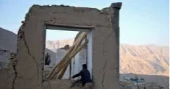
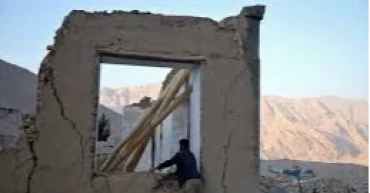
According to Hafizullah Basharat, a spokesman for the Kabul governor, the fatalities occurred when a house collapsed on the outskirts of Kabul, killing eight members of the same family and injuring a child.
Kabul lies around 290 kilometers from the epicenter. No immediate reports of casualties or damage were received from areas closer to the quake’s origin, which is located in a remote region where communication delays are common.
The earthquake struck at a depth of more than 180 kilometers, allowing it to be felt across a wide area of both countries. In Pakistan, tremors were reported in cities including Islamabad, Peshawar, Chitral, Swat and Shangla, though no casualties or damage were immediately reported.
Afghanistan’s Health Ministry said medical teams in Kabul and other provinces had been placed on alert following the quake.
The region is known for frequent seismic activity, with devastating earthquakes recorded in recent years. In August last year, a powerful quake killed more than 2,200 people in eastern Afghanistan, while another in November left dozens dead and hundreds injured in the north.
Afghanistan’s vulnerability to such disasters is compounded by widespread poverty and fragile infrastructure, particularly in rural areas where homes are often built from mud and wood and lack resilience against strong tremors.
1 day ago
Bahrain cracks down on dissent as Iran war fuels unrest
Bahrain has intensified a sweeping crackdown on dissent as its conflict with Iran deepens, with activists and families accusing authorities of reviving harsh tactics used during the 2011 Arab Spring uprising.
The case of Mohamed al-Mousawi, a Shiite Muslim who died in custody last month, has become a flashpoint in the Sunni-ruled, Shiite-majority kingdom, which hosts the US Navy’s 5th Fleet.
Al-Mousawi was detained in March as Bahrain came under missile attacks from Iran. Days later, his family was called to collect his body from a military hospital.
Relatives said the 32-year-old, who had previously been imprisoned and was saving to start a business, showed signs of severe abuse, including slash marks, bruising and injuries on the soles of his feet.
Bahrain’s Interior Ministry said al-Mousawi had been arrested on suspicion of spying for Iran — an allegation denied by his family — and dismissed images of his injuries as “inaccurate and misleading.” Authorities said the country is acting to protect national security and rejected claims of sectarian bias.
Allegations of torture
Al-Mousawi had served around 11 years of a 21-year sentence on charges including arson and belonging to a terrorist cell before being released in 2024 under a royal amnesty.
According to relatives and a family friend, he disappeared on March 19 after attending prayers with two others who also remain missing. His body was returned on March 27.
Witnesses who saw the body alleged signs of torture, including burns and injuries consistent with whipping. A forensic expert with the New York-based Physicians for Human Rights said the wounds described were consistent with blunt force trauma and possible torture.
The Interior Ministry said al-Mousawi had been held by the National Security Agency, whose arrest powers were reinstated in 2017 after being curtailed following the 2011 unrest.
A death certificate listed the cause of death as a heart attack, though his family said he had no known preexisting conditions.
War heightens tensions
Rights groups say al-Mousawi’s death comes amid a broader crackdown targeting Bahrain’s Shiite community since Israel and the US launched military operations against Iran on Feb. 28.
Authorities have arrested dozens of people during the conflict for filming military activity, participating in protests, expressing support for Iran or allegedly sharing sensitive information.
Activists say the measures echo a long-running campaign to suppress dissent that peaked in 2011, when Bahrain’s ruling Al Khalifa family, backed by Saudi Arabia and the United Arab Emirates, crushed pro-democracy protests.
“It remains to be seen how far the government will go,” said Bahraini activist Maryam al-Khawaja. “What we’re seeing now is more heavy-handed than in recent years.”
The government said its actions are a “direct and proportionate response” to Iranian attacks and rejected accusations of sectarian persecution.
Security concerns and arrests
Since the war began, at least 41 people — including migrant workers — have been detained for sharing images of what authorities described as Iranian attacks or for expressing sympathy for Iran. Some face charges including treason, which can carry life imprisonment or the death penalty.
Bahrain says it has been targeted by more than 600 Iranian drone and missile strikes, which have killed at least two people and damaged key infrastructure, including a desalination plant, an oil refinery and an aluminum smelter. Iranian forces have also targeted the US Navy’s 5th Fleet headquarters in the country.
Videos circulating online show some demonstrators expressing support for Iran and acts of unrest, including arson and attacks on property.
Fears of harsher punishment
In a separate case, 21-year-old Hussein Fatiil was detained shortly after posting a video from a protest outside the US Embassy, where he and a friend were seen waving a poster of Iran’s supreme leader.
His father said the two were taken by plainclothes officers and later charged with multiple offenses, including misuse of social media, inciting hatred and treason.
“The charges are extremely serious and exaggerate what happened,” his father said, adding that the protest had been peaceful.
He expressed fears that his son could face the harshest penalties, including death.
1 day ago
US aircraft shot down as war in Iran escalates; one crew member missing
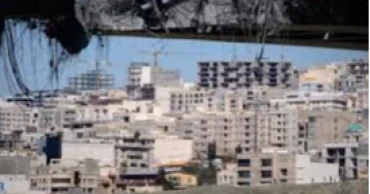
Iran shot down two US military planes in separate attacks Friday, with one service member rescued and at least one missing, in a dramatic escalation nearly five weeks after the war began.
It was the first time US aircraft have been downed in the conflict and came just two days after President Donald Trump said in a national address that the US has “beaten and completely decimated Iran” and was “going to finish the job, and we’re going to finish it very fast.”
One fighter jet was shot down in Iran, officials said. A US crew member from that plane was rescued, but a second was missing, and a US military search-and-rescue operation was underway.
Neither the White House nor the Pentagon released public information about the downed planes. In a brief telephone interview with NBC News, Trump declined to discuss the search-and-rescue efforts but said what happened would not affect negotiations with Iran.
“No, not at all. No, it’s war,” he said.
Separately, Iranian state media said a US A-10 attack aircraft crashed in the Persian Gulf after being struck by Iranian defense forces.
A US official who spoke on condition of anonymity to discuss a sensitive military situation said earlier that it was not clear whether the aircraft crashed or was shot down, or whether Iran was involved. Neither the status of the crew nor exactly where it went down was immediately known.
Those incidents came as Iran fired on targets across the Middle East on Friday, keeping the pressure on Israel and its Gulf Arab neighbors despite US and Israeli insistence that Iran’s military capabilities have been all but destroyed.
Second service member’s status unknown
Neither the White House nor the Pentagon released public information about the downed planes. But the Pentagon notified the House Armed Services Committee that the status of a second service member from the fighter jet was not known.
In an email from the Pentagon obtained by The Associated Press, meanwhile, the military said it received notification of “an aircraft being shot down” in the Middle East, without providing more details.
Iran’s attacks on Gulf energy infrastructure and its tight grip on the Strait of Hormuz — through which a fifth of the world’s oil and natural gas transits in peacetime — have roiled stock markets, sent oil prices skyrocketing and threatened to raise the cost of many basic goods, including food.
Downed jet could mark a new level of pressure on the US
Prior to word of the rescue, social media footage showed American drones, aircraft and helicopters flying over the mountainous region where a TV channel affiliated with Iranian state television had said earlier that at least one pilot bailed out of the fighter jet.
An anchor urged residents to hand over any “enemy pilot” to police and promised a reward.
It was the first time the US has lost aircraft in Iranian territory during the conflict and could mark a new level of pressure on the US military.
Throughout the war, Iran has made a series of claims about shooting down piloted enemy aircraft that turned out not to be true. Friday was the first time Iran went on television urging the public to look for a downed pilot.
Iranian state media said in a post on the social platform X that the military shot down a US F-15E Strike Eagle. The aircraft is a variation of the Air Force fighter jet that carries a pilot and a weapons systems officer.
Alan Diehl, a former investigator for the Air Force Safety Center, said the Strike Eagle has an emergency locator beacon in a survival kit that can be set to activate automatically or manually.
Iran targets a desalination plant and a refinery
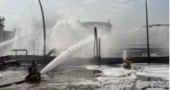
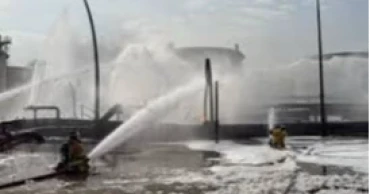
News about the downed planes came after Iran attacked Kuwait’s Mina al-Ahmadi oil refinery. The state-run Kuwait Petroleum Corp. said firefighters were working to control several blazes.
Kuwait also said an Iranian attack caused “material damage” to a desalination plant. Such plants are responsible for most of the drinking water for Gulf states and have become a major target in the war.
Also, sirens sounded in Bahrain, Saudi Arabia said it destroyed several Iranian drones, and Israel reported incoming missiles.
Authorities in the United Arab Emirates shut down a gas field after a missile interception reportedly rained debris on it and started a fire.
Activists reported strikes around Tehran and the central city of Isfahan, but it was not immediately clear what was hit.
In Lebanon, where Israel has launched a ground invasion in its fight with the pro-Iranian Hezbollah militant group, an Israeli drone strike on worshippers leaving Friday prayers near Beirut killed two people, according to the state-run National News Agency.
More than 1,900 people have been killed in Iran since the war began on Feb. 28 with US and Israeli strikes. In a review released Friday, the Armed Conflict Location and Event Data, a US-based group, said it found that civilian casualties were clustered around strikes on security and state-linked sites “rather than indiscriminate bombardment” of urban areas.
More than two dozen people have died in Gulf states and the occupied West Bank, 19 have been reported dead in Israel, and 13 US service members have been killed.
More than 1,300 people have been killed and more than 1 million displaced in Lebanon. Ten Israeli soldiers have also died there.
Iran keeps a chokehold on the Strait of Hormuz
World leaders, meanwhile, have struggled to end Iran’s stranglehold on the waterway, which has had far-reaching consequences for the global economy and has proved to be its greatest strategic advantage in the war.
The UN Security Council was expected to take up the matter Saturday.
Trump has vacillated on America’s role in the strait, alternately threatening Iran if it does not open it and telling other nations to “go get your own oil.” On Friday, he said in a post on social media that “with a little more time, we can easily OPEN THE HORMUZ STRAIT, TAKE THE OIL, & MAKE A FORTUNE.”
Spot prices of Brent crude, the international standard, were around $109, up more than 50% since the start of the war, when Iran began restricting traffic through the strait.
1 day ago
No sign of war winding down in Mideast
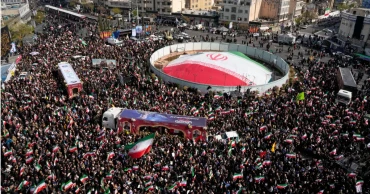
There was little sign Friday of the war in the Mideast winding down as Israel said it faced incoming fire from Iran, Kuwait and Bahrain reported being under attack, and Iran said eight people were killed while celebrating the close of Persian new year near a major bridge hit by a U.S. strike.
Tehran continued to demonstrate its ability to strike its neighbors even as U.S. President Donald Trump claimed the threat from the country was nearly eliminated and cheered the collapse of the bridge on Thursday, reportedly the tallest in the Middle East.
Iran decried the strike on the bridge, which also injured 95 people celebrating Nature Day, when Iranians gather for picnics and other celebrations outdoors on the last day of Nowruz, the Persian new year.
“Striking civilian infrastructure only conveys the defeat and moral collapse of an enemy in disarray,” Iran’s Foreign Minister Abbas Araghchi wrote Thursday in a post on X.
Iran’s attacks on Gulf states along with its chokehold on the Strait of Hormuz have disrupted the world’s energy supplies with effects far beyond the Middle East. That has proved to be Iran’s greatest strategic advantage in the war. Britain held a call with nearly three dozen countries about how to reopen the strait once the fighting is over.
Trump has insisted the strait can be taken by force — but said it is not up to the U.S. to do that. In an address to the American people Wednesday night, he encouraged countries that depend on oil from Hormuz to “build some delayed courage” and go “take it.”
Before the U.S. and Israel started the war on Feb. 28 with strikes on Iran, the waterway was open to traffic and 20% of all traded oil passed through it.
Iran continues to strike Israel and Gulf countriesIran responded defiantly to Trump’s speech, in which the American president claimed U.S. military action had been so decisive that “one of the most powerful countries” is “really no longer a threat.”
A spokesman for Iran’s military, Lt. Col. Ebrahim Zolfaghari, insisted Thursday that Tehran maintains hidden stockpiles of arms, munitions and production facilities. He said facilities targeted so far by U.S. strikes are “insignificant.”
Trump, in his address, said U.S. “core strategic objectives are nearing completion.”
Iran state media reported the attack on the B1 bridge, which was still under construction, citing authorities in Alborz province.
Trump posted footage on social media showing what he said was the collapse of Iran's biggest bridge and threatening, “Much more to follow.” It was not immediately clear if the footage Trump shared was the B1 bridge.
In Lebanon — where Israel has launched a ground invasion against Iran-backed Hezbollah militants — Israeli strikes killed 27 people over 24 hours, the Health Ministry said.
More than 1,900 people have been killed in Iran during the war, while 19 have been reported dead in Israel. More than two dozen people have died in Gulf states and the occupied West Bank, while 13 U.S. service members have been killed.
More than 1,300 people have been killed and more than 1 million displaced in Lebanon. Ten Israeli soldiers have also died there.
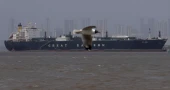
Nearly three dozen nations talk about securing the Strait of HormuzIranian attacks on about two dozen commercial ships, and the threat of more, have halted nearly all traffic in the waterway that connects the Persian Gulf to the open ocean.
Since March 1, traffic through the strait has dropped 94% over the same period last year, according to the Lloyds List Intelligence shipping data firm. Two ships are confirmed to have paid a fee, the firm said, while others were allowed through based on agreements with their home governments.
Saudi Arabia piped about 1 billion barrels of oil away from the Strait of Hormuz in March, according to maritime data firm Kpler, while Iraq said Thursday that it had started to truck oil across Syria to avoid the strait.
The 35 countries that spoke Thursday, including all G7 industrialized democracies except the U.S., as well as the United Arab Emirates and Bahrain, signed a declaration last month demanding Iran stop blocking the strait.
Thursday’s talks were focused on political and diplomatic measures, but British Foreign Secretary Yvette Cooper said military planners from an unspecified number of countries will also plot ways to ensure security once fighting ends, including potential mine-clearing work and “reassurance” for commercial shipping.
No country appears willing to try to open the strait by force while the war is raging. French President Emmanuel Macron, while on a visit to South Korea, called a military operation to secure the waterway “unrealistic.”
But there is a concern that Iran might limit traffic through the waterway even after U.S. and Israeli attacks cease.
Oil prices rise again even as Trump suggests the war could end soonThe conflict is driving up prices for oil and natural gas, roiling stock markets, pushing up the cost of gasoline and threatening to make a range of goods, including food, more expensive.
Oil prices remained elevated, however, at $111.54 for a barrel of U.S. crude, having soared following Trump’s address. That's up about 50% from Feb. 28.
Though the oil and gas that typically transits the strait is primarily sold to Asian nations, Japan and South Korea were the only two countries from the region joining Thursday's call about the strait. The supply of jet fuel has also been interrupted, with consequences for travel worldwide.
2 days ago
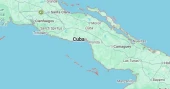
Cuba frees 2,010 amid US pressure
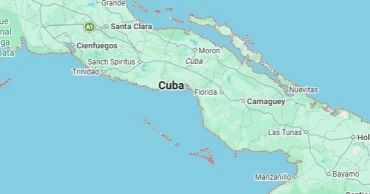
The Cuban government said Thursday it had pardoned 2,010 people at the same time the Trump administration has placed extreme pressure on the government and suffocated the island with an oil blockade.
Cuba’s government said the pardons were a “humanitarian gesture” in connection with Holy Week and didn’t mention mounting pressures with the U.S.
The government said it had “released” foreigners and Cubans, including women, the elderly and young people. Cuban authorities didn’t name who was released or under what conditions, nor did it mention the crimes they were accused of committing.
Authorities also provided no details on whether any of those pardoned were protesters convicted and sentenced for terrorism, contempt or public disorder.
Cuba’s government does not recognize political prisoners, but the activist group Prisoners Defended registered 1,214 people imprisoned for political reasons in Cuba.
Cuban authorities said the pardon decision “was based on a careful analysis of the characteristics of the crimes committed by those sanctioned, their good behavior in prison, having served a significant portion of their sentence, and their health status,” according to a statement published in state media.
The release comes as the Trump administration has placed extreme pressure on Cuba’s government, imposing an oil blockade for months that has fueled blackouts and left many civilians suffering.
3 days ago
UN to vote on diluted proposal to reopen Strait of Hormuz
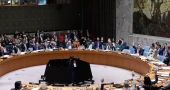
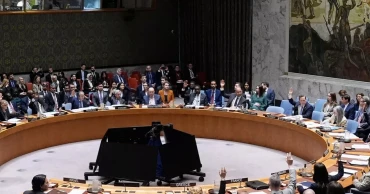
The U.N. Security Council is scheduled to vote Friday on a proposal to secure the Strait of Hormuz after it was significantly watered down in the face of opposition from China and Russia about allowing force to reopen the critical waterway that Iran has largely cut off to global shipping.
The final draft of Bahrain's resolution, obtained Thursday by The Associated Press, authorizes the use of defensive — but not offensive — action to ensure vessels can safely transit the strait. One-fifth of the world's oil typically passes through the waterway where Iran's stranglehold during the war has sent energy prices soaring.
Bahrain’s initial draft resolution would have allowed countries “to use all necessary means” — U.N. language that would include possible military action — “in the Strait of Hormuz, the Gulf and the Gulf of Oman” to secure passage and deter attempts to interfere with navigation.
Russia, China and France, all veto-wielding countries of the 15-member Security Council, had expressed opposition to approving the use of force. The final draft eliminates any reference to allowing offensive military action, but the three countries' views on the changes are not known, so Friday’s vote will be closely watched.
The proposal now authorizes countries “to use all defensive means necessary and commensurate with the circumstances in the Strait of Hormuz and adjacent waters” to secure passage and deter attempts to interfere with international navigation “for a period of at least six months.”
It says countries acting alone on in “multinational naval partnerships” can take defensive means provided advance notification is given to the Security Council.
It comes after U.S. President Donald Trump said in an address Wednesday that America and Israel will continue to bomb Iran “extremely hard” over the next two to three weeks but gave no definitive end date for the conflict. Iran has kept up retailatory attacks in the region and its chokehold on the strait has been a pain point for Trump and the world as rising energy prices roil the global economy.
Before Bahrain released its final draft, Russia’s U.N. Ambassador Vassily Nebenzia said the proposal “does not solve the puzzle.” He said what would do so is ending the hostilities.
China’s U.N. Ambassador Fu Cong opposed the original draft’s authorization for the use of force, calling it “unlawful and indiscriminate.” Speaking to the council earlier Thursday, he warned that it “would inevitably lead to further escalation of the situation and lead to serious consequences.” He urged the council “to proceed with caution” and actively work for de-escalation and dialogue.
France’s U.N. Ambassador Jérôme Bonnafont also called for de-escalation, telling the council that “defensive measures that avoid any broad use of force need to be promoted.” He later indicated that the new draft focusing on defense might be acceptable.
The Security Council adopted a Bahrain-sponsored resolution on March 11 condemning Iran’s “egregious attacks” on Gulf nations and called for Tehran to immediately halt its strikes, which followed the U.S. and Israel launching the war on Feb. 28.
That resolution, adopted by a vote of 13-0 with Russia and China abstaining, also condemned Iran’s actions in the Strait of Hormuz as a threat to international peace and security and called for an immediate end to all actions blocking shipping.
3 days ago
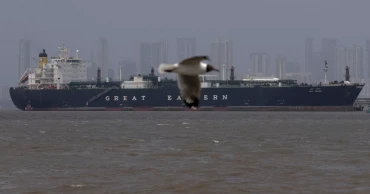
Oil prices rise despite Trump hinting at possible end to war
The conflict is driving up prices for oil and natural gas, roiling stock markets, pushing up the cost of gasoline and threatening to make a range of goods, including food, more expensive.
On Thursday, Brent crude, the international standard, rose again and was at $108 in spot trading, up about 50% from Feb. 28 when Israel and the U.S. started the war.
Though the oil and gas that typically transits the strait is primarily sold to Asian nations, Japan and South Korea were the only two countries from the region joining Thursday's call about the strait.
The supply of jet fuel has also been interrupted by the conflict, with consequences for travel worldwide.
3 days ago
Could Artemis II pave the way for humans back on the Moon?
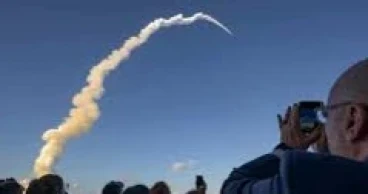
NASA has successfully launched the Artemis II mission, marking the first crewed journey into the moon’s vicinity since the Apollo programme concluded in 1972.
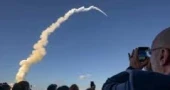
The 322-foot Space Launch System (SLS) rocket lifted off at 6:35pm ET (22:35 GMT) on Wednesday from Cape Canaveral, Florida, sending the Orion crew capsule on a 10-day mission.
Towering at the height of a 32-storey building, the rocket rose into the early evening sky before large crowds gathered near the launch site. The crew are now on a mission that will take them around the moon and back to Earth.
Originally targeted for launch as early as February 6 and later March 6, the mission faced delays after a hydrogen leak forced NASA to roll the rocket back to its vehicle assembly building for further inspection.
The mission had previously been scheduled for November 2024, but NASA announced a delay due to technical investigations, particularly involving the Orion’s heat shield.
Who is part of the Artemis II mission?
All three NASA astronauts are veterans of Earth-orbit science expeditions to the International Space Station, while the lone Canadian joining them on a voyage around the moon and back is a spaceflight rookie.
• Reid Wiseman, 50, commander: The NASA veteran and former International Space Station commander is leading the Artemis II mission. A test pilot-turned-astronaut, he has leadership and deep spaceflight experience.
• Victor Glover, 49, pilot: The US Navy aviator is the first Black astronaut assigned to a lunar mission and flew on SpaceX Crew-1.
• Christina Koch, 47, mission specialist: The record holder for the longest single spaceflight by a woman at 328 days is a veteran of multiple spacewalks and has scientific and deep-space mission expertise.
• Jeremy Hansen, 50, mission specialist: The first Canadian set to travel to the moon is a former fighter pilot. His presence represents international collaboration in deep space exploration.
With inputs from Al Jazeera
3 days ago
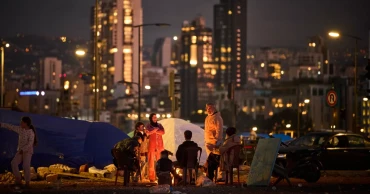
UK to host Strait of Hormuz summit
U.K. Prime Minister Keir Starmer announced that Britain will host an international diplomatic conference this week focused on exploring ways to reopen the Strait of Hormuz.
Starmer says 35 countries have signed a statement committing to work together on restoring maritime security to the key oil transport route.
He said Wednesday that Foreign Secretary Yvette Cooper will lead a conference on the issue, and military planners are also working on plans for security once the Iran war ends.
Starmer said “a united front of military strength and diplomatic activity” is needed to restore stability.
4 days ago
29 killed as Russian military plane crashes in Crimea
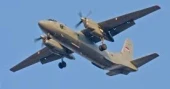
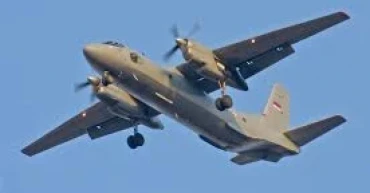
A Russian military transport aircraft crashed in annexed Crimea, killing 29 people on board, including crew members and passengers, according to Russian media reports citing the Defense Ministry early Wednesday.
The An-26 aircraft was on a routine flight over the Crimean Peninsula, which Russia annexed from Ukraine in 2014, when contact with the plane was lost around 6 pm on Tuesday.
According to state news agencies Tass and RIA Novosti, the Soviet-era turboprop aircraft crashed into a cliff.
Russia’s Investigative Committee said there were seven crew members and 23 passengers on board, though it was not immediately clear if any crew member survived.
Authorities have opened a criminal investigation into possible violations of flight safety rules. Rescue operations are ongoing in a mountainous and forested area in the Bakhchisarai district where the crash occurred.
Interfax, citing the Defense Ministry, reported that a technical fault is believed to be the likely cause of the crash, adding there was no indication of external interference.
Military aviation accidents in Russia have occurred repeatedly since the country launched its military offensive in Ukraine.
In recent incidents, an An-22 transport aircraft crashed in the Ivanovo region in December, killing seven crew members. A MiG-31 fighter jet went down in the Lipetsk region in October, while a Tu-22M3 bomber crashed in the Irkutsk region in April 2025.
Earlier, in October 2022, a Su-34 bomber crashed into a residential area in the city of Yeysk near the Azov Sea, triggering a major fire and killing 15 people.
4 days ago