NEWS ON DATE - 05-12-2025
Jeddah welcomes global stars for opening of Red Sea International Film Festival
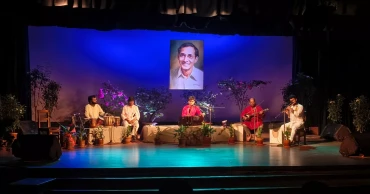
The fifth edition of the Red Sea International Film Festival, one of the Middle East’s largest film festivals, opened Thursday in the coastal city of Jeddah, marking a significant moment for the kingdom’s growing film industry.
Running from Dec. 4 to 13, the Red Sea International Film Festival brings together filmmakers and talent from around the world, screening more than 100 films from over 70 countries.
The festival’s prestigious “Red Sea: Competition” strand features a selection of 16 narrative features, animations and documentaries from the Arab world, Asia and Africa, all vying for the top honor: the Yusr Awards, which will be presented at the closing ceremony.
The festival takes place in Jeddah’s Al-Balad district — a UNESCO World Heritage site — blending Saudi heritage with international cinema.
This year, the selection jury is being led by the Academy Award-winning filmmaker Sean Baker, best known for “Anora,” which won five Oscars, four of which went to Sean Baker himself.
“This festival is really exciting because of how big it’s become just in the last five years,” Baker said. “It’s rare that I see a festival just exploding in terms of importance and impact on world cinema.”
The festival opens with “Giant,” a true story of legendary British-Yemeni boxing champion Prince Naseem ‘Naz’ Hamed. The film stars Egyptian-British actor Amir El-Masry as Hamed and Pierce Brosnan as his Irish trainer, Brendan Ingle, and is directed by British filmmaker Rowan Athale.
“It was probably one of the hardest roles I’ve ever done,” El-Masry said, noting that his preparation involved four and a half weeks of training, during which he lost about eight kilos.
“It’s been a passion project for me for a long time,” said Athale. “I come from a similar neighborhood — actually within a few miles of Naz. He was a hero of mine growing up, particularly being multiracial in the region. I’ve always wanted to make a film about him. So it’s a privilege to make it.”
Reflecting on the premiere, he added, “To have it as the opening night film here — I mean, look at this. I’ve never seen anything like this. Not at Cannes, not anywhere. It’s daunting, it’s terrifying, but it’s an honor.”
The opening night drew a wide range of international stars, including Hollywood and Bollywood figures including Adrien Brody, Sir Michael Caine, Vin Diesel and Ana de Armas walking the red carpet.
Veteran actor Giancarlo Esposito, also attending the festival, said the gathering reflects the unifying power of cinema. “This celebration at the Red Sea Film Festival is really about celebrating film,” he said.
The Red Sea International Film Festival was founded by Saudi Arabia’s Ministry of Culture and supported by the Red Sea Film Foundation. It is funded by the kingdom’s Public Investment Fund sovereign wealth fund and private sponsors. It aims to play a vital role in promoting regional filmmakers and fostering global connections.
The festival is part of Saudi Arabia’s Vision 2030 objectives, which include diversifying the economy, strengthening cultural infrastructure and fostering local creative talent.
The event comes as Saudi Arabia invests heavily in sectors like film, gaming and sports as part of its broader transformation efforts. However, various rights groups have criticized these actions, saying they serve to draw away attention from the kingdom’s human rights record, including its high rate of executions and restrictions on free expression.
43 minutes ago
Fire raises concerns as Hong Kong approaches Sunday legislative poll
The deadliest fire in Hong Kong in decades is piling pressure on Beijing’s “patriots-only” governance system, casting a shadow on elections widely seen as a further step to tighten control over the city's legislature.
Sunday's vote to elect new lawmakers to Hong Kong's 90-member Legislative Council comes just 11 days after a massive fire engulfed seven towers in a high-rise apartment complex, killing at least 159 people in the financial hub's worst blaze since 1948.
With many voters in the city grown politically apathetic since China’s crackdown shut out the pro-democracy camp in recent years, Sunday's turnout rate will be a key barometer of public sentiment toward the government and its handling of the fire.
While there hasn’t yet been significant public protests because of the chilling effect of a wide-ranging security crackdown that started five years ago, some residents have raised concerns among friends, on social media and to reporters about government oversight in building maintenance projects and official investigation efforts.
Nearly 40% of incumbents, including household names and mildly vocal politicians, are stepping aside for this election. More candidates with mainland Chinese business links, as well as more members of China’s parliament, are joining the race.
Observers suggest the candidate lineup signals Beijing’s tightening control over even its loyalists and a preference for politicians more in tune with its agenda.
A change of guard
Starting in late September, many veteran lawmakers announced one by one that they would not seek reelection. Regina Ip, a leading member of Hong Kong’s cabinet, said she wanted to pass the torch to the younger generation and denied that age was a factor.
Several relatively outspoken lawmakers also stepped aside. One of them, Doreen Kong, insisted she faced no pressure to bow out.
The changes drew wide attention to the legislature, now filled with Beijing loyalists after China overhauled electoral rules in 2021.
Under the rules, the number of directly elected seats was reduced from 35 to 20. Forty other seats are chosen by a predominantly pro-Beijing election committee, with voters in professional, business and other designated sectors picking another 30 for their industries. All candidates must pass official vetting, including by national security authorities.
Pro-democracy politicians in the legislature have completely disappeared after many were arrested under a 2020 national security law Beijing imposed to quell the massive protests that started in 2019.
The pro-Beijing camp praised the new model’s efficiency, but Hong Kong think tank POD Research Institute in September said its survey showed growing public concerns about the quality of debate in the legislature.
More candidates with mainland Chinese ties
The new candidate pool marks a deeper change.
The Associated Press found that at least 26 of 161 candidates, or 16%, held positions in Chinese-funded businesses without declaring party affiliations — almost double the figure reported by local newspaper South China Morning Post in the 2021 election. Most were connected to state-owned enterprises.
Among all candidates, 16 are delegates to China's top legislature — more than double from the last election — and 13 others are members of China's top political advisory body. The directly-elected seats drew more candidates than four years ago, including district councilors handling municipal matters. Still, many of those new candidates are not familiar names to voters.
John Burns, an honorary professor of politics and public administration at the University of Hong Kong, said the central government has “very much controlled” the city's elections since 2021. Burns said it appears that the central authorities have a new informal criterion on an upper age limit and possibly less appetite for outspoken lawmakers.
He said members of China's legislature and political advisory body are more in tune with Beijing's agenda, while those who work for state-owned enterprises are under more control by the central authorities, in addition to having better resources for their roles.
“They’re trying to ensure that the new people adopt a national perspective, national agenda ... and not focus on sectional interests, not focus on vested interests, and not perhaps representing the concerns of people in Hong Kong,” he said.
He added that central authorities also appeared to be trying to minimize the influence of traditional political parties.
Other new faces joining the race include Olympic fencing champion Vivian Kong, who has faced questions over her eligibility to run in the tourism sector. She cleared the official vetting process in November after citing her efforts to promote horse racing tourism.
Candidates defend dual roles
Hong Kong leader John Lee maintained that personnel changes in the election are normal during a change of term, and condemned attempts by “opposing forces” to smear the election with accusations of interference. He added it’s justifiable for Beijing to care about the election.
Incumbent finance lawmaker Ronick Chan, an adviser at Bank of China (Hong Kong) Limited, whose parent company is a state-owned commercial bank, said working in Chinese-funded enterprises does not conflict with serving as a legislator.
“Employees of Chinese-funded enterprises frequently engage with national policies in their daily work," he said in a text message. “That helps Hong Kong better understand the central government’s concerns and facilitates the city's service to and integration into national development.”
His rival Ip Tsz-kin, who works in the Bank of Communications (Hong Kong) — also affiliated with another state-owned bank — told the SCMP that candidates must work for Hong Kong's future development regardless of their company background. He did not reply to the AP’s request for comment.
During an election candidate forum, candidate Rex Lai said patriot organizations can mobilize volunteers to support relief efforts in a disaster.
In November, China’s Hong Kong affairs office said the pool of new candidates will boost the development of “high-quality democracy” that suits Hong Kong.
It said the legislature needs new blood, and that the participation of professional elites from new sectors, innovation industries and think tanks, among other areas, signals hopes for better alignment with China’s next five-year plan.
Push for turnout could be dampened by fire aftermath
Voter turnout rate in the 2021 election had dropped to 30.2%, a record low. Officials have been pulling out all the stops to boost that figure until the fire brought a temporary halt.
Burns noted that about 60% of the popular vote went to the pro-democracy camp in past elections before 2021. He believed those voters would continue to stay away from Sunday's election.
He said that while some pro-government voters would be grateful for the authorities' response to the fire, others could have reservations about voting due to the systemic problems uncovered by the fire and the huge death toll.
To drive up turnout, the government has extended voting hours, added voting stations and offered subsidies to centers for older adults and people with disabilities. City leader Lee urged civil servants to vote and companies provided time off for employees casting ballots. Authorities have made arrests over social media content that allegedly discouraged voting or for damaging promotional election materials.
“This fire has run a truck right through that campaign,” Burns said. “That makes it very difficult for the authorities to better the thirty percent, and so probably it will be lower."
51 minutes ago
Will the proposed Dhaka Central University see the light of day?
The sun rises over the capital’s seven historic colleges, casting long shadows across empty classrooms and silent corridors. Soon, they are meant to combine their resources to form the Dhaka Central University (DCU), a dream wrought from years of student protests. Yet the air is thick with uncertainty.
The ordinance that would breathe life into the university is yet to be issued, debates flare over the role of BCS Education Cadre teachers, and structural concerns for female students echo through the deserted halls. The fate of the revered higher secondary programs hangs by a thread. DCU’s story is yet to unfold, a drama of ambition, conflict, and hope waiting to ignite - that may yet be left in the lurch.
Journey to a New University
The seven colleges—Dhaka College, Eden Mohila College, Govt. Shaheed Suhrawardy College, Kabi Nazrul Govt. College, Begum Badrunnesa Govt. Mohila College, Mirpur Govt. Bangla College, and Govt. Titumir College—were brought under Dhaka University (DU) in February 2017 after decades under the National University system.
Nearly 200,000 students study in these colleges. Claiming academic discrimination and delayed sessions under DU, students renewed their longstanding demand for a separate university during the 2024 student movement. Following the success of that movement, that seemingly opened the doors for various groups to realise their demands through street protests, the seven colleges' own movement gained momentum.
In response, the Education Ministry formed a four-member expert committee under the University Grants Commission (UGC) to design a structural framework for the colleges.
Following student agitation and clashes with DU students on January 27, steps were initiated to formally detach the colleges from DU. The UGC proposed an interim structure under which a principal-level administrator, supervised by a UGC member, would run the institution until a full university system was set.
A decade on, Uttara lake development still stuck in limbo
The name Dhaka Central University was finalized after consultations. On May 18, 2025, retired Dhaka College principal Prof. A.K.M. Ilias was appointed as interim administrator for two years. Admission notices followed in July, and results for the first undergraduate batch were released on August 26. Around 72,000 students applied for 11,150 seats across Science, Arts & Social Sciences.
A draft ordinance, prepared by a committee led by Prof. Mohammad Tanzimuddin Khan—was released on September 24, seeking feedback from teachers, students, and other stakeholders. More than 6,000 responses poured in, sparking heated debate and divisions.
On November 18, the Education Ministry said it had decided in principle to establish DCU, claiming the move would ensure quality education, timely exams, fast results, and improved administration.
Born into Session Jams
Despite completing admissions for the 2024–25 academic year and announcing that classes would begin on November 23, no classes commenced. Most universities have already been in session for months, and DU has finished 2 units admission tests for the next academic year.Consequently, DCU’s first batch has suffered what amounts to a one-year session delay, even without attending a single class.
On November 30, students blocked the Shahbagh intersection demanding immediate commencement of classes after another postponed start date passed. Earlier, the ministry had extended the admission deadline and rescheduled classes to November 30, but no progress followed.
Academic Schools and Growing Controversy
The draft ordinance divides the colleges into four academic schools:
School of Arts & Humanities at Govt. Bangla College(Journalism, Economics, Development Studies, Film Studies, International Politics)
School of Science at Dhaka College, Eden Mohila College, Badrunnesa College(Biochemistry, Data Science, Zoology, Physics, Psychology, etc.)
School of Business Studies at Titumir College(Accounting, HRM, Marketing, Banking & Insurance, Hospitality)
School of Law & Justice at Kabi Nazrul College and Shaheed Suhrawardy College
A segment of students reject the hybrid, multi-campus schooling system, fearing it will diminish their college identity and autonomy. Dhaka College alumni have demanded full cancellation of the draft to preserve institutional independence.
Bangladesh’s banking sector sees surge in small deposits as ultra-rich exit post-changeover
The ordinance proposes a hybrid teaching model, with 35–40% instruction online but all exams in person. University activities would run from 1pm to 7pm on existing college campuses.
Students’ concerns over autonomy
Female students from Eden Mohila College and Begum Badrunnesa College argue that the proposed schooling threatens the purpose of women-only institutions. On December 2, Eden students held a press conference demanding the college remain exclusively for women. The next day, students blocked roads and marched toward Dhaka College, joined by faculty members.
Even now, a segment of students has yet to applaud the initiative to convert the seven colleges into a university.
Rudro Sheikh, a fourth-year student of the Department of Philosophy at Dhaka College, told UNB, “The proposal is not fully aligned with reality. Without proper infrastructure, research facilities, and permanent faculty, university status adds value in name only, not in education quality. The priority should be maintaining stability and transparency in existing colleges rather than expanding a name without ensuring quality.”
Teachers’ Alarm Over Career Security
Teachers remain deeply concerned. Under the draft, BCS General Education Cadre members are not considered DCU faculty and cannot conduct first-year classes or exams, raising fears that around 1,500 teaching posts, including 1,100 permanent—may lose status or be abolished. Faculty members argue that this threatens their promotions and fundamental rights.
Tensions escalated on October 14 when teachers and students clashed at Dhaka College. On December 2, the “Seven Colleges' Identity Protection Committee” demanded cancellation of the hybrid system and insisted on permanent inclusion of BCS cadre members in all academic and administrative roles. They warned of possible indefinite strikes if the ordinance proceeds.
HSC Students Enter the Debate
Five of the seven colleges— Dhaka College, Shaheed Suhrawardy, Badrunnesa, Kabi Nazrul, and Bangla College—run higher secondary programs.
Students from these programs fear DCU will eventually eliminate HSC sections, despite the draft ordinance stating they would remain. They also fear that the proposed DCU structure threatens college autonomy.
On December 1, Dhaka College HSC students blocked Science Lab and New Market intersections demanding the ordinance be withdrawn and college autonomy preserved.
Ordinance Deadline Looms
On October 15, the ministry called the ordinance’s finalization “time-sensitive” and urged responsible public engagement.
But student frustration has intensified. On December 3, students blocked roads in front of Dhaka College and issued an ultimatum: the ordinance must be released by December 6. Failing that, they vowed to begin a continuous sit-in in front of the Education Building from December 7.
Interim administrator Prof. A K M Elias said, “The Ministry of Education is closely monitoring the situation, and we hope the issues will be resolved very soon.”
Dhaka to get state-of-the-art special needs school
UGC member Prof. Tanzim Uddin Khan, said to UNB, “We do not have the authority to make comments regarding the seven colleges. According to our terms of conditions, we have completed the responsibilities assigned to us.”
He added that they no longer have any role in this matter; it is now entirely under the jurisdiction of the Ministry of Education.
For now, Dhaka Central University remains suspended between aspiration and deadlock, a project weighed down by mistrust, administrative vacuum, and unresolved questions of identity, autonomy, and inclusion.
1 hour ago
SUST launches bus tracking system for students
Shahjalal University of Science and Technology (SUST) has launched a bus tracking system on Thursday to make student transportation easier.
The ‘SUST Bus Tracking System’ app was officially inaugurated by Vice-Chancellor Prof. Dr. A M Sarwaruddin Chowdhury at 11 am on a trial basis.
The app was developed by Saifur Rahman and his team from the Department of Computer Science and Engineering (2020-21 session) of the university.
Nomination collection for SUSTCSU polls begins
Pro Vice-Chancellor Prof. Dr. Md Sajedul Karim, Treasurer Prof. Dr. Md Ismail Hossain, Transport Administrator Prof. A F M Zakaria, Additional Director of ICT Cell Prof. Dr. Pabel Shahriar, Registrar Syed Shalim Mohammad Abdul Qadir, College Inspector (Acting) Md Yunus Ali, Additional Accounts Director Md Murshed Ahmed, Superintending Engineer of the Transport Department Emran Ahmed Chowdhury, VC Secretary and Additional Registrar Dr. A F M Salauddin, Additional Accounts Director Abu Sadat Mohammad Sayem Talukdar also graced the ceremony.
Through the app, students can track the live location of buses and also check bus stops and route information.
8 hours ago
SUCSU Election: 251 candidates collect nomination papers in first three days
A total of 251 candidates collected nomination papers in three days for the Shahjalal University of Science and Technology Central Students’ Union (SUCSU) and hall union elections, the election commission said on Thursday.
Professor Dr. Md. Nazrul Islam, spokesperson for the election commission, said the distribution of nomination papers concluded today. On the first day, December 2, 26 papers were collected for the central union and 20 for the hall unions. On December 3, 58 papers were taken for the central union and 45 for hall unions. On the final day, December 4, 61 candidates collected papers for the central union and 41 for hall unions.
In total, 145 papers were distributed for the central union and 106 for the hall unions. Of these, 72 were male and 34 were female candidates. Participation of female candidates was also seen in the central union election, with 15 women collecting nomination papers.
Professor Dr. Nazrul Islam said, “The nomination process was completed peacefully and orderly. The number of candidates this year is encouraging, and female participation is also noteworthy.”
After nearly 28 years, elections will be held for 23 central union posts and nine hall union posts. The voting is scheduled for January 20.
8 hours ago
Zubaida leaves London for Dhaka to accompany ailing Khaleda to UK
Dr Zubaida Rahman, wife of BNP Acting Chairman Tarique Rahman, is on her way to Dhaka to accompany her critically ill mother-in-law BNP Chairperson Begum Khaleda Zia, during her flight to the UK in a special air ambulance arranged by the Emir of Qatar for advanced treatment.
BNP Media Cell member Atiqur Rahman Rumon said Zubaida boarded a Biman Bangladesh Airlines flight from London Heathrow at around 6.03 pm (London time).
“The flight is expected to land in Dhaka around 9:30am tomorrow (Friday),” he told UNB.
Her daughter, Barrister Zaima Rahman, saw her off at the airport.
Once she arrives in Dhaka, Zubaida will join Khaleda Zia on the Qatar royal air ambulance for the journey to the United Kingdom.
Rumon said Dr Zubaida, who is also a member of the medical board overseeing Khaleda’s treatment, has been monitoring her condition closely through virtual consultations from London.
Earlier in the day, Mahdi Amin, an adviser to Tarique Rahman, said in a Facebook post that Khaleda has shown “some improvement” and will be admitted to a hospital in London.
BNP Secretary General Mirza Fakhrul Islam Alamgir said all preparations have been completed to fly Khaleda to the UK early Friday morning on the Qatar royal air ambulance, which is equipped with advanced medical facilities, including an on-board operation theatre.
Khaleda Zia to be flown to UK for advanced treatment: Fakhrul
“A team of doctors will travel with Madam,” he added.
Khaleda Zia has been undergoing treatment at Evercare Hospital since 23 November.
She was moved to the Critical Care Unit on 27 November with multiple complications related to her liver, kidneys and heart, and remains under close observation.
BNP sources said Tarique Rahman and Dr Zubaida have already arranged treatment for her at London Bridge Hospital.
This will be Khaleda Zia’s second medical evacuation on a Qatar royal air ambulance. On 8 January she travelled to London for treatment and returned to Dhaka on 6 May. Dr Zubaida accompanied her then, ending her 17-year stay in London.
She returned to London on 5 June after a month-long stay in Dhaka, and is now flying back again mainly to accompany the BNP chief abroad.
Meanwhile, BNP sources said Khaleda’s departure for London may be delayed until late Friday morning (5 December 2025), as the Qatar royal air ambulance is likely to arrive in Dhaka later than planned due to technical issues.
Dr Zubaida is also scheduled to reach Dhaka around 9:30am on Friday to travel with her.
At a press conference at the BNP Chairperson’s Gulshan office on Thursday afternoon, Mirza Fakhrul said the air ambulance was expected late at night.
Air ambulance delay may slightly push back Khaleda Zia’s departure
He later told UNB that “some technical problems” have emerged which may delay its arrival.
Tarique Rahman, Dr Zubaida and their daughter Zaima Rahman have been living in London since 2008.
Dr Zubaida, a former government doctor, topped the national merit list in her MBBS examinations and secured first place in the BCS (Health) cadre in 1995. She was later dismissed from government service under the Awami League government after travelling to London on study leave in 2008.
She completed her postgraduate degree in medicine at Imperial College London.
8 hours ago
Ireland, Spain and Netherlands boycott Eurovision over Israel’s participation
Ireland, Spain and the Netherlands have announced they will not take part in next year’s Eurovision Song Contest after Israel was allowed to compete.
The three countries were among those urging organisers to bar Israel over the rising humanitarian toll in Gaza and concerns about unfair voting practices.
Despite the calls, contest members chose not to vote on Israel’s participation. Instead, they approved new rules aimed at protecting the integrity of the event.
Dutch broadcaster Avrotros said taking part “under the current circumstances” goes against its core public values.
Spain’s broadcaster RTVE said earlier that it would withdraw if Israel remained in the competition. It confirmed Spain will not join Eurovision 2026 and will not air the final or the semi-finals.
RTVE also said its request for a secret ballot on Israel’s participation was rejected. The broadcaster said the refusal showed political pressure around the contest and increased its distrust in the organisers.
Broadcasters in other countries, including Slovenia and Iceland, are also expected to pull out next year.
With inputs from BBC
8 hours ago