Others
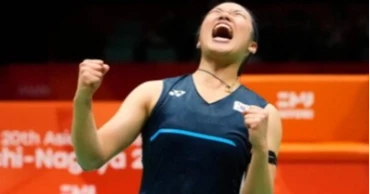
An Se-young wins second Asian Games badminton gold, adds to Olympic and world titles
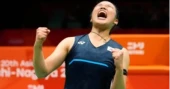
South Korea’s An Se-young strengthened her status as the world’s top-ranked women’s badminton player Tuesday by winning her second consecutive Asian Games gold medal.
An defeated Japan’s three-time world champion Akane Yamaguchi 21-17, 21-9 in the final to claim the title.
The victory adds another major achievement to An’s career. She is also an Olympic champion from the Paris Games and a two-time world champion.
Badminton is hugely popular across Asia, where the sport is known for its fast pace, long rallies, diving saves and powerful overhead shots.
An reached the final after beating China’s Chen Yufei in the semifinals, extending her winning streak against her Chinese rival to five matches.
The South Korean star has also been outspoken about conditions within her national team. After winning Olympic gold in Paris two years ago, she said national training officials had made her compete despite a knee injury and criticized what she described as outdated training methods.
An later threatened to compete independently but ultimately decided against leaving the national team system.
Shuttlecock shortageWhile it has not affected competition at the highest level, the rising price and limited supply of traditional shuttlecocks have become a concern in badminton.
China is the world’s leading producer of shuttlecocks, but a decline in poultry production in recent years, partly linked to bird flu, has reduced the supply of goose and duck feathers used to make them.
The shortage has pushed prices higher and encouraged officials to consider synthetic alternatives.
Earlier this year, the Badminton World Federation approved synthetic shuttlecocks for use in lower-level competitions. Players have noted that synthetic models have different speed and flight characteristics from traditional feather shuttlecocks.
The BWF said the initiative is part of its long-term effort to assess synthetic shuttlecocks for possible use in elite-level competitions.
1 day ago
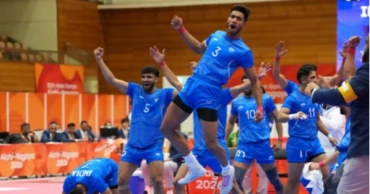
Kabaddi leads lineup of lesser-known regional sports at Asian Games
The Asian Games feature many sports that may be less familiar to audiences outside Asia, including kabaddi, sepaktakraw, wushu and kurash.
Alongside popular Olympic sports, the Games provide a platform for traditional and regional competitions that have strong followings in parts of Asia but have yet to gain the same global popularity.
Among them, kabaddi is perhaps the most distinctive. Believed to have originated in the Indian subcontinent, the contact team sport is hugely popular in India, where professional leagues attract millions of viewers. Historically, the game was used to develop strength, agility, breath control and self-defense skills.
India won both kabaddi gold medals at the Asian Games, with the women's team beating Iran 37-34 and the men's team defeating Iran 40-34.
Indian player Pawan Kumar said his team focused on protecting its lead after gaining an advantage.
“Once we had the lead, we wanted to protect it,” Kumar said. “So we played safe and used the time available to us. That helped us maintain our advantage until the end.”
Kabaddi is played without a ball, bat, goal or racket. Instead, players use tags, tackles and wrestling techniques. The sport was featured as a demonstration event at the 1936 Berlin Olympics but has not become a regular Olympic sport.
It has similarities to games such as “Red Rover” in the United States and “British Bulldog” in England.
Under the Asian Games format, two teams of seven players compete on a rectangular court. One attacking player, known as a raider, crosses the centerline and has 30 seconds to touch as many opponents as possible before returning to his or her own side without being tackled.
A match consists of two 20-minute halves. Teams score by tagging opponents or successfully stopping a raider.
Sepaktakraw: volleyball played with the feetSepaktakraw resembles volleyball but comes with a major difference: players cannot use their hands. Instead, they use their feet and other parts of the body to send a ball over a net about five feet high.
Depending on the format, teams have two, three or four players. The objective is similar to volleyball — send the ball over the net and make it land on the opponent's side.
The ball is smaller than a volleyball or soccer ball and is roughly the size of a cantaloupe or large grapefruit. The sport originated in Southeast Asia and is sometimes called “kick volleyball.”
Wushu is also known as kung fuWushu, commonly known as kung fu, is the Chinese term for martial arts. It has been part of the Asian Games since 1990, when it was introduced at the Beijing Games.
Although wushu has been proposed for the Olympics, it has never been included as a medal sport.
The competition has two main disciplines. Taolu involves athletes performing choreographed routines that demonstrate martial arts techniques, while sanda is a full-contact discipline often described as Chinese kickboxing.
Kurash traces its roots to UzbekistanKurash is a traditional form of wrestling with roots in Central Asia, particularly Uzbekistan. The sport includes several folk wrestling styles and is believed to have existed for thousands of years.
It made its Asian Games debut at the 2018 Games in Indonesia, where Uzbekistan topped the medal table. Iran, Mongolia, Taiwan and India also won multiple medals at the event.
2 days ago
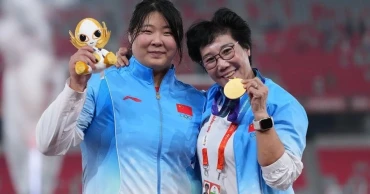
China wins three golds as Boonson equals Asian 200m record
Thailand’s Puripol Boonson equaled the Asian record in the men’s 200 meters, while China secured three athletics gold medals at the 2026 Asian Games on Sunday.
Boonson clocked 19.88 seconds in the men’s 200m final to match the Asian record set by China’s Xie Zhenye in 2019. China’s Huang Youwen finished second in 20.45 seconds.
“It was the first time I’d ever raced someone at that level, and it was a great experience,” Huang said. “We were only 50 meters in, and I could already tell how fast he was.”
Huang said he would set ambitious goals ahead of next year’s world championships.
China began its gold-medal haul with Chen Yuanjiang’s victory in the men’s 110m hurdles. Chen finished in 13.15 seconds, ahead of Japan’s Rachid Muratake and the Philippines’ John Tolentino.
China had won the event at 10 consecutive Asian Games before failing to claim the title at the 2023 Hangzhou Games.
“I’m thrilled. We’ve taken this gold medal back,” Chen said after his victory.
In the women’s javelin, China’s Asian record holder Yan Ziyi secured gold with a 70.46-meter throw on her opening attempt. Japan’s Olympic champion Haruka Kitaguchi took silver with 62.70 meters.
Yan’s effort also surpassed the previous Asian Games record of 66.09 meters set by compatriot Liu Shiying.
“I didn’t expect to wrap it up in one throw,” Yan said, adding that she hopes to target another record at next year’s world championships in Beijing.
Singapore’s Shanti Pereira successfully defended her women’s 200m Asian Games title with a season-best 22.78 seconds. China’s 17-year-old Chen Yujie, who won the 100m with a Games record, took silver in 22.93 seconds.
Chen said she had planned to stay close to Pereira through the bend before attempting to overtake her in the final straight.
In the women’s long jump, China’s Huang Yingying produced a 6.55-meter effort in her final attempt to overtake India’s Ancy Sojan Edappilly by two centimeters. China’s Tan Mengyi won bronze with 6.46 meters.
Huang, who also won silver in the triple jump, said she needed to improve her consistency ahead of next year’s world championships and the 2028 Olympics.
In the men’s high jump, Chinese Taipei’s Fu Chao-hsuan cleared 2.25 meters to win gold, with India’s Sarvesh Kushare taking silver. Qatar’s 35-year-old Olympic medalist Mutaz Barshim withdrew from the final.
Earlier Sunday, Japan’s Hayato Katsuki won the men’s marathon race walk in 3:03:36, finishing ahead of China’s Zhou Yingcheng. Kazakhstan’s Yasmina Toxanbayeva claimed the women’s title in 3:22:20, while China’s Danzengquzong and Ma Li took silver and bronze.
China’s men’s and women’s 4x100m relay teams also won their respective heats to advance to the finals.
2 days ago
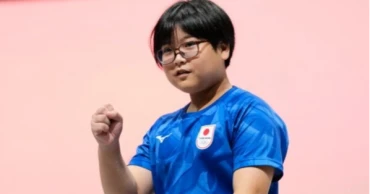
11-year-old Japanese player Yuki Kurihara wins esports gold at Asian Games
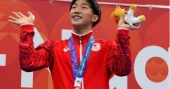
Eleven-year-old Japanese elementary school student Yuki Kurihara made history on Saturday by winning the gold medal in esports at the Asian Games.
Kurihara defeated South Korea’s Kang Dongshin 10-2 in the final of the Puyo Puyo Champions puzzle game to claim the title.
He had earlier beaten Thailand’s 28-year-old Tanarak Wongkitikun 10-1 in the semifinals.
“I’m really happy,” Kurihara said after winning the gold medal. “The gold medal is really beautiful, shiny and heavy.”
He also said he liked the mascot plush toy he received as part of the prize.
“The plush toy is super cute, and it’s cool that it is gold-colored too,” he said.
Kang praised the young Japanese player after the final.
“It’s obvious that my opponent was skilled and above my level,” Kang said. “His technical ability and accuracy are incredible.”
Kurihara is believed to be the youngest-ever gold medalist in Asian Games history, which dates back to the first edition in New Delhi, India, in 1951. He is also the youngest athlete competing at the current Games.
Japanese media reports said Kurihara trains for about eight hours a day while continuing his school studies. He became interested in esports when he was in kindergarten and reportedly considers eel his favorite training food.
Esports made its Asian Games debut three years ago in Hangzhou, China. The event proved highly popular, with tickets distributed through a lottery system. Esports has also attracted a large following in Japan.
Several other young athletes are making headlines at the Games. Hong Kong’s Kamus Wong is competing in skateboarding at age 12, while 13-year-old Chinese swimmer Yu Zidi has won three gold medals.
Meanwhile, 17-year-old Japanese swimmer Shin Ohashi set a world record in the 200-meter breaststroke on Thursday.
4 days ago
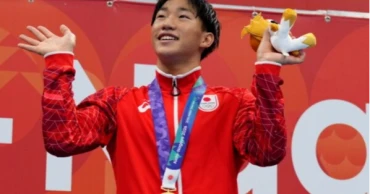
Japan’s Shin Ohashi sets world record in 200m breaststroke at Asian Games
Japan’s 17-year-old Shin Ohashi set a world record in the men’s 200-meter breaststroke at the Asian Games on Thursday, clocking 2 minutes, 4.83 seconds.
Ohashi broke the previous record of 2:05.48, set by China’s Qin Haiyang at the 2023 world swimming championships in Fukuoka, Japan.
“I wasn’t expecting to post a time like that,” Ohashi said. “So I was really happy. At the same time, I felt a huge sense of relief.”
Kyrgyzstan’s Denis Petrashov finished second in 2:08.67, while South Korea’s Cho Sung-jae took bronze in 2:08.76.
Ohashi, who already held the fastest time in the event this year at 2:06.59, has emerged as the swimmer to beat in the breaststroke this season.
“I may be the world-record holder now, but the level of competition around the world will keep rising,” he said. “I don’t want to be left behind. Instead, I want to be the one who sets the pace, so I’ll keep working hard in training.”
Ohashi’s record briefly shifted attention away from China’s 13-year-old swimming sensation Yu Zidi, who has won three gold medals at the Games in the 200-meter butterfly, 200-meter individual medley and 400-meter individual medley. She will not compete in any more individual events.
Ohashi also won the men’s 400-meter individual medley earlier this week, finishing in 4:07.02. The world record in the event is 4:02.50, held by France’s Leon Marchand, who won four gold medals at the 2024 Paris Olympics.
Ohashi said his strongest performance on Thursday came in the final 50 meters, when he managed to maintain his pace instead of slowing down.
“I think my biggest strength is my ability to keep my swimming compact and maintain a good tempo,” he said. “Ultimately, I think my biggest goal is to win an Olympic gold medal.”
Marchand has been among the presenters handing out medals during the Games. Swimming events are being held at the Olympic pool in Tokyo.
At 1.69 meters tall, Ohashi is not physically imposing compared with many elite swimmers. Earlier this year, he also broke Japan’s national record in the 100-meter breaststroke, a mark previously held by four-time Olympic gold medalist and three-time world champion Kosuke Kitajima.
China continues gold rush in poolChina remained dominant in the swimming events despite Ohashi’s world record, winning four of the seven gold medals contested Thursday.
After five days of competition, with swimming scheduled to conclude Friday, China has won 25 gold medals from 34 events.
China’s Thursday winners were Wu Qingfeng in the women’s 50-meter freestyle in 23.98 seconds, Zhang Zhanshuo in the men’s 800-meter freestyle in 7:42.49, the men’s 4x100-meter freestyle relay team in 3:10.60 and the women’s 4x200-meter freestyle relay team in 7:49.37.
Japan also won gold through Kotomi Kato, who took the women’s 200-meter breaststroke in 2:22.57.
The other gold medal went to Bahrain’s Mikhail Arkhangelskiy, who won the men’s 50-meter butterfly in 22.91 seconds. Born in Russia, Arkhangelskiy has competed for Florida State University.
5 days ago
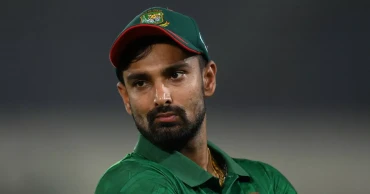
Liton sets sights on Asian Games Gold, Olympics
Bangladesh captain Liton Das wants his team to reach the Asian Games cricket final and compete for gold, but he is also thinking beyond the tournament.
Cricket will return to the Olympics at the 2028 Los Angeles Games, and Liton sees Bangladesh’s Asian Games campaign as part of a bigger opportunity for the sport.
Bangladesh are sending their national team to the Asian Games this time, rather than a second-string side. It will also be Liton’s first appearance at the multi-sport event.
“It is a big thing to play for the national team, and playing at a place like this is also a big thing,” Liton told reporters at the Sher-e-Bangla National Cricket Stadium on Wednesday. “You may win a trophy whenever you win elsewhere, but here there is a chance to win gold. It is a big dream. I think all the cricketers are excited.”
Bangladesh have traditionally looked to cricket for medals at the Asian Games. The women’s team, however, lost to Pakistan in the bronze-medal match on Tuesday, leaving the men’s team as the country’s main hope of a cricket medal.
“There is a lot of interest among our players because this tournament does not come around every time,” Liton said. “You get franchise leagues or national-team tournaments every year. But this is a rare event. Every player is excited, and we will try to fulfil the big dream.”
For now, Liton said, the target is simply to get to the final.
“We are looking at how we can reach the final,” he said. “Because if you play the final, you have a chance to win gold. In cricket, we always say, match by match. We will go match by match.”
The 2028 Olympics will feature six men's cricket teams. The highest-ranked team from each of Asia, Africa, Oceania and Europe will qualify directly. The United States, as host, will also qualify if it is among the top 15 teams in the ICC T20 rankings. The remaining place will be decided through a qualifying tournament.
Bangladesh will compete with New Zealand, Pakistan and Sri Lanka for a place in the Olympics.
Liton also hopes success in cricket can help raise the profile of other sports in Bangladesh.
“Being able to do something for the country is a big thing,” he said. “And if it is through sport, why not? We are different in cricket. But if something can improve other sports through us, or if opportunities come for other sports, we will try.”
6 days ago

Amicus United crowned LAABRACU Futsal League 2026 champions
Amicus United have been crowned champions of the LAABRACU Futsal League 2026, organised with the participation of current and former students of the School of Law at BRAC University.
The team secured the title with a convincing 3–0 victory over Invictus Victor in the final.
Organised by the Law Alumni Association of BRAC University (LAABRACU), the tournament featured a total of 12 teams. De Jure Academy served as the title sponsor of the tournament.
The LAABRACU Futsal League 2026 was held throughout the day on Saturday (19 September) at the Multipurpose Hall of BRAC University, followed by the prize-giving ceremony at the end of the competition.
BRAC University Registrar Dr David Dowland attended the ceremony as the chief guest.
Among others, the prize-giving ceremony was attended by LAABRACU President Meher Niger, Vice President Yasir Adnan, General Secretary Tafsir Ahmed Khan, BRAC University Alumni Relations Manager Farhad Hossain, and Rafiqul Islam Shimul, one of the proprietors of De Jure Academy.
The tournament was coordinated overall by Sheikh Rasiful Islam, Sports and Cultural Secretary of LAABRACU.
According to the organisers, the tournament was aimed at strengthening interaction and engagement among current and former students of the BRAC University School of Law while fostering a vibrant and active alumni community through sports.
10 days ago
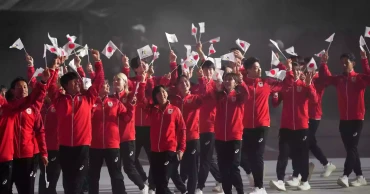
Asian Games open in Nagoya with more athletes than Olympics, unusual sports
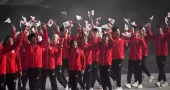
The Asian Games officially opened Saturday with a colorful ceremony, beginning a 16-day sporting event that has already been underway for more than a week.
Basketball competition began on Sept. 10 due to the packed schedule, while the men's semifinals were held Friday, a day before the official opening. Soccer has also been underway for almost as long. While the Summer Olympics usually begin a few days before their opening ceremonies, the Asian Games have started even earlier.
The event features at least 11,000 athletes from 45 countries and regions competing in 43 sports. The 2024 Paris Olympics had about 10,700 athletes, while roughly 12,000 competed at the 2023 Asian Games in Hangzhou, China.
Japanese organizers have not yet announced the final number of athletes, but the total could match or exceed the figure from Hangzhou, partly because of several new sports.
Alongside Olympic sports such as athletics, swimming and soccer, the Asian Games feature traditional Asian disciplines including kurash, kabaddi and sepaktakraw. Kurash is an ancient wrestling style from Uzbekistan, kabaddi resembles a physical team version of tag, and sepaktakraw combines elements of volleyball and soccer.
Mixed martial arts, padel, teqball and esports have also been added, making the schedule particularly busy.
Japan has the largest delegation with 933 athletes, while China has sent more than 800. China topped the medal table at the 2023 Games with 201 gold medals, followed by Japan with 52 and South Korea with 42.
Royal family leads opening ceremony
Emperor Naruhito and Empress Masako were among the leading dignitaries at the opening ceremony. Sheikh Joaan bin Hamad Al Thani, who was elected president of the Olympic Council of Asia earlier this year, also attended.
"Tonight the eyes of Asia, and much of the world, turn to Japan," Sheikh Joaan said in his address before the Emperor officially declared the Games open.
International Olympic Committee President Kirsty Coventry was also present.
The ceremony was themed "Harmonic Heart Beat," with a large heart-shaped stage set up on the infield of Nagoya City Stadium.
Afghanistan led the traditional athletes' parade, while host Japan entered last to loud applause.
Controversies before opening
The official opening may bring some relief to organizers, who faced several controversies during preparations.
One major issue involved accommodation. Instead of building a dedicated athletes' village, organizers planned to house an estimated 17,000 athletes and officials on a large cruise ship, in hotels and in wooden containers converted into accommodation.
Japan officially spent $13 billion on the Tokyo Olympics, which were postponed until 2021 because of the COVID-19 pandemic. A government audit later suggested the actual cost may have been about twice that amount. Organizers therefore sought to avoid similarly high spending for the Asian Games.
Some athletes have complained that beds and rooms are too small, while others have reported leaks in the wooden accommodation units. The wide spread of venues around Nagoya could also create logistical challenges.
Nagoya, Japan's third-largest metropolitan area, has a population of about 9.5 million and is located around 200 miles (350 kilometers) south of Tokyo.
Political issues also emerged before the opening.
On Friday, organizers mistakenly played the North Korean national anthem during a field hockey match between South Korea and Bangladesh. South Korean players stood at attention as the unfamiliar anthem played. Many South Koreans are not familiar with North Korea's national anthem and did not immediately recognize it.
Around the same time, Taiwanese Sports Minister Lee Yang, a two-time Olympic badminton gold medalist, was temporarily prevented from attending a welcoming ceremony involving Taiwan and several other countries, including North Korea, Palestine and India.
The Olympic Council of Asia described the incident as a misunderstanding but did not provide a full explanation. Lee was later allowed to join the ceremony.
Taiwan competes in the Asian Games and Olympics as Chinese Taipei and does not use its own flag because China claims sovereignty over the island off its eastern coast.
10 days ago

Mitchell scores 33 as Fever beat Tempo 103-85
Kelsey Mitchell scored 33 points to set a WNBA season scoring record, while Caitlin Clark added 28 points and matched her season high with 14 assists as the Indiana Fever defeated the Toronto Tempo 103-85 on Friday night.
The victory was Indiana’s eighth in its last 10 games.
Mitchell broke A’ja Wilson’s previous WNBA single-season scoring mark of 1,021 points, set with Las Vegas in 2024, with a 3-pointer in the third quarter. Mitchell now has 1,034 points this season.
She also extended her WNBA record by scoring at least 20 points in 25 consecutive games. Mitchell shot 12 of 17 from the field and made seven of 11 attempts from 3-point range.
Clark went 7 for 15 from the field and 2 for 8 from beyond the arc. She made all 12 of her free-throw attempts and recorded her 14th double-double of the season in her first game since helping the United States win the women’s FIBA World Cup in Germany.
The game was the first for both teams after a nearly three-week break for the World Cup.
Clark previously recorded 14 assists against Toronto in a home victory on June 16.
Laura Juskaite led Toronto with 22 points, while Kiki Rice scored 18. Isabelle Harrison and Temi Fagbenle each added 16 points for the Tempo, who suffered their fifth consecutive loss.
Toronto began its inaugural season with a 9-9 record but has since gone 2-21.
The Tempo played without guard Marina Mabrey, who will miss the team’s final four games because of a right adductor injury. The team announced Wednesday that Mabrey had been ruled out. She has not played since Toronto’s home loss to Indiana on Aug. 18.
Toronto Raptors guard Immanuel Quickley attended the game.
11 days ago

Female athletes criticize Sydney Sweeney ad for sexualizing women in sports
An advertising campaign featuring American actor Sydney Sweeney has drawn criticism from female athletes, who say the campaign sexualizes women and undermines the image of female athletes.
The ad for sports prediction market platform Novig features Sweeney wearing little or no clothing, with footballs and sports apparel used to cover parts of her body.
Several female athletes criticized the campaign on social media, describing it as disrespectful to women in sports.
Four-time Olympic swimming gold medalist Ariarne Titmus expressed her anger on Instagram, questioning why women’s bodies continue to be used for commercial gain and why women’s sports are still being sexualized.
British sprinter Amy Hunt also criticized the campaign in a BBC post-race interview Sunday after finishing fourth in the 200 meters at the Ultimate Championship in Budapest, Hungary.
“Sydney Sweeney, this is what women in sport look like,” Hunt said while looking into the camera. “Muscles, hard work, sweat, blood, tears.”
Former US gymnast Gracie Kramer also described the ad as infuriating. She said female athletes have long faced sexualization and pressure to be judged by their appearance rather than their athletic abilities.
Kramer shared images of female athletes training on Instagram with the caption, “What a woman in sports looks like.”
Sofie Fella, a Chinese-German rugby player, said female athletes can serve as role models for girls and women by challenging society’s traditional ideas about beauty and femininity.
“And that’s why that Sydney Sweeney ad is so disrespectful to every female athlete in the world,” she wrote on Instagram.
Novig did not immediately respond to an email seeking comment. Sweeney’s publicist also did not immediately respond to a request for comment.
Amid the criticism, Sweeney posted several covers from ESPN The Magazine’s “Body Issue” over the weekend. The annual edition featured athletes posing nude or semi-nude while highlighting different body types.
Sweeney, a two-time Emmy nominee, starred in and produced “Christy,” a 2025 biographical film about American professional boxer Christy Martin.
The controversy is not the first involving one of Sweeney’s brand partnerships. Her 2025 American Eagle campaign, which played on the similar-sounding words “jeans” and “genes,” also sparked widespread debate online.
15 days ago