Bangladesh

Office space for proposed 'United Islami Bank' approved in Sena Kalyan Bhaban
Bangladesh Bank (BB) has approved and allocated office space in ‘Sena Kalyan Bhaban’ for the proposed government-owned Shariah-based bank to be formed through the merger of five struggling banks, tentatively named 'United Islami Bank PLC’.
The proposed bank activities are progressing through the office allocation, which is formed from the merger of five distressed banks.
The Common Services Department-1 of Bangladesh Bank confirmed the allocation by issuing an office order on Tuesday (September 30).
Govt to provide Tk 20200 crore as capital to establish ‘United Islami Bank’ merging 5 troubled Islami Banks
According to the order, a total of 2,306 square feet of space at Suite No. 1707 on the 17th floor of Sena Kalyan Bhaban has been allocated to serve as the new entity’s registered office.
Sources indicated that the allocation for the new bank, which will be formed through the merger of five struggling Shariah-based banks, was approved by the Governor based on a proposal submitted by the central bank's Resolution Department.
10 months ago
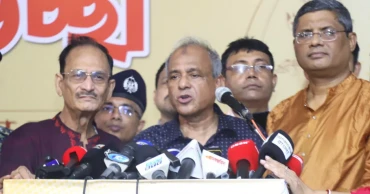
Home Adviser urges to observe Durga Puja preserving sanctity
Home Adviser Lieutenant General (Retd.) Md Jahangir Alam Chowdhury has urged all to celebrate the Sharadiya Durga Puja with sanctity and due religious fervor.
The adviser made the call while briefing journalists after visiting the Dhakeshwari National Temple in the capital on Tuesday afternoon.
“Durga Puja is a sacred religious festival. Its sanctity must be preserved. Everyone have to remain cautious so that no anti-social activities take place in the mandaps. Devotees have also to ensure that no one enters the mandaps with shoes,” he said.
Highest level of security ensured for Durga Puja celebration in Bangladesh: IGP
Referring to recent incidents in the Chittagong Hill Tracts, the adviser said a small group of miscreants attempted to disrupt the festival there. “Their efforts have completely failed. They were aided by some fascist quarters, but thanks to the cooperation of traditional devotees and all concerned, their plot did not succeed,” he added.
President of Bangladesh Puja Udjapan Parishad Basudev Dhar and President of Dhaka Metropolitan Sarbajanin Puja Committee Jayanta Kumar Deb, among others, were present at the briefing.
10 months ago

Four cops injured in attack during Durga Puja duty in Bagerhat
Four police personnel were injured in an attack by unidentified miscreants while performing Durga Puja duty in Chitalmari upazila of Bagerhat district on Sunday night.
Police arrested three women in connection with the incident.
The attack took place late Sunday night in front of Amodini’s House Sarbajanin Durga Temple at Hadiarghop village of the upazila.
Prior to the attack, an Ansar member named Md Al Amin, who was on duty at the Puja mandap, came under attack. The miscreants attempted to strangle him to death, police said.
Following the attack, police maintained a constant presence at the Puja mandap to ensure the safety of devotees.
The injured police personnel include Sub-Inspector (SI) Sanjay Mondal, in-charge of Boro Baria Police Camp, Assistant Sub Inspector (ASIs) Akhtar Hossain and Bashir Ahmed and constable Sagar Mallik.
Of them, Sanjay and Akhtar were admitted to Chitalmari Upazila Health Complex while the other two received first aid, according to police.
The three arrested women—Sathi Begum, 45; Panna Begum, 38; and Lavoni Begum, 32—belong to the same family and reside at Hadiarghop village.
Meanwhile, ASI Bashir Ahmed of Boro Baria Police Camp filed a case with Chitalmari Police Station on Monday, naming nine persons, including the three women, and 10 to 12 others unnamed in connection with the attack.
Speaking from the health complex on Tuesday, SI Sanjay said that on Sunday night while the Ansar member was on duty at the temple, a local named Hafiz Sikdar asked him the time.
When Al Amin replied it was 7 pm, Sikdar mysteriously became enraged and attempted to strangle him. Police and army personnel initially arrived at the scene, prompting Sikdar to flee. After they left, Sikdar returned and threatened Al Amin again, he said.
SI Sanjay said that upon receiving news of the threat, he returned to the spot with a security team on duty at the Puja.
Sikdar and several members of his family, including men and women, carried out an attack on them with sharp weapons.
Officer-in-charge of Chitalmari Police Station SM Shahadat Hossain a case was filed on charge of obstructing government officials in the discharge of their duties.
Three arrestees were sent to court and police were trying to arrest the remaining accused, he added.
10 months ago

NCP among 2 parties set to get registration: EC Secretary
The Election Commission is set to award registration to two new political parties – National Citizen Party (NCP) and Bangladesh Jatiya League – as they have fulfilled conditions, said EC Senior Secretary Akhtar Ahmed on Tuesday.
“We received applications from 143 parties seeking registration. After scrutiny, we shortlisted 22 parties for further field-level inquiries. After reviewing this information (gleaned from field-level), our position is that two parties have preliminarily met the conditions. The two parties are National Citizen Party (NCP) and Bangladesh Jatiya League,” he said while briefing reporters in the evening.
The EC Secretary said the Commission will now publish a public notification in newspapers inviting objections, if any, against the registration of the two parties.
He, however, said there is an unresolved issue over the election symbol sought by NCP. “The symbol they (NCP) requested is not included in our schedule of symbol related rules. So, we will write to them asking to confirm a suitable alternative (from the schedule). After they confirm, we will publish the notification mentioning their symbol.”
Akhtar Ahmed said Bangladesh Jatiya League sought a right symbol (which is within the schedule of symbols).
No room for confusion over JaPa’s registration, symbol: presidium member Rezaul
He said the EC needs further reviews for three other parties at the EC Secretariat and its field-level offices before taking the final decision to award them registration.
The three parties are Bangladesh Aam Janagan Party, Bangladesh Janata Party and Jatiya Samajtantrik Dal (Jasod- Shahjahan Siraj).
Besides, Bangladesh Nezam Islami Party is also eligible for registration in line with a court verdict, he said.
The Commission will also carry out extensive review and scrutiny on nine more parties. The nine parties are Aam Janata Dal, Bangladesh Ganotantrik Party (BJP), Bangladesh Samajtantrik Dal (Marxist), Bangladesh Justice and Development Party, Bhashani Janashakti Party, Bangladesh Bekar Mukti Parishad, Janata Dal, Moulik Bangla and Janata Party Bangladesh.
“We will search for more information about these nine parties,” said the EC Secretary.
So, the EC will carry out a search for further information about 12 parties including Aam Janagan Party, Bangladesh Janata Party and Jatiya Samajtantrik Dal (Jasod- Shahjahan Siraj), he added.
Earlier on September 25, Bangladesh Labour Party, known as an ally of BNP in its simultaneous movement, received official registration as a political party from the Election Commission with the electoral symbol ‘pineapple,’ on Thursday, following a High Court order.
With the Labour Party, the total number of registered political parties now stands at 52, including Awami League. But AL’s registration was suspended by the EC in May last soon after the government banned its activities under the Anti-Terrorism Act, until the International Crimes Tribunal completes the trial of the party and its leaders.
Labour Party gets EC registration with ‘Pineapple’ symbol
A total of 56 parties have so far obtained registration, but five of them—Bangladesh Jamaat-e-Islami, Freedom Party, Oikyabodha Nagorik Andolan, PDP and Jatiya Ganatantrik Party (Jagpa)—later lost their status due to different grounds and court orders. But Jamaat has recently got back their registration following the court order.
10 months ago
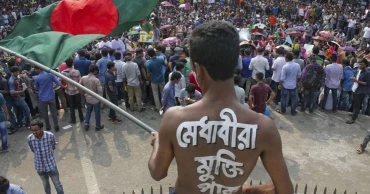
41 districts out of 64 witnessed killings during July Uprising: IO
Law enforcement agencies and armed cadres of the then ruling Awami League engaged in a killing spree that was spread across 438 locations in 41 of the 64 districts in the country during the student-led uprising in July-August 2024, according to the investigation officer (IO) in a case alleging crimes against humanity against former prime minister Sheikh Hasina and others at the International Crimes Tribunal-1 (ICT-1) on Tuesday.
Mohammad Alamgir as the IO was testifying for the third straight day this week- the 54th witness in the case against Hasina, her home minister Asaduzzaman Khan Kamal, who followed her into a life of exile in India, and her chief of police, ex-IGP Chowdhury Abdullah Al Mamun, who has turned approver for the state to help the tribunal, and possibly gain a softer sentence in the bargain.
The IO today wrapped up his testimony before the full three-member tribunal led by Chairman Justice Golam Mortuza Mazumder.
Alamgir said in his statement that in addition to killings, lethal weapons were used against protesters in more than 50 districts during the uprising.
Police fired over 300,000 rounds of ammunition - 305, 311 to be precise - during the uprising, the IO also said, with almost one-third -95,313 rounds - reportedly fired in the capital city of Dhaka alone. The numbers revealed by Alamgir do not include the BGB or Army's figures.
He testified that the AL’s actions during the 2024 movement, including abductions, killings, assaults, and torture, were aimed at 'clinging to power'.
He also said that over the previous 15 years, successive AL governments engaged in extrajudicial killings, enforced disappearances, rigged elections, and other coercive measures to suppress opposition and retain power. As a result, people from all walks of life participated in the 2024 student uprising.
Parts of Alamgir’s testimony were broadcast live on BTV. Videos previously aired by BBC and Al Jazeera documenting atrocities during the July 2024 movement were also presented as evidence in the tribunal.
Hasina mass murderer, evidence against her overwhelming: Shafiqul Alam
Earlier, several relatives of martyred protesters, including the father of Shaheed Abu Sayed, had testified in the trial.
Other notable witnesses included Nahid Islam, convenor of National Citizens’ Party and one of the coordinators who led with the spirit the July uprising, and Dr. Mahmudur Rahman, editor of the daily Amar Desh.
The prosecution team in the case comprised Chief Prosecutor Mohammad Tajul Islam, Mizanul Islam, and Gazi SH Tamim.
Lawyers representing the absconding accused Sheikh Hasina and Asaduzzaman Khan Kamal include state-appointed lawyer Amir Hossain, while former IGP Chowdhury Abdullah Al-Mamun, now a state witness, is represented by Zayed Bin Amzad.
The tribunal formally indicted Sheikh Hasina, former Home Minister Asaduzzaman Khan Kamal, and ex-IGP Chowdhury Mamun on July 10, following which hearings began.
Chowdhury Mamun later applied to become an approver, confessing to the crimes to assist the tribunal, and has since testified.
Besides this case, Sheikh Hasina faces two other cases at the tribunal: one concerning enforced disappearances and killings over her 15-and-a-half-year rule, and another over killings during a Hefazat-e-Islam rally at Motijheel’s Shapla Chattar.
10 months ago
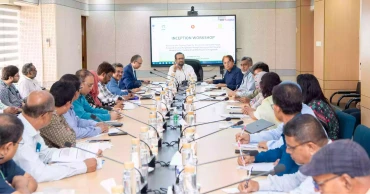
PKSF to install over 500 desalination plants to provide safe drinking water in coastal areas
Palli Karma-Sahayak Foundation (PKSF) will set up more than 500 solar-powered desalination plants in the coastal areas of Bangladesh to mitigate the acute drinking water crisis faced by local communities.
The plants, using Reverse Osmosis (RO) technology, will provide safe drinking water to low-income households in Satkhira, Khulna, and Bagerhat districts. PKSF has already installed 83 desalination plants in the coastal belt, according to a press release.
The announcement came at an inception workshop on the ‘Safe Water Project’ held at PKSF Bhaban in Agargaon, Dhaka. PKSF Managing Director Md Fazlul Kader chaired the meeting, while Additional Managing Director Dr Mohammad Jashim Uddin, Deputy Managing Directors Dr Fazle Rabbi Sadeque Ahmed and Md Hasan Khaled, and General Manager Dr AKM Nuruzzaman also spoke.
Financed by the Adaptation Fund, the Safe Water Project aims to increase access to potable water in project areas from the current 30.3 percent to 95 percent within three years, directly benefitting around half a million people. Special focus will be given to extreme-poor households, forest-dependent families, and marginalized rural communities.
In his speech, PKSF Managing Director Fazlul Kader said people in coastal regions are often compelled to consume saline water due to the absence of easily accessible fresh water sources, which has worsened their living conditions. He noted that drinking saline water is linked to waterborne diseases, skin ailments, hypertension, and reproductive health problems for women.
“To tackle this crisis, PKSF is installing desalination plants through an appropriate business solution with active community participation,” he said.
Additional Managing Director Dr Mohammad Jashim Uddin highlighted that PKSF has been working to ensure safe drinking water in coastal areas since Cyclone Sidr in 2007.
Deputy Managing Director Dr Fazle Rabbi Sadeque Ahmed explained that RO plants purify water by forcing saline water at high pressure through a semi-permeable membrane, which allows water molecules to pass while blocking salts and contaminants.
10 months ago
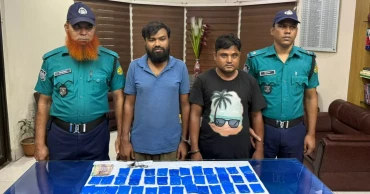
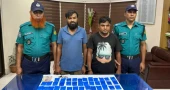
2 men held with 7,600 yaba pills in Ramna
Police have arrested two alleged drug peddlers along with 7,600 yaba tablets from Ramna area of Dhaka.
The arrestees were identified as Saju Hossain Mondal, 38, and Aminul Islam, 40. Police also seized a motorcycle used for drug transportation.
Officer-in-charge of Ramna Model Police Station Golam Faruque said the duo was arrested during a drive conducted on Monday afternoon.
Police set up a check-post in front of Toma Tower at Kakrail intersection after being tipped-off that a consignment of yaba was being transported from Motijheel to Kakrail by a motorcycle, he said.
When a motorcycle arrived at the check-post, police signaled it to halt but sensing the presence of the law enforcers, the suspects tried to flee but were immediately detained, the police official said.
During the search, police recovered a total of 7,600 pieces of Yaba pills from 38 packets from their possession, he said.
The market price of the seized yaba tablets were estimated at Tk 22.8 lakh, the OC said, adding that a case was filed under the Narcotics Control Act with Ramna Police Station.
10 months ago
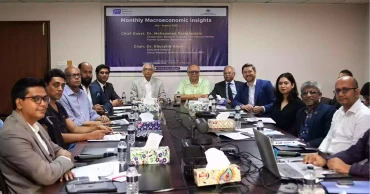
PRI seminar issues strong call for central bank independence, reforms to tax laws and institutions
Economists and business leaders at a policy dialogue on Monday stressed the urgent need for tax reforms, central bank independence, and institutional strengthening to ensure Bangladesh’s economic stability and sustainable growth.
The discussion was held at the Policy Research Institute (PRI) conference room as part of the July-August edition of its Monthly Macroeconomic Insights (MMI), hosted by PRI’s Centre for Macroeconomic Analysis (CMEA) in partnership with the Australian Government’s Department of Foreign Affairs and Trade (DFAT).
Chaired by PRI Executive Director Dr Khurshid Alam, the session highlighted the difficult trade-offs facing the economy.
“Growth is being held back by constraints on imports of capital machinery and essential inputs. The real question is whether we should pursue sustainable growth supported by stability and sound macroeconomic conditions, which will require deeper reforms,” Dr Alam said.
Former Bangladesh Bank governor and Chairperson of East West University’s Board of Trustees, Dr Mohammed Farashuddin, attended as Chief Guest. Stressing tax reform, he said, “Every year, 20 lakh new taxpayers must be added so the burden does not fall disproportionately on existing taxpayers.
At the same time, the government must take stronger action against money launderers.” He also called for stronger support for small entrepreneurs through skills training and low-interest loans to generate employment.
Delivering the keynote, Dr Ashikur Rahman, Principal Economist at PRI, warned that past erosion of Bangladesh Bank’s independence had created conditions for financial irregularities that undermined the banking system.
“Central bank independence is no longer a desirable policy choice; it is a fundamental necessity for Bangladesh’s economic future,” he said, urging reforms that would give Bangladesh Bank autonomy comparable to the Bank of England or the US Federal Reserve.
Metropolitan Chamber of Commerce and Industry (MCCI) President Kamran T. Rahman said expanding employment and skills development is crucial to harness the country’s demographic dividend.
Deputy Head of Mission at the Australian High Commission Clinton Pobke stressed that rare reform windows must not be lost and reaffirmed Australia’s commitment to support Bangladesh’s reform agenda through deeper trade, investment, and development cooperation.
10 months ago
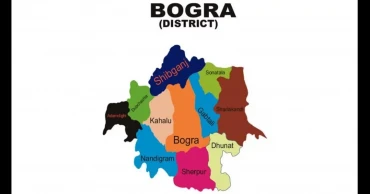
Jubo Dal leader hacked to death in Bogura
A ward level leader of Jubo Dal, youth wing of the BNP, was hacked to death in Kahaloo upazila of Bogura district on Tuesday afternoon.
The incident occurred around 2pm at UttarPara of Magura village under Malancha union of the upazila.
The deceased was identified as Rahul Sarker, 35, organizing secretary of ward No-13 of Bogura city Jubo Dal and son of the late Abdus Sobahan Sarker of Kaigari area in Shajahanpur upazila, said Wasim Reza, publicity secretary of Bogura city Jubo Dal.
Inspector (investigation) of Kahaloo Police Station Mahbubur Rahman said Rahul went to UttarPara village to fish in a leased pond. While fishing with a rod, a group of assailants armed with sharp weapons attacked him, leaving him dead on the spot.
DB arrests 7 members of 'honey trap' gang in Bogura
Police recovered the body and sent it to Shaheed Ziaur Rahman Medical College morgue for autopsy, he said, suspecting that a past personal dispute led to the killing.
Wasim Reza demanded immediate arrest of the culprits and exemplary punishment.
10 months ago
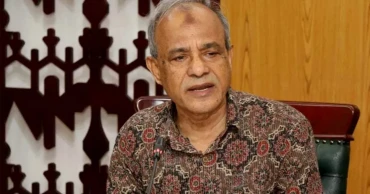
Situation in Khagrachhari now normal: Home Adviser
The situation in the hills of Khagrachhari has returned to normal, Home Affairs Adviser Lt. Gen (retd) Jahangir Alam Chowdhury claimed on Tuesday.
He made the claim while talking to reporters after a meeting at his ministry regarding recent violence in Guimara upazila of the district.
Responding to journalists’ questions, the adviser said the current situation in the hills is calm and there are no major problems.
He also said certain groups attempted to disrupt Hindu devotees from celebrating Puja peacefully but their efforts failed.
The ministry condemned recent attacks by miscreants in Khagrachhari that left three local people dead and several others, including members of the army and police, injured.
The unrest followed the alleged gang rape of an eighth-grade girl on September 23.
The victim’s father filed a case against three unidentified people with Khagrachhari Sadar police station.
Khagrachhari violence: Blockade disrupts daily life for 4th day
The next day, the police, with army assistance, arrested a suspect, Shoyon Sheel, who is now in custody for interrogation.
Protests demanding punishment have been ongoing under the banner of ‘Jumma Chhatra Janata,’ including indefinite road blockades.
On Sunday, at Ramessu Bazar in Guimara, protesters clashed with law enforcement, injuring 25 people, including army personnel, and vandalising several shops and houses.
Authorities have imposed Section 144 in the area to prevent further violence, and the situation remains tense.
10 months ago