NCP

Nahid demands Home Minister’s removal, blames him for law and order failure
National Citizen Party (NCP) Convener Nahid Islam on Monday said restoring law and order in the country would not be possible as long as Home Minister Salahuddin Ahmed remains in office as he has “failed to fulfill his responsibilities”.
“We believe he has already failed. If a person has failed, he cannot and should not remain in charge,” Nahid said at a press briefing following a meeting at the party office in the capital.
He said the Home Minister should step down to set an example of accountability within the government.
“We have already seen a few reshuffles in the cabinet. So, now he should be removed. An example needs to be set that if someone fails in their duties, they must step down and make way for a successor,” he said.
“This will send a message to everyone including the government officials working under him,” he added.
Nahid accused the government of failing to rein in its party activists.
Referring to the recent demolition of the Radda MCH-FP Centre in Mirpur and the attack on content creator Salman Muqtadir’s studio, he said the incidents reflected the deteriorating law and order situation.
He alleged that law enforcement agencies remained inactive during the attacks, raising questions about the government's ability to ensure public safety.
“The government had promised that the law and order situation would improve after an elected government came to power. But the situation has deteriorated further,” he said.
The NCP leader also accused the government of politicising public recruitment, citing the exclusion of candidates from the primary school teacher recruitment process following police verification.
He said qualified candidates should not be disqualified without specific evidence of their involvement in criminal or anti-state activities.
Nahid said Prime Minister Tarique Rahman's recent address to the United Nations General Assembly had failed to reflect the expectations and concerns of Bangladeshi people.
He said the prime minister missed an opportunity to highlight key national concerns including the ongoing energy crisis, border killings, push-ins from India, the Rohingya crisis and the implementation of the Teesta project.
On constitutional reforms, Nahid rejected the government's initiative to form a parliamentary committee to amend the Constitution, arguing that fundamental reforms could not be achieved through the regular amendment process.
He called for the immediate convening of the Constitution Reform Council to implement the July National Charter, warning that the NCP would continue its programmes and move towards tougher action if the government fails to do so.
Nahid also expressed concern over the proposed Cyber Security Act, alleging that it could curtail freedom of expression and be used to suppress criticism of the government.
On the upcoming local government elections, he said the NCP would contest independently and support candidates committed to combating extortion, terrorism and land grabbing.
Senior party leaders Akhter Hossen, Sarjis Alam, Hasnat Abdullah, Nasiruddin Patwari, among others, were also present at the meeting.
2 days ago

Asif Mahmud demands arrest, neutral probe into Radda centre vandalism
National Citizen Party (NCP) Spokesperson Asif Mahmud Shojib Bhuyain on Sunday demanded the immediate arrest of those involved in the attack, vandalism and looting at the Radda MCH-FP Centre in the capital’s Mirpur area and called for a neutral investigation into the incident.
He visited the health centre around noon with party leaders and activists, inspecting the sections damaged in the vandalism and looting.
Asif spoke with patients who were still receiving treatment at the facility and demanded that the damaged centre be rebuilt and health services restored as soon as possible.
During the visit, NCP activists removed a signboard of a shopkeepers' co-operatives society, which was put up in front of the centre.
Speaking after the inspection, Asif said the facility had long been providing essential maternal and child healthcare services, including vaccination.
“Such destruction of a healthcare facility is completely unacceptable,” he said.
He said medicines, vaccines, injections and medical equipment were also looted from the centre.
The NCP leader alleged that the incident was not isolated and involved a BNP lawmaker, a city corporation administrator and local police, describing it as an “organised crime” and “state-sponsored looting.”
He further alleged that police were present at the scene when the vandalism began but left the spot, returning only after the incident ended.
Asif demanded action against those involved in the attack as well as those accused of negligence of duty.
He said the Radda clinic will not be allowed to be grabbed, adding that health workers will try to keep maternal and child healthcare services running even amid the debris.
2 days ago

Nahid questions state of law and order after overnight demolition of a healthcare centre
National Citizen Party (NCP) convener Nahid Islam on Saturday questioned whether any government exists in the country, after a maternal and child healthcare facility, which had served the community for five decades was demolished overnight in the capital.
In a statement, Nahid said the razing of the Radda MCH-FP Centre, which had run maternal care and vaccination programmes for 50 years, exposed how fragile the country's law and order situation has become, as vandalism and looting continued through the night while law enforcement remained silent and unmoved.
"A country cannot run this way," he said, adding that the demolition and takeover of a hospital in the heart of the capital, carried out like illegal land grabbing, raised public questions over the very existence of a functioning government.
Nahid said locals allege that BNP reserved-seat lawmaker Ferdousi Ahmed Misty and an influential leader of Dhaka North BNP were behind instigating the vandalism and occupation of the facility.
He further said the home minister's largely inactive role, despite the steady deterioration of law and order over recent days, was a matter of shame for the entire nation.
"Our clear demand is that everyone involved in the vandalism and looting at the Radda MCH-FP Centre must be arrested immediately and brought to justice," Nahid said.
He also demanded that the masterminds behind the incident be identified and brought under the law, ensuring exemplary punishment for the guilty.
3 days ago
Chhatra Shakti protests govt's alleged politicisation of teacher recruitment at primary level
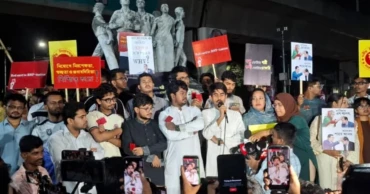
Dhaka University unit of Jatiya Chhatra Shakti, the student wing of the NCP, on Friday held a “Red Card to BNPization” program, accusing the government of politicizing primary school teacher recruitment and depriving qualified candidates of jobs in the name of police verification.
The human chain program was held at Raju Memorial Sculpture on Dhaka University campus around 7:30pm.
The protesters demanded an end to political discrimination in public recruitment, an impartial investigation into allegations of recruitment irregularities, reinstatement of candidates whose appointments were cancelled following verification, and a transparent, merit-based recruitment process.
Addressing the program, Kurratul Ain Kaniz, vice-president of the Shamsun Nahar Hall Students’ Union, said meritorious young jobseekers had sacrificed their lives during the 2024 mass uprising, but were now being subjected to harassment and facing obstacles in the recruitment process.
“After being elected, the BNP government is now harassing those meritorious jobseekers and obstructing their recruitment process. We strongly condemn such activities,” she said.
She said Chhatra Shakti and students and members of the public across the country would stand beside the affected jobseekers.
“We are showing a red card to the BNP government,” she said.
She also demanded the immediate reinstatement of candidates whose appointments had been cancelled despite being recommended for government jobs.
“If the government betrays the students again, we will once again build a strong movement against the BNP with the participation of students, as we did during July,” she said.
Hasib Al Islam, president of the DU unit of Chhatra Shakti, alleged that the BNP government was appointing its party supporters to various positions after assuming power.
“Their only qualification is that they are BNP leaders or activists. No country can run this way,” he said.
He also alleged that students and members of the public were being subjected to harassment in the name of police verification and demanded an immediate end to it.
“The politicization of primary teacher recruitment and the exclusion of qualified candidates must be reversed immediately,” Hasib said.
He said candidates who had been excluded on political grounds or because of their political ideology should be reinstated, while membership of an organization affiliated with the ruling party should not be used either to deny or grant jobs irrespective of merit.
“If you do not turn back from this path of politicization, we know how to remove you from power,” he said.
Hasib urged the government to follow what he described as the spirit of the July mass uprising, building a state based on equality and free from discrimination.
Meanwhile, the Dhaka University unit of Islami Chhatra Shibir also demanded an end to harassment and deprivation of candidates in government recruitment in the name of police verification, as well as merit-based recruitment and an end to political discrimination.
In a statement issued Friday, it demanded an impartial investigation into allegations of political discrimination and recruitment deprivation, fair remedies for victims and a transparent, merit-based recruitment system.
The Dhaka University Central Students’ Union (DUCSU) also demanded prompt measures for candidates who have not received appointment letters for primary school teaching posts and an end to harassment in the name of verification.
4 days ago

Nahid calls for security, justice
National Citizen Party (NCP) Convener Nahid Islam said the 11-party alliance wants security for the country and safety for its children.
He made the remarks while speaking at the closing rally of the 11-party alliance’s Dhaka-Rangpur long march on Saturday.
“We have not received justice for the killing of martyr Sharif Osman Hadi. Justice must be served. Death sentences are being handed down to those who are not in the country. We want to see verdicts against those who are actually here,” he said.
Nahid also demanded implementation of the Teesta Master Plan.
He said the alliance’s eight-point programme could “liberate Bangladesh”.
An activist of the 11-party alliance was hacked and injured in Sirajganj, he said.
“If there is even one more attack, we are prepared to strike back,” Nahid said, warning that attempts to suppress the opposition would fail.
10 days ago

Nahid accuses PM Tarique of emerging as ‘new authoritarian’
National Citizen Party (NCP) Convener Nahid Islam on Friday accused BNP Chairman and Prime Minister Tarique Rahman of emerging as a ‘new authoritarian,’ saying democracy and human rights are not safe under his leadership.
“Democracy is not safe in Tarique Rahman’s hands, nor are human rights. Tarique Rahman has emerged as a new authoritarian,” Nahid said while addressing an NCP human chain in front of the Jatiya Sangsad.
The NCP arranged the human chain protesting what it described as the BNP government’s passage of laws violating human rights, suppression of dissent and deprivation of citizens’ fundamental rights.
He alleged that the BNP government was suppressing dissent and passing laws that undermine citizens’ fundamental rights, despite its earlier struggle for democracy and human rights during the ousted Awami regime.
Nahid demanded amendments to laws concerning enforced disappearances and the National Human Rights Commission, as well as proposed changes to Cyber Security Act, saying such measures must not curtail freedom of expression.
He questioned the government’s handling of disappearance allegations, particularly the case of Miraj Sheikh, who, he said, had remained missing for five months.
He also criticised the use of the Anti-Terrorism Act against NCP-linked activists Gazi Salahuddin Tanvir and Sifat, arguing that offensive speech should not be treated as terrorism.
“But it is not terrorism. People’s mouths are being silenced and their right to speak is being stopped in the name of the Anti-Terrorism Act,” he said.
He alleged that law-enforcement agencies should not investigate disappearance complaints involving other law-enforcement agencies and expressed concern that provisions penalising false complaints could discourage victims’ families from seeking justice.
Nahid also alleged that the Anti-Corruption Commission was being used against opposition figures.
“You are using the ACC against us, against our leaders; by all means, continue doing so,” he said.
“You have not formed a police reform commission; instead, the police force is being prepared to suppress the opposition,” he added.
He called for independent mechanisms to investigate human-rights violations and protect democratic and constitutional rights.
11 days ago

Govt moving towards deals with Israel, India on surveillance: Patwari
National Citizens Party (NCP) Chief Coordinator Nasiruddin Patwari on Thursday alleged that the current government is moving towards agreements with India and Israel related to surveillance and access to citizens’ digital communications.
“We have heard that, behind the scenes, the current government is also moving towards such agreements with Israel and India. But they will not admit it publicly,” he said.
Patwari made the remarks at a discussion titled “SRB, enforced disappearance and cyber law: Human rights violations”, organised by the NCP at its central office in the afternoon.
Referring to the Digital Security Act enacted by the previous government, he said the law had been used to justify checking the Facebook and WhatsApp messages of political figures and other people.
He alleged that the previous government had entered into agreements with foreign powers, including India and Israel, to obtain such security and surveillance capabilities.
He called on experts in the field to bring the issue to public attention and examine whether the current government is pursuing similar arrangements.
“If the government goes to a foreign state and says it needs to see what the people of Bangladesh are doing on Messenger and WhatsApp, and asks companies operating here for call records, that raises questions about citizens’ security,” he said.
Patwari said the state has a responsibility to ensure security both offline and online and that laws are necessary to protect people from genuine security threats.
But, he said, national security should not be compromised in the name of protecting citizens, nor should citizens be handed over to foreign powers.
He said many Bangladeshis are not sufficiently aware of their constitutional and legal rights and that this lack of awareness was being used to introduce laws that could be used as “weapons”.
Referring to Salahuddin Ahmed, He said there was no guarantee in Bangladesh regarding compensation for victims of enforced disappearance or whether such cases would be investigated independently.
“The person who was a victim of this kind of incident is now, through the stroke of his own pen, bringing such laws back to Bangladesh,” he alleged.
AB Party secretary general Asaduzzaman Fuad alleged that the government is using legal provisions against critics over their Facebook posts and other public comments.
He said offensive or rude language should not automatically be treated as a criminal offence and alleged that such legal measures were aimed at weakening the balance within society and the state.
He said the government is also restricting criticism by bringing people under legal provisions for spreading what it considers misinformation or for making comments that could prejudice or harm the reputation of ministers and MPs.
He questioned the effectiveness of such restrictions, saying similar practices had existed during the Awami League government but had not prevented citizen journalists and others from disseminating information.
The speakers at the discussion included of NCP Law Affairs Secretary Zahirul Islam Musa, NCP Joint Member Secretary Faridul Haque, Jatiya Narishakti Convener Monira Sharmin, Citizens Coalition co-coordinator Fahim Mashroor, Member of the NCP Political Council Sarwar Tushar, NCP MP from Narayanganj-4 Abdullah Al Amin, National Human Rights Commission (NHRC) member Nabila Idris, Women’s reserved seat MP Tasmia Pradhan.
12 days ago

NCP slams EC as ‘spineless’, warns of street movement over local polls
The National Citizen Party (NCP) has strongly protested and condemned what it called the Election Commission's "independence-less and spineless" role, pointing to contradictory statements from the EC and a state minister over the schedule and process for upcoming local government elections.
In a joint statement issued on Tuesday evening, NCP Convener Nahid Islam and Member Secretary Akhter Hossen said Election Commissioner Abul Fazal Md Sanaullah announced possible dates for the seven phases of local government elections, only for State Minister for Local Government, Rural Development and Co-operatives Mir Shahe Alam to immediately claim the government has no knowledge of the matter and that no discussions have taken place with the EC.
Compounding the confusion, they said, EC Secretary Akhtar Ahmed publicly stated afterwards that the state minister's remarks will be treated as binding and that he will not "dare" to make any counter-comments, a response the NCP leaders said exposed the commission's "extreme spinelessness and subordination."
While it is natural for an independent constitutional body like the EC to have its own decisions and positions, the NCP leaders said, the secretary's silence in the face of the state minister's comments proves the commission can no longer exercise the independent role granted to it by the Constitution and has become fully subservient to the government.
They added that the EC's shifting statements under government pressure and influence reflect "extreme capriciousness" that is destroying even the minimum guarantee of a neutral and fair election.
The NCP leaders expressed outrage, alleging that instead of strengthening state institutions after coming to power, the current administration has instead focused on their partisan capture.
They described the attempt to “control” the EC and run elections under the government's own supervision as a clear manifestation of "fascist-style greed for power and undemocratic practice."
The party further alleged that the government has moved to turn the constitutional body into a partisan instrument by appointing, on a contractual basis, a person linked to its own party's election-related activities as an additional secretary of the commission.
The NCP demanded that the EC immediately free itself from government influence and interference and function as an independent, autonomous institution.
It also called for a clear explanation to the nation over what it termed the commission's unprofessional conduct in capitulating before the executive branch, and demanded an immediate end to what it described as the executive's illegal influence and undemocratic interference over the EC and other state institutions.
Nahid and Akhter warned that the public, following the new democratic journey that began after the July uprising, will not accept an Election Commission that is spineless and subservient to the government bureaucracy.
They cautioned that if the government fails to let the EC function impartially and continues to run institutions in an undemocratic manner according to its own wishes, the NCP will launch a tough resistance movement on the streets alongside the country's people.
14 days ago

NCP threatens movement over ACC probe against Asif Mahmud
The National Citizen Party (NCP) has threatened to wage street movement against what it called a "politically motivated" inquiry by the Anti-Corruption Commission (ACC) against its Spokesperson Asif Mahmud Shojib Bhuyain, accusing the government of turning the anti-graft body into a “partisan tool”.
In a joint statement issued on Monday evening, NCP Convener Nahid Islam and Member Secretary Akhter Hossen said the ACC is using "rumours and politically motivated propaganda" spearheaded by the Awami League, which faces a ban on its activities, to justify the investigation, which proved that the government has "unmistakably politicised" the commission.
They alleged the ACC is being revived as a “political weapon”, reminiscent of the Awami League era, to tarnish the image of top leaders of the July uprising and suppress anti-fascist forces.
The NCP leaders claimed that the ACC's inquiry against Asif Mahmud stemmed from "false and misleading" reports published by a so-called online portal run by a leader of the banned Bangladesh Chhatra League, the Awami League's student wing.
"A commission that stages the drama of investigation based on baseless, imaginary reports fabricated by cadres of a banned student organisation cannot claim even a minimum of neutrality or moral standing," the statement reads.
It added that the move is designed to “politically harass” the architects of the mass uprising and pave the way for the return of "fascism."
The NCP said it stands ready to fully cooperate with any fair investigation, only if the commission is reconstituted as a genuinely independent and impartial body in line with the July National Charter 2025.
"If this unconstitutional and politicised commission, under the guise of a neutral probe, is turned into a tool to suppress the opposition and the July uprising fighters, the NCP will never accept it," it said.
The party urged the government to refrain from "following the footsteps of the fallen fascists."
It also called for an immediate end to what it described as a conspiratorial campaign to target political opponents, and demanded the reconstitution of the ACC in line with the spirit of the July Charter.
The NCP warned that it will launch a "strong resistance movement" on the streets against what they called the political abuse of power and a government "blueprint" against them if there is no end to harassment of the July fighters.
15 days ago
JU Chhatra Shakti demands probe into JUCSU VP’s alleged BCL links
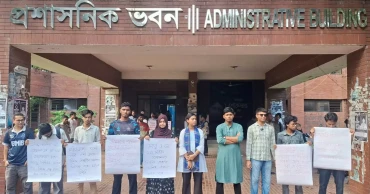
Jahangirnagar University (JU) unit of Jatiya Chhatra Shakti on Sunday staged a human chain demanding an investigation into alleged links between Jucsu Vice President Abdur Rashid Zitu and banned Bangladesh Chhatra League (BCL), along with five other demands.
The organisation held the programme in front of the university’s Administrative Building in the afternoon.
The demands include scrapping the alleged discriminatory accommodation notification for Jucsu and Hall Union leaders; investigating alleged financial transactions in the recruitment and promotion boards for university officers and employees; probing allegations of extortion from autorickshaws and shops involving Jucsu VP Jitu and the Salim-Barkat Hall VP; investigating allegations that Fazilatunnesa Hall VP Oishi Sarker embezzled Tk 60,000 from the university treasury fund; filing an anti-terrorism case against detained Asadul Alam Sheikh, who is accused of having links with BCL, instead of a cyber security case; and investigating alleged contacts between Jucsu VP Jitu and teacher Hosne Ara Baby and the banned BCL.
The student organisation had submitted a memorandum to the university administration with four demands on August 19. It later added two more demands.
Speaking at the programme, JU unit president Zia Uddin Ayan said the administration had taken no action despite the memorandum.
He alleged that JUCSU VP Zitu was involved in extortion and had links with the banned BCL. Referring to a conversation published in the media, Ayan said Zitu allegedly told a BCL activist, “If I win, you win too.”
He demanded an immediate investigation into the allegations, saying the administration must take action against anyone found involved.
Ayan also questioned why Asadul Alam Sheikh had been charged under the Cyber Security Act despite allegations of direct links with the banned BCL. He demanded that authorities file a case against him under the Anti-Terrorism Act.
He further alleged that Oishi Sarker had embezzled Tk 60,000 from the university treasury fund and called for an investigation.
Jatiya Chhatra Shakti JU unit general secretary Nadia Rahman Anwesha alleged that political influence continued on campus despite the post-July political environment.
She also alleged that money was taken from a company in the name of allocating space and that authorities awarded projects without tenders by citing emergency works.
Referring to the alleged conversations between Jitu and a BCL activist, she demanded an investigation into the matter.
Anwesha warned that they would besiege the Registrar Building if the administration failed to form probe committees and take action soon.
The organisation also called on the university authorities to take urgent decisions on the demands at the Syndicate meeting scheduled for Sunday.
16 days ago