Business

BAJUS raises gold price by Tk 1,633 per bhori
The Bangladesh Jewellers Association (BAJUS) on Tuesday raised the price of gold in the domestic market, after two consecutive cuts, fixing the price of 22-carat gold at Tk 2,21,441 per bhori, including VAT.
In a notice issued in the morning, BAJUS said the decision was taken in view of a rise in the price of pure gold in the local market, and the new rate came into effect from 10 am the same day.
According to the revised rate, 21-carat gold will now cost Tk 2,11,468 per bhori, 18-carat gold Tk 1,81,608 per bhori, and traditional gold Tk 1,48,366 per bhori, all inclusive of VAT.
BAJUS said the new prices will remain effective at all jewellery outlets until further notice, though making charges will continue to apply depending on the design of ornaments. Since VAT is already included in the sale price of gold and silver ornaments, jewellers cannot charge it separately from customers.
The association also said its existing rules on ornament exchange and repurchase, excluding specified VAT, making charges and the value of stones, will remain unchanged.
BAJUS had last adjusted gold prices on the morning of July 14, when the rate of 22-carat gold, including VAT, was cut by Tk 2,158 to Tk 2,19,808 per bhori.
So far in 2026, gold prices have been revised 92 times in the domestic market, increased on 44 occasions, decreased on 47 occasions, and adjusted once for VAT.
Despite the rise in gold prices, silver prices remained unchanged. Currently, 22-carat silver is being sold at Tk 4,607 per bhori, 21-carat at Tk 4,374, 18-carat at Tk 3,791, and traditional silver at Tk 2,858 per bhori.
14 days ago

Grameenphone auditor flags Tk 125.80 billion BTRC tax demand as 'unresolved risk'
The auditor of Grameenphone Ltd. has issued an "Emphasis of Matter" in its report on the telecom operator's interim financial statements for the six months ended June 30, 2026, drawing attention to an unresolved BDT 125.80 billion demand notice from the Bangladesh Telecommunication Regulatory Commission (BTRC), disclosure documents filed with the Dhaka Stock Exchange (DSE) showed on Monday.
The demand, issued on April 2, 2019, followed an information system audit by BTRC covering the period from Grameenphone's inception in 1997 to December 31, 2014. It includes BDT 40.86 billion attributable to the National Board of Revenue (NBR).
Grameenphone declares 105% interim cash dividend for H1 2026
According to the disclosure, Grameenphone has challenged the demand through a Title Suit in the District Court. The case was scheduled for mediation on April 26, 2026, but the hearing was adjourned, with the next date now set for October 5, 2026.
In a related appeal, the High Court Division (HCD) had earlier granted an injunction against the demand, which the Appellate Division (AD) subsequently upheld, both in a Civil Petition and a Review Petition, on condition that Grameenphone deposit BDT 20 billion.
The company made that deposit in 2020, and the amount continues to be carried under "Other non-current assets" in its books, as stated in the interim financial statements.
Hearings on the pending Review Petition and Appeal have yet to take place before the AD and HCD, respectively, and will proceed as per court scheduling, the disclosure noted.
The BTRC audit demand separately covers disputes over VAT deductibility on payments to the regulator and the spectrum assignment fee. Grameenphone said it had already settled the principal amount tied to that portion, BDT 3.92 billion on June 14, 2023, following a separate AD ruling.
Citing the ongoing litigation, Grameenphone's management said significant uncertainty remains over the validity of the audit demand and its eventual outcome, and that no provision has been made in the interim accounts for the demand or any accrued interest, apart from what has been disclosed in Note 45(a) to the audited financial statements for the year ended December 31, 2025.
14 days ago
ADB warns against fake loan scams using its name
Asian Development Bank (ADB) has warned people about fraudulent loan schemes being circulated through fake websites, counterfeit Facebook pages, and forged identity documents using the name and credentials of the organization and its officials.
It does not provide direct loans, grants, funds, or any other form of financial assistance to individuals, ADB said in a press release issued on Monday.
It also clarified that it never asks individuals to share personal financial information in exchange for support or requests money transfers through mobile banking or any other payment channel.
ADB said fraudsters have recently been creating fake websites, unauthorised social media pages, and forged documents to impersonate the bank and its officials in order to deceive people and extort money.
It has no association with or involvement in such activities, it said.
Reaffirming its role as a long-standing development partner of Bangladesh, ADB said it works only with the Government of Bangladesh and private sector organizations through transparent and accountable procedures to implement development projects.
ADB advised people to consider any offer of direct loans or financial assistance from individuals claiming to represent ADB as fraudulent and to remain cautious of such scams.
14 days ago

DCCI urges NBR to avoid harassment of businesses in source tax monitoring drive
The Dhaka Chamber of Commerce and Industry (DCCI) has said if the initiative of the National Board of Revenue (NBR) to strengthen deduction, deposit, monitoring and verification of source tax under the tax law is properly implemented, it will play a positive role in overall revenue collection and expansion of the tax net.
In a press release issued on Monday, the DCCI welcomed the NBR initiative but simultaneously expressed concern that, in implementing the law, business entities that are already compliant in their tax management must not face unnecessary harassment.
DCCI urges faster FTAs, stronger economic diplomacy
It also urged the NBR to ensure fair treatment for business entities that have not yet achieved full compliance by giving them adequate time and opportunity to do so.
The chamber further said effective use of automation and digital systems in the country's overall revenue management is necessary to help the government meet its revenue collection targets and expand the tax net, which will significantly ease the unwanted suffering of the private sector.
It said it believes that revenue collection and a business-friendly environment are two goals that can be achieved simultaneously.
However, the DCCI stressed there is no alternative to continued constructive dialogue with NBR alongside joint efforts by the government and private sector to bring greater discipline to tax management across all classes of businesses.
14 days ago

Remittance inflow surges 27.6% to $1.94 billion in first 19 days of July
Bangladeshi expatriates living in different countries across the world remitted US$1.94 billion in the first 19 days of July, recording a robust 27.6 percent growth compared to the corresponding period of the previous year, according to the latest data of Bangladesh Bank.
During the same period last year, the country received $1.52 billion in remittance inflows.
On July 19 alone, expatriates sent home $140 million.
The central bank also revised the remittance inflow figure for the three-day period between July 16 and July 18 to $166 million.
The strong growth in remittance inflows at the beginning of the fiscal year 2026-27 provides a substantial boost for the country's foreign exchange reserves and overall macroeconomic stability.
14 days ago
BSEC trains 21,732 people in FY26 to boost investor education
The Bangladesh Securities and Exchange Commission (BSEC) trained a total of 21,732 people in the fiscal year 2025-26 as part of its nationwide investment education programme, aimed at helping investors make informed decisions and building a healthy, risk-aware capital market.
In a press release, the BSEC on Monday said it regularly organises training sessions, seminars, workshops and conferences under its investment education initiative, in addition to conducting training for employees of market intermediary institutions and observing World Investor Week.
BSEC seeks public opinion on draft amendments to Margin Rules 2025
Between July 2025 and June 2026, the commission's Financial Literacy Division alone trained 4,660 people through eight separate programmes.
Of them, 1,896 received training as individual investors, while 1,194 employees of capital market intermediary institutions were trained.
A workshop titled "Capital Market Workshop" was held for 52 journalists covering the capital market, and a seminar on Surveillance and Capital Issue & Financial Literacy, organised with the US Securities and Exchange Commission (US SEC), drew 61 participants.
Separately, 106 approved representatives of Dhaka Stock Exchange (DSE) TREC holders received training, and 1,290 people took part in activities marking World Investor Week 2025.
The commission also trained 35 SME entrepreneurs on raising capital through public offerings and held a financial investment education workshop for 26 women investors.
Beyond the commission's own programmes, the BSEC said it works jointly with the Dhaka Stock Exchange, Chittagong Stock Exchange, Central Depository Bangladesh Limited (CDBL), Investment Corporation of Bangladesh (ICB), Bangladesh Institute of Capital Markets (BICM), Bangladesh Academy for Securities Markets (BASM), brokers, merchant bankers and listed companies to build a sound and inclusive capital market and raise awareness about investment risks among the general public.
According to the combined figures for 2025-26, the commission's Administration and Finance Division trained 1,442 people, while its Market and Intermediaries Affairs Division trained 308.
The Dhaka Stock Exchange trained 1,339 people and the Chittagong Stock Exchange 3,350, while CDBL trained 111 and ICB 181. BICM and BASM trained 2,589 and 1,339 people respectively, brokers trained 3,876 people, publicly listed companies trained 385, and market bankers trained 2,352 people, taking the combined total to 21,732.
14 days ago
ADB brand being exploited to commit financial fraud in Bangladesh
The Asian Development Bank (ADB) has warned people in Bangladesh against fraudulent schemes that are using the bank’s name and logo to offer fake loans in exchange for fees.
ADB said it does not provide loans, funds or financial assistance directly to individuals. It also never asks people to share personal financial information or make payments through mobile financial services or any other channel in return for financial assistance.
The warning comes following reports that fraudsters have created fake websites, Facebook pages, social media accounts and other deceptive materials impersonating ADB and its officials.
According to the Manila-based multilateral lender, the scammers are using ADB’s name and logo to mislead people and solicit money, although the bank has no connection with such activities.
ADB urged members of the public to remain vigilant and ignore any offers claiming to provide ADB loans or direct financial assistance. It also advised anyone approached by individuals or groups making such claims to report the matter to the appropriate authorities.
The bank reiterated that it works with the Government of Bangladesh and private sector organisations to finance development projects through established and transparent business processes.
“Any person claiming to represent ADB and offering loans or financial assistance directly to individuals is acting fraudulently,” the bank said.
ADB has advised people seeking more information about scams involving its name, officials or offices to consult its official scam advisories.
15 days ago

Asian markets mostly rise, South Korea's Kospi tumbles nearly 5% amid AI stock selloff
Most Asian stock markets ended higher on Monday, but South Korea's benchmark Kospi index plunged nearly 5% as investors sold off artificial intelligence (AI)-related stocks.
Japanese markets remained closed for a public holiday, while US stock futures showed mixed trends.
Oil prices continued to rise, gaining more than 2%, as tensions between the United States and Iran intensified, raising fears of supply disruptions. Brent crude climbed 2.6% to $90.40 a barrel, while US benchmark crude rose 2.2% to $83.58 a barrel.
The latest gains came after the US carried out attacks for a ninth consecutive night, with Iran continuing retaliatory strikes against US allies across the Middle East.
Analysts at ING said the ongoing exchange of attacks could lead to wider conflict across the Persian Gulf if the situation continues to escalate. They also noted that tanker traffic through the Strait of Hormuz, a key route for global oil shipments, has slowed sharply, adding pressure to oil supplies.
In stock markets, South Korea's Kospi fell 4.9% to 6,490.97, dragged down by losses in major technology shares. Samsung Electronics dropped 4.4%, while memory chipmaker SK Hynix declined 3.3%.
Taiwan's Taiex index slipped less than 0.1%. However, Taiwan Semiconductor Manufacturing Co. (TSMC), the island's largest chipmaker, rose 2% after tumbling 7.3% on Friday. Investors had reacted negatively to the company's announcement that it would invest an additional $100 billion to expand chip production in the United States.
Elsewhere in the region, Hong Kong's Hang Seng Index advanced 2.1% to 25,105.78, the Shanghai Composite Index gained 1.2% to 3,808.39, and Australia's S&P/ASX 200 edged up 0.2% to 8,815.30. India's Sensex, however, fell 0.9%.
AI-related technology shares remained under pressure after heavy losses on Friday, reflecting growing concerns that the sector may be overvalued following months of strong gains. Many investors chose to book profits by selling their holdings.
Market sentiment was also affected by the launch of a new open-source AI model, Kimi K3, developed by Beijing-based Moonshot AI. The release drew comparisons with the "DeepSeek moment" in early 2025, when a Chinese AI model unsettled global markets by demonstrating that lower-cost Chinese AI systems could compete with leading products from companies such as Anthropic and OpenAI.
On Wall Street on Friday, the S&P 500 fell 1% to 7,457.69, the Dow Jones Industrial Average lost 0.8% to 52,146.42, and the Nasdaq Composite dropped 1.4% to 25,520.24.
Chipmakers also posted losses, with Nvidia falling 2.2%, while Broadcom and Advanced Micro Devices (AMD) each declined about 1%.
SpaceX shares dropped 5.4%, falling below their initial public offering price of $135 and hitting their lowest level since the company's Nasdaq debut last month.
In currency trading, the US dollar slipped to 162.37 Japanese yen from 162.43 yen, while the euro rose slightly to $1.1446 from $1.1438.
15 days ago

US-Bangla plans expansion to 30 international destinations by 2027
The Managing Director of US-Bangla Airlines, Mohammed Abdullah Al Mamun, on Sunday announced an ambitious expansion plan under which the carrier aims to operate flights to 30 destinations in 20 countries by December 2027, alongside the launch of a second airline under the US-Bangla Group.
Speaking at a Meet the Press programme in Cox's Bazar, Mamun said US-Bangla, which began operations in 2014, has grown into one of Bangladesh's largest private airlines and remains committed to expanding both its domestic and international network.
He said the airline currently operates scheduled flights on six domestic routes and to 14 international destinations across 10 countries.
Mamun said the group would operate two separate airlines—one as a full-service carrier and the other as a low-cost carrier (LCC)—to cater to different categories of passengers. An official announcement regarding the new airline will be made on July 29 at a programme in Dhaka.
15 days ago
AIIB eyes long-term partnership in Bangladesh's infrastructure sector
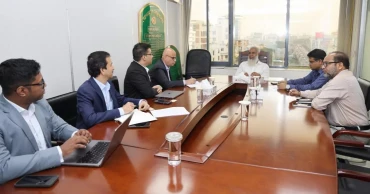
A four-member high-level delegation from the Asian Infrastructure Investment Bank (AIIB) held a courtesy meeting with Secretary of the Bridges Division and Executive Director of the Bangladesh Bridge Authority Mohammad Abdur Rouf on Sunday, aimed at boosting sustainable investment and technical cooperation in the country's transport and communication infrastructure sector.
The AIIB delegation was led by Rajat Misra, Director General of the bank's Public Sector Clients Department (Region 1).
Opening the meeting, the Bridges Division secretary welcomed the delegation and highlighted the success and socio-economic impact of Bangladesh's mega projects, particularly the Padma Bridge, Jamuna Bridge and Dhaka Elevated Expressway.
He noted that under the visionary leadership of Prime Minister Tarique Rahman, Bangladesh is moving toward building world-class infrastructure.
Both sides held detailed discussions on the potential for AIIB-financed, environment-friendly and technology-driven communication infrastructure in line with Bangladesh's development goals.
They expressed positive interest in investment opportunities in several key projects, including measures to ease traffic congestion, modern toll management systems, the Dhaka-Chattogram Elevated Expressway, the Dhaka East-West Elevated Expressway, a subway system, and a second Jamuna Bridge.
The Bridges secretary emphasised that loan terms and conditions must be affordable and sustainable in keeping with Bangladesh's socio-economic context.
He said regular technical-level communication between the two institutions would continue to expedite the investment process.
Rouf requested AIIB to submit a formal written proposal outlining the terms and areas of investment, which would be reviewed before further steps are taken subject to government approval.
He also reaffirmed the Bridge Authority's commitment to implementing projects with transparency and accountability, in line with the head of government's declaration.
Delegation leader Rajat Misra praised Bangladesh for breaking away from conventional patterns of infrastructure development through the successful application of modern technology.
Citing Bangladesh's emerging economic strength in South Asia, he said AIIB is keen to establish a long-term partnership with the country.
15 days ago