World

Saudi crown prince urges Trump to avoid escalating Iran conflict
Saudi Crown Prince Mohammed bin Salman urged US President Donald Trump not to escalate the conflict with Iran during a phone conversation on Saturday, as Trump considers launching new military strikes against Tehran, according to a person familiar with the discussion.
The call, first reported by media, came amid growing concerns in Riyadh that US attacks on Iran’s energy facilities or other critical infrastructure could trigger retaliatory strikes against Saudi Arabia and other Gulf states’ energy assets. The source, who was not authorized to speak publicly, said the crown prince sought clarification from Trump about the military options under consideration.
Trump warns of continued military action against Iran
A White House official confirmed the leaders spoke but declined to disclose details of the conversation.
Earlier this week, Saudi Arabia joined the United States in strikes targeting logistics and weapons facilities used by Iranian-backed militias in Iraq, while continuing to advocate renewed US-Iran negotiations to end the five-month conflict. The crown prince also sent Saudi Defense Minister Khalid bin Salman to Washington for separate meetings with Trump and Vice President JD Vance on Iran strategy.
Trump has vowed retaliation after Iran’s failed attack on a US base in Jordan. The State Department on Saturday issued security alerts for Americans in 10 Middle Eastern countries, warning of possible flight disruptions and heightened regional risks as tensions continue to rise.
2 days ago

India's Assam flood death toll rises to 82
The death toll in ongoing floods in India's northeastern state of Assam has risen to 82, with two people still missing, officials said Saturday.
According to Assam Chief Minister Himanta Biswa Sarma, Sivasagar district reported the highest 42 deaths, followed by Charaideo and Jorhat districts with 21 and nine deaths respectively.
According to Sarma, the floods hit 2,251 villages, affecting over 1.1 million people in the state. Floods have fully damaged 2,530 residential houses and another 9,668 houses have suffered partial damage.
The authorities have set up 218 relief camps where 71,889 people have taken shelter. Besides, 1,811 relief distribution centers have been opened in the affected districts.
"Relief operations continue to expand across the state, with the number of relief distribution centers increasing to 1,811 now," Sarma said. "Every effort remains focused on relief, rehabilitation and restoring normalcy."
2 days ago
Israel says five Hamas weapons depots destroyed in Gaza
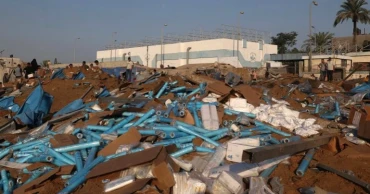
The Israeli military and the Shin Bet security agency said they destroyed five Hamas weapons depots across the Gaza Strip during overnight operations.
According to the Israeli army, one of the targeted depots was located adjacent to Al-Aqsa Martyrs Hospital in Deir el-Balah. It alleged that the sites were being used by Hamas to store assault rifles, explosive devices, anti-tank launchers and other military equipment.
The hospital administration and Gaza authorities, however, disputed the claim, saying the targeted facilities were being used to store the hospital's medical supplies.
With inputs from Al Jazeera
2 days ago

12 killed in road accidents ahead of Senegal's Grand Magal pilgrimage
At least 12 people have been killed in road accidents ahead of Senegal's annual Grand Magal pilgrimage in the central city of Touba, the National Fire Brigade said on Saturday.
The fatalities have been recorded since the brigade launched its emergency operation on July 28, Lieutenant Djily Diouf, communications officer for the contingent deployed for the pilgrimage, was quoted as saying by the Senegalese Press Agency.
As of 8:00 am local time on Saturday, firefighters had responded to 182 emergency incidents involving 304 people, Diouf said.
Among those operations, 133 were road accidents involving 286 people. Firefighters provided assistance to 274 victims, while 12 people were confirmed dead.
To support the large influx of pilgrims, the brigade has also supplied 281 cubic metres of water in Touba to help meet increased demand and avert potential shortages.
For this year's pilgrimage, the National Fire Brigade has deployed 563 personnel along with 91 emergency and support vehicles to provide rescue, firefighting and medical services.
The Grand Magal, scheduled to take place on Sunday, is one of Senegal's largest annual religious gatherings. Organised by the Mouride Muslim brotherhood, the event commemorates the 1895 exile of its founder, Cheikh Ahmadou Bamba, by the French colonial authorities.
2 days ago

Trump warns of continued military action against Iran
US President Donald Trump has threatened further military strikes against Iran as Washington presses for the reopening of the Strait of Hormuz, amid escalating tensions across the Middle East.
Speaking at Camp David on Friday, Trump said the US would continue striking Iran "very hard" until it could no longer sustain the conflict. White House Press Secretary Karoline Leavitt accused Tehran of violating a truce memorandum, attacking commercial ships and killing US troops, warning that Iran would continue to face consequences.
Trump announces Hamas disarmament agreement, but challenges remain
The US State Department also issued heightened security alerts for Americans in 10 regional countries, citing risks of flight disruptions and airspace closures.
On Saturday, Kuwait said its forces responded to fresh Iranian drone attacks targeting key facilities, though no casualties were reported. Separately, two tanker-related incidents occurred in the Strait of Hormuz off Oman, with one vessel sustaining engine room damage after being hit by a projectile.
In Gaza, Israeli strikes killed at least four people after Hamas announced it was willing to disarm under a US-brokered ceasefire framework. Israel said it targeted Hamas positions and weapons storage sites. Egypt welcomed Hamas's response, while Israeli far-right minister Itamar Ben-Gvir rejected the proposal.
Elsewhere, Yemen's Houthi rebels diverted Saudi shipping, Israel destroyed an alleged Hezbollah tunnel network in southern Lebanon, and Lebanese President Joseph Aoun criticised the operation ahead of planned talks in Rome. An Israeli army officer was also wounded during operations in southern Lebanon.
2 days ago

UK PM Burnham opens ‘No. 10 North’ in Manchester to shift power beyond London
British Prime Minister Andy Burnham has opened a new government office in Manchester, saying the move marks the beginning of a major shift in political power and investment away from London.
The new office, known as "No. 10 North," is about 260 kilometres from the prime minister's official residence at 10 Downing Street and is central to Burnham's plan to give more powers and funding to regional leaders across the UK.
Burnham, who previously served as Mayor of Greater Manchester before becoming prime minister, said the office represents "a North Pole that balances the South Pole" of Westminster politics.
"This is not just another office. It represents a fundamental change in how the country approaches growth and investment," he said on Friday.
Burnham plans to work from the Manchester office at least one day each week alongside a permanent team of advisers, civil servants and policy experts.
More powers for local leadersAs part of the new approach, Burnham announced that regional mayors will be allowed to keep a larger share of income and business tax revenue collected in their areas.
He described the move as the biggest transfer of power, funding and responsibility from the central government in a generation, although details of the funding arrangements have yet to be released.
Burnham hopes the policy will help create jobs and boost economic growth in areas that have struggled with industrial decline, unemployment and population loss.
Building on Manchester's successDuring his nine years as Greater Manchester mayor, Burnham oversaw major investment in the city, including new housing, public transport and business development.
Supporters say his approach combined public investment with private sector partnerships while giving local communities greater control over housing, transport and public services.
Burnham now wants to apply the same model across the country.
Mixed reactionsPolitical analyst Rob Ford of the University of Manchester said the move shows Burnham is serious about reducing the UK's traditionally centralised system of government.
"The UK is one of the most centralised democracies in the developed world. Changing that will be a major challenge," Ford said.
Critics, however, argue that Manchester's economic success has not benefited all surrounding communities and say Burnham must ensure other regions also receive greater powers and investment.
Support from regional leadersSupporters welcomed the decision to establish a government office outside London.
Rose Marley, chief executive of Cooperatives UK, said holding government meetings in Manchester would make it easier for organisations outside the capital to engage with ministers.
She also said the move could help ensure a wider range of regional voices is heard in national decision-making.
Some residents also supported the initiative but said similar offices should eventually be created in other parts of England to ensure balanced regional development.
Burnham said No. 10 North is intended to become a permanent centre for regional decision-making as part of his government's broader plan to reduce the UK's long-standing economic divide between London and the rest of the country.
2 days ago

US to make visa bond programme permanent, raises maximum fee to $20,000
The United States will make permanent a visa bond programme requiring applicants from 50 countries, most of them in Africa, to pay a refundable bond before applying for certain US visas.
According to a draft notice published Friday in the Federal Register, the US State Department said a year-long review found the programme helped reduce visa overstays, prompting the decision to make it permanent from Monday.
The revised rules also raise the maximum bond amount from $15,000 to $20,000. The previous minimum bond of $5,000 has been removed, leaving bond amounts of $10,000 or $20,000, depending on the decision of a consular officer.
The programme applies to applicants seeking B1 business visas and B2 tourist visas.
The bond is refunded if the visa application is rejected or, if approved, once the traveller complies with all visa conditions and leaves the United States as required.
The Trump administration introduced the programme in August last year as part of broader efforts to reduce illegal immigration and prevent visitors from overstaying their visas.
The State Department said it costs the US government about $18,000 to locate, arrest and deport each person who remains in the country after their visa expires.
According to the department, nearly 45,500 visitors from the 50 affected countries overstayed their visas in 2024. During the first 10 months of the bond programme, fewer than 50 overstays were recorded from those countries.
US officials described the programme as successful in reducing visa violations.
However, critics argue that the policy places a heavy financial burden on people from low-income countries who want to travel to the United States for tourism, business, education or to visit family members.
The State Department had originally expected around 2,000 applicants to be affected by the programme. Instead, about 20,000 applicants were required to pay the bond.
Nearly half of those applicants decided not to proceed with their visa applications, contributing to an 83 percent drop in business and tourist visas issued to citizens of the affected countries.
The department said it expects the permanent programme to further reduce demand for B1 and B2 visas from countries covered by the policy.
2 days ago

Strong El Niño threatens more heatwaves, floods, and drought: UN
The United Nations' World Meteorological Organization (WMO) has warned that a strong El Niño event is expected to intensify between August and October, increasing the likelihood of extreme weather across many parts of the world.
The climate pattern is forecast to contribute to above-average global temperatures, significant shifts in rainfall, and continued unusually warm sea surface temperatures in the tropical Atlantic.
According to the WMO, sea surface temperature anomalies in key monitoring areas are expected to exceed 2.9°C, signaling a powerful El Niño.
The agency says these forecasts provide governments and communities with valuable time to prepare for potential impacts through early planning and risk reduction measures.
UN Secretary-General António Guterres said El Niño is worsening the effects of an already overheating planet, pointing to intense heatwaves, devastating wildfires, and record-breaking ocean temperatures.
He argued that continued reliance on fossil fuels is driving the climate crisis and warned that expanding coal, oil, and gas production will increase future risks. He urged immediate action to protect vulnerable populations and address the underlying causes of climate change.
WMO Secretary-General Celeste Saulo emphasized that although El Niño is one of the world's most closely monitored climate phenomena, forecasts alone cannot prevent disasters.
She noted that the current event is unfolding alongside unprecedented ocean warming and rising global temperatures, making early preparedness more important than ever. She added that timely, reliable climate information can help governments, humanitarian organizations, and sectors such as agriculture and health reduce the impacts of extreme weather and protect at-risk communities.
2 days ago
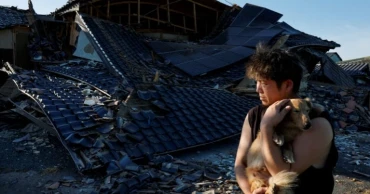
Death toll from Japan earthquake rises to 34 as survivors struggle with heat, water shortages
The death toll from the powerful earthquake that struck southwestern Japan has risen to 34, as thousands of survivors continue to endure extreme heat, water shortages and fuel scarcity while staying in emergency shelters or sleeping in their vehicles.
Rescue teams remained engaged in search operations on Friday, the fourth day after the magnitude 7.1 earthquake hit Kyushu, Japan's southern main island, on Tuesday. Authorities have not yet confirmed how many people remain missing.
The Kumamoto prefectural government said at least 96 people were injured, including six seriously. Officials are also investigating another death that may be linked to the earthquake.
Japanese Prime Minister Sanae Takaichi instructed authorities to do "whatever it takes" to restore water supplies and called for close coordination with the military and other agencies.
Although thousands of homes lost electricity after the quake, power was fully restored by Friday evening, according to the local utility company.
Historic inn badly damagedThe earthquake damaged more than 1,500 buildings, including 179 that were completely destroyed, according to preliminary government estimates.
Among the damaged buildings is Kinparo, a 116-year-old traditional Japanese inn in Yatsushiro City. Its entrance collapsed, walls cracked and roof tiles fell during the quake.
Workers began clearing debris on Friday as experts prepared to assess the damage to the registered historic property.
Owner Keisuke Matsumoto said the repairs would be costly but expressed hope that the family-run inn, built by his great-great-grandfather, could be preserved.
His mother, Misao Matsumoto, said she escaped without injury but was deeply saddened to see the historic building badly damaged.
Water and fuel shortages continueNearly 80,000 households remained without running water on Friday, while more than 9,000 people were staying in evacuation centres.
Authorities were adding power supplies to shelters to improve access to air conditioning as temperatures reached 36 degrees Celsius.
Fuel shortages have also become a growing problem after damaged roads and power outages disrupted fuel deliveries and forced many petrol stations to close.
Many displaced residents have been sleeping in their cars for privacy, but limited fuel supplies have made it difficult to keep air conditioners running during the intense heat.
Hirokazu Sato, whose home was destroyed, said he, his wife and their three children were living in their car until temporary housing became available.
"We have to keep the air conditioner running day and night, but that uses a lot of fuel," he said.
Businesses affectedThe earthquake has also disrupted businesses across Kumamoto, an important manufacturing hub for Japan's semiconductor and automotive industries.
Taiwan Semiconductor Manufacturing Company (TSMC), which operates a facility in Kumamoto, said all employees were safe and operations were gradually resuming after inspections confirmed the buildings were structurally sound.
Rescue efforts continueSearch teams, assisted by rescue dogs, continued looking for survivors at damaged buildings, including the collapsed Aeon Mall in Kashima town.
The shopping centre was crowded when the earthquake struck. Company officials said about 3,000 shoppers were safely evacuated before an explosion occurred in another section of the building.
The mall's second floor later collapsed, trapping several people. Eleven people were rescued, but seven of them were confirmed dead.
Rescue operations have ended at a Nippon Paper Industries factory in Yatsushiro, where a chimney collapsed during the quake. Eleven workers were pulled from the site, but nine died.
Searches are continuing at collapsed homes across southern Kumamoto, although authorities have not released an official figure for the number of people still missing.
2 days ago
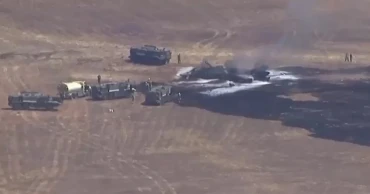
Marine Corps says F-35B stealth fighter crashed in California, pilot ejected safely
The U.S. Marine Corps says the pilot of an F-35B stealth fighter is expected to live after ejecting from the jet before it crashed in California.
The jet went down Friday near the Miramar air base in San Diego. "The pilot ejected, was transported to a local medical facility in stable condition for evaluation and treatment of non-life-threatening injuries," the Marine Corps said in an updated statement.
Aerial video from a news helicopter showed a plume of black smoke rising from the wreckage in a dirt field, with multiple military and firefighting vehicles and people standing nearby. What appeared to be white flame retardant covered the ground, and at least one person was spraying the wreckage with a fire hose.
Wade Lott saw the crash as he drove to work at a concrete company just south of the flight line.
"It just blew up, it was crazy," said Lott, 36, who watched from his truck as two jets descended toward the runway together. The first landed without incident, but the second suddenly began slowing down, almost as if it were trying to hover, Lott said. When the jet was about 100 feet (30 m) above the ground, the pilot ejected and their parachute deployed as they rose about 200 feet (61 m) into the air just in time.
"The jet hit the ground right next to another plane," said Lott. "It plowed into the runway and just blew up."
Candace Hadley, a spokesperson for San Diego Fire, said firefighters were on scene to respond to a vegetation fire that sparked near the crash site. She referred additional questions to Marine Corps Air Station Miramar.
The base used to host the Navy fighter pilot training school depicted in the original "Top Gun" movie, and was known as "Fightertown USA" in its heyday. The school was relocated to Naval Air Station Fallon in Nevada in 1996 after the base was transferred to the Marine Corps.
The U.S. Marine Corps, Navy and Air Force together have more than 630 F-35s, according to a 2024 analysis by the Government Accounting Office. The F-35B is one of several versions, and has an engine designed for short takeoffs and vertical landings. A single F-35B costs about $109 million. The report estimated that the overall F-35 program will cost roughly $2 trillion after the military buys more than 1,800 more jets and operates them for decades to come.
A Marines statement called Friday's crash a "Class A mishap." That's the most severe mishap category, used when the damage totals more than $2 million, an aircraft is destroyed or a service member killed. In the Air Force alone, there have been at least 17 other "Class A mishaps" involving F-35 aircraft since 2000, according to Air Force Safety Center statistics.
At least seven other military aircraft mishaps have happened in the U.S. this year, according to the Flight Safety Foundation's Aviation Safety Network database.
The F-35s are considered the safest and most capable fighter jets the military has in its fleet, according to the Lexington Institute think tank that focuses on defense technology and national security.
There have been fewer crashes involving any of the F-35 models since the jet was adopted in 2015 compared to other fighters when those planes were new, and fatal crashes are rare in F-35s.
In five F-35 crashes, the pilots were able to eject, though at least one sustained injuries. That pilot was injured when an F-35 crashed near the international airport in Albuquerque, New Mexico, in May 2024. The jet was heading an Air Force base in California from Texas.
2 days ago