World

Last 12 months on Earth were the hottest ever recorded, analysis finds
The last 12 months were the hottest Earth has ever recorded, according to a new report by Climate Central, a nonprofit science research group.
The peer-reviewed report says burning gasoline, coal, natural gas and other fossil fuels that release planet-warming gases like carbon dioxide, and other human activities, caused the unnatural warming from November 2022 to October 2023.
Over the course of the year, 7.3 billion people, or 90% of humanity, endured at least 10 days of high temperatures that were made at least three times more likely because of climate change.
Western and Arab officials are gathering in Paris to find ways to provide aid to civilians in Gaza
"People know that things are weird, but they don't they don't necessarily know why it's weird. They don't connect back to the fact that we're still burning coal, oil and natural gas," said Andrew Pershing, a climate scientist at Climate Central.
"I think the thing that really came screaming out of the data this year was nobody is safe. Everybody was experiencing unusual climate-driven heat at some point during the year," said Pershing.
The average global temperature was 1.3 degrees Celsius (2.3 degrees Fahrenheit) higher than the pre-industrial climate, which scientists say is close to the limit countries agreed not to go over in the Paris Agreement — a 1.5 C (2.7 F) rise. The impacts were apparent as one in four humans, or 1.9 billion people, suffered from dangerous heat waves.
At this point, said Jason Smerdon, a climate scientist at Columbia University, no one should be caught off guard. "It's like being on an escalator and being surprised that you're going up," he said. "We know that things are getting warmer, this has been predicted for decades."
Israeli military tour of northern Gaza reveals ravaged buildings, toppled trees, former weapons lab
Here's how a few regions were affected by the extreme heat:
1. Extreme heat fueled destructive rainfall because a warmer atmosphere holds more water vapor, which lets storms release more precipitation. Storm Daniel became Africa's deadliest storm with an estimated death toll that ranges between 4,000 and 11,000, according to officials and aid agencies. Greece, Bulgaria, and Turkey also saw damages and fatalities from Storm Daniel.
2. In India, 1.2 billion people, or 86% of the population, experienced at least 30 days of elevated temperatures, made at least three times more likely by climate change.
3. Drought in Brazil's Amazon region caused rivers to dry to historic lows, cutting people off from food and fresh water.
4. At least 383 people died in U.S. extreme weather events, with 93 deaths related to the Maui wildfire event, the deadliest U.S. fire of the century.
5. One of every 200 people in Canada evacuated their home due to wildfires, which burn longer and more intensely after long periods of heat dry out the land. Canadian fires sent smoke billowing across much of North America.
6. On average, Jamaica experienced high temperatures made four times more likely by climate change during the last 12 months, making it the country where climate change was most powerfully at work.
India bars protests that support Palestinians
"We need to adapt, mitigate and be better prepared for the residual damages because impacts are highly uneven from place to place," said Kristie Ebi, a professor at the Center for Health and the Global Environment at the University of Washington, citing changes in precipitation, sea level rise, droughts, and wildfires.
The heat of the last year, intense as it was, is tempered because the oceans have been absorbing the majority of the excess heat related to climate change, but they are reaching their limit, said Kim Cobb, a climate scientist at Brown University. "Oceans are really the thermostat of our planet ... they are tied to our economy, food sources, and coastal infrastructure."
2 years ago
Thousands fall ill in eastern Pakistan due to heavy smog, forcing closure of schools, markets, parks
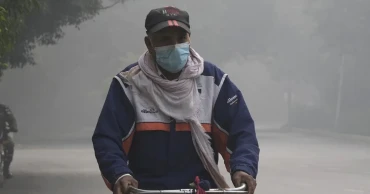
Toxic gray smog has sickened tens of thousands of people in Pakistan’s cultural capital of Lahore, forcing authorities to shut schools, markets and parks for four days, officials said Thursday.
The decision came after the country’s second-largest city was repeatedly ranked the world’s most polluted city. Doctors advised people to wear face masks and stay at home. Residents said many people were coughing and having breathing problems.
“Wearing of marks and staying at home are the two easiest solutions to avoid getting rushed to hospitals with respiratory-related diseases, infections in eyes and skin diseases,” said Salman Kazmi, a doctor at Lahore’s main Mayo Hospital, where thousands of people were treated for such ailments this week.
On Thursday, the concentration of PM 2.5, or tiny particulate matter, in the air approached 450, considered hazardous.
Experts say the burning of crop residue at the start of the winter wheat-planting season is a key cause of the pollution.
Lahore was once known as the city of gardens, which were ubiquitous during the Mughal era of the 16th to 19th centuries. But rapid urbanization and surging population growth have left little room for greenery in the city.
2 years ago

India, Pakistan border guards trade fire along their frontier in Kashmir; one Indian soldier killed
Indian and Pakistani soldiers exchanged gunfire and shelling along their highly militarized frontier in disputed Kashmir, killing an Indian border guard, officials said Thursday.
Authorities in the Indian-controlled portion of Kashmir said Pakistani soldiers fired mortars and machine guns at border posts in the southern Jammu area on Wednesday night, calling it “unprovoked.”
Read: Indian states vote in key test for opposition and PM Modi ahead of 2024 national election
India’s Border Security Force said in a statement that its soldiers “befittingly responded” and that one of its border guards was killed.
The fighting ended early Thursday.
There was no immediate comment from Pakistan. Each side often accuses the other of starting border skirmishes in the Himalayan region, which both claim in its entirety.
Last month, two Indian border guards and three civilians were injured in fighting along the fronter with Pakistan.
India and Pakistan have a long history of bitter relations over Kashmir. They have fought two of their three wars since 1947 over their competing claims to the region. In the Indian-controlled portion of Kashmir, militants have fought against Indian rule since 1989. In 2003, the two nations agreed on a cease-fire that has largely held despite regular skirmishes.
Read: Afghans in droves head to border to leave Pakistan ahead of a deadline in anti-migrant crackdown
The nuclear-armed countries’ contended frontier includes a 740-kilometer (460-mile) rugged and mountainous stretch called the Line of Control that is guarded by their armies.
Both countries also have separate paramilitary border forces guarding their somewhat defined, lower-altitude 200-kilometer (125-mile) boundary separating Indian-controlled Kashmir and the Pakistani province of Punjab.
In 2021, the two nations reaffirmed their 2003 cease-fire accord after months of near-daily fighting that killed scores on both sides in Kashmir.
2 years ago

5.2-magnitude quake hits Jordan-Syria region
A 5.2-magnitude earthquake jolted Jordan-Syria region at 0232 GMT on Thursday, the GFZ German Research Centre for Geosciences said.
Read: 3 earthquakes jolt district close to Nepal capital
The epicenter, with a depth of 10.0 km, was initially determined to be at 36.53 degrees north latitude and 36.30 degrees east longitude.
Read: Two earthquakes strike Nepal, sending tremors through the region
2 years ago

Western and Arab officials are gathering in Paris to find ways to provide aid to civilians in Gaza
Officials from Western and Arab nations, the United Nations and nongovernmental organizations are gathering Thursday in Paris for a conference on how to provide aid to civilians in the Gaza Strip during Israel's war with Hamas, including proposals for a humanitarian maritime corridor and floating field hospitals.
French President Emmanuel Macron, who has called for a “humanitarian pause” in the war, wants the conference to address the besieged Palestinian enclave's growing needs including food, water, health supplies, electricity and fuel.
Read: Israeli military tour of northern Gaza reveals ravaged buildings, toppled trees, former weapons lab
Over 50 nations are expected to attend including several European countries, the United States and regional powers like Jordan, Egypt and the Gulf countries, the French presidency said. Also attending is Palestinian Prime Minister Mohammad Shtayyeh.
Israeli authorities won't participate in Thursday’s conference, the Elysee said.
The head of the U.N. agency for Palestinian refugees, the U.N.'s top aid official and the president of the International Committee of the Red Cross are expected to provide details about urgent needs in the Gaza Strip.
More than 1.5 million people — or about 70% of Gaza's population — have fled their homes, and an estimated $1.2 billion is needed to respond to the crisis in Palestinian areas.
Cyprus President Nikos Christodoulides will present his plan for a humanitarian sea corridor to Gaza which he has said aims for a “sustained, secure high-volume flow of humanitarian assistance to Gaza in the immediate, medium and long term.” Ships would deliver the aid from Cyprus’ main port of Limassol, some 255 miles away (410 kilometers.)
Read: Israel fights Hamas deep in Gaza City and foresees control of enclave’s security after war
French officials said they are also considering evacuating injured people onto hospital ships in the Mediterranean off the Gaza coast. Paris sent a helicopter carrier off the Cyprus coast and is preparing another with medical capacities on board for that purpose.
Thursday's discussions will also include financial support and other ways to help Gaza's civilians.
France is expected to announce some additional funding. Since the Hamas attack on Oct. 7, Paris has provided an additional 20 million euros ($21.4 million) in humanitarian aid for Gaza, through the U.N. and other partners and sent 54 tons of aid via three flights to Egypt.
On Tuesday, the German government said it will provide 20 million euros in new funding, in addition to releasing 71 million euros already earmarked for the U.N. agency for Palestinian refugees following a review it launched after the Hamas attack.
Read: Israel-Hamas war crowds crisis-heavy global agenda as Blinken, G7 foreign ministers meet in Japan
European Council President Charles Michel and European Commission President Ursula von der Leyen are also attending the conference. The 27-nation bloc is the world’s top aid supplier to the Palestinians. It has sent almost 78 million euros this year.
2 years ago

Israeli military tour of northern Gaza reveals ravaged buildings, toppled trees, former weapons lab
An Israeli tank rolls across a sandy moonscape, surrounded by rubble. Damaged buildings are visible in every direction. Toppled trees lie along the Mediterranean shoreline.
The Israeli military escorted international journalists into the northern Gaza Strip on Wednesday, giving them a glimpse of the aftermath of 12 days of heavy fighting in the area.
Israel has been at war against Gaza’s Hamas rulers since the Islamic militant group carried out a bloody cross-border attack on Oct. 7, killing over 1,400 people, mostly civilians, and kidnapping more than 240 others. Israel responded with weeks of intense airstrikes before launching a ground operation on Oct. 27.
Growing numbers of Palestinians flee on foot as Israel says its troops are battling inside Gaza City
“It’s been a long two weeks of fighting,” said Lt. Col. Ido, whose last name was withheld under military guidelines. “We've lost some soldiers.”
The initial focus of the operation was northern Gaza, near the Israeli border, before troops moved in on Gaza City, which Israel says is the center of Hamas’ military operations.
The Palestinian Health Ministry says 10,500 people have been killed in the Hamas-run territory. Israel says several thousand Hamas militants are among the dead. It also says Hamas uses civilians in residential areas as human shields, and so is responsible for the high death toll. Hamas has denied this.
The drive into Gaza on Wednesday was in a windowless armored vehicle. A screen inside showed images of the shoreline, damaged buildings and downed trees. Israeli tanks and armored vehicles sat motionless as soldiers patrolled the area.
Israel fights Hamas deep in Gaza City and foresees control of enclave’s security after war
During the tour, the army said it had found ammunition and a weapons-making facility inside one building. Much of the lab had been removed, but the remnants of rockets, thousands of which have been launched at Israel during the fighting, could be seen.
One floor above the lab was what appeared to be a children’s bedroom. The bright pink room had multiple beds, a doll and a Palestinian flag.
A month into war, Netanyahu says Israel will have an 'overall security' role in Gaza indefinitely
During the less than two hours they spent inside Gaza on Wednesday, journalists could hear gunfire but did not witness any live fire. Israeli troops instructed the journalists not to move around too much.
The army ordered civilians to evacuate to the southern Gaza Strip ahead of the ground offensive. While about 70% of Gaza's population is believed to have fled their homes, U.N. officials estimate that roughly 300,000 people have remained behind.
But in this corner of northern Gaza, Ido said the order appears to have worked.
“We have not seen any civilians here – only Hamas,” he said, adding that militants had been spotted operating aboveground and emerging from their underground tunnel system.
“We gave all the people that live here a good heads-up that we’re coming,” he added.
2 years ago

Destroying civilian housing and infrastructure is an international crime, warns UN expert
The world must act now to end the horrifying and massive attacks against civilian housing and infrastructure in Gaza, which comes at a tremendous cost to human life, a UN expert said on Wednesday.
“Carrying out hostilities with the knowledge that they will systematically destroy and damage civilian housing and infrastructure, rendering an entire city – such as Gaza city - uninhabitable for civilians is a war crime,” said Balakrishnan Rajagopal, the UN Special Rapporteur on the right to adequate housing.
Israel-Hamas war: Why India’s Congress is facing backlash over ‘support for Palestine’
The expert said systematic or widespread bombardment of housing, civilian objects and infrastructure are strictly prohibited by international humanitarian law, criminal law and human rights law.
“Such acts amount to war crimes and when directed against a civilian population, they also amount to crimes against humanity,” Rajagopal said.
In a recent report to the UN General Assembly, Rajagopal used the term “domicide” to refer to such systematic or widespread attacks on housing and civilian infrastructure that causes death and suffering.
In that report, the expert pointed out that domicide had been committed in a number of conflict affected countries in various regions of the world. “It is now being committed in Gaza, and the world continues to watch helplessly while core international human and humanitarian law norms are brazenly breached,” he said.
Attacks by Israel on targets within Gaza have destroyed or damaged 45 percent of all housing units in the Gaza strip, internally displaced about 1.5 million people and killed over 10,000 people, including over 80 UN staff.
Over 25,000 people have been wounded in the airstrikes. Sixty-seven percent of all fatalities are reportedly children or women. More than 2,300 people – among them 1300 children are reported missing, most of them likely trapped under the rubble.
International humanitarian law is based on the distinction between civilian and military objects, the expert said.
“Apartment buildings are not military objects. Hospitals and ambulances are not military objects. Refugee camps are not military objects. Schools are not military objects. Churches or mosques are not military objects. Water and electricity infrastructure for civilians are not military objects,” Rajagopal said.
“Civilian housing in Israel is also not a military object - launching indiscriminate rocket attacks on them from Gaza or elsewhere is a war crime,” he warned.
Islamic parties stage protest condemning Israeli attacks on Palestine
Even when civilian housing may be used by combatants to take shelter, as alleged in the attacks on the Jabalia refugee camp, launching attacks on entire apartment blocks is prohibited if they will lead to disproportionate damage, death and displacement of a large number of civilians, the UN expert warned.
“No asserted right of self-defence under international law can cover such attacks,” he said. “This is particularly the case when the right of self-defence is asserted in the context of an occupation.”
Ordering the evacuation of more than 1 million people from northern Gaza into southern Gaza, knowing that it will be impossible to provide adequate housing and humanitarian aid, while maintaining a blockade, cutting off water, food, fuel and medicine and repeatedly attacking evacuation routes and “safe zones” were a cruel and blatant violation of international humanitarian law, Rajagopal said. “These actions by Israel constitute international crimes.”
The call for a ceasefire in the recent UN General Assembly resolution must be followed by concrete measures to leverage parties to the conflict to abide by it, the Special Rapporteur said.
“The international community must consider the precedent set in the 1970s when measures to end apartheid in South Africa were taken by the General Assembly by unseating the South African delegation owing to widespread and systematic violations of human rights, which are inconsistent with the purposes and principles of the UN Charter,” he said.
Bangladesh demands immediate end of Israeli brutalities in Palestine
“There can be no peace without justice,” Rajagopal said, urging the International Criminal Court to investigate alleged international crimes in Israel and the occupied Palestinian Territory without delay or bias, and hold those responsible for war crimes, crimes against humanity and apartheid, accountable. “All State parties to the Rome Statute must support efforts by the Court,” he said.
2 years ago

India bars protests that support Palestinians
From Western capitals to Muslim states, protest rallies over the Israel-Hamas war have made headlines. But one place known for its vocal pro-Palestinian stance has been conspicuously quiet: Indian-controlled Kashmir.
Indian authorities have barred any solidarity protest in Muslim-majority Kashmir and asked Muslim preachers not to mention the conflict in their sermons, residents and religious leaders told The Associated Press.
The restrictions are part of India's efforts to curb any form of protest that could turn into demands for ending New Delhi's rule in the disputed region. They also reflect a shift in India's foreign policy under populist Prime Minister Narendra Modi away from its long-held support for the Palestinians, analysts say.
India has long walked a tightrope between the warring sides, with historically close ties to both. While India strongly condemned the Oct. 7 attack by the militant group Hamas and expressed solidarity with Israel, it urged that international humanitarian law be upheld in Gaza amid rising civilian deaths.
But in Kashmir, being quiet is painful for many.
“From the Muslim perspective, Palestine is very dear to us, and we essentially have to raise our voice against the oppression there. But we are forced to be silent,” said Mirwaiz Umar Farooq, a key resistance leader and a Muslim cleric. He said he has been put under house arrest each Friday since the start of the war and that Friday prayers have been disallowed at the region’s biggest mosque in Srinagar, the main city in Kashmir.
Read: Israel-Hamas war crowds crisis-heavy global agenda as Blinken, G7 foreign ministers meet in Japan
Anti-India sentiment runs deep in the Himalayan region which is divided between India and Pakistan and claimed by both in its entirety. In 2019, New Delhi removed the region’s semiautonomy, drastically curbing any form of dissent, civil liberties and media freedoms.
Kashmiris have long shown strong solidarity with the Palestinians and often staged large anti-Israel protests during previous fighting in Gaza. Those protests often turned into street clashes, with demands for an end of India’s rule and dozens of casualties.
Modi, a staunch Hindu nationalist, was one of the first global leaders to swiftly express solidarity with Israel and call the Hamas attack “terrorism.” However, on Oct. 12, India’s foreign ministry issued a statement reiterating New Delhi’s position in support of establishing a “sovereign, independent and viable state of Palestine, living within secure and recognized borders, side by side at peace with Israel.”
Two weeks later, India abstained during the United Nations General Assembly vote that called for a humanitarian cease-fire in Gaza, a departure from its usual voting record. New Delhi said the vote did not condemn the Oct. 7 assault by Hamas.
“This is unusual,” said Michael Kugelman, director of the Wilson Center’s South Asia Institute.
India “views Israel’s assault on Gaza as a counterterrorism operation meant to eliminate Hamas and not directly target Palestinian civilians, exactly the way Israel views the conflict,” Kugelman said. He added that from New Delhi's perspective, “such operations don’t pause for humanitarian truces.”
India’s foreign minister, Subrahmanyam Jaishankar, sought to justify India’s abstention.
“It is not just a government view. If you ask any average Indian, terrorism is an issue which is very close to people’s heart, because very few countries and societies have suffered terrorism as much as we have,” he told a media event in New Delhi on Saturday.
Even though Modi’s government has sent humanitarian assistance for Gaza's besieged residents, many observers viewed its ideological alignment with Israel as potentially rewarding at a time when the ruling party in New Delhi is preparing for multiple state elections this month and crucial national polls next year.
Read: UN Security Council fails to agree on Israel-Hamas war as Gaza death toll passes 10,000
The government's shift aligns with widespread support for Israel among India’s Hindu nationalists who form a core vote bank for Modi and his Bharatiya Janata Party. It also resonates with the coverage by Indian TV channels of the war from Israel. The reportage has been seen as largely in line with commentary used by Hindu nationalists on social media to stoke anti-Muslim sentiment that in the past helped the ascendance of Modi's party.
Praveen Donthi, senior analyst with the International Crisis Group, said the war could have a domestic impact in India, unlike other global conflicts, due to its large Muslim population. India is home to some 200 million Muslims who make up the predominantly Hindu country’s largest minority group.
“India's foreign policy and domestic politics come together in this issue," Donthi said. “New Delhi's pro-Israel shift gives a new reason to the country’s right-wing ecosystem that routinely targets Muslims.”
India’s foreign policy has historically supported the Palestinian cause.
In 1947, India voted against the United Nations resolution to create the state of Israel. It was the first non-Arab country to recognize the Palestinian Liberation Organization as the representative of the Palestinians in the 1970s, and it gave the group full diplomatic status in the 1980s.
After the PLO began a dialogue with Israel, India finally established full diplomatic ties with Israel in 1992.
Those ties widened into a security relationship after 1999, when India fought a limited war with Pakistan over Kashmir and Israel helped New Delhi with arms and ammunition. The relationship has grown steadily over the years, with Israel becoming India’s second largest arms supplier after Russia.
After Modi won his first term in 2014, he became the first Indian prime minister to visit Israel in 2017. Israel’s prime minister, Benjamin Netanyahu, travelled to New Delhi the following year and called the relationship between New Delhi and Tel Aviv a “marriage made in heaven.”
Weeks after Netanyahu’s visit, Modi visited the occupied West Bank city of Ramallah, a first by an Indian prime minister, and held talks with Palestinian President Mahmoud Abbas. “India hopes that Palestine soon becomes a sovereign and independent country in a peaceful atmosphere,” Modi said.
Modi’s critics, however, now draw comparisons between his government and Israel’s, saying it has adopted certain measures, like demolishing homes and properties, as a form of “collective punishment” against minority Muslims.
Even beyond Kashmir, Indian authorities have largely stopped protests expressing solidarity with Palestinians since the war began, claiming the need to maintain communal harmony and law and order.
Read: Blinken tries to cajole wary Arabs on support for post-conflict Gaza as Israel's war intensifies
Some people have been briefly detained by police for taking part in pro-Palestinian protests even in states ruled by opposition parties. The only state where massive pro-Palestinian protests have taken place is southern Kerala, which is ruled by a leftist government.
But in Kashmir, enforced silence is seen not only as violating freedom of expression but also as impinging on religious duty.
Aga Syed Mohammad Hadi, a Kashmiri religious leader, was not able to lead the past three Friday prayers because he was under house arrest on those days. He said he had wanted to stage a protest rally against “the naked aggression of Israel." Authorities did not comment on such house arrests.
“Police initially allowed us to condemn Israel’s atrocities inside the mosques. But last Friday they said even speaking (about Palestinians) inside the mosques is not allowed,” Hadi said. “They said we can only pray for Palestine — that too in Arabic, not in local Kashmiri language.”
2 years ago

Growing numbers of Palestinians flee on foot as Israel says its troops are battling inside Gaza City
Thousands of Palestinians are fleeing south on foot with only what they can carry after running out of food and water in the north, a U.N. agency said Wednesday, as Israel said its troops were battling Hamas militants deep inside Gaza City.
Over 70% of Gaza's population of 2.3 million have already fled their homes, but the growing numbers making their way south point to an increasingly desperate situation in and around Gaza's largest city, which has come under heavy Israeli bombardment.
The war triggered by Hamas' Oct. 7 assault inside Israel has entered a second month, with an increasingly dire humanitarian situation inside the besieged Palestinian enclave and no end in sight.
Israel has said its war to end Hamas' rule and crush its military capabilities will be long and difficult, and that it will maintain some form of control over the coastal enclave indefinitely. Support for the war remains strong inside Israel, where the focus has been on the plight of the more than 240 hostages held by Hamas and other militant groups.
Read: Israel fights Hamas deep in Gaza City and foresees control of enclave’s security after war
About 15,000 people fled northern Gaza on Tuesday, triple the number that left Monday, according to the U.N. Office for the Coordination of Humanitarian Affairs. They are using Gaza's main north-south highway during a daily four-hour window announced by Israel.
Those fleeing include children, the elderly and people with disabilities, and most walked with minimal belongings, the U.N. agency said. Some say they had to cross Israeli checkpoints, where they saw people being arrested, while others held their hands in the air and raised white flags while passing Israeli tanks.
Residents reported loud explosions overnight into Wednesday across Gaza City and in its Shati refugee camp, which houses Palestinian families who fled or were driven out of what is now Israel during the 1948 war surrounding its establishment.
“The bombings were heavy and close,” said Mohamed Abed, who lives in Gaza City’s Sheikh Radwan neighborhood. He said residents panicked when they heard the news late Tuesday that Israeli ground forces were fighting deep inside the city.
The Israeli military said it killed one of Hamas' leading developers of rockets and other weapons, without saying where he was killed. Hamas has denied that Israeli troops have made any significant gains or entered Gaza City. It was not possible to independently confirm battlefield claims from either side.
Read: UN Security Council fails to agree on Israel-Hamas war as Gaza death toll passes 10,000
Israel is focusing its operations on Gaza City, which was home to some 650,000 people before the war and where the military says Hamas has its central command and a vast labyrinth of tunnels. Hundreds of thousands have heeded Israeli orders to flee the north in recent weeks, even though Israel also routinely strikes what it says are militant targets in the south, often killing civilians.
Tens of thousands of Palestinians remain in the north, many sheltering at hospitals or U.N. schools. The north has been without running water for weeks, and the U.N. agency said the last functioning bakeries shut down on Tuesday for lack of fuel, water and flour. Hospitals running low on supplies are performing surgeries — including amputations — without anesthesia, it said.
Majed Haroun, who lives in Gaza City, said women and children go door to door asking for food, while those in shelters rely on local donations. “They should allow aid for those children,” he said.
The situation is little better in the south, where hundreds of thousands of displaced people are packed into U.N.-run schools and other facilities. At one packed shelter, 600 people must share a single toilet, according to the U.N. office.
A month of relentless bombardment in Gaza since the Hamas attack has killed more than 10,300 Palestinians — two-thirds of them women and minors, according to the Health Ministry in the Hamas-run territory, whose figures have largely held up under scrutiny after previous wars. More than 2,300 are believed to have been buried by strikes that in some cases have demolished entire city blocks.
In the Oct. 7 incursion, Hamas militants killed over 1,400 people, mostly civilians, and captured 242, including men, women, children and older adults. Israel says 30 of its soldiers have been killed in Gaza since the ground offensive began, and Palestinian militants have continued to fire rockets into Israel on a daily basis.
The death toll on both sides is without precedent in decades of Israeli-Palestinian violence.
Israeli officials say thousands of Palestinian militants have been killed, and blame civilian deaths on Hamas because it operates in residential areas. Gaza's Health Ministry does not distinguish between civilians and combatants.
Prime Minister Benjamin Netanyahu said this week that Israel would maintain “overall security responsibility” in Gaza for an “indefinite period” after defeating Hamas.
Israel's main ally, the United States, is opposed to any reoccupation of the territory, from which Israel removed soldiers and settlers in 2005.
The U.S. has suggested that a revitalized Palestinian Authority could govern Gaza. But the internationally recognized PA, whose forces were driven out of Gaza by Hamas 16 years ago, says it would only do so as part of a solution to the conflict that creates a Palestinian state in Gaza, the West Bank and east Jerusalem — territories Israel seized in the 1967 Mideast war.
Israel's government was staunchly opposed to Palestinian statehood even before the Oct. 7 attack. Along with Egypt, it has maintained a crippling blockade on Gaza since Hamas seized power in 2007.
Hundreds of trucks carrying aid have been allowed to enter Gaza from Egypt since Oct. 21. But humanitarian workers say the aid is far short of mounting needs. Egypt’s Rafah crossing has also opened to allow hundreds of foreign passport holders and medical patients to leave Gaza.
Read: Congresswoman Rashida Tlaib accuses Biden of supporting genocide in Gaza, says colleagues more focused on silencing her
The war has stoked wider tensions, with Israel and Lebanon’s Hezbollah militant group trading fire along the border. More than 160 Palestinians have been killed in the Israeli-occupied West Bank since the war began, mainly during violent protests and gunbattles with Israeli forces during arrest raids.
Some 250,000 Israelis have been forced to evacuate from communities along the borders with Gaza and Lebanon.
2 years ago

Israel fights Hamas deep in Gaza City and foresees control of enclave’s security after war
Israel said Tuesday that its ground forces were battling Hamas fighters deep inside Gaza’s largest city, signaling a major new stage in the month-old conflict, and its leaders foresee controlling the enclave's security after the war.
The push into Gaza City guarantees that the already staggering death toll will rise further, while comments from Prime Minister Benjamin Netanyahu about controlling Gaza’s security for “an indefinite period” pointed to the uncertain endgame of a war that Israel says will be long and difficult.
Israeli ground troops have battled Palestinian militants inside Gaza for over a week, cutting the territory in half and encircling Gaza City. The army's chief spokesman, Rear Adm. Daniel Hagari, said that Israeli ground forces “are located right now in a ground operation in the depths of Gaza City and putting great pressure on Hamas.”
Hamas spokesman Ghazi Hamad, speaking on Tuesday from Beirut, denied that Israeli forces were making any significant military gains or that they had advanced deep into Gaza City.
“They never give the people the truth,” Hamad said. He added that numerous Israeli soldiers were killed on Monday and “many tanks were destroyed.”
“The Palestinians fight and fight and fight against Israel, until we end the occupation,” said Hamad, who left Gaza days before Hamas' Oct. 7 rampage in southern Israel, which sparked the war.
A month into war, Netanyahu says Israel will have an 'overall security' role in Gaza indefinitely
The Associated Press could not independently verify the claims of either side.
Israelis commemorated the 30th day — a milestone in Jewish mourning — since the Hamas incursion, which killed 1,400 people. About 240 people Hamas abducted during the attack remain in Gaza, and more than 250,000 Israelis have evacuated homes near the borders of Gaza and Lebanon amid continuous rockets fired into Israel.
A month of relentless bombardment in Gaza has killed more than 10,300 Palestinians, two-thirds of them women and minors, according to the Health Ministry of the Hamas-run territory. More than 2,300 are believed buried from strikes that reduced entire city blocks to rubble.
Around 70% of Gaza’s 2.3 million people have fled their homes, and many of them are crowded into U.N. schools-turned-shelters. Civilians in Gaza are relying on a trickle of aid and their own daily foraging for food and water from supplies that have dwindled after weeks of siege.
Israel-Hamas war crowds crisis-heavy global agenda as Blinken, G7 foreign ministers meet in Japan
FLEEING SOUTHIsrael unleashed another wave of strikes across the Gaza Strip on Tuesday as hundreds more Palestinians fled Gaza City to the south.
Some arrived on donkey carts, most on foot, some pushing elderly relatives in wheelchairs, all visibly exhausted. Many had nothing but the clothes on their backs. “There is no food or drink, people are fighting in the bakeries,” said one man who didn’t want to give his name.
Hundreds of thousands have heeded Israeli orders to head to the southern part of Gaza, out of the ground assault’s path. Others are afraid to do so since Israeli troops control part of the north-south route. Bombardment of the south has also continued.
An Israeli airstrike destroyed several homes early Tuesday in Khan Younis. An Associated Press journalist at the scene saw first responders pulling five bodies — including three dead children — from the rubble. One man wept as he carried a bloodied young girl, until a rescue worker pried her from his arms, saying, “Let her go, let her go,” to rush her to an ambulance.
AP video at a nearby hospital showed a woman desperately searching for her son, then crying and kissing him when she found him, half-naked and bloodied, but apparently without serious injuries. A girl sobbed next to a baby on a stretcher, apparently dead.
“We were sleeping, babies, children, elderly,” said one survivor, Ahmad al-Najjar, who is the general director at the Education Ministry in Gaza.
In the town of Deir al-Balah, rescue workers brought out at least four dead and a number of wounded children from the wreckage of a flattened building, witnesses said. “My daughter,” screamed a woman as she ran behind them.
Israel says it targets Hamas fighters and infrastructure and accuses the group of endangering civilians by operating among them.
At a school in Khan Younis, thousands of displaced were living in classrooms and the playground. One of them, Suhaila al-Najjar, said the last month had been filled with sleepless nights.
“What’s to come? How will we live? Bakeries have closed, there’s no gas. What will we eat?” she said.
ISRAEL TO MAINTAIN CONTROLIsrael has vowed to remove Hamas from power and crush its military capabilities — but neither Israel nor its main ally, the United States, has said what would come next.
Netanyahu told ABC News that Gaza should be governed by “those who don’t want to continue the way of Hamas,” without elaborating.
“I think Israel will, for an indefinite period, will have the overall security responsibility because we’ve seen what happens when we don’t have it. When we don’t have that security responsibility, what we have is the eruption of Hamas terror on a scale that we couldn’t imagine,” he said.
Civilians fleeing northern Gaza's combat zone report a terrifying journey on foot past Israeli tanks
Netanyahu did not make clear what shape that security control would take. The White House on Tuesday reiterated that President Joe Biden does not support an Israeli reoccupation of the Gaza Strip after the war.
“We do think that there needs to be a healthy set of conversations about what post-conflict Gaza looks like and what governance looks like,” said White House National Security Council spokesman John Kirby, adding that he would leave it to Netanyahu to clarify what he means by “indefinite.”
Israeli officials say the offensive against Hamas will last for some time and acknowledge that they have not yet formulated a concrete plan for what comes after the war. The defense minister has said Israel does not seek a long-term reoccupation of Gaza but predicted a lengthy phase of low-intensity fighting against “pockets of resistance.” Other officials have spoken about establishing a buffer zone that would keep Palestinians away from the Israeli border.
“There are a number of options being discussed for The Day After Hamas,” said Ophir Falk, a senior adviser to Netanyahu. “The common denominator of all the plans is that 1) there is no Hamas 2) that Gaza is demilitarized 3) Gaza is deradicalized.”
Israel withdrew troops and settlers in 2005 but kept control over Gaza’s airspace, coastline, population registry and border crossings, excepting one into Egypt. Hamas seized power from forces loyal to President Mahmoud Abbas in 2007, confining his Palestinian Authority to parts of the occupied West Bank. Since then, Israel and Egypt have imposed a blockade on Gaza to varying degrees.
In his ABC interview, Netanyahu also expressed openness for the first time to “little pauses” in the fighting to facilitate delivery of aid to Gaza or the release of hostages. But he ruled out any general cease-fire without the release of all the hostages.
HEAVY FIGHTING IN THE NORTHFor now, Israel’s troops are focused on northern Gaza, including Gaza City, which before the war was home to about 650,000 people. Israel says Hamas has extensive militant infrastructure within residential areas, including a vast tunnel network.
The military says it has killed thousands of Hamas fighters. The Gaza Health Ministry’s death toll does not distinguish between civilians and combatants — and slain fighters not brought to hospitals would not be in its count. Israel also says 30 of its soldiers have been killed in Gaza since the ground offensive began.
Several hundred thousand people are believed to remain in the north in the assault’s path.
Residents in northern Gaza reported heavy battles overnight into Tuesday morning on the outskirts of Gaza City. The Shati refugee camp — a built-up district housing refugees from the 1948 war surrounding Israel’s creation and their descendants — has been heavily bombarded over the past two days, residents said.
The war has also stoked wider tensions, with Israel and Lebanon’s Hezbollah militant group trading fire along the border. More than 160 Palestinians have been killed in the West Bank since the war began, mainly during violent protests and gunbattles with Israeli forces during arrest raids.
Hundreds of trucks carrying aid have been allowed to enter Gaza from Egypt since Oct. 21. But humanitarian workers say the aid is far short of mounting needs. Egypt’s Rafah Crossing has also opened to allow hundreds of foreign passport holders and medical patients to leave Gaza.
2 years ago