Lifestyle

Sweeping, mopping may boost mental well-being
Cleaning chores such as sweeping, mopping and decluttering may offer mental health benefits by promoting mindfulness, reducing stress and creating a sense of achievement, according to psychologists and Zen practitioners.
During spring cleaning season, many people see household chores as exhausting or stressful. However, experts say repetitive physical activities can help regulate emotions and calm the mind.
A popular Zen saying states, “Before enlightenment, chop wood, carry water. After enlightenment, chop wood, carry water.” Zen apprentices, known as “unsui” monks, spend much of their daily routine cleaning and organizing spaces.
“We sweep dust to remove worldly desires. We scrub dirt to free ourselves of attachments," wrote Shoukei Matsumoto, a Buddhist monk from Kyoto, Japan, in his book A Monk’s Guide to a Clean House and Mind. “The time we spend carefully cleaning out every nook and cranny of the temple grounds is extremely fulfilling.”
Clinical psychologist Holly Schiff said repetitive chores can soothe the nervous system because they are predictable and structured.
“Repetitive, physical activities like cleaning can be regulating for the nervous system because they're predictable, structured, and give a clear sense of completion,” she said.
Schiff added that seeing immediate results from cleaning can provide satisfaction that many emotional or mental tasks do not.
Experts advise people who dislike cleaning to focus less on finishing tasks quickly and more on the process itself. Paying attention to sensory details such as movement, rhythm or water temperature can make cleaning feel more meditative.
“If you slow it down and focus on the sensory aspects of it, it can start to function more like a mindfulness exercise," Schiff said.
Matsumoto described cleaning as a form of “Habitat Care,” explaining that it strengthens the relationship between people and their surroundings.
“In our practice, we don't see cleaning as a chore to control the environment. Instead, we view it as ‘Habitat Care,'” he said.
He also encouraged people not to seek perfection in cleaning.
“Peace is found not in the final ‘tidy state,'" he said, "but in the humble, ongoing act of emptying the space and our minds.”
According to Schiff, feelings of overwhelm often come from thinking about the entire task at once rather than starting with one small action.
“Just choose one surface, one task, or one room for starters,” she suggested.
Matsumoto said a clean environment can create a feeling of calm even after the person who cleaned it has left.
“In a clean space, even if the person who cleaned it is not there, we can feel their consideration and awareness,” he said. “This awareness creates a sense of peace and safety, similar to why sacred spaces like temples feel different from the busy streets.”
Source: NDTV
2 months ago

Iran war tests UAE’s image as a safe business hub in the Middle East
The ongoing Iran war is putting the United Arab Emirates’ long-standing reputation as a safe haven for business and tourism under growing pressure.
For decades, the UAE has promoted itself as a stable destination for international companies and investors in a region often marked by conflict. But the war has brought missile and drone attacks, disrupted oil exports and sharply reduced tourism, raising concerns about the resilience of its economic model.
The UAE, a close ally of the United States and Israel, has faced more Iranian missile and drone attacks than any other country during the conflict. Iran’s effective closure of the Strait of Hormuz, a vital route for global energy shipments, has significantly reduced the Emirates’ crude oil and natural gas exports.
The Gulf nation has responded by accelerating plans to build a second pipeline to bypass the strait and recently decided to leave the OPEC oil alliance to allow greater long-term production.
Although the United States and Israel launched the war, the UAE has become deeply involved because of its strategic location across the Gulf from Iran.
A drone strike on Sunday targeted the Barakah nuclear power plant in western Abu Dhabi, highlighting the security risks the country continues to face. Officials said there was no radiation leak and the plant remains operational.
Despite these challenges, the UAE’s large financial reserves have helped prevent major job losses and discouraged foreign companies from leaving. However, analysts warn that a prolonged conflict could damage the country’s carefully built image as a stable and reliable place to do business.
The UAE has taken an increasingly tough stance against Iran, accusing it of threatening regional security and warning that it reserves the right to respond diplomatically or militarily.
“The UAE will not tolerate any threat to its security and sovereignty,” the Foreign Ministry said in a statement on Sunday.
The country’s foreign policy has become more assertive in recent years under President Sheikh Mohammed bin Zayed Al Nahyan, whose leadership has shaped the UAE’s growing role in regional conflicts, including in Yemen.
The war has also hurt sectors beyond energy.
Tourism and business events, which account for more than 12% of the UAE’s economy, have been hit hard. More than 70 scheduled events have been postponed or cancelled since the conflict began in February, according to Northbourne Advisory, a Qatar-based communications firm.
Hotel occupancy in Dubai has fallen sharply, with some estimates suggesting rates could drop to as low as 10% in the second quarter, compared with about 80% before the war.
Dubai International Airport, one of the world’s busiest for international travel, has restored most of its flight schedule, but recurring missile and drone alerts continue to unsettle businesses and travelers.
Even so, Dubai is trying to project a sense of normalcy. The city hosted a shortened version of its annual Art Dubai exhibition over the weekend, where artists said cultural events remain important despite the surrounding conflict.
“Life doesn’t stop in a world war,” Beirut-based artist Alfred Tarazi said. “We can only counter a narrative of violence with culture.”
2 months ago

Swatch watch launch sparks chaos as buyers rush to cash in on resale market
The launch of a new Swatch model triggered chaotic scenes in several cities around the world, highlighting the growing influence of “drop culture,” where limited-edition products attract huge crowds and are quickly resold at much higher prices.
In Paris, police used tear gas to control crowds. In Milan, a fight broke out. Long overnight queues were seen outside Swatch stores in London, Singapore and New York City.
At the center of the frenzy is the Royal Pop, a colorful pocket watch developed in collaboration with luxury Swiss brand Audemars Piguet.
The watch sells for about $400, but many buyers were hoping to resell it online for thousands of dollars. Listings quickly appeared on eBay, with some asking more than $4,000.
Pierre-Yves Donze, a professor at Osaka University Graduate School of Economics, said many buyers appeared more interested in making money than in collecting the watch.
“People wanted to profit from reselling the product rather than buying it because they liked the brand,” he said.
Swatch said there is no shortage of the Royal Pop and urged customers not to panic.
In a statement, the company said problems occurred at around 20 of its 220 stores worldwide because some shopping centers were not prepared to handle such large crowds.
Swatch said the Royal Pop has generated more than 11 billion views on social media since its launch.
The company compared the excitement to the launch of the MoonSwatch in 2022, a collaboration with sister company Omega, which also drew massive crowds.
Swatch has long been known for creating excitement around its products. Since its founding in the 1980s, the company has successfully marketed stylish and affordable watches to consumers worldwide.
Over the weekend, stores in London, several other UK cities, France and the Netherlands were forced to close because of security concerns.
In France, police used tear gas grenades and spray to disperse crowds outside Swatch stores in Paris, Lyon and Montpellier.
Swatch France said several stores were closed temporarily to ensure public safety.
The company assured customers that the Royal Pop will remain available in stores for several months.
Unlike many product launches, the watch was sold only in physical stores and not online, a decision that critics said contributed to the chaos by attracting resellers eager to make quick profits.
Some injuries, arrests and property damage were reported.
Fashion commentator Odunayo Ojo said most major brands now release limited products online to avoid safety risks.
“Swatch should have known what could happen,” he said.
By Monday, crowds had largely disappeared as customers were told new shipments of the Royal Pop were on the way.
2 months ago

Argentine group helps former lab rats find loving homes
In Argentina’s capital, an unusual annual event is giving unwanted laboratory rats and mice a second chance at life.
At “Ratapalooza” in Buenos Aires, animal lovers gather to adopt rodents that were bred in research facilities and are no longer needed for scientific studies.
The event is organised by Team Ratas, a volunteer group dedicated to rescuing and rehoming lab rats and mice that would otherwise be euthanised.
During the fair-like event, visitors can meet adoptable rats, learn how to care for them and buy rat-themed items such as mugs, stickers and keychains. The proceeds help cover veterinary treatment and food costs for the animals.
María Gabriela Aponte, one of the adopters, said many people have misconceptions about rats.
“Rats are very intelligent and affectionate animals,” she told The Associated Press while holding one of her adopted pets.
According to Team Ratas, anyone wishing to adopt must have a large cage, enrichment toys, access to a veterinarian experienced in exotic animals and enough time to spend with the pets each day.
A growing rescue movement
The initiative began in 2016 when founder Dominique Verdier adopted two rats from a university laboratory that no longer needed them.
Since then, Team Ratas has built a network of about 90 foster homes in Buenos Aires and surrounding areas. The group works with 11 laboratories and animal facilities and has rescued more than 8,000 rodents over the past decade, placing around 3,000 in permanent homes.
The organisation has also attracted a large online following, with more than 60,000 followers on [Instagram](https://www.instagram.com?utm_source=chatgpt.com).
Challenging the stigma around rats
Verdier said pet rats are often misunderstood and unfairly associated with disease.
She stressed that laboratory rats are healthy because they are raised in controlled environments and have no contact with wild rodents.
“They do not transmit diseases,” she said.
Silvina Diaz, who studies rats and mice at the University of Buenos Aires, supports the adoption effort.
“It is wonderful that these animals can go to families that will give them a good life,” she said.
Despite occasional criticism on social media, Verdier says she remains committed to the cause.
“Some people think it is silly,” she said. “But I have been doing this for 10 years, and it continues to grow.”
2 months ago

Aishwarya Rai’s yellow saree at Cannes remains an iconic fashion moment
Aishwarya Rai Bachchan’s first appearance at the Cannes Film Festival in 2002 is still remembered as one of the most iconic fashion moments in the event’s history.
The actress wore a striking canary yellow saree designed by Neeta Lulla for the premiere of Devdas. She attended the event with co-star Shah Rukh Khan and director Sanjay Leela Bhansali.
The saree was made from Banarasi net fabric inspired by the Dhakai net used in the costumes of ‘Devdas’. It featured antique gold zardozi embroidery along the borders and was paired with a gold choker and matching earrings.
In a recent Instagram video, Neeta Lulla shared how the outfit came together. She said Bhansali wanted the look to reflect the character Paro from the film and maintain a distinctly Indian feel rather than a Western style.
Lulla said she chose canary yellow and added small golden motifs, known as bootis, across the saree to give it a richer look while keeping the design elegant and simple.
She recalled being surprised by the final result, saying the colour and embroidery created a powerful impact on such a minimal design.
The look continues to inspire fashion lovers more than two decades later. Actress Alia Bhatt recently described Aishwarya’s debut appearance at Cannes as one of the most memorable and iconic red carpet moments she has seen.
Aishwarya Rai’s 2002 Cannes appearance is still widely celebrated as a proud showcase of Indian fashion on one of the world’s biggest cinematic stages.
Source: NDTV
2 months ago

Why American comic books continue to captivate readers
With their glossy covers, colorful artwork and larger-than-life heroes, American comic books have remained a beloved part of popular culture for generations.
Often featuring superheroes in dramatic poses battling villains, comic books may appear exaggerated and unrealistic. Yet their blend of action, fantasy and moral struggles has given them lasting appeal.
Unlike Europe’s graphic novels or Japan’s manga, American superhero comics are deeply tied to the country’s culture and values. Their stories often center on themes of power, responsibility and justice.
The modern superhero era gained momentum in 1961 when Marvel Comics introduced the Fantastic Four. After being exposed to cosmic rays during a space mission, the four characters gained extraordinary powers but were forced to deal with the personal costs of their transformation.
That idea was carried forward by characters such as Spider-Man, Hulk and Wolverine. Their powers often isolate them, turning them into reluctant heroes struggling with personal flaws.
Spider-Man’s famous message, “With great power comes great responsibility,” has become one of the defining ideas of American comics.
Today, Marvel Comics and DC Comics continue to reinvent their stories to reflect changes in society.
Female characters such as Gwen Stacy, Jean Grey and Susan Storm have taken on larger leadership roles. Meanwhile, Miles Morales has introduced a new generation to Spider-Man.
Many iconic characters still reflect enduring tensions in American life. Batman, through his alter ego Bruce Wayne, represents loneliness and emotional distance. Captain America carries the ideals of World War II-era America while often feeling out of place in the modern world.
Even villains mirror contemporary concerns. Lex Luthor, Superman’s arch-enemy, embodies the dangers of unchecked ambition and technological power.
Though comic books are often dismissed as simple entertainment, they continue to resonate because they tell stories about identity, responsibility and the struggle to do what is right.
2 months ago

Dropbox says remote work boosts productivity and helps retain talent
As many companies are requiring employees to return to the office, Dropbox says it remains committed to a remote work model that allows most of its staff to work from anywhere.
The San Francisco-based Dropbox adopted a “virtual-first” model in 2020 during the COVID-19 pandemic and has continued with the approach after meeting all of its financial goals, according to Chief People Officer Melanie Rosenwasser.
Rosenwasser told The Associated Press that the company believes flexibility has become one of the most important aspects of modern work and has helped Dropbox recruit and retain employees while reducing costs.
Under the virtual-first model, employees work remotely for most of the year but meet in person at least once every quarter for strategic planning, team building and strengthening workplace relationships.
Dropbox does not follow a hybrid model, which Rosenwasser said often forces workers to endure long commutes only to spend the day in online meetings.
The company relies heavily on written communication and asynchronous work, allowing employees to collaborate and make decisions without needing to be online at the same time.
Staff also observe four-hour “core collaboration hours” that overlap across time zones. Outside those hours, employees are free to arrange their work schedules to suit their personal responsibilities and preferences.
To reduce time wasted in meetings, Dropbox only schedules meetings when there is a need to discuss, debate or decide an issue.
Rosenwasser said burnout remains one of the biggest challenges of remote work because personal and professional boundaries can become blurred.
To address this, the company encourages flexible workdays and has tested initiatives such as “Meet & Move,” in which employees take phone meetings while walking rather than sitting at a desk.
Dropbox has also reorganized internal meetings to give workers longer blocks of uninterrupted time for focused tasks.
To maintain a sense of community, the company holds quarterly off-site gatherings and sponsors optional local events for employees who live in the same cities.
New employees are paired with onboarding buddies and mentors to help them adjust and build connections.
Rosenwasser said the remote work model has led managers to focus more on clear goals and measurable results instead of monitoring whether employees are physically present in an office.
2 months ago

Seattle to host floating fan zone for World Cup
Seattle will create a floating fan zone and soccer field on its waterfront during this summer’s FIFA World Cup, combining the city’s maritime heritage with efforts to grow long-term interest in soccer.
Seattle Sounders FC, Seattle Reign FC and their partners announced the Seattle Soccer Celebration from a barge near Waterfront Park’s Pier 62 on Elliott Bay.
The venue will operate from June 11 to July 6 and will host youth soccer events, public watch parties on a giant video screen, cultural programs, private events and other activities. Fans can register for ticket information through the event website.
Hugh Weber, president of business operations for the two clubs, said the waterfront location will showcase Seattle’s skyline and provide visitors with a memorable introduction to the city.
The floating field will serve as the symbolic 52nd mini-pitch built in Washington state through the RAVE Foundation initiative, which aims to expand access to soccer ahead of the World Cup.
Other partners in the project include Friends of Waterfront Park and presenting sponsor Lenovo.
Waterfront Park will also be one of Seattle’s free official FIFA fan zones during the tournament.
Organizers hope the event will have a lasting impact similar to the 1994 World Cup in the United States, which significantly increased the sport’s popularity nationwide.
Weber said the goal is to attract people who may not have previously followed soccer and turn them into long-term supporters after the tournament ends.
2 months ago

Rare Congo sanctuary protects orphan bonobos from poaching threat
In a quiet forested area on the outskirts of Kinshasa, a rare sanctuary is giving orphaned bonobos a second chance at life as poaching continues to threaten one of humanity’s closest relatives.
At the Lola ya Bonobo centre in the Democratic Republic of Congo, caregiver Micheline Nzonzi gently held a one-year-old bonobo, feeding and comforting the fragile orphan she will help raise for the next several years.
“Without me, without us, these bonobos cannot survive,” said Nzonzi, who has worked as a foster mother for 24 years. “They survive thanks to human affection.”
The sanctuary is the world’s only facility dedicated to orphaned bonobos, many of whom are rescued from poachers or taken from households where they were illegally kept after being captured for bushmeat.
Although bonobos are legally protected, hunting continues in parts of the Congo Basin, where demand for wild meat remains high. Conservation workers say bonobos often fetch higher prices because of their symbolic value as great apes.
“We are educating people not to kill bonobos,” said Arsène Madimba, an educator at the sanctuary. “They cannot be kept as pets and cannot be eaten. Because of poaching, orphaned bonobos are traded across the country.”
Bonobos raise their young for four to five years, making their population slow to recover. Conservation experts warn this leaves them highly vulnerable to habitat loss and hunting pressure.
Last year, Congolese authorities floated the idea of “bonobo credits,” a scheme similar to carbon credits that would reward communities for protecting forests. The plan has yet to be implemented.
Experts also point to cultural differences in attitudes toward primate meat in the region, which continue to fuel illegal trade despite bans intended to stop it.
Inside the sanctuary, dozens of adult bonobos live alongside 11 young ones, each assigned to a human foster mother who cares for them until they are strong enough to join larger social groups.
In rare cases, some bonobos may eventually return to the wild after years of rehabilitation.
Scientists estimate that only about 20,000 bonobos remain in the wild today, down from around 100,000 in the 1980s, a sharp decline driven mainly by the bushmeat trade.
Known for sharing nearly 99 percent of human DNA, bonobos are considered among the closest living relatives of humans. They are also noted for their peaceful social behavior and female-led groups.
Despite protections, illegal trade continues in markets around Kinshasa, where wildlife meat is still sold secretly, including primates in some cases.
Sanctuary workers say rescued babies often form strong emotional bonds with caregivers, recognizing them individually. During feeding time, bonobos gather excitedly, sometimes even showing gestures interpreted as gratitude.
2 months ago
US faces ‘reading recession’ as student test scores continue to decline
The United States is experiencing what researchers describe as a “reading recession,” with student reading performance continuing to fall nationwide even as some districts show local improvements, according to a new analysis.
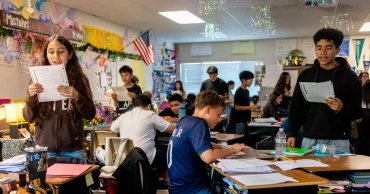
At a classroom in Modesto, California, teacher Nancy Barajas uses an unusual pre-test routine — dimming the lights, playing music and letting her sixth graders dance under a disco ball — to boost confidence before exams.
The approach appears to be working locally. Schools in Modesto have recorded steady gains in both reading and math scores in recent years, though overall performance remains below grade level.
However, national data paints a more concerning picture. A study by researchers from Harvard, Stanford and Dartmouth examined state test scores for grades three to eight across more than 5,000 school districts in 38 states, compiled into a national Education Scorecard.
The findings show that only five states and the District of Columbia recorded meaningful improvement in reading between 2022 and 2025. Overall, students remain about half a grade level behind pre-pandemic reading benchmarks, with only marginal gains in math.
The decline in reading achievement, experts say, began well before the COVID-19 pandemic. Data from the National Assessment of Educational Progress shows falling reading scores for eighth graders since 2013 and for fourth graders since 2015.
Harvard professor Thomas Kane, who helped develop the Education Scorecard, said the pandemic worsened a longer-term decline, describing it as “a mudslide that followed seven years of steady erosion in achievement.”
Researchers point to several possible causes, including increased screen time and reduced recreational reading among children, as well as weaker accountability systems in schools.
Despite the national trend, some states — including Louisiana, Maryland, Tennessee, Kentucky and Indiana — have shown progress after adopting “science of reading” methods that emphasize phonics-based instruction over older approaches that relied more on context-based guessing.
Several states have also introduced dyslexia screening, teacher training programs and instructional coaching to improve literacy outcomes. However, the reforms have not guaranteed success everywhere, with some states still seeing declines.
In Modesto, schools have revamped reading instruction during and after the pandemic, while also expanding support for English learners and investing in teacher training programs, including a phonics-based initiative known as LETRS. The district reports gains equivalent to roughly 18 weeks of additional learning in math and 13 weeks in reading, though overall achievement remains low.
Other districts have also seen improvement by focusing on attendance. In Detroit, Michigan, increased school attendance combined with literacy reforms has helped boost performance, though scores still lag behind national averages. The district, once the subject of a lawsuit over the right to read, used settlement funds to expand learning support and improve school services.
In some schools, additional staff now provide small-group instruction, while attendance officers actively follow up with absent students to keep them in class.
In the southern United States, several states have led reforms in reading and math instruction. Louisiana and Alabama are among the few states where math scores have surpassed pre-pandemic levels. Louisiana is also the only state to exceed its 2019 reading average.
Alabama’s phonics-based reading reforms have contributed to notable gains, later expanded into broader math reforms requiring standardized instruction and regular student assessments.
Despite improvements in some regions, educators and researchers say nationwide recovery remains uneven. They stress that sustained investment, consistent instruction and stronger accountability will be needed to reverse the long-term decline in reading performance.
2 months ago