Lifestyle

Harry, Meghan to spend extended period in UK with children
Prince Harry and his wife Meghan are planning to return to the United Kingdom with their children for an extended stay from this fall, but they will not resume their duties as working members of the royal family, The Associated Press learned Wednesday.
Their children, Prince Archie, 7, and Princess Lilibet, 5, have enrolled at British schools and are expected to begin classes in September, according to a person close to the Sussexes who spoke on condition of anonymity.
The family plans to live at a private residence outside London that is not linked to the royal family. They will keep their home in Montecito, California, as well as their holiday property in Portugal.
The Daily Telegraph first reported the development. Asked about the report at an event with US veterans in Washington on Wednesday night, Harry said, "Nothing to say."
Harry and Meghan stepped down from royal duties and moved to California more than six years ago. They later signed commercial deals, including with Netflix and Spotify.
Their relationship with other members of the royal family has remained strained. However, Harry has recently spoken about wanting to rebuild ties with his father, King Charles III, who is undergoing treatment for an undisclosed type of cancer.
Charles was informed about the couple's plans on Sunday. Harry and Meghan also visited the UK last month.
Buckingham Palace generally does not comment on speculation involving non-working members of the royal family. A spokesperson for Harry and Meghan also declined to comment.
According to a source close to the couple, Meghan will continue to run her company, As Ever, from the UK, while Harry will be able to spend more time working with his UK-based charities.
Harry and Meghan's relationship with the royal family has been tense since they moved to a mansion in Montecito.
In interviews and Harry's memoir, "Spare," the couple said they left Britain to escape the pressures and restrictions of royal life. They also accused palace officials of failing to properly support Meghan over her mental health and said a member of the royal family had raised concerns about the skin color of their first child before his birth. Meghan has described herself as biracial.
Relations were further strained by Harry's legal battles with British tabloid newspapers. He has accused them of illegally accessing his phone and invading his privacy when he was younger.
Harry has lost several lawsuits against media organizations, including a case against the publisher of the Daily Mail that ended last month.
The latest case could leave Harry facing legal costs running into millions of pounds. The court ruled that he and other plaintiffs were responsible for the publisher's legal fees. Associated Newspapers said its legal costs amounted to 34.5 million pounds ($47 million).
Harry has also been involved in a legal dispute with the British government over security arrangements for his family during visits to the UK. He argues that he and his family need armed police protection because of the risks associated with being members of the royal family, even though they are no longer working royals.
After losing a court challenge over his security last year, Harry said he wanted to improve relations with his family.
"I would love reconciliation with my family. There's no point in continuing to fight anymore," Harry told the BBC, adding that he did not know how much longer his father had.
Harry returned to the UK last month for several charity engagements. Meghan and the children joined him for part of the trip, and they met King Charles at his Highgrove estate in western England.
It was the first time Archie and Lilibet had seen their grandfather since Queen Elizabeth II's Platinum Jubilee in 2022.
While Harry has recently spent time with his father, there has been little indication of improved relations with his elder brother, Prince William, heir to the throne.
Peter Hunt, a former BBC royal correspondent, said the family's return would come as a surprise to William.
"In the short term, Harry will be able to deepen his rapprochement with his father," Hunt told Britain's Press Association. "And his presence back home will make it harder for his brother to duck a reconciliation."
2 months ago
Chinese Valentine's Day rooted in legend, tradition beyond romance
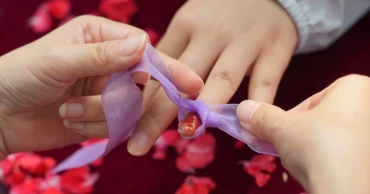
Chinese Valentine's Day is about much more than flowers and chocolates. Known as Qixi, the ancient festival combines romance with legends, prayers and traditional cultural practices that continue to be observed today.
Qixi is celebrated on the seventh day of the seventh month of the Chinese lunar calendar, which fell on Aug. 19 this year. The festival is also observed in Singapore, Vietnam and several other Asian countries.
2 months ago

Robots ask for tips, but who gets the money?
Robots are increasingly becoming part of the service industry, from making cocktails and coffee to delivering food. Now, some of them are also asking customers for tips.
That is raising a simple question: Who actually gets the money?
At The Tipsy Robot bar inside Las Vegas’ Venetian Hotel, two robotic arms prepare automated cocktails. A margarita costs $17, but customers are also asked to pay a 10% service fee.
Similar situations are appearing elsewhere. At Artly Coffee in New York, a robotic barista prompted customers for tips. At Newark Liberty International Airport, a self-checkout machine suggested a tip when customers bought a bottle of water from an unstaffed kiosk.
In Portland, Oregon, restaurant Top Burmese uses a robot to deliver meals, although human workers take customers’ orders.
While customers may willingly tip human servers for good service, tipping a machine can feel different. It is also often unclear who receives the money.
Representatives of The Tipsy Robot and Artly Coffee say all tips go to human employees and that their companies do not take any share. Artly has since removed its automatic tip prompts following complaints from customers.
But experts say the situation could be more complicated elsewhere.
Holona Ochs, an associate professor of political science at Lehigh University and co-author of the book Gratuity, said there is no clear legal standard determining who owns tips given to robots.
“We have every reason to believe that some unscrupulous employers are taking the robot tips for themselves,” Ochs said, stressing that the key issue is who benefits and who pays.
Tipping has already become a growing source of frustration for consumers, especially in the United States. Digital payment systems increasingly ask customers to choose tip percentages, sometimes even when little or no human service is involved.
The issue is particularly important in the US, where tipped workers can legally receive a much lower minimum wage. The federal minimum wage is $7.25 an hour, while the minimum cash wage for tipped workers is $2.13 an hour, provided employers make up the difference when necessary.
US law prevents companies, owners and supervisors from taking tips meant for workers. But those rules may not clearly cover money given to robots.
Still, robots do not necessarily mean fewer jobs for people.
Abigail Smathers, director of content at Artly Coffee, said the company employs people alongside its robots and does not want to replace workers simply to cut costs. She said the company removed tip prompts and increased workers’ pay partly because of customer concerns.
She also said robots can help address labor shortages in the service industry without replacing human workers.
Katerina Berezina, an associate professor at the University of Mississippi who studies hospitality technology, said it would be unfair to assume that companies use robots only to make more money.
She said service fees or tips could help cover the labor, maintenance and technology costs involved in operating robots.
However, labor advocacy group One Fair Wage argues that automation could allow restaurants to continue paying workers low wages instead of addressing the underlying problems in the industry.
Experts say customers will play an important role in determining whether robot tipping becomes common.
Michael Lynn, professor emeritus at Cornell University and author of *The Psychology of Tipping*, said people usually tip to reward good service, help workers with low wages or avoid feeling judged.
Those reasons largely do not apply when dealing with a robot, he said.
A study found that only about 11% of participants said they would tip a robot bartender. However, people who had previously interacted with robot bartenders were more likely to consider tipping.
The same study found that about 42% of participants who initially refused to tip a robot changed their minds when they were told the money would go to human workers.
Lynn believes robot tipping is unlikely to become widely accepted. Businesses may introduce the option to increase revenue, but if customers dislike it, they could simply refuse to pay.
“There is no god of tipping, no one can make you pay,” he said, arguing that tipping habits are shaped by customers themselves.
For now, robot tipping appears to be an experiment whose future may depend largely on how consumers respond.
Source: BBC
2 months ago
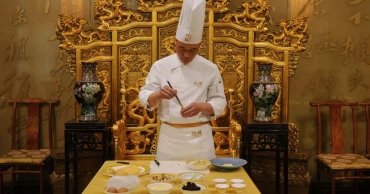
Once shaped by court rituals, China’s imperial cuisine survives into modern times
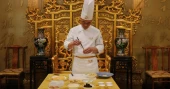
China’s imperial cuisine, once shaped by elaborate court rituals and the dining traditions of emperors and their households, continues to survive today through restaurants and culinary traditions that preserve dishes from the country’s imperial past.
One story associated with Empress Dowager Cixi dates to the final decades of imperial China. It is said that Cixi once dreamed about a pastry and was served the same treat for breakfast the following morning. Delighted, she summoned the chef and rewarded him with a silver ingot.
“It was originally called ‘minced pork pancake,’ but because it had fulfilled her dream, it later became known as ‘dream pastry,’” said Zhou Tong, a chef at Fangshan Restaurant in Beijing.
Fangshan specializes in imperial cuisine and preserves dishes associated with Cixi as well as other culinary traditions of China’s imperial court. The restaurant was established in 1925 by former Qing Dynasty chefs at Beihai Park, a historic garden where members of several Chinese dynasties rested, conducted government affairs and held ritual ceremonies.
“The name Fangshan literally means ‘imitating the imperial cuisine,’” said assistant general manager Di Xin.
Several other restaurants in Beijing also offer versions of imperial cuisine, while the Palace Museum preserves Qing Dynasty objects connected to court dining, including molds used to make pastries.
Every meal had its own rituals
Imperial cuisine included the food eaten daily by emperors as well as elaborate feasts held by the imperial court throughout the year.
Each occasion followed specific rituals. At Qing Dynasty banquets, for example, drinking milk tea was an important opening step, said Teng Deyong, a researcher at China’s Palace Museum.
During banquets, emperors would present wine or food to princes and government officials. Those receiving the offerings were expected to perform rituals and pay their respects to the emperor before eating or drinking.
Sacrificial ceremonies followed a different set of rules and could include offerings of meat.
“At the Palace of Earthly Tranquillity, there was the eating of sacrificial pork, which we know was one of the most important rituals of the Qing imperial court,” Teng said.
The pork used in the ceremony was boiled without salt. Afterward, it was distributed among guests, and receiving the sacrificial meat was regarded as a significant honor.
The practice of serving unseasoned food also has roots in earlier Chinese ritual traditions. Wandi Wang, a professor of Chinese at Lehigh University in Pennsylvania, said the “Book of Rites,” a classical text on ceremonies and rituals, describes a meat broth known as “grand stew” that was served without seasoning during sacrificial ceremonies.
“The absence of added flavoring was itself meaningful: the unseasoned dish evoked an earlier and simpler way of cooking and thus expressed a ritual ideal of honoring antiquity and remembering cultural origins,” Wang said.
Traditional methods preserve imperial pastries
Pastries played an important role in imperial cuisine, and the imperial court maintained a specialized institution dedicated to producing them.
At Fangshan, Zhou prepares pastries including Cixi’s dream pastry and a small steamed corn bun, using recipes based on imperial court traditions.
“When customers visit, our servers often tell them the stories behind these dishes,” Zhou said. “People enjoy them even more because they carry such meaningful history.”
Zhou learned traditional pastry-making techniques from a master who had learned them from his own mentor, continuing a craft passed down through generations.
Traditional imperial methods require much of the preparation to be done by hand, without blenders or food processors. Beans, for example, are pulverized using sieves, while certain types of flour are prepared in specially made copper pots.
“A machine may be more convenient, but the texture is completely different,” Zhou said. “You lose the delicate graininess and sandy mouthfeel that handcrafted pastries are supposed to have.”
Fangshan’s popular specialties include pea flour cake and red bean rolls. During peak periods, customers order more than 200 of the cakes each day.
Preserving ancient techniques in a changing world
When Fan Liangliang joined Fangshan as a kitchen apprentice, he had to relearn much of what he had been taught in culinary school. Instead of using faster techniques, he adopted slower traditional methods that were unfamiliar to him.
One such technique is known as “Nizihuo,” which Fan described as mincing ingredients such as fish, shrimp or chicken into a smooth paste and then shaping it into decorative forms such as frogs, birds and flowers.
“This is one of the hallmarks of imperial cuisine,” Fan said. “Every dish had to be innovative, visually beautiful, nutritious and worthy of presentation on the imperial dining table.”
Some rare ingredients once used in imperial dishes, including bear paws, are no longer served. Fan said modern alternatives are used while attempting to preserve the original character and spirit of the dishes.
2 months ago
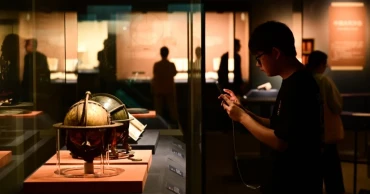
Ancient Chinese astronomical instruments draw visitors on cosmic journey
A museum exhibition in east China’s Anhui Province is offering visitors a different perspective on the country’s ancient civilization by highlighting its long history of astronomical observation and scientific exploration.
Rather than focusing mainly on traditional treasures such as porcelain, calligraphy and ritual vessels, the exhibition features jade cosmological diagrams, ancient star charts and bronze astronomical instruments created by Chinese scholars centuries ago.
Titled “Heavenly Questions: The Cosmological Vision of Chinese Civilization,” the exhibition at the Anhui Museum brings together nearly 300 artifacts from 48 institutions across China. It is one of the country’s rare exhibitions dedicated specifically to presenting ancient Chinese views of the universe through cultural relics.
Since opening in July, the exhibition has attracted around 350,000 visitors, many drawn by the astronomical instruments once used to observe, measure and understand the cosmos.
Among the main attractions is a jade slab dating back 5,800 to 5,300 years and roughly the size of a smartphone. Eight arrows at its center represent the eight directions, while arrows at the four corners appear to correspond with sunrise and sunset positions during the winter and summer solstices. The cosmological diagram may predate Britain’s Stonehenge.
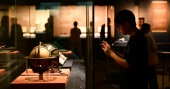
Other notable exhibits include China’s oldest equatorial astronomical instrument, a disk bearing the 28 lunar star mansions discovered in the tomb of a marquis dating to 165 BC, and a bronze water clock from the Western Han Dynasty (202 BC-25 AD), the earliest dated water clock ever discovered.
The exhibition also features a rubbing of a Southern Song Dynasty (1127-1279) stone-carved astronomical chart showing more than 1,400 stars. It remains the oldest known all-sky map based on actual astronomical observations.
“These ‘hardcore creations’ in ancient astronomy laid the technological foundation for studying the laws of celestial motion,” said Meng Qian, director of the museum’s research department.
The exhibition concludes by connecting ancient astronomical achievements with China’s modern space program. Ancient instruments, including globes and gnomons, are displayed alongside models of modern spacecraft such as the Yutu lunar rover and lunar soil samples collected by the Chang’e-6 mission in 2024.
Many of China’s major space missions also carry names rooted in ancient Chinese mythology and culture. The country’s lunar exploration program is named after Chang’e, the legendary goddess of the moon. The Mars rover Zhurong takes its name from an ancient fire god, while the space-survey telescope Mozi is named after the philosopher credited with some of China’s earliest optical experiments.
The exhibition takes its title from “Tianwen,” or “Heavenly Questions,” an epic poem written more than 2,000 years ago by patriotic poet Qu Yuan. China’s Mars exploration program also carries the name Tianwen.
“This exhibition lets ancient astronomy and modern space exploration illuminate and interpret each other,” said Shi Yunli, a professor at the University of Science and Technology of China and an adviser to the exhibition.
“When visitors stand between the folded bronze gnomon and the Yutu rover, they see not just two objects on display, but they see a 5,000-year chain of quest,” Shi said.
The exhibition will continue through mid-October as China’s space exploration program moves toward new milestones.
“We hope this exhibition will let visitors look back at the early lights of our culture, and also see the way forward,” Meng said.
2 months ago
Iran war threatens education as families struggle to survive
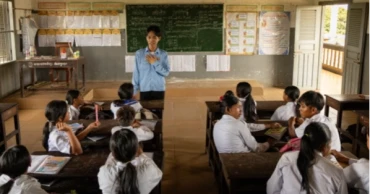
Sou Sreynich, 13, dreams of becoming a teacher, but she knows she has fallen behind in her education.
She did not start attending school until she was 10, several years later than most Cambodian children. Her mother delayed sending her because she feared the boat ride to school could be dangerous before Sreynich was old enough to swim. Such concerns are common among families living on Cambodia's Tonle Sap, Southeast Asia's largest freshwater lake.
Now, rising fuel prices linked to the Iran war are creating another obstacle. Unlike the widespread school shutdowns seen during the COVID-19 pandemic, the conflict's effect on education is less obvious. However, poor families are being hit hardest as transportation becomes more expensive and governments face increasing pressure on their education budgets.
Life on Tonle Sap already depends heavily on boats. Climate change has made conditions even more difficult by causing increasingly unpredictable floods and droughts. Teachers at Sreynich's school say 10 students have drowned there over the years.
If the conflict continues, as many as 23.4 million additional children could fall into poverty by the end of the year, according to a recent UNICEF report. Around 80% of those children are expected to live in Africa and Asia.
Each morning, fuel-powered boats travel through Kampong Prahok, often operated by students only slightly older than the children they transport. The boats stop beside floating homes as students in school uniforms climb aboard, carefully protecting their books and backpacks from the water.
Sreynich's family, like many others around Tonle Sap, depends mainly on fishing. They supplement their income by picking chilies and cleaning fish for other people. But higher fuel costs have made it impossible for them to travel farther into the lake, where fish are more abundant.
When the family struggles financially, Sreynich sometimes misses one or two days of school to help her parents earn money. She worries about falling further behind but remains determined to finish her education.
Poor families face difficult choicesFor families already struggling to survive, higher prices caused by the war are forcing them to decide whether limited money should go toward food, fuel, housing and electricity or toward keeping their children in school.
Sabrina Hervey of the Qatar-based Education Above All Foundation said the conflict could cause millions of children to leave school or prevent others from enrolling altogether.
In parts of Southeast Asia, some children are already leaving school to work.
In Vietnam, sisters Ly, 16, and Nhi, 13, come from a fishing family with nine children. Their education has repeatedly been interrupted because their parents have struggled to provide for the family.
Their father lost his fishing job after rising diesel costs made it too expensive for boat owners to operate. With the family already carrying debt, his temporary jobs were not enough to support all nine children.
The two girls eventually left school and moved to Hanoi, where they worked long hours at a restaurant. Their jobs exposed them to dangerous conditions involving sharp equipment, hot surfaces and heavy lifting. For 13-year-old Nhi, working was also a violation of Vietnam's child labor laws.
The Hanoi-based Blue Dragon Children's Foundation stepped in during April, helping the sisters return to school.
Michael Brosowski of the organization said the effects of the war have developed gradually but are having serious consequences. When families reach a financial crisis, they often choose to keep some children in school while sending others to work. Children who leave school become more vulnerable to exploitation, trafficking and homelessness.
Rising fuel costs affect education systemsHigher energy prices are increasing the cost of nearly every aspect of education. Transportation for students and teachers is becoming more expensive, while schools must pay more for basic supplies such as pencils and chalk. Aid workers also face higher costs when traveling to isolated communities.
Governments are under similar pressure because food and energy bills are rising, leaving fewer resources available for education.
On Tonle Sap, where almost everything must be transported by boat, costs were already higher than elsewhere in Cambodia.
Samphors Vorn of the nonprofit Aide et Action, which supports Sreynich's school, said even operating the school's computer laboratory has become significantly more expensive.
Conflict threatens education gains around the worldDeveloping countries that depend heavily on imported fuel have been particularly vulnerable to the economic effects of the war. Higher fertilizer prices and declining remittances are adding further pressure to already fragile economies.
Bangladesh, whose economy was already facing difficulties, is also at risk of losing progress made in reducing poverty and improving education.
A U.N. Development Programme report warned that increased fuel costs and government spending on subsidies could put additional pressure on Bangladesh's finances, leaving less money available for health care and education.
Girls may face even greater risks in some South Asian countries because struggling families often prioritize boys' education. Arshad Malik of Save the Children International warned that worsening economic conditions could lead to more girls leaving school and an increase in child marriages.
According to UNICEF, South Asia is home to 45% of the world's child brides, the largest share of any region.
School meal programs could also be affected. More than 466 million children worldwide receive at least one meal at school each day, according to the U.N. World Food Programme. These meals encourage children to remain in school while improving concentration, learning and healthy development.
However, such programs could face growing financial pressure as the conflict disrupts fertilizer supplies and increases transportation costs. The impact may be especially severe in parts of West and Central Africa, which depend heavily on imported food.
Health and aid workers in northern Nigeria are already reporting that more children are suffering from malnutrition again.
Hervey said she is deeply concerned about how much worse the situation could become if the economic effects of the conflict continue.
2 months ago

Europe's tallest Virgin Mary statue unveiled in Polish village
A 55.6-metre statue of the Virgin Mary, believed to be the tallest of its kind in Europe, was inaugurated Saturday in a small Polish village in the presence of former Polish President and anti-communist icon Lech Walesa.
Hundreds of people attended the consecration ceremony in Konotopie, a central Polish village with fewer than 150 residents.
Priests in white robes celebrated Mass as helicopters dropped small red roses over the gathering. The ceremony also featured performances of traditional Polish music and dance by the renowned Mazowsze folk ensemble.
The statue rises 55.6 metres (182 feet) above the village, including a 15-metre crown-shaped pedestal.
It is taller than Rio de Janeiro’s Christ the Redeemer, which stands about 38 metres including its pedestal, and also exceeds Poland’s Christ the King monument in Swiebodzin, which reaches roughly 52 metres including the mound beneath it.
A larger statue of the Virgin Mary, measuring about 98 metres, stands in the Philippines. However, the newly unveiled monument in Poland is believed to be Europe’s tallest statue of Mary.
Walesa, 82, who led Poland’s anti-communist movement as head of the Solidarity trade union, attended the inauguration from the front row.
“I started with the Virgin Mary and I end with the Virgin Mary,” Walesa told The Associated Press, reflecting on the causes he has championed throughout his life, including democracy and Catholicism.
During his years leading the Solidarity movement, Walesa was known for wearing a pin depicting the Black Madonna and has frequently spoken about the role of his Catholic faith in his opposition to communist rule.
Catholicism has traditionally played a major role in Polish public life. The country is home to St John Paul II, who served as pope from 1978 until his death in 2005.
However, the influence of the Catholic Church has declined in recent years, particularly among younger people and urban residents. The Church remains especially influential in rural areas and among older generations.
Bishop Wieslaw Mering, who attended the ceremony, said he was concerned about the declining influence of the Church and the growing number of people moving away from Catholicism.
He said the history of Christianity has experienced both periods of strength and decline, but described the new monument as a reminder of the enduring role of the Virgin Mary in Poland.
The monument was commissioned and financed by Polish entrepreneurs Roman and Grazyna Karkosik, who live in a nearby palace.
Roman Karkosik built his fortune through business ventures and investments on the Warsaw Stock Exchange and became one of Poland’s wealthiest people.
The couple said they built the monument as an expression of gratitude to God.
Grazyna Karkosik said the statue was intended for everyone and expressed hope that visitors would use the experience to reflect on their lives as well as their faith.
Local authorities hope the monument will attract pilgrims and tourists to the small village. A viewing platform has been built inside the statue’s pedestal, adding a tourist attraction to the religious site.
2 months ago
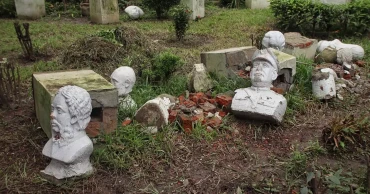
Broken sculptures, fading history: DU’s ‘Swadhinata Sangram’ complex
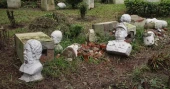
The scars of vandalism remain clearly visible at the ‘Swadhinata Sangram’ sculpture complex on Fuller Road at Dhaka University nearly two years after August 5, 2024, with most of the sculptures still lying broken.
2 months ago

Laufey’s fan event ‘A Very Laufey Day’ expands to 75 cities
Grammy-winning Icelandic singer-songwriter Laufey’s annual fan celebration, “A Very Laufey Day,” has grown into a global event designed to bring her listeners together offline through music, art and community activities.
Laufey launched the event in 2023 ahead of the release of her second album, “Bewitched.” She wanted to encourage fans to leave their homes, explore places she had enjoyed and experience what she described as her idea of a “perfect day” while connecting with other listeners.
Each year, Laufey creates itineraries for participating cities, directing fans to places such as museums, bookstores, cafes and music venues. What began as a small idea has expanded significantly, with fans also embracing the event by wearing vintage outfits inspired by the singer and treating the occasion as an unofficial holiday.
The fourth edition of “A Very Laufey Day” will take place on Aug. 23 and feature activities in 75 cities across 25 countries under the theme “A Celebration of the Arts.”
The programme will include performances and cultural events featuring symphony orchestras, ballet, jazz, opera and theatre. Fans will also be able to take part in activities organised with libraries, bookstores, coffee shops and yogurt and ice cream stores.
Laufey’s concert film, “A Night at the Symphony: Hollywood Bowl,” will be screened at selected cinemas as part of the celebration.
The singer has also partnered with museums and cultural institutions around the world, including New York’s Guggenheim, the Los Angeles County Museum of Art, the Museum of Contemporary Art Chicago, London’s Tate Modern and National Gallery, Chile’s Museo Nacional de Bellas Artes, and Seoul’s Daelim Museum.
Some participating venues and businesses will offer limited-edition merchandise and special Laufey-themed drinks.
Laufey said this year’s event focuses particularly on making arts and cultural institutions more accessible to her predominantly Gen Z and Gen Alpha audience.
She said she wanted to reduce the barriers that can make younger people hesitant to visit museums, galleries or attend classical performances and other forms of “high culture.”
“These spaces don’t have to be intimidating,” she said, adding that she wants to make such cultural experiences enjoyable and accessible for her fans.
The singer described organising the event as a “fun puzzle” each year, with its international reach continuing to expand.
2 months ago
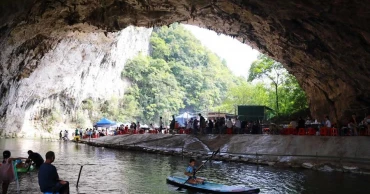
From cave exploration to cafes, China's karst 'cool resources' fuel summer tourism
As heatwaves sweep across China during the summer, the country's southwestern karst regions are turning their naturally cool caves into unconventional tourist attractions, offering visitors a respite from the heat while creating new business opportunities.
Guided by a local expert, tourist Chang Ting recently entered a natural cave in Guizhou Province. After walking about 100 metres along a narrow, rocky passage, she lost mobile phone reception.
“It felt like stepping into a crack in time, and all the noise faded away,” said Chang, who is from Xi'an, capital of northwestern Shaanxi Province.
Cave exploration has emerged as a new summer tourism trend among young Chinese travellers. The growing interest is providing visitors with novel sightseeing experiences while helping boost local consumption.
Videos featuring cave exploration in Guizhou have gone viral on major lifestyle and short-video platforms, collecting more than 5 million likes, while related topics have attracted hundreds of millions of views.
2 months ago