lifestyle

Hainan sees surge in duty-free sales as policy evolves over 15 years
China’s southern island province of Hainan has recorded strong growth in offshore duty-free shopping over the past 15 years, with total sales reaching 286.4 billion yuan, according to local customs authorities.
The sales volume includes around 347 million items since the policy was introduced in April 2011 to boost tourism and consumer spending.
Over the years, the policy has been revised and improved several times to expand its scope and attract more shoppers.
At present, Hainan has 12 offshore duty-free stores operating across the island, reflecting the steady expansion of the programme.
3 months ago

World’s largest art heist still a mystery as $500m paintings remain missing
More than three decades after 13 priceless artworks were stolen from the Isabella Stewart Gardner Museum in 1990, the case remains unsolved, with the missing pieces now valued at over $500 million.
The robbery is still considered the largest art theft in history, far exceeding other museum heists. In 2013, the Federal Bureau of Investigation said it had identified those responsible but never publicly named them, keeping speculation alive.
A former FBI investigator, Geoffrey Kelly, has now shared new details in his book “Thirteen Perfect Fugitives,” outlining how authorities tracked the stolen artworks through criminal networks. He also identified suspects he believes were involved and revisited key evidence, challenging long-held theories.
The museum itself was designed to remain unchanged after the death of its founder, Isabella Stewart Gardner, in 1924. Today, the empty frames of the stolen paintings still hang on the walls as a reminder of the crime.
The theft took place in the early hours of March 18, 1990, shortly after St. Patrick’s Day celebrations. Two men posing as police officers tricked security guards into letting them inside. They tied up the guards and stole several major works, including paintings by Johannes Vermeer and Rembrandt, along with pieces by Edgar Degas and Édouard Manet.
The thieves also took a decorative Napoleonic eagle finial and security tapes, puzzling investigators. The museum later offered a reward, eventually raising it to $10 million, for information leading to the recovery of the artworks.
Over the years, investigators followed numerous leads, including possible links to the Irish Republican Army and Boston’s underworld figures such as Whitey Bulger. Agents even carried out undercover operations abroad, but none led to the recovery of the paintings.
The case has been complicated by violence. Several individuals suspected of having links to the robbery were killed or died under unclear circumstances. Among them was Robert “Bobby” Donati, a known mob associate, who was found murdered in 1991. Another suspect, George Reissfelder, also died under suspicious conditions, and a painting believed to have been in his possession later disappeared.
Investigators believe the crime may have been connected to a local criminal network in Boston, but a lack of solid evidence made it difficult to bring charges. Limited resources in the early stages of the investigation also slowed progress, as authorities were focused on other major crimes at the time.
There were also suspicions about a possible insider role. One museum guard, Rick Abath, was questioned after reportedly opening a door against protocol shortly before the robbery. However, no charges were filed, and he denied any involvement before his death in 2024.
Kelly described the missing artworks as “perfect fugitives,” noting that unlike people, they leave no trace and can remain hidden for decades. Despite many false leads over the years, including sightings in private homes and antique shops, none of the stolen pieces have been recovered.
Because the artworks are so well known, experts say selling them openly is nearly impossible. While stealing them may have been easy, turning a profit remains the biggest challenge.
Still, Kelly believes the paintings are likely still out there and could one day resurface.
3 months ago
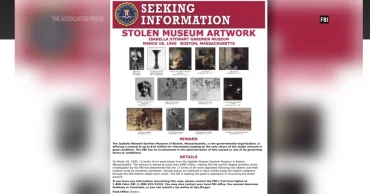
Inside the world’s largest art heist
For decades, the 1990 theft of 13 artworks from the Isabella Stewart Gardner Museum — now valued at more than $500 million — has remained unsolved.
It remains the largest art theft in history — far surpassing more recent museum thefts, including a daylight heist at the Louvre involving far fewer works that was resolved more quickly. In 2013, the FBI said it knew who was responsible for the Boston museum heist but declined to name them, fueling speculation that persists today.
A former FBI agent who led the investigation for more than two decades is now offering the first detailed account of how investigators reached that conclusion — and publicly identifying the men he believes were involved. In a new book, “Thirteen Perfect Fugitives,” Geoffrey Kelly traces how the artworks moved through criminal networks, where violence took the lives of key suspects and witnesses, and challenges long-circulating theories by revisiting key details.
The irony at the center is Gardner’s intention for the museum to remain frozen in time, stipulating in her will that nothing in the Venetian palazzo-inspired building would be changed after her death. Gardner, who lived in the museum and died there in 1924, intended for the paintings, sculptures and architectural fragments to remain exactly as she had arranged.
The empty gilded frames of the missing paintings still hang in the museum today — silent witnesses to what was taken.
The art heistEarly on March 18, 1990, as Boston wound down from St. Patrick’s Day celebrations, two men dressed as police officers arrived at the museum and persuaded a security guard to let them in, violating protocol.
The men handcuffed the guards in the basement and made their way to the museum’s Dutch Room, where they cut Vermeer’s “The Concert” and Rembrandt’s “Christ in the Storm on the Sea of Galilee” from their frames, also taking works by Degas and Manet.
They also took a Napoleonic eagle finial — a decorative metal piece of comparatively little value that investigators later found puzzling — and the museum’s security videotapes.
The museum offered a $5 million reward that they then doubled a decade later for information leading to the recovery of the works.
3 months ago

Cross-border travel in Beijing up significantly this year
More than 7 million border crossings were recorded in Beijing in 2026 as of Sunday morning, a 13% rise from a year earlier, according to official data.
This year, the number of exits and entries by foreign nationals at Beijing ports had surpassed 2.28 million as of Sunday morning, up 34 percent from the same period of 2025, according to the Beijing General Station of Exit and Entry Frontier Inspection.
As of Saturday, about 828,000 foreign arrivals at Beijing ports this year had entered under visa-free or temporary entry permit policies, accounting for over 70 percent of all foreign entrants.
The recent surge in Beijing's inbound tourism is partly attributable to the continuous optimization of visa-free policies. To date, China has introduced unilateral visa-free policies for 50 countries and implemented 240-hour transit visa-free arrangements for 55 countries.
To boost clearance efficiency and deliver better services amid the increasing passenger flow, Beijing has introduced a series of measures, including a one-stop service for issuing temporary entry permits and conducting inspections for people applying for the 240-hour visa-free transit, as well as guidance on visa-free policies and assistance in filling out arrival cards for first-time visitors to China.
3 months ago

Japan’s radio taiso keeps morning fitness tradition alive, supports long life
Japan begins its day with a long-standing fitness routine known as Radio Taiso, a simple and energetic exercise programme that has become part of daily life and is often linked to the country’s high life expectancy.
Every morning at 6:30, radio broadcasts play music along with step-by-step instructions for light exercises. Millions of people follow the routine in parks, schools, offices and at home, moving together in a shared rhythm.
The practice dates back nearly a century, having been introduced in 1928 during the time of Emperor Hirohito. Its lasting popularity comes from its simplicity and accessibility, as the exercises are suitable for people of all ages and fitness levels.
The routine includes basic movements such as stretching upward, twisting the body, bending at the waist, swinging the arms and light jogging or jumping in place. It lasts about 10 minutes and can be done at any intensity, depending on the participant’s ability.
The programme is divided into short segments that gradually become slightly more challenging. Participants perform a series of arm movements, waist bends, shoulder lifts, small jumps and marching steps, along with neck stretches and light squats. Each movement is repeated several times, with reminders to breathe slowly and relax.
Beyond physical fitness, Radio Taiso also serves as a social activity, especially for older people. In Tokyo’s Kiba Park, groups gather regularly to exercise together.
Mieko Kobayashi, 88, said she attends almost every day unless the weather is bad. “By moving my body, I feel better,” she said.
Her friend Yoshiko Nagao, 77, noted that many participants live alone, making the daily gathering an important social connection. “Laughing and chatting while taking a walk after the exercise is also good,” she said. “We come even on New Year’s Day.”
Kenji Iguchi, 83, who has been joining for about two decades, said the routine helps him stay active. “It’s for my joints, mainly the knees and back, because of my age,” he said, adding that meeting familiar faces is something he looks forward to every day.
Japan is known for having one of the world’s longest life expectancies, averaging around 85 years, supported by healthy diets, quality healthcare and active lifestyles. Government data shows a record number of people aged 100 or older, with nearly 100,000 centenarians currently living in the country.
Interestingly, Radio Taiso has its roots in the United States. It was inspired by a similar programme promoted by an insurance company in the 1920s. Japanese officials later brought the idea home, where it quickly spread nationwide.
The routine was briefly banned after World War II during the US occupation, as group exercises were seen as having militaristic elements. However, it returned in 1951 due to strong public demand.
Today, more than 20 million people in Japan take part in Radio Taiso at least once a week, according to a recent survey. The tradition has also spread abroad, particularly in Brazil, home to a large Japanese community.
3 months ago

China to send giant pandas to Atlanta zoo again under new conservation deal
China has announced it will send a new pair of giant pandas to Zoo Atlanta, marking a fresh phase of panda cooperation with the United States despite ongoing tensions between the two countries.
According to the China Wildlife Conservation Association, a male panda named Ping Ping and a female named Fu Shuang will be sent from the Chengdu Research Base of Giant Panda Breeding. The move is part of a 10-year conservation partnership agreement signed with the zoo last year.
The association did not mention when the pandas will arrive but said preparations are underway in the United States, including upgrades to the animals’ living facilities to ensure a safe and comfortable environment. Chinese experts have also provided technical support for the improvements.
The announcement comes just weeks before a planned visit by US President Donald Trump to China in mid-May, where he is expected to hold talks with President Xi Jinping on several issues, including trade.
Zoo Atlanta welcomed the news, saying it is honored to care for the pandas and continue working with Chinese partners.
“We can't wait to meet Ping Ping and Fu Shuang and welcome visitors back to experience the joy of giant pandas,” said Zoo President Raymond B. King.
China’s Foreign Ministry said the new cooperation will help improve panda care, support global biodiversity efforts and strengthen ties between the people of China and the United States.
Under a previous agreement that ended in 2024, Zoo Atlanta housed pandas Lun Lun and Yang Yang, which gave birth to seven cubs. The two pandas and their youngest offspring returned to China in October 2024, joining their other cubs already there.
Giant pandas have long been seen as a symbol of friendship between China and the United States, dating back to 1972 when China gifted a pair to the National Zoo in Washington. Since then, China has used panda loans as part of its international diplomacy efforts.
Officials say the renewed cooperation will also support research, including disease prevention, treatment and scientific exchange between the two countries.
The International Union for Conservation of Nature removed giant pandas from its endangered list in 2016, reclassifying them as “vulnerable.”
In 2024, the National Zoo in Washington and the San Diego Zoo also received pandas from China.
3 months ago

UK passes law to gradually end cigarette sales for future generations
Britain has moved closer to phasing out smoking for good after Parliament approved a new law that will stop future generations from legally buying cigarettes.
Under the Tobacco and Vapes Bill, anyone born after December 31, 2008 will never be allowed to purchase cigarettes. The measure, described by supporters as a landmark step in public health policy, now only needs formal approval from King Charles III before becoming law.
The law also gives the government wider powers to regulate tobacco, vaping and nicotine products, including rules on flavours and packaging.
Smoking is already banned for people under 18 in the UK, but the new system will gradually raise the buying age each year, effectively shutting future generations out of legal cigarette access entirely.
Health campaigners welcomed the decision. Hazel Cheeseman, chief executive of Action on Smoking and Health, said the move made the end of smoking “inevitable” after years of campaigning.
Health Secretary Wes Streeting said the policy would protect children from addiction, saying it would create “the first smoke-free generation.”
Britain’s smoking rate has fallen sharply since the 1970s, but about 6.4 million people, or roughly 13 percent of the population, still smoke, according to official data. Authorities say smoking causes around 80,000 deaths every year and remains the leading preventable cause of death and illness in the country.
The UK now joins a small group of countries taking strong legal steps to phase out smoking, although similar efforts in New Zealand were later rolled back.
3 months ago

Danakil Depression: Ethiopia’s extreme landscape offers rare glimpse into Earth’s forces
The Danakil Depression in Ethiopia is considered one of the most extreme environments on Earth, known for its intense heat, active volcanoes, acidic pools and strikingly colourful landscapes shaped by ongoing geological activity.
Often described as a “gateway to hell,” the region stands apart from typical travel destinations, as its defining features are natural forces such as shifting tectonic plates, geothermal activity and volcanic eruptions rather than human-built landmarks.
Located in the Afar region in northwestern Ethiopia near the Eritrean border, the depression is one of the lowest and most hostile places on the planet. It sits at the junction of three tectonic plates — African, Arabian and Somali — making it a key site for studying continental drift.
Due to this constant geological movement, parts of the land lie more than 100 metres below sea level. Scientists say the Earth’s crust here continues to crack and sink, allowing magma to rise closer to the surface and reshape the terrain.
The region is also among the hottest inhabited places in the world, with temperatures often exceeding 40 degrees Celsius and sometimes reaching 45 degrees. Low rainfall and harsh conditions mean that very few plants or animals can survive, while steam vents, sulphur fumes and exposed salt flats dominate the landscape.
One of its most notable features is Erta Ale, an active volcano that contains a rare, permanent lava lake. The molten lava continuously bubbles and glows, offering scientists and visitors a unique view of volcanic activity.
Another major attraction is Dallol, where bright mineral formations, sulphur vents and highly acidic pools create an almost surreal environment. Some of these المياه have extremely low pH levels, making them among the most acidic on Earth and highly dangerous despite their vivid colours.
Although much of the area is uninhabited, the Afar people live in nearby settlements and have adapted to the harsh conditions over generations. Their livelihoods depend largely on salt mining and livestock such as camels and goats, with traditional salt caravans still transporting blocks of salt across the desert.
Reaching the Danakil Depression is difficult and typically involves travelling from the city of Mekelle in four-wheel-drive vehicles, often with guided tours due to safety and environmental challenges.
The best time to visit is between November and February, when temperatures are relatively lower, though still extreme. Experts advise careful preparation, including adequate supplies and experienced guidance.
Scientists consider the Danakil Depression a natural laboratory that offers valuable insights into Earth’s structure and the processes that shape continents, while for travellers it provides a rare opportunity to witness raw geological forces in action.
3 months ago

Lufthansa to cancel 20,000 short-haul flights as kerosene prices doubled
German airline Lufthansa has announced plans to cancel around 20,000 short-haul flights through October as kerosene prices have reportedly doubled following the outbreak of the war in Iran.
The airline said the decision is expected to save about 40,000 tonnes of fuel and is aimed at reducing “unprofitable short-haul flights” across its network.
According to the company, the first phase of cancellations—affecting around 120 flights per day—began on Monday and will remain in effect until the end of May.
Lufthansa also confirmed that it will permanently withdraw 27 aircraft from its Lufthansa CityLine unit, citing strike-related disruptions and rising fuel costs linked to Middle East tensions.
The airline said the broader restructuring comes amid increasing pressure on European carriers due to fuel supply risks.
Meanwhile, the International Energy Agency has warned that Europe could face jet fuel shortages lasting up to six weeks if supply disruptions continue.
3 months ago

Berlin Zoo offers special dementia-friendly tours, bringing joy to visitors and families
A special guided tour at the Berlin Zoo is helping people living with dementia reconnect with familiar surroundings and enjoy moments of calm, memory and joy.
Eighty-six-year-old Christel Krueger and her daughter were among participants last month in a program organized by Malteser Deutschland, part of the international Catholic aid group Order of Malta.
Standing by the glass of a hippo enclosure, Krueger watched a mother hippopotamus and her calf resting in the water. Nearby, other participants observed elephants and rhinos at a relaxed pace designed to avoid stress or confusion.
“I’ll still be thinking about it when I go home,” said 85-year-old Ingrid Jansen, describing how the experience stayed with her.
The initiative is part of a growing global effort to make cultural spaces more accessible for people with disabilities, including those with dementia, hearing or visual impairments, and autism.
Organizers say traditional tours are often too fast and overwhelming. These special visits instead focus on fewer exhibits, slower movement and sensory experiences such as sounds and smells that can help trigger memories.
“People with dementia are often not visible in society,” said Christine Gruschka, who helps coordinate the program. “They still deserve to take part in public life, feel included and be seen.”
Millions of people worldwide live with dementia, a condition that affects memory, thinking and daily functioning. In Germany alone, around 1.6 million people are affected, a number expected to rise significantly in the coming decades.
The Berlin program includes visits not only to the zoo but also to museums and historic sites, with plans to expand further.
For families and caregivers, the tours also offer emotional support. Relatives say shared experiences like these help them connect in new ways with loved ones who are gradually losing cognitive abilities.
“I can’t communicate with her the same way anymore, but I can see she notices things and responds,” said Manuela Grudda, whose mother participated in the tour. “That means a lot to me.”
Organizers say such programs help ensure that people with dementia remain part of everyday social and cultural life rather than being isolated.
3 months ago