special
WFP warns of looming Rohingya food crisis, urges global action
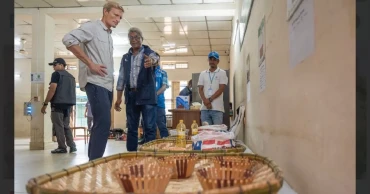
Deputy Executive Director (DED) and Chief Operating Officer (COO) of the World Food Programme (WFP) Carl Skau has said that they need to address the urgent situation facing the Rohingya but WFP’s funding will soon run out by the end of November.
“They (the Rohingya) have nowhere else to turn. They cannot work, they cannot integrate, and they certainly cannot return to Rakhine given the security situation there now – they are 100% dependent on the assistance we provide,” he told UNB in an interview during his recent visit to Bangladesh.
Rohingya crisis not a distant issue but ASEAN concern, says APHR
“And we know from experience that when we withdraw or shrink our assistance, people are forced to turn to negative coping mechanisms,” Skau warned.
Money is Running Out
He expressed their admiration for the generosity and the support the Bangladeshi people have shown, and the communities in Cox's Bazar who are really contributing to this response.
“We always invest in the host communities. The food we provide for the Rohingya is procured in Bangladesh, including Cox's Bazar, making sure there is a return for the Bangladeshi economy as part of our response,” Skau said.
“But our money is running out. We don't have the budget to continue our operation beyond the end of November,” he added.
That was one of the reasons he visited Bangladesh to meet with the government, partners, donors, and also with their teams on the ground, who he describes as “the lifeline”.
“We are providing food for the entire population of the camp – on a monthly basis. And obviously, if we stop that, it would not only have a very negative impact on the humanitarian situation – people will be hungry and they would suffer – but also all kinds of other negative implications, including people having to leave the camps to try to find resources elsewhere,” Skau said.
Diversifying Funding Base
10 months ago
Coast Guard Boost: Govt revises project to tackle facilities, logistics gaps
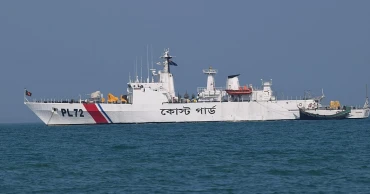
Struggling with shortages in operational facilities, housing and logistics, the Bangladesh Coast Guard is set to get a much-needed boost as the government has cleared the 2nd revision of a major project, raising its cost and pushing back the deadline for completion.
Under the latest revision, the cost of the project titled ‘Establishment of Logistics and Fleet Maintenance Facilities for Bangladesh Coast Guard (2nd Revised)’ increased to Tk 757.62 crore, a jump of Tk 173.21 crore or 29.64 percent over the previously revised allocation.
The coast guard’s responsibilities include combating piracy and illegal trafficking, safeguarding fisheries along with oil, gas and forest resources, and preventing environmental pollution in Bangladesh’s waters and coastal regions.
It also works to maintain security and law and order by supporting seaport safety while carrying out relief and rescue operations in coastal areas during natural disasters.
The project, which aims to develop Coast Guard’s own fleet maintenance capacity and central logistics support system, has already undergone one revision.
Padma swallows Paturia terminals amid administrative standoff
The Executive Committee of the National Economic Council (ECNEC) initially approved the project in June 2016 at an estimated cost of Tk 448.47 crore with a target completion date of June 2021, according to a project document obtained by UNB.
The first revision, approved in January 2022, raised the cost to Tk 584.40 crore and extended the implementation period to June 2023.
Later, the tenure was extended twice more without cost escalation to June, 2024 and then June, 2026. Now, the second revision proposes both a cost hike and time extension until June 2026.
Planning Commission officials said the cost hike and time extension were necessary due various factors, including damages to river protection embankments that required design changes, delays in land acquisition, slow release of funds, and disruption of procurement activities during the Covid-19 pandemic.
The surge in the dollar exchange rate also created difficulties in opening letters of credit (LCs), delaying machinery imports.
Besides, repeated attempts to procure some goods and equipment packages failed to attract eligible bidders within the approved estimates, forcing re-tendering and cost adjustments.
Lack of experts forces one-year extension for Bangladesh’s Carew project
Another reason cited was the project’s specialised nature. Different types of works were grouped under the same procurement packages, creating complexities in bidding and execution.
When the civil works estimates were updated based on the 2022 (revised 2023) schedule of rates, prices of many items exceeded the previously approved estimates, further necessitating cost revision.
Under the revised plan, the project will cover land development, construction of 13 non-residential buildings, procurement of vehicles, pontoons, electrical and firefighting equipment, machinery, computers, office furniture and other infrastructure.
The largest share, Tk 289.89 crore, has been earmarked for machinery and equipment, followed by Tk 189.65 crore for other buildings and infrastructure and Tk 169.10 crore for non-residential facilities.
The facilities are being built on 29.73 acres of Coast Guard-owned land in Gajaria upazila of Munshiganj along the Meghna River.
The area was chosen as it provides river access and adequate space for dockyard and support facilities.
Due to limited land availability in Dhaka for expansion, the Munshiganj site has been identified as the hub for new support units, administrative buildings, warehouses, training facilities and maintenance workshops.
As of January 2025, the project has achieved 76.98 percent financial progress (Tk 410.2 crore spent) and 70.19 percent physical progress.
Ctg’s mega road project delayed as land acquisition hits deadlock
The government’s long-term Vision 2030 for Coast Guard envisions significant expansion of manpower and operational responsibilities.
According to the 8th Five-Year Plan, the government also prioritises strengthening maritime surveillance capacity by procuring ships, vessels, and advanced technologies.
Officials said this project is fully aligned with those targets.
The Planning Commission recommended approval of the revised proposal stating that once completed, the project will significantly enhance Coast Guard’s own fleet maintenance capabilities.
It will also establish centralised warehousing for machinery, equipment, and accessories, thereby improving operational efficiency and readiness to respond to maritime challenges.
10 months ago

Remembering the TigerCaravan: Most Successful Innovative Conservation Campaign by USAID, Bangladesh Forest Department and WildTeam
In early 2016, a brightly painted 40-foot bus rolled out of Dhaka, carrying not commuters but a mission. Its design caught eyes immediately: shaped like a tiger, roaring in orange and black, it was a moving museum and a traveling classroom. Its purpose was urgent and ambitious to bring the Sundarbans and its tigers into the heart of Bangladesh, reminding us all that the Bengal tiger, our national pride, was under threat. This was the TigerCaravan, and it became one of the most innovative tools ever used to spread messages of biodiversity conservation in the country.
The caravan was not an isolated effort. It originated from the Bengal Tiger Conservation Activity (Bagh), a flagship environmental project funded by the U.S. Agency for International Development (USAID). Under the leadership of the Bangladesh Forest Department, the project was implemented by WildTeam, a national NGO focused on enhancing the conservation status of key species and habitats in Bangladesh. Together, this coalition envisioned a campaign that aimed to go beyond reports and policies, to reach people directly in their streets, schools, and marketplaces.
10 months ago
Billion-dollar Teesta mega project: A recipe for catastrophe
The billion-dollar Teesta mega project is set to unleash a multifaceted disaster while offering a group of people the opportunity to make endless profits, warned water and environment experts and activists.
Barely anything is officially known about the project, which is likely to be implemented soon, potentially harming people, the environment, the economy, and Bangladesh's diplomatic relations.
Scraping information from promotional materials, feasibility studies, and news reports, the experts analysed potential aspects of the project, revealing it was neither technically sound nor scientifically okay nor environmentally justifiable.
Crises that warranted the project in the first place, such as flash floods, riverbank erosion, and lean-season water shortage, will worsen, the experts feared.
Bangladesh looks on as China, India move to have Brahmaputra in chokeholds
“The project will present Bangladesh with needs such as relentless dredging of the Teesta River and constant repairing and maintenance of its banks,” said Md Khalequzzaman, who teaches geology at the Commonwealth University of Pennsylvania.
“It will benefit a group of people such as contractors, managers, politicians and the Chinese government,” he added.
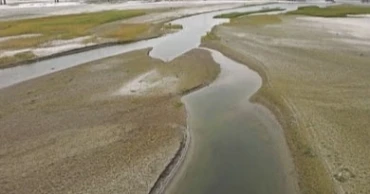
With a substantial loan and technical assistance from the state-owned Chinese company Power China, the project named Teesta River Comprehensive Management and Restoration Project aims to change the nature of the river from braided to meandering by building 114km of embankments and reducing its width to a maximum of 1 km. The current average width of the river is 3km.
The project also promises to reclaim 170 square km of land, control flood and riverbank erosion, and increase navigation and irrigation.
What’s in the plan?
The project wishes to confine the wandering river into a trained main channel with a scour canal nestled in it. The river's banks will be embanked for more than 100 km.
The experts argued that no amount of digging in Bangladesh could address the main problem with the Teesta: water shortage during the lean season.
Fragile bamboo bridge puts Kurigram’s Phulbari residents in danger
Rising in the eastern Himalayas, about 2,000 sq km of the watershed of the Teesta, representing 17 per cent of the whole watershed, belongs to Bangladesh. Obstructions, a barrage and water withdrawal in the upstream Indian states of Sikkim and West Bengal reduced the flow and sediment deposition in the Teesta from 60 bcm and 49 mt to 25 bcm and 3mt over the past decades, respectively. India obstructed the Teesta unilaterally, diverting almost all water during the lean season and dumping excessive water on Bangladesh during the monsoon. In 2006, Bangladesh received 700 cusec during the lean season, which dropped the 1990-96 level of 10,000 cusec. In 2016, the flow in the river during the dry season dropped to over 300 cusec.
The water that might become available in the proposed main channel of the river after deepening the riverbed is nothing but the shallow groundwater, said Khaleq in an analysis. He shared the analysis with UNB.
Such dredging will allow storing additional water during the lean season if a dam or barrage is built downstream. But there is no such plan in the project. Building of such a dam or barrage, however, will have other challenges, such as trapping sediments and filling up the river quickly.
“Intervening with natural river flow will bear many environmental consequences,” said professor AKM Saiful Islam of the Institute of Water and Flood Management at BUET.
“Wrapping the river’s bank with concrete will hamper groundwater recharge and draining of water from the floodplain,” he said, adding that the entire ecology will be affected.
Experts consulted for the report unanimously agreed that the mega project would provide legitimacy to India’s unfair and unilateral control of the Teesta water by trying to solve a transboundary water dispute without getting most of the natural water flow from the upstream.
“Teesta is not a mere conduit of water transport. High precipitation together with huge sediments from geologically active mountains gives rise to braided rivers such as the Teesta," Khaleq wrote in his analysis.
Erosion sparks panic, Tk 629cr Kurigram embankment on the brink
Teesta historically carries more sediment than any other similar river in Bangladesh. The underlying geological forces will gradually convert the Teesta back into a braided river by riverbank erosion and sediment deposition, the analysis said, noting that the Teesta watershed generates the highest amount of sediments per unit area - 3,200 tons per sq km per year. Since the Teesta River carries unusually high volumes of sediments for its size, it is likely that the narrowed channel will be overwhelmed by sediment volume, eventually leading to sandbars, reducing the river's water-carrying capacity and frequent flash flooding, Khaleq said.
The trained river will have to be continuously dredged to keep it navigable, the analysis said. The Teesta River carries about 49 million tons of sediment each year, Khaleq analysed, if all sediments were to be deposited in the riverbed, then it would take only 7 years to fill up the dredged channel.
“It can be concluded that narrowing the river from an average width of 3 km to 700 m will result in higher flow velocity, increased riverbank erosion, and higher flooding intensity due to water congestion upstream of these bridges,” said the analysis.
“If the width of the river is reduced to 700 m for the entire length of the river upstream of Kaunia Bridge, then the riverbanks on both sides will experience increased flow velocity and riverbank erosion,” the analysis added.
The project will leave the cross-sectional area of the Teesta at 25 per cent and 38 per cent of the original river.
In the event of a 50-year flood, which carries 10,680 cubic meters per second, the narrow and shallow channel will be filled to the brim in less than five hours, said the analysis. Floods generally last for more than one day in a large watershed such as the Teesta. The dredged channel will be overwhelmed after a few hours of a 1968-type flood, and the river will likely spread over the floodplain in the reclaimed area. In other words, the dredged canal will not be able to accommodate floodwater for even one day during a large flood of 1968 magnitude or a 50-year type flood, the analysis said.
Padma swallows Paturia terminals amid administrative standoff
If the river width is constricted from 5 km to 1 km or less, the analysis said, the riverbank will have a much steeper slope, likely to be in the order of 60 degrees. In addition, the scour channels within the main channel will have vertical walls—90-degree slopes. Over time, the riverbank materials will adjust to their natural slope of 25 to 30 degrees and, in doing so, the riverbank will undergo erosion and widening to reach the natural angle of repose.
The water law stipulates consultation with the Teesta dwellers, water resource specialists, sociologists and civil society members before approving such a project, said water expert Ainun Nishat.
“But we have no idea what is in the project or in the government's mind," he said.
The project should be halted, said Sharif Jamil, the head of Waterkeepers Bangladesh, unless it is proved essential to protect people’s interests and the environment.
Train of rough weather events exposes Bangladesh's disaster vulnerability
“The project involves a geopolitically sensitive location that for long attracted the interests of Asia’s archrivals—India and China,” he said.
“Keeping Teesta alive without having a proper share of its water from the upstream nation is impossible,” he said.
Neither the water resources and environment, forest, and climate adviser Syeda Rizwana Hasan nor the water resources secretary Mokabbir Hossain responded to calls made or messages sent over the phone for a comment on the matter.
10 months ago
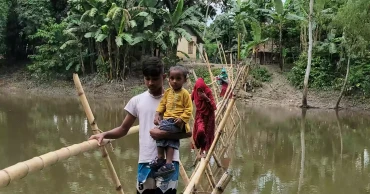
Fragile bamboo bridge puts Kurigram’s Phulbari residents in danger
For more than three years, over 10,000 people in eight villages of Kurigram’s Phulbari upazila have been living with a daily risk to life and limb, crossing a fragile bamboo bridge over the Neelkomol River.
The makeshift bridge, built by locals between Balatari and Chandrakhana villages under Phulbari Sadar Union, was erected after the collapse of a wooden bridge.
Since then, despite repeated visits and assurances from public representatives and officials, no permanent concrete structure has been constructed.
Residents of Balatari, Chandrakhana, Jelepara, Kumarpur, Bamanitari, Abashon, Bairagipara and Dashiar Char remain dependent on the risky bamboo crossing.
Accidents are common, villagers say, and at least one life has already been lost.
Sixty-year-old farmer Ehsan Ali recounted the tragedy of losing his son Atikur Rahman, 36, who succumbed to injuries after falling from the bridge.
“I myself have fallen twice. Every time we hear promises, but no bridge. Only Allah knows when a proper bridge will be built here,” he said, his voice choked with grief.
Students, too, have suffered. College-goer Faruk Hossain recalled a recent accident that left him with injuries and a broken mobile phone.
“The bamboo bridge is a constant risk, especially for women carrying children. A concrete bridge has become a necessity,” he said.
Local farmer Akter Ali said that villagers themselves bear the burden of repairs.
“I donate 50 to 60 bamboos annually while others contribute labour. Walking on it is a daily struggle. If not a concrete bridge, at least a wooden one should be built for now,” he added.
Heavy goods cannot be carried across the bamboo structure, leaving boats as the only transport option. Meanwhile, schoolchildren, farmers and daily commuters risk their safety every day.
Officials acknowledge the problem.
Local Government Engineering Department (LGED) Upazila Engineer Mamunur Rahman said he had visited the site and sent a proposal for a 120-metre bridge over the Neelkomol River.
“We are in touch with higher authorities for approval,” he said.
Phulbari Upazila Nirbahi Officer (UNO) Rehenuma Tarannum confirmed that funds had already been allocated for a temporary bamboo-wooden bridge.“The work will begin soon to ease movement,” she said.
But for villagers who have heard similar pledges for years, patience is wearing thin. For now, their fragile bamboo bridge stands as both a lifeline and a looming hazard.
10 months ago

Election campaign: EC bans AI misuse, social media abuse, posters, drones
The Election Commission has finalised the Code of Conduct, imposing a ban on the misuse of artificial intelligence (AI) and social media, along with the use of posters, drones and quadcopters in election campaigns.
Besides, no pamphlets, leaflets, handbills, festoons or banners made from non-biodegradable materials such as rexine, polythene, plastic or any other material that is harmful to the environment shall be used in the campaign.
The Election Commission on Wednesday finalised the code of conduct for the political parties and candidates in the parliamentary election rule 2025, incorporating such provisions ahead of the next general election planned to be held in early February 2026.
According to the code of conduct, Artificial Intelligence (AI) cannot be used for malicious purposes in any election-related matter, including campaigning.
The name and account ID, e-mail ID and other identifying information of a candidate or his election agent or party related social media must be submitted to the Returning Officer before the commencement of the campaign.
As per the code, all types of harmful content, including hate speech, misinformation, disfiguring someone's face and fabricated election-related information, shall not be created and disseminated as well as hate speech, personal attacks, or inflammatory language targeting opponents, women, minorities, or any other group of people shall not be used in the social media.
The punishment for violating this code has been made stricter as the maximum punishment has been proposed to increase up to six months’ imprisonment and a fine of Tk 150,000 instead of six months’ imprisonment and a fine of Tk 50,000.
“The use of AI is discouraged..... Nothing can be done about using social media or using artificial intelligence that violates the code of conduct,” said Election Commissioner Abul Fazal Md Sanaullah on Wednesday at a press briefing.
At the briefing, he raised the changes proposed in the draft of the Representation of the People Order (Amendment) Ordinance, 2025 which was sent to the Law Ministry to turn into a law as ordinance ahead of the 13th national election.
No Poster
As per the code of conduct, any type of poster cannot be used in the election campaign, while no pamphlets, leaflets, handbills, festoons or banners made from non-biodegradable materials such as rexine, polythene, plastic or any other material that is harmful to the environment shall be used.
In this regard, Sanaullah said the use of posters was also banned in the proposed RPO (Amendment) Ordinance, 2025.
Besides, no polythene-coated banner, leaflet, handbill or festoon and plastic (PVC) banner can be used in the election campaign in line with the code of conduct.
A candidate cannot install more than 20 billboards in an election area (constituency) and a billboard shall be maximum 16 feet by 9 feet in size.
In the code of conduct, members of the constitutional bodies, the chief adviser, advisers or the persons holding equivalent posts of the interim or caretaker government alongside the prime minister, the speaker, ministers, the chief whip, the deputy speaker, the opposition leader, the deputy leader of the House, the deputy opposition leader, state ministers, whips, deputy ministers and persons holding equivalent posts, MPs and city corporation mayors have been defined as very important persons (VVIPs) and different types of restrictions were slapped on the VVIPs regarding joining the election programmes and campaign.
VVIPs will not be allowed to visit the election area during the by-election to any parliamentary constituencies.No Drone, Quadcopter
The code of conduct banned the use of any type of drone, quadcopter or such type of machine in the election campaign and the balloting hours.
Besides, the general secretary or persons holding equivalent posts will also be allowed to use helicopters in the campaign but no leaflet, banner or other type of campaign matters can be displayed, distributed or dropped using the copter. But only the chief of a party or the persons holding equivalent posts could use helicopters in the past.
Loud Speakers
The sound from mike (microphone) or loudspeaker used in election campaigns shall not exceed 60 decibel and the mike or other sound amplifying machine must be used from 2pm to 8pm every day.
The violation of the code of conduct could lead to cancellation of the candidature as a provision incorporated in the code alongside the RPO.
Election Commissioner Abdur Rahmanel Masud told the media on Wednesday that the code of conduct was sent to the Law Ministry for vetting. They have made the punishment stricter for violation of the election code, he added.
But this code of conduct will be final as no approval of the government is required in this regard.
11 months ago
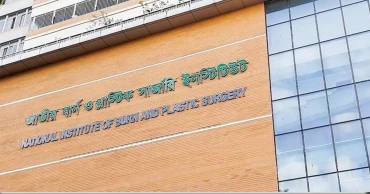
Bangladesh’s burn victims face awful fight amid facility shortage
For burn victims survival often hinges on a race against time but for those living far from the capital in Bangladesh race is increasingly unwinnable.
Bangladesh saw 140 deaths in 26,659 fire incidents reported across the country in 2024, according to Fire Service and Civil Defence.
Access to specialised burn treatment outside Dhaka remains extremely limited, forcing critically injured patients to rely on the overburdened National Institute of Burn and Plastic Surgery in the capital, while the actual need is even higher.
A government project to set up 100-bed burn and plastic surgery units at five major medical college hospitals — in Sylhet, Barishal, Rangpur, Rajshahi and Faridpur — was supposed to bring some changes.
But the long-awaited project is facing major delays and a significant cost hike.
Initially approved in January 2022, the project was scheduled for completion by June, 2025 at a cost of Tk 456.08 crore.
But delays, redesigns, and a staggering 78.96% cost hike — raising the revised budget to Tk 816.19 crore — have pushed the completion deadline to June 2028.
Of the revised allocation, Tk 464.74 crore will come from the government exchequer (GOB) while Tk 351.45 crore will be provided as a loan from the Saudi Fund for Development (SFD).
The government initiated the project in 2017 and it was approved by the Executive Committee of the National Economic Council (ECNEC) in December 2021.
Administrative approval followed in April 2022. The original plan envisioned completion by June 2025.
According to a project document obtained by UNB, the delay stems from a series of unforeseen challenges, including the Covid-19 pandemic, site selection complications, and revisions in the project design.
Initially, the plan involved vertical expansion and floor renovations in existing structures, but structural flaws — including cracks in parts of the Rajshahi Medical College Hospital premises — forced a shift to constructing entirely new buildings.
Read: Grief and gloom grip burn institute as families await news after BAF crash
However, the scope was later changed to construct entirely new dedicated buildings at all five medical college hospitals.
Under the revised plan, 11-storey foundation structures with six floors initially at Sylhet, Rangpur, Rajshahi, and Barishal medical colleges.
In Faridpur, a nine-storey building on an 11-storey foundation will be built due to land constraints.
The new facilities will each cover over 8,400 square meters and house state-of-the-art burn and plastic surgery units.
Officials said construction costs surged primarily because of the updated Public Works Department (PWD) rate schedule in 2022 which significantly raised civil works estimates.
“The cost escalation became unavoidable. Besides, the SFD requested a fresh cost reassessment as the original agreement was signed nearly five years ago,” a senior Planning Commission official said.
The revision also incorporates five new expenditure codes for special facilities, telecommunication equipment, stamps, and other operational needs, further contributing to the cost hike, he said.
Experts and healthcare professionals say the delay is causing suffering to burn victims outside Dhaka.
Read more: 3 of a family burnt in explosion from ‘gas leak’ in Dhaka
As there is no specialised burn unit in these districts, critical patients need to be rushed to the National Institute of Burn and Plastic Surgery in the capital which is already overwhelmed with cases.
“Every day we receive critical burn patients from across the country and unfortunately many of them die because they do not get timely treatment closer to home,” said a senior doctor at the Burn Institute seeking anonymity.
“The establishment of regional burn units is crucial to saving lives,” he added.
Doctors on the frontlines say the delay is costing lives. “The first four to five hours after a burn injury — the golden hours — are crucial. But we often fail to treat patients in time due to the lack of local facilities. Many patients die on the way to Dhaka,” said a doctor of the burn unit at Mymensingh Medical College Hospital.
Once completed, the project will benefit nearly 6 crore people in the five districts and surrounding areas, providing affordable, quality treatment for burn and reconstructive surgery cases.
It is also expected to reduce the pressure on Dhaka hospitals.
The Planning Commission, in its review, has recommended forwarding the revised proposal to the Executive Committee of the National Economic Council (ECNEC) for approval to fast-track implementation.
Read more: 8 burnt in Dinajpur gas cylinder fire
Officials stressed that timely completion is essential to strengthening the country’s burn and plastic surgery treatment network, improving emergency response capacity and saving lives.
In Bangladesh, burns are mainly caused by fire, electricity, and chemicals, with thermal and electrical burns being the most common. Recent incidents, like the Uttara plane crash and fires in markets and homes, have added to the growing number of burn victims in urgent need of care.
11 months ago

Hilsa slips out of reach as scarcity drives up prices in Khulna
Known as the pride of Bangali's dining tables, hilsa has now become a luxury in Khulna markets.
Despite the peak season, dwindling catches have sent prices soaring, leaving traders struggling and ordinary consumers priced out.
Visits to Khulna’s main wholesale fish hubs, Bhairab River’s Ghat No. 5 and the Rupsha Fish Ghat, popularly known as the ‘Hilsa Ghats’, revealed an unusually bleak scene.
The once-abundant display of hilsa in baskets and trays has thinned considerably, forcing prices to spiral.
“My father and grandfather were in this business. Our family has been trading hilsa for around 70 to 80 years. But we’ve never seen a shortage like this season,” said Sayeed Ali, a wholesale fish trader.
“Usually, we sell to retail traders, but due to the soaring prices, many have now shifted to other fish businesses,” he said.
165 fishermen jailed for defying hilsha ban
For ordinary consumers, the fish that once embodied celebration is now a distant dream.
Jalal, a 60-year-old rickshaw puller at Khulna’s New Market kitchen market, shared his frustration.
Hilsa is now just for display at the shops. We can’t afford to buy it. Two years ago, my younger daughter insisted I buy some, so I spent Tk 550 for four small jatka. I haven’t been able to buy any since. Now I just go to the market, look at it from a distance and listen to others talk about it,” he said.
He went on to say, “I have to run a family of five on what little I earn from pulling a rickshaw all day. House rent, groceries, my daughters’ and son’s expenses—it’s hard to manage even the basics. Buying hilsa is beyond imagination.”
At New Market and Moylapota kitchen markets, hilsa weighing over 1 kg is being sold at Tk 2,700 each.
Hilsha selling like hot cake in wholesale market
Those weighing between 700–900 grams are priced at Tk 2,200, fish between 600–700 grams at Tk 1,900, and the smaller sizes of 400–600 grams at around Tk 1,200.
For middle-class families, these figures are equally daunting.
“Even during the peak season, the price of hilsa is beyond reach for ordinary consumers. Though I crave it, I haven’t bought any yet,” said Masuma Lima, a shopper at New Market.
“Managing household expenses on a middle-class budget has become increasingly difficult. If we can’t afford to buy river-caught hilsa even once or twice a year, what’s left? Now we just settle for seeing photos of it on Facebook,” Lima said.
Traders themselves are struggling to keep the business afloat. “With current prices, it’s tough for us to even stock fish. Buyers don’t come like they used to. Even after sitting all day, we may sell just a few fish. After transport, shop rent and paying staff, there’s nothing left,” said Badsha Morol, a fish trader at New Market.
“We used to run our families on this business, but even in peak season, profits are minimal," he said.
Vegetable prices soar in Dhaka's kitchen markets; no item below Tk 80
Another trader, Pranto, echoed the concern.
“Even if five to seven buyers show up a day, most leave after hearing the price. The demand for hilsa is dropping. Often, fish stays unsold for two to four days, and we’re forced to sell at cost or even less. Right now, selling hilsa has become extremely difficult,” said.
11 months ago
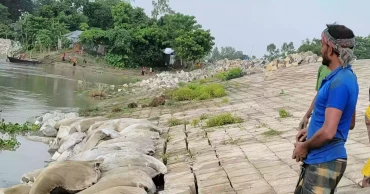
Erosion sparks panic, Tk 629cr Kurigram embankment on the brink
A vital flood control embankment at Saradob village in Kurigram Sadar upazila, is under severe threat as ongoing erosion by the Dharala River continues to damage parts of the Tk 629 crore project.
Locals said 30 metres of concrete blocks along the 350-metre stretch of the embankment began collapsing on Friday night, sparking panic among villagers and putting over a thousand families and several thousand hectares of cropland at risk.
Although the Water Development Board (WDB) has been dumping sand-filled geo-bags to protect the embankment, residents alleged that sufficient concrete blocks were not placed. Many have been living in fear since the initial collapse.
“This embankment is our shield. If it breaks, thousands of hectares of farmland and hundreds of families will be devastated. We have not yet recovered from the 2022 floods. If this embankment washes away, our village will be completely ruined,” said Sirajul Islam, a farmer from Saradob village.
Another farmer, Abdul Hossain, raised concerns over irregularities in the construction work. “Due to the lack of required concrete blocks, the embankment is unable to withstand the river current. If it cannot be saved, we will lose everything,” he said.
The Tk 629 crore Dharla project, launched in 2020, aims to protect riverbanks in Kurigram.
The project encompasses 20.29 kilometres of riverbank protection, 17.9 kilometres of alternative embankment construction, and re-excavation of 14.889 kilometres of flood control embankments.
According to the WDB, 97 percent of the work has already been completed.
Officials said the project has safeguarded 22,400 families, 50 markets, 30 river ghats, and 10,000 hectares of farmland from seasonal floods.
WDB Sub-Divisional Engineer Munna Haque explained that changes in the river’s course due to upstream silt deposits have redirected currents toward the embankment, causing partial collapse.
“We are currently dumping geo-bags. Once water levels recede, the damaged section will be repaired,” he added.
Executive Engineer Md Rakibul Hasan said the collapsed section was built by contractor Hasibul Hasan of Rangpur, but the work has not yet been officially handed over. “The contractor will have to bear the responsibility if the embankment sustains damage. For now, geo-bags are being used to protect the structure and permanent repairs will be carried out once water levels decrease,” he said.
11 months ago
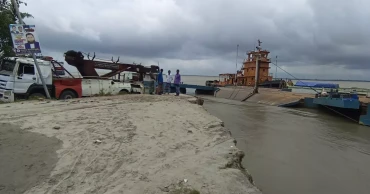
Padma swallows Paturia terminals amid administrative standoff
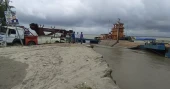
The mighty Padma River has already swallowed half of three ferry terminals and the entire launch terminal at Paturia in Manikganj, yet urgent protective measures remain stalled amid an administrative deadlock between two state agencies.
As the river continues to erode the banks, the Bangladesh Inland Water Transport Authority (BIWTA) insists that river-training work falls under the jurisdiction of the Water Development Board (BWDB).
The BWDB, however, argues that maintenance and protection of ferry terminals are the BIWTA’s responsibility.
Caught in this tug of war, no effective action has been taken to save the crucial Paturia-Daulatdia ferry route.
The lack of coordination has left thousands of passengers and vehicles vulnerable, even though the opening of the Padma Bridge eased some pressure on the crossing. The route remains vital as it links 21 southwestern districts to Dhaka and beyond.
Local residents warn that the entire cluster of ferry terminals could soon vanish unless immediate and coordinated efforts are launched.
Many accuse the BIWTA of failing to act on repeated warnings from terminal authorities as river levels began to rise with the onset of monsoon rains.
The erosion escalated dramatically on August 5 when strong currents battered the launch terminal. Within hours, one jetty collapsed along with three major support pillars, and by nightfall, the terminal had disappeared into the river, witnesses said.
The damage soon spread to ferry terminals 3, 4 and 5, crippling pontoons and ramps.
On August 7, the BIWTA attempted to contain the erosion by dropping around 400 geo-bags, but the effort proved futile as the current swept them away.
On August 8, terminal 4’s ramp and pontoon were torn off and later recovered nearly 1.5 kilometres downstream by a BIWTC rescue tug. A further 700 geo-bags were deployed in the following days, but locals said it was far from sufficient.
Frustrated by the minimal response, hundreds of residents staged a demonstration at the ferry ghat on August 17, demanding decisive measures.
Abdus Salam, Acting Deputy General Manager of BIWTC’s Aricha office, admitted that the situation is worsening rapidly.
“Despite the damage, we are trying to keep ferry services running for public convenience. But it's becoming increasingly difficult due to strong currents and erosion,” he said.
Nepal Chandra Debnath, Executive Engineer of BIWTA's Aricha River Port, described the crisis as unprecedented.
“We haven’t seen such erosion in two decades. We are placing geo-bags daily but the current is too strong. River training is typically done by the Water Development Board. We've informed both the ministry and the Board in writing. Once a decision comes through major protection works will begin,” he explained.
Muhammad Akhtaruzzaman, Executive Engineer of the Manikganj Water Development Board, maintained that responsibility rests elsewhere. “The maintenance and management of the ferry terminals fall under BIWTA. We only provide technical assistance if needed,” he said.
After visiting the erosion-hit site, BIWTA’s Chief Engineer Md Mohidul Islam described the crisis as a natural phenomenon.
He suggested altering the river’s flow by creating a central channel to help mitigate future erosion.
A major river training project had been initiated in 2019 but was discontinued in 2023, he said adding, the government is now considering a fresh project under the Water Development Board, but it is still awaiting inter-ministerial approval.
11 months ago