Local-Business

62,150 tonnes of US wheat reach Chattogram port under G2G deal
A consignment of 62,150 metric tonnes of wheat from the United States reached the outer anchorage of Chattogram Port on Friday under a government-to-government (G2G) agreement.
This is the second shipment under the deal, following an earlier delivery of 58,457 metric tonnes of wheat, according to the Ministry of Food.
Officials said sampling and testing of the wheat onboard have already begun, while steps are underway to ensure swift unloading of the cargo.
Of the total volume, 37,290 metric tonnes will be discharged at Chattogram port while the remaining 24,860 metric tonnes will be unloaded at Mongla port.
Bangladesh has so far imported a total of 467,884 metric tonnes of wheat under previous G2G arrangements, including 237,845 tonnes under G2G-01 and 230,039 tonnes under G2G-02, officials added.
The country’s annual wheat demand is estimated at around 7 million metric tonnes, against a domestic production of about 1 million tonnes, leaving a significant gap to be met through imports by both public and private sectors.
4 months ago
Gold prices fall by Tk 6,590 per bhori in Bangladesh
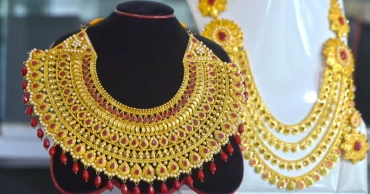
Gold prices in Bangladesh have been reduced by Tk 6,590 per bhori, bringing the rate of 22-carat gold down to Tk 234,855, according to the Bangladesh Jewelers Association (BAJUS).
In a statement issued on Friday morning, BAJUS said the new prices were set in line with the overall market situation, particularly a decline in the price of pure gold (tejabi gold) in the local market.
The revised rates came into effect from 10am.
Under the new pricing structure, 22-carat gold is being sold at Tk 234,855 per bhori (11.664 grams), while 21-carat gold has been fixed at Tk 224,182 per bhori.
The price of 18-carat gold now stands at Tk 192,164 per bhori, and traditional gold at Tk 156,473 per bhori.
Earlier, on March 25, BAJUS had reduced gold prices by Tk 5,482 per bhori, setting the rate of 22-carat gold at Tk 241,445.
So far in 2026, gold prices have been adjusted 47 times in the country, with 26 hikes and 21 reductions recorded.
Despite the latest cut in gold prices, silver rates remain unchanged. Currently, 22-carat silver is being sold at Tk 5,365 per bhori.
The price of 21-carat silver stands at Tk 5,132, 18-carat at Tk 4,432, and traditional method silver at Tk 3,324 per bhori.
4 months ago
BSEC approves Tk 500cr zero-coupon bond for Akij Food & Beverage
Bangladesh Securities and Exchange Commission (BSEC) on Wednesday approved a Tk 500 crore zero-coupon bond for Akij Food and Beverage Limited to support its financing needs.
The approval came at the commission’s 1004th meeting held at the BSEC office in Agargaon, chaired by BSEC Chairman Khondker Rashed Maqsood.
According to a press release, the unsecured, non-convertible and fully redeemable bond will have a tenure ranging from six months to a maximum of five years.
The bond will be issued through private placement to banks, non-bank financial institutions, insurance companies, institutional investors and high-net-worth individuals.
Each unit of the bond will carry a face value of Tk 10 lakh.
Sena Insurance PLC will act as the trustee, while North Star Investments (BD) Limited has been appointed as the fund arranger.
4 months ago

Gold price drops by Tk 5,482 per bhori in Bangladesh
Gold prices in Bangladesh have been cut by Tk 5,482 per bhori, with the price of 22-carat gold now set at Tk 241,445, according to the Bangladesh Jewelers Association.
In a statement issued on Wednesday morning, BAJUS said the new prices were fixed considering the overall market situation, particularly a decline in the price of pure gold (tejabi gold) in the local market.
The revised rates have come into effect immediately.
Under the new pricing, 22-carat gold will be sold at Tk 241,445 per bhori (11.664 grams) while 21-carat gold has been set at Tk 230,481 per bhori.
The price of 18-carat gold stands at Tk 197,530 per bhori, and traditional method gold at Tk 160,905 per bhori.
Previously, on March 19, BAJUS had reduced gold prices by Tk 7,698 per bhori, fixing the rate of 22-carat gold at Tk 246,927.
So far in 2026, gold prices have been adjusted 46 times in the country, with increases recorded on 26 occasions and decreases on 20.
Despite the latest cut in gold prices, silver rates remain unchanged. Currently, 22-carat silver is being sold at Tk 5,365 per bhori.
The price of 21-carat silver stands at Tk 5,132, 18-carat at Tk 4,432, and traditional method silver at Tk 3,324 per bhori.
In 2026, silver prices have been revised 29 times, including 16 increases and 13 decreases.
4 months ago
Islami Bank will no longer serve any specific group or party: BB Governor
Bangladesh Bank Governor Mohammad Mostaqur Rahman on Monday asserted that Islami Bank Bangladesh PLC (IBBL) will no longer operate under the influence of any specific group, political party, or family, marking a departure from its functioning during the previous Awami League regime.
The Governor made these remarks during a high-level meeting at the central bank headquarters with the Chairman of Islami Bank, four board members, and the top 10 executives of the Shariah-based bank.
"Islami Bank was once an exceptionally strong institution, but it later suffered from a severe lack of good governance," the Governor reportedly told the officials.
He assured that the central bank would provide all necessary cooperation to restore the bank’s stability and maintain its performance, an official present in the meeting told this to UNB.
The meeting comes amid ongoing protests by thousands of terminated IBBL officials seeking reinstatement. When asked if the Governor addressed these human resource grievances, a meeting attendee confirmed the matter was not raised during today's session.
The Shadow of S. Alam Group
According to a Bangladesh Bank report recently submitted to the Anti-Corruption Commission (ACC), the S. Alam Group exerted significant influence over eight banks, four of which were directly or indirectly under its control. The group reportedly withdrew Tk 1.90 lakh crore in loans from these four institutions.
Data from the Bangladesh Financial Intelligence Unit (BFIU) reveals that Tk 93,364 crore was laundered from these banks through fraudulent means and shell companies. Notably, Tk 1.05 lakh crore was taken from Islami Bank alone.
The report highlights that Saiful Alam Masud, head of S. Alam Group, used his influence to secure these funds either in his own name or through various intermediaries.
Financial Performance in 2025
Despite past governance challenges, Islami Bank reported significant operational growth over the last year. By the end of 2025, the bank's total deposits stood at Tk 1.83 lakh crore, marking an increase of over Tk 22,000 crore within a single year. Deposits in the agent banking sector also rose by Tk 5,000 crore to reach Tk 22,000 crore.
In terms of international trade and remittances, the bank collected Tk 76,000 crore in expatriate income over the past year. During the same period, IBBL’s import and export trade volumes reached Tk 60,000 crore and Tk 32,000 crore, respectively. The bank’s customer base has expanded to 30 million, with 5 million new customers joining in the last year alone.
Islami Bank board meeting discusses business performance, takes policy decisions
While the bank’s non-performing loans (NPLs) stood at a high of Tk 1.06 lakh crore (58 percent of total loans) as of September last year, the bank managed to recover Tk 14,159 crore in the final quarter. Currently, the bank's total defaulted loans stand at Tk 92,115 crore, accounting for 47 percent of its total loan portfolio.
4 months ago
NBR launches system for individual taxpayers to request income tax deadline
The National Board of Revenue (NBR) has introduced an online system allowing individual taxpayers to apply for an extension to submit their income tax returns for the 2025–2026 tax year.
The revenue authority has made online submission of income tax returns mandatory for most individual taxpayers, with a few exceptions.
According to the NBR, nearly five million individual taxpayers have already registered on its e-Return system, while around 4.1 million have submitted their returns for the current tax year.
The deadline for filing returns for individual taxpayers has been extended until 31 March 2026, the NBR said in a press release on Monday.
However, taxpayers who submit a written request before the deadline may receive an additional extension of up to 90 days, subject to approval by the respective tax commissioner.
To make the extension process easier, faster and more transparent, the NBR has launched a dedicated online facility within its e-Return system.
Taxpayers can now log in to the system and apply for additional time through the “Time Extension” menu. The concerned tax commissioner will review the application online and either approve or reject it.
If the request is approved, taxpayers will be able to submit their returns within the extended deadline without any penalty or additional tax, the NBR said.
However, taxpayers must be registered in the e-Return system and submit the extension request before 31 March 2026 to use the online facility.
Those taxpayers for whom online filing is not mandatory may apply for an extension either online or by submitting a written application directly to the relevant tax circle.
The NBR has urged all individual taxpayers to submit their income tax returns for the 2025–2026 tax year through the e-Return system by 31 March 2026, or within the additional time approved by the tax commissioner.
4 months ago
Bangladesh Bank raises credit card loan limit to Tk 40 lakh
Bangladesh Bank (BB) on Sunday issued a comprehensive policy for credit cards, doubling the loan limit to Tk 40 lakh from the previous Tk 20 lakh to encourage a cashless ecosystem.
The central bank also capped the maximum interest rate on credit card loans at 25 percent.
According to the new circular, banks can now provide up to Tk 20 lakh in unsecured loans (without collateral) and up to Tk 40 lakh against collateral. Previously, these limits were Tk 10 lakh and Tk 20 lakh, respectively.
The policy further specifies that cardholders can withdraw a maximum of 50 percent of their total credit limit in cash.
The central bank stated that the updated policy aims to reduce complexities as the use of credit cards as an alternative to cash continues to rise. The guidelines are designed to strengthen risk management, protect consumer rights, and encourage responsible lending.
The policy clarifies that the maximum 25 percent interest rate can only be applied to the outstanding balance, not the total bill amount. While interest-free periods apply to purchases, no such facility will be available for cash withdrawals.
Regarding fees, the central bank directed that no charges can be levied before a card is activated. Late payment fees can only be imposed once per billing cycle. Furthermore, banks must notify cardholders via written or electronic means at least 30 days before changing interest rates or other charges.
To prevent harassment, the guidelines strictly prohibit banks or recovery agents from physically or mentally harassing or threatening customers. The privacy of the cardholder's family, friends, or referees must be maintained.
Recovery-related communication, whether via phone or in person, must be restricted to standard office hours. Banks are also required to maintain 24-hour helplines to allow customers to block cards immediately in case of loss or theft.
To obtain a credit card, applicants must be at least 18 years old, possess an e-TIN certificate, and have a clean Credit Information Bureau (CIB) report. Students aged 16 who are dependents of a primary cardholder are eligible for supplementary cards.
This new policy replaces the previous guidelines issued in 2004.
4 months ago

NBR extends corporate tax return deadline to April 15
The National Board of Revenue (NBR) on Sunday extended the deadline for companies to submit their income tax returns by one month.
The new submission date is now April 15.
The extension applies specifically to the 2025-26 tax year, according to an NBR notification issued on Sunday.
The decision comes in response to formal requests from various business sectors that sought additional time to complete the mandatory filing process.
Under the previous schedule, the deadline for corporate tax return submissions was set to expire on March 15.
4 months ago

Gold price drops by Tk 2,683 per bhori in Bangladesh
The price of gold has been reduced by Tk 2,683 per bhori in the local market, with the new rate for 22-carat gold set at Tk 262,265 per bhori, the Bangladesh Jewellers Association (Bajus) announced on Saturday.
In a statement issued in the morning, Bajus said the decision was taken considering the overall market situation following a decrease in the price of pure gold (tejabi gold) in the local market. The new rates came into effect immediately.
According to the revised prices, 21-carat gold will cost Tk 250,368 per bhori (11.664 grams), while 18-carat gold has been fixed at Tk 214,618 per bhori. The price of gold produced through the traditional method has been set at Tk 174,785 per bhori.
Bajus last adjusted gold prices on March 13, when the price of 22-carat gold was reduced by Tk 2,158 to Tk 264,948 per bhori.
So far in 2026, gold prices have been adjusted 43 times in the country, including 26 increases and 17 reductions.
Along with gold, the price of silver has also been cut this time. The price of 22-carat silver has been reduced by Tk 292 to Tk 6,065 per bhori.
Under the new rates, 21-carat silver will cost Tk 5,774 per bhori, while 18-carat silver has been set at Tk 4,957 per bhori. Silver produced through the traditional method will cost Tk 3,732 per bhori.
With this latest revision, silver prices have been adjusted 27 times in the local market so far this year, including 16 increases and 11 reductions.
4 months ago
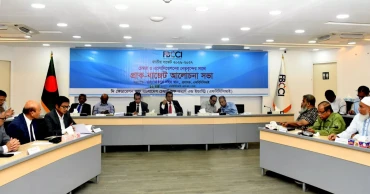
FBCCI calls for policy continuity, tax reforms to boost investment in FY27 budget
The Federation of Bangladesh Chambers of Commerce and Industry (FBCCI) on Thursday urged the government to ensure policy continuity in the upcoming national budget for FY2026–27 to facilitate business expansion and maintain investor confidence amid ongoing global economic uncertainties.
The call came during a pre-budget consultation meeting with FBCCI’s member bodies held at the apex trade body's Motijheel office in the city, where recommendations for the next fiscal budget were discussed.
In its proposals, FBCCI emphasised rationalising interest rates, increasing the tax-to-GDP ratio, full implementation of one-stop services for businesses, and modernising port and logistics management.
The organisation also called for ensuring uninterrupted power and energy supply, developing priority sectors to diversify exports, establishing a central bonded warehouse, and enacting stakeholder-based legislation.
During the open discussion, business leaders advised the government to expand the tax net to raise the country’s tax-to-GDP ratio. They also urged the National Board of Revenue (NBR) to strengthen transparency and accountability through automation and integration in tax policy, procedures and administration.
FBCCI Administrator Md Abdur Rahim Khan said the government aims to increase the tax-to-GDP ratio to 15 percent.
Assuring the business community, he said efforts to increase revenue collection would not necessarily lead to higher tax burdens on existing taxpayers. “Revenue growth will rather come through expanding the tax base.”
Rahim Khan also said FBCCI will present the rational proposals from the private sector at the 46th advisory committee meeting of the NBR.
Earlier, in his welcome remarks, FBCCI Secretary General Md Alamgir said the FY2026–27 budget is being prepared at a time when the global economy remains unstable, the energy market volatile and investment prospects uncertain.
“In such circumstances, preparing the national budget will be challenging for the new government,” he said, urging the business community to support the government by offering constructive and realistic proposals.
The meeting was attended by former NBR member and FBCCI Budget Expert Committee member Md Farid Uddin and Aminur Rahman, along with former FBCCI directors, leaders of various chambers and associations, and officials of the organisation.
4 months ago