local-business
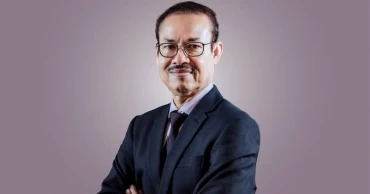
Masud Khan appointed BSEC Chairman
The government has appointed Masud Khan as the Chairman of Bangladesh Securities and Exchange Commission (BSEC) as part of its efforts to strengthen the country's capital market regulatory framework.
The Financial Institutions Division of the Ministry of Finance issued a notification in this regard on Thursday.
According to the notification, Masud, Group CEO of Crown Cement PLC, has been appointed Chairman of the BSEC for a four-year term under Section 5(2) of the BSEC Act, 1993.
The notification said he will assume the new role subject to relinquishing all employment and professional engagements with Crown Cement and other organisations.
Under the terms of his appointment, he will receive government pay, allowances and other benefits applicable to the position.
A seasoned corporate executive with more than four decades of experience in multinational and local companies, Masud has been serving as an independent director and chairman of the audit committee of Singer Bangladesh Limited and Community Bank Bangladesh.
He was also serving as an independent director of British American Tobacco Bangladesh and chairman of its Nomination and Remuneration Committee.
Before joining Unilever Consumer Care as Chairman, Masud worked for 18 years as Chief Financial Officer (CFO) of LafargeHolcim Bangladesh.
Earlier, he spent two decades in various finance and leadership positions at British American Tobacco.
Masud has also been associated with the Institute of Chartered Accountants of Bangladesh (ICAB) as a faculty member for more than 40 years.
He earned a Bachelor of Commerce (Honours) degree from St. Xavier’s College in Kolkata. A Chartered Accountant (CA) and Cost and Management Accountant, Masud won a silver medal in the All-India Chartered Accountancy Examination in 1977. He is also a Fellow of the Institute of Certified Management Accountants of Australia and New Zealand.
His appointment came hours after former chairman Khondoker Rashed Maqsood resigned on Thursday morning after serving for 21 months during the tenure of the interim government.
Four commissioners of the securities regulator also stepped down on the same day.
The development follows the passage of the Bangladesh Securities and Exchange Commission (Amendment) Act, 2026 in Parliament on April 30, which abolished the previous age limit of 65 for appointing the BSEC chairman and commissioners.
The government said the amendment was intended to enable the appointment of experienced professionals to the country's capital market regulator.
1 month ago

Auditor flags UCB’s Tk 5,595 crore provision shortfall, warns of deep capital deficit
The external auditor of United Commercial Bank PLC (UCB) has raised serious concerns over the bank’s financial health, highlighting a provision shortfall of nearly Tk 5,595 crore and a significant capital deficit in its audit report for the year ended December 31, 2025.
According to a disclosure published by the Dhaka Stock Exchange (DSE) on Tuesday, the auditor issued a qualified opinion on UCB’s financial statements, citing inadequate provisions against classified loans and other assets.
The audit report said UCB’s total loans and advances stood at Tk 61,789.01 crore at the end of 2025, including classified loans amounting to Tk 9,576.23 crore. Against the required provision of Tk 7,679.42 crore, the bank maintained only Tk 2,524.38 crore, leaving a shortfall of Tk 5,155.04 crore.
The auditor also identified a provision shortfall of Tk 439.89 crore against other assets, including an impairment loss of Tk 438.02 crore related to UCB Fintech Company Limited, a subsidiary in which UCB holds a 99.99 percent stake.
The report noted that despite the subsidiary incurring cumulative losses of Tk 438.02 crore, no impairment loss was recognized in the bank’s standalone financial statements.
However, the auditor noted that Bangladesh Bank allowed the bank to finalize its 2025 financial statements without adjusting the total provision shortfall of Tk 5,594.93 crore.
The report further revealed that UCB faced a reported capital shortfall of Tk 2,659.64 crore against the Basel III requirement as of December 31, 2025. Had the full provision shortfall been recognized, the capital deficit would have widened to Tk 5,975.52 crore.
The auditor also said the bank’s Capital to Risk-Weighted Assets Ratio (CRAR) stood at 8.42 percent, well below the regulatory requirement of 12.50 percent. Without regulatory forbearance and after accounting for the identified provision gaps, UCB would have posted an aggregate loss of Tk 3,278.88 crore and its CRAR would have dropped to just 0.93 percent on a standalone basis.
In an emphasis of matter paragraph, the auditor drew attention to Tk 196.88 crore in fixed deposits placed with several non-bank financial institutions (NBFIs), of which Tk 155.48 crore had matured long ago and were considered doubtful of recovery. No provision was maintained against these deposits, resulting in an additional provision shortfall of Tk 155.48 crore.
The auditor nevertheless stated that its opinion was not modified in respect of the matters highlighted under the emphasis of matter section.
2 months ago

12-kg LPG price cut by Tk 55 for June
The Bangladesh Energy Regulatory Commission (BERC) has reduced the price of privately supplied liquefied petroleum gas (LPG) for June, lowering the retail price of a 12kg cylinder by Tk 55 to Tk 1,885.
The new prices came into effect from 6pm on Tuesday, according to a BERC notification issued as part of its monthly price adjustment mechanism.
Under the revised rates, the retail consumer price of privately marketed LPG has been fixed at Tk 157.06 per kilogram.
LPG price to remain steady for May
Accordingly, the price of a 5.5kg cylinder has been set at Tk 864, while a 12.5kg cylinder will cost Tk 1,963. Prices for larger cylinders have been fixed at Tk 2,356 for 15kg, Tk 2,513 for 16kg, Tk 2,827 for 18kg, Tk 3,141 for 20kg, Tk 3,455 for 22kg, Tk 3,927 for 25kg, Tk 4,712 for 30kg, Tk 5,183 for 33kg, Tk 5,497 for 35kg and Tk 7,068 for 45kg cylinders.
BERC said the revised rates were determined based on the Saudi Aramco Contract Price (CP) for June 2026, which was set at US$760 per metric tonne for propane and US$820 per metric tonne for butane.
Considering a propane-butane mix ratio of 35:65, the average Saudi CP stood at US$799 per metric tonne.
The regulator also took into account a freight and trader premium of US$200 per metric tonne and an average exchange rate of Tk 122.81 per US dollar while calculating the new prices.
For LPG supplied in liquid form through reticulated systems, the price has been set at Tk 153.31 per kilogram. Gas supplied in vapour form through such systems will cost Tk 0.3407 per litre or Tk 340.70 per cubic metre.
BERC also reduced the price of autogas to Tk 86.93 per litre from Tk 89.52 per litre in May.
The commission said prices of state-owned LPG would remain unchanged.
Under an order issued on February 23, the consumer price of a 12.5kg cylinder sold through dealer or retailer points of government-owned companies will continue at Tk 776.93.
The latest reduction follows BERC’s decision in May to keep the price of a 12kg LPG cylinder unchanged at Tk 1,940.
Earlier, on April 19, the regulator increased the price of a 12kg cylinder by Tk 212 to Tk 1,940.
Before that, on April 2, it raised the price from Tk 1,341 to Tk 1,728, an increase of Tk 387.
As a result, the price of a 12kg cylinder rose by a cumulative Tk 599 within just 17 days between April 2 and April 19 before easing slightly in June.
According to BERC, the revised rates have been implemented under Order No. 2026/19 with effect from Tuesday evening.
2 months ago
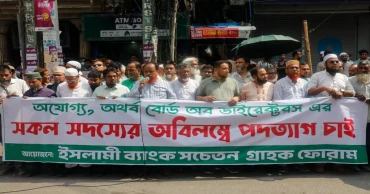
Islami Bank depositors vow to continue protests to press for 7-point demand
Agitating depositors of Islami Bank Bangladesh PLC under the banner of “Islami Bank Sachetan Grahak Forum” (Conscious Depositors' Forum) on Tuesday vowed to continue their protest until their seven-point demand, including the resignation of newly appointed Chairman Md Khurshid Alam, is realised.
At a press conference held in front of the Islami Bank Tower at Dilkusha in the capital, they announced a rally for tomorrow (Wednesday) at Dilkusha at 11:00am to press for their demands.
Speaking at the press conference, Convener of “Sachetan Grahak Forum” Nur-Un-Nabi said they sent the list of their demands to Bangladesh Bank Governor Md Mostaqur Rahman for immediate execution.
The agitating depositors continued their sit-in programme in front of the bank's head office for the second consecutive day on Tuesday.
The other demands are reinstatement of Omar Faruk Khan to the post of managing director, exclusion of anyone linked to past financial plundering from the bank’s Board of Directors, repeal of Section 18(A) of the Bank Resolution Act, recovery of looted funds by liquidating the seized domestic assets and ownership stakes held by the controversial S Alam Group, implementing legal barriers to ensure S Alam Group can never regain control of Islami Bank or any other financial institution, and bringing all individuals involved in looting Islami Bank and the wider banking sector to justice with exemplary punishment.
The leadership crisis at Islami Bank intensified on the final working day before the Eid holidays when the central bank-appointed independent director and then-chairman M Zubaidur Rahman abruptly resigned.
Hours later, at around 9:00pm that night, Bangladesh Bank appointed its former Deputy Governor Md Khurshid Alam as the new chairman of the bank.
Khurshid Alam previously stepped down from his deputy governor post following the fall of the Awami League government on August 5, 2024.
At the press conference, the forum leaders strongly condemned recent remarks made by Bangladesh Bank Spokesperson Arief Hossain Khan, labelling his statements as "deeply political and incorrect."
On Monday, Arief Hossain told reporters that members of a specific political party were instigating instability surrounding Islami Bank, asserting that central bank decisions will not be altered by street protests.
Reacting sharply to the remark, the agitating depositors said such a political statement coming from a responsible official of the regulatory body is highly unfortunate.
Describing them as genuine depositors, they said they took to the streets to place their legitimate demands solely under their identity as clients.
2 months ago
Banking sector in deep crisis as classified loans hit record 32.26 percent in Q1
Bangladesh’s banking sector has hit an unprecedented crisis point as non-performing loans (NPLs) and wider classified assets surged to historic highs in the first quarter (Q1) of 2026, posing a severe structural threat to the macroeconomic stability.
According to the Bangladesh Bank’s classified loan and provision report revealed on Tuesday for March 2026, total classified loans—which include NPLs and unclassified distressed assets—skyrocketed by Tk 31,487 crore in just three months, reaching a staggering Tk 5.88 lakh crore.
This brings the ratio of classified loans to an unprecedented 32.26 percent of the country's total banking credit ecosystem, meaning nearly one out of every three Taka disbursed by the banking sector is now severely compromised.
While overall classified assets reached 32.26 percent, the central bank's tight definition of pure default loans (NPLs) alone stood at Tk 5.64 lakh crore at the end of March 2026, commanding 30.92 percent of total outstanding loans.
This reflects a sharp quarterly rise from December 2025's figure of Tk 5.49 lakh crore (29.92 percent). More alarmingly, on a year-on-year basis, NPLs ballooned by an astronomical Tk 2.06 lakh crore from the Tk 3.57 lakh crore recorded in March 2025.
Toxic Debt: 94 percent Declared 'Bad/Loss':
A deeper dive into the metrics reveals that the quality of classified assets has deteriorated to fatal stages. A massive Tk 5.51 lakh crore or 93.69 percent of all problem loans has migrated into the ‘Bad or Loss’ category. Financial experts note that recovery prospects for assets in this bracket are statistically nominal, meaning these losses will severely eat into the capital base of the banks.
Compounding this pipeline of toxic debt is the sharp rise in Special Mention Accounts (SMA) loans showing early signs of distress. SMA assets jumped by 27.8 percent in three months to Tk 1.32 lakh crore, serving as a leading indicator that NPL volumes will experience further upward pressure in the upcoming quarters.
Tk 2.05 lakh crore provisioning shortfall:
The sheer magnitude of defaults has left the banking sector dangerously under-cushioned. Against a regulatory required provision of Tk 4.61 lakh crore to cover potential loan losses, the industry has managed to preserve only Tk 2.56 lakh crore.
This has dragged the systemic provisioning shortfall to Tk 2.05 lakh crore, escalating from Tk 1.91 lakh crore in December 2025. This massive deficit impairs the net profitability, capital adequacyratios, and global credit ratings of local commercial banks.
State Banks Bleed, Foreign Banks Stable:
The systemic rot remains highly concentrated in state-run entities, though private commercial lenders are showing a highly concerning downward spiral:
State-Owned Commercial Banks (SoCBs): Standing at the epicenter of the crisis, SoCBs recorded a classified loan ratio of 45.85 percent, with Tk 1.50 lakh crore out of their Tk 3.27 lakh crore portfolio flagged as distressed. Their pure NPL ratio sits at 45.21 percent.
Private Commercial Banks (PCBs): Holding the largest absolute volume of toxic debt, PCBs saw their classified loan ratio rise from 28.25 percent to 30.11 percent in Q1 2026, with total classified assets reaching Tk 4.16 lakh crore.
Specialized Banks: These state-backed development lenders (focused on agriculture and specific sectors) posted a classified loan ratio of 40.72 percent (Tk 19,175 crore out of Tk 47,086 crore).
Foreign Commercial Banks (FCBs): Consistently outperforming domestic peers through rigorous risk management and governance, FCBs maintained a classified loan ratio of just 4.82 percent (Tk 3,263 crore out of Tk 67,628 crore) and an NPL ratio of 3.99 percent.
The central bank's latest disclosures flash a critical red flag for policy-makers. With nearly a third of the country's credit locked up in unproductive or toxic assets, the capacity of commercial banks to fund new manufacturing, infrastructure, and job-creating ventures is severely restricted, said M. Masrur Reaz is a economist and public policy expert who served as Senior Economist and Program Manager at the World Bank Group.
He warns that if immediate structural reforms, aggressive asset recovery measures, and absolute political neutrality in credit management are not enforced, the resulting liquidity strain, capital erosion, and dent in depositor confidence could significantly derail Bangladesh’s mid-term economic recovery.
2 months ago
Stocks extend rally for second day after Eid; DSE turnover crosses Tk 10 billion
Bangladesh’s capital market extended its post-Eid rally for a second consecutive session on Tuesday, with key indices gaining further ground and turnover on the Dhaka Stock Exchange (DSE) surpassing Tk 10 billion.
The benchmark DSEX advanced 33 points, while the Shariah-based DSES and blue-chip DS30 indices rose by 2 points and 5 points respectively.
The gains followed Monday’s strong performance, when DSEX climbed 36 points, DSES added 4 points and DS30 increased 13 points.
Market activity also improved significantly. Total turnover on the DSE stood at Tk 10.80 billion, up from Tk 9.12 billion in the previous session. It was the first time since May 12 that daily turnoverexceeded the Tk 10 billion mark.
Most listed companies ended higher, with share prices of 230 issues advancing, 116 declining and 47 remaining unchanged.
Sonargaon Textiles Ltd topped the DSE gainers' list, rising nearly 10 percent, while Bangladesh Industrial Finance Company Ltd suffered the steepest fall, losing around 9 percent.
The Chittagong Stock Exchange (CSE) also closed in positive territory, with its broad-based CASPI index gaining 8 points.
Of the traded issues on the CSE, 128 advanced, 58 declined and 31 remained unchanged.
Turnover at the port city bourse, however, fell to Tk 270 million from Tk 470 million in the previous session.
Eastern Insurance PLC and New Line Clothing Ltd emerged as the top gainers on the CSE with nearly 10 percent price appreciation, while GSP Finance Company (Bangladesh) PLC was the worst performer, shedding 10 percent.
2 months ago
Newly appointed Islami Bank Chairman will not be removed: Bangladesh Bank
Bangladesh Bank has confirmed that the newly appointed Chairman of Islami Bank Bangladesh PLC, Md. Khorshid Alam will not be removed from his post despite ongoing street protests demanding his resignation.
The announcement came on Monday from central bank spokesperson Arief Hossain Khan, following violent clashes outside the Islami Bank headquarters in Motijheel earlier in the day.
A group of demonstrators, rallying under the banner of the "Islami Bank Customers' Forum," staged a protest in front of the head office on Monday morning to demand the cancellation of Khorshid Alam’s appointment. The situation escalated when police used batons, water cannons, tear gas, and sound grenades to disperse the crowd.
Responding to the demonstrations, central bank spokesperson Arief Hossain Khan stated that the regulatory appointment has no connection to the street agitation.
"The movement has no link to the appointment. If Bangladesh Bank alters a decision today because of a protest, and then a counter-group launches an agitation opposing that new decision, what will the central bank do? Bangladesh Bank will move at its own pace based on its independent procedures. There is no possibility of changing the central bank’s decision due to street demonstrations," Khan told UNB.
Bangladesh Bank appointed Md. Khorshid Alam, a former deputy governor of the central bank, as the chairman of Islami Bank on the night of May 24.
The appointment followed the sudden resignation earlier that day of M Zubaidur Rahman, who had been appointed as chairman during the interim government's tenure. Rahman resigned after facing intense pressure and demonstrations from individuals identifying themselves as bank officials and customers. Sources added that the Managing Director (MD) of the bank is also currently on extended leave.
Meanwhile, Bangladesh Jamaat-e-Islami strongly condemned the police action against the demonstrating customers outside the bank's headquarters.
In a statement issued on Monday, Jamaat-e-Islami Secretary General Mia Golam Porwar said that ordinary account holders were conducting a peaceful sit-in program under the "Islami Bank Customers' Forum" banner when police initiated an unprovoked baton charge and used teargas and water cannons.
Denouncing the use of force, Porwar expressed his full solidarity with the customers, describing their demands as logical and just.
2 months ago
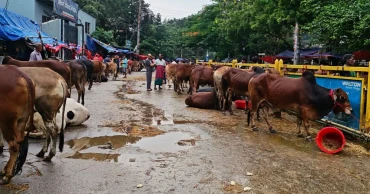
Cattle prices crash over 50% in Dhaka markets on last day
Prices of sacrificial cattle at Dhaka's makeshift markets have plummeted by more than 50 percent in the final hours before Eid-ul-Azha, with traders reporting heavy losses while buyers welcomed the sharp decline, though poor weather and soaring transport costs are dampening the overall festive mood.
Visits to several cattle markets across the capital on Wednesday revealed a dramatic single-day price drop for medium and large cattle, while smaller animals remained largely steady in price.
At the Notunbazar 100-Feet cattle market, trader Aynal, who brought 19 cattle from Chuadanga, said buyers are now offering Tk 1.20 lakh to Tk 1.50 lakh for animals he had priced at Tk 2.50 lakh.
“If I sell at these prices, I will face massive losses,” he said, adding that he managed to sell only seven animals.
Another trader, Shahin, who travelled from Jamalpur with seven cattle, sold only three. He said a cow he had refused to part with at Tk 1.80 lakh is now being offered Tk 1.20 lakh, while another priced at Tk 3 lakh is drawing bids of just Tk 1.50 lakh.
At the Aftabnagar market, buyer Raisu noted that demand for premium cattle has virtually collapsed. “No one is willing to go beyond Tk 5 lakh. Sellers asking Tk 8 to Tk 10 lakh are hearing counter-offers of Tk 3 to Tk 3.50 lakh. Those who brought high-value animals will likely return home without selling.”
At Meradiya market, Monsur, who oversees the haseel (transaction tax) booth, confirmed the price slide. “Animals that were selling for Tk 1.50 lakh are now going for Tk 70,000 to Tk 80,000,” he said, noting that transaction volumes have fallen sharply compared to last Eid.
Weather and Logistics Add to Woes
Traders and buyers alike pointed to several days of continuous rainfall as the primary driver of the market downturn, creating waterlogging at multiple venues with no drainage arrangements in sight.
Buyer Sakibul Alam at the Tejgaon cattle market said adverse weather forced him to hire a pickup truck — at twice the usual rate. “The cattle price has come down, but extra costs are being added from every direction.”
Trader Suleman from Jamalpur, selling at Aftabnagar, said rising fodder prices and higher transport costs had already squeezed his margins before reaching Dhaka. “We raise cattle for Eid expecting extra profit. But at the prices buyers are offering, selling to a butcher by the kilogram would fetch more.”
Buyer Saidul Islam at Meradiya noted that a five percent haseel charge, roughly Tk 10,000 on a Tk 2 lakh purchase, is also factored into buyers' calculations, adding further pressure on transaction prices.
Sellers are urging hat authorities to ensure proper drainage infrastructure at cattle markets in future years, warning that the combination of poor facilities and unpredictable weather is making the annual trade increasingly unviable for farmers.
2 months ago

Gold prices rise ahead of Eid as BAJUS revises rates
Bangladesh Jewellers Association (BAJUS) has raised gold prices in the domestic market ahead of Eid, pushing the price of 22-carat gold up by Tk 2,158 per bhori to Tk 2,38,121, effective from 10:00am Monday.
The price revision comes on the back of rising pure gold (tejabi) values in the local market, BAJUS said in a statement.
Under the revised rates, 21-carat gold will now be sold at Tk 2,27,331 per bhori, 18-carat at Tk 1,94,847 and traditional-method gold at Tk 1,58,689 per bhori (1 bhori = 11.664 grams).
The latest hike reverses a cut made just two days ago.
On May 23, BAJUS had reduced the price of 22-carat gold by the same margin Tk 2,158 per bhori, setting it at Tk 2,35,963.
Gold prices in Bangladesh have now been revised 69 times so far in 2026, with 37 upward and 32 downward adjustments, reflecting the continued volatility in global bullion markets.
Silver prices have also been revised upward alongside gold. The price of 22-carat silver has been raised by Tk 117 per bhori to Tk 5,774.
Other silver rates now stand at Tk 5,540 for 21-carat, Tk 4,724 for 18-carat and Tk 3,558 per bhori for traditional-method silver.
Silver prices have seen 40 revisions in 2026, 22 increases and 18 reductions.
2 months ago

Bibir Bazar land port to remain closed for 7 days over Eid
Import-export activities between Bangladesh and India through Bibir Bazar land port in Cumilla will remain suspended for seven days from Monday on the occasion of Eid-ul-Azha.
“All types of import and export activities through the port will remain closed from May 25 to May 31,” said Nirmal Pal, general secretary of the land port’s Clearing and Forwarding Agents Association.
However, movement of passport holders between the two countries will continue during the period, he said.
Business activities at the port will resume from June 1, he added.
2 months ago