local-business

Islami Bank board meeting discusses business performance, takes policy decisions
The Board of Directors of Islami Bank Bangladesh PLC held a meeting on Thursday to review the bank’s recent business performance and deliberate on key strategic matters.
The meeting, held at the Islami Bank Tower in the capital, was presided over by Professor Dr. M. Zubaidur Rahman, Chairman of the bank.
The session was attended by the heads of the bank's specialized committees and top management, including Mohammad Khurshid Wahab, Chairman of the Executive Committee.
Md. Abdus Salam, FCA, FCS, Chairman of the Audit Committee, Professor Dr. M. Masud Rahman, Chairman of the Risk Management Committee, Md. Abdul Jalil, Independent Director, Md. Omar Faruk Khan, Managing Director, Md. Habibur Rahman, Company Secretary.
According to a press release, the board conducted a comprehensive review of the bank’s current operational status and financial health. Following the discussions, several important policy-related decisions were adopted to strengthen the bank's governance and market position.
The board expressed its commitment to maintaining the bank's growth momentum while ensuring compliance with regulatory frameworks.
4 months ago

Fuel supply to continue on holidays to stabilise market: BPC
The Bangladesh Petroleum Corporation (BPC) has decided to continue supplying fuel oil on weekly holidays (Friday and Saturday) to ensure market stability and maintain uninterrupted supply across the country.
In a message signed by BPC Deputy Secretary Shahina Sultana on Thursday, the corporation said the move aims to keep the supply of fuel oil normal in line with public demand.
According to the statement, the government has already scheduled fuel imports from abroad and shipments are arriving regularly as part of the planned supply chain.
At the same time, fuel is being distributed from the main installations to depots across the country through rail wagons and tankers on a regular basis to ensure smooth delivery to dealers.
Following directives from the Energy and Mineral Resources Division and BPC, the depots and main installations of the corporation’s marketing companies will remain open on government holidays to continue fuel distribution nationwide.
Earlier on Wednesday, BPC issued another directive to ease fuel supply pressure in divisional cities and meet public demand.
The corporation reduced the previous restriction on fuel allocation cutting the reduction in average sales of octane and petrol in divisional cities from 25 percent to 15 percent.
Under the revised instruction, filling stations will now receive fuel supplies based on the updated allocation chart to ensure smoother distribution.
4 months ago

Gold price drops by Tk 3,324 per bhori in Bangladesh
The price of gold in Bangladesh dropped by Tk 3,324 per bhori on Thursday, following two consecutive hikes, according to the Bangladesh Jewellers Association (BAJUS).
In a notification issued on morning, BAJUS said the new price of 22-carat gold has been fixed at Tk 267,106 per bhori (11.664 grams), effective immediately.
The association said the price adjustment was made as the price of pure gold (tejabi gold) declined in the local market.
Under the new rates, 21-carat gold will cost Tk 254,975 per bhori, while 18-carat gold has been priced at Tk 218,583 per bhori. The price of gold produced through the traditional method has been set at Tk 178,401 per bhori.
BAJUS last adjusted gold prices on March 11, when the price of 22-carat gold was increased by Tk 2,216 per bhori to Tk 270,430.
So far in 2026, gold prices have been adjusted 41 times in the local market: raised 26 times and reduced 15 times.
Alongside gold, the price of silver has also been reduced this time. BAJUS lowered the price of 22-carat silver by Tk 350 per bhori, setting the new rate at Tk 6,357.
In 2026, silver prices have been adjusted 26 times so far, with 16 increases and 10 reductions.
4 months ago

Gold price rises again in Bangladesh
Gold prices in Bangladesh have increased again within a day as the Bangladesh Jewellers Association (Bajus) on Wednesday raised the price of 22-carat gold by Tk 2,216 per bhori.
With the latest adjustment, the price of 22-carat gold has been set at Tk 270,430 per bhori (11.664 grams), according to a Bajus notification issued in the morning.
The association said the price of tejabi gold (pure gold) has increased in the local market, prompting the revision of gold prices. The new rates have taken immediate effect across the country.
Under the revised pricing, 21-carat gold will cost Tk 258,124 per bhori, while 18-carat gold has been fixed at Tk 221,266 per bhori. The price of gold produced through the traditional method has been set at Tk 180,617 per bhori.
Just a day earlier, on Tuesday, Bajus had increased the price of 22-carat gold by Tk 3,266 per bhori, setting it at Tk 268,214.
So far in 2026, gold prices have been adjusted 40 times in the country, including 26 hikes and 14 reductions.
Alongside gold, the price of silver has also been increased. Bajus raised the price of 22-carat silver by Tk 175 per bhori, setting it at Tk 6,707.
The price of 21-carat silver has been fixed at Tk 6,415 per bhori, while 18-carat silver will cost Tk 5,482 per bhori. Silver produced through the traditional method has been priced at Tk 4,082 per bhori.
This year so far, silver prices have been revised 25 times, including 16 increases and nine decreases.
4 months ago

Bangladesh Bank appoints observers to 4 private banks to curb irregularities
Amid ongoing concerns over governance and allegations against independent directors, Bangladesh Bank has appointed observers to four private commercial banks.
The banks are National Bank, Premier Bank, IFIC Bank, and Al-Arafah Islami Bank.
The central bank issued formal letters last week appointing four officials of director rank to monitor the operations of these banks. The move follows the dissolution of the banks' previous boards shortly after the fall of the Awami League government, which was triggered by widespread reports of corruption and financial anomalies.
Although independent and shareholder directors were subsequently appointed by the central bank to manage these banks, officials noted that the situation has not seen significant improvement. Sources within Bangladesh Bank indicated that the observers were specifically deployed following allegations against some of the current independent directors.
The newly appointed observers will attend all meetings of the Board of Directors, Executive Committees, and Audit Committees to provide rigorous oversight.
According to central bank sources, the appointees are Munir Ahmed Chowdhury, Director of Bank Supervision Department-12 appointed at National Bank.
Mohammad Anisur Rahman, Director of Islamic Banking Regulation and Policy Department of the central bank to Al-Arafah Islami Bank. ANM Moinul Kabir, Director of the Payment Systems Department to Premier Bank: and AKM Kamruzzaman, Director of Forex Reserve and Treasury Management Department-1 to IFIC Bank.
The four banks were previously under the control of influential groups and individuals closely linked to the former administration. National Bank was operated by the Sikdar Group, while Premier Bank was led by HBM Iqbal’s Premier Group. IFIC Bank was under the chairmanship of Salman F. Rahman, former advisor to the ousted Prime Minister, and Al-Arafah Islami Bank was overseen by Abdus Samad, Vice Chairman of the S. Alam Group.
The dual presence of both independent directors and central bank observers has raised questions within the banking sector regarding the specific message the regulator intends to send regarding the stability and integrity of these institutions.
4 months ago
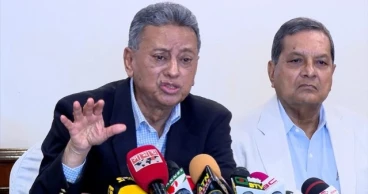
Middle East tensions figuring in govt's policy plans for economy: Amir Khasru
Finance Minister Amir Khasru Mahmud Chowdhury on Monday said the government is taking into account the possible economic impacts of ongoing geopolitical tensions in the Middle East while preparing its policy plans and economic projections.
“We are conducting our overall economic activities while anticipating the possible challenges that may arise from the current global situation,” he said.
Responding to a question at a briefing marking the launch of the government’s “Family Card” programme at the Multipurpose Hall of the Ministry of Finance, the minister said the government is closely monitoring global developments and adjusting its strategies accordingly.
Khosru noted that conflicts and other global disruptions pose potential risks to economies worldwide, and Bangladesh is not outside their influence.
He said the government has already factored such uncertainties into its economic forecasts and policy directions.
“This is something we cannot avoid. Therefore, we are incorporating these realities into our projections and planning,” he said.
The finance minister said the government’s future economic outlook and projections will reflect the uncertainties created by global conflicts and geopolitical developments.
“We are working continuously, and our projections for the coming days will take into account the global problems emerging from war and other international factors,” he added.
Khosru said relevant ministries and agencies are coordinating efforts to address potential economic pressures and maintain stability in key sectors.
He also stressed the importance of ensuring energy security amid the uncertain global environment.
“Energy security is extremely important for us. We are seeking cooperation from various partners and are in discussions with suppliers and governments,” he said.
The minister said the government remains committed to managing the country’s economic activities prudently while preparing for possible external shocks arising from global crises.
He expressed confidence that with careful planning and coordination among relevant agencies, Bangladesh will be able to navigate potential challenges stemming from global geopolitical tensions.
4 months ago

Businesses urge govt to pass amendment to anti-tobacco law in first session of parliament
Leaders of various business associations on Monday urged the government to pass the Smoking and Tobacco Products Usage (Control) (Amendment) Ordinance 2025 as a law in the first session of the 13th National Parliament, warning that delaying the move could weaken tobacco control efforts and harm public health.
They said if the ordinance remains only on paper and is not enacted by Parliament, it will become ineffective, leading to an increase in tobacco-related deaths, higher healthcare costs and setbacks in achieving the Sustainable Development Goals (SDGs).
The call came at a discussion titled “The Importance of Strengthening Tobacco Control Law for Preventing Non-Communicable Diseases and Protecting Public Health,” organised by Dhaka Ahsania Mission at the Zahur Hossain Chowdhury Hall of the National Press Club.
Speakers at the meeting said about 21.3 million people aged 15 years and above in Bangladesh currently use tobacco, while nearly 200,000 people die every year from tobacco-related diseases—an average of around 545 deaths per day.
They warned that the death toll could rise further if the ordinance is not passed during the first session of the new Parliament.
Business leaders also pointed out that although the government earns around Tk 40,000 crore annually from tobacco-related revenue, the total economic loss caused by healthcare expenses, productivity loss and premature deaths exceeds Tk 87,000 crore.
They said the interim government approved the Tobacco Control Ordinance in December last year to address the issue, and stressed that it must now be passed as a law in Parliament to ensure its effective implementation.
Presenting the keynote, Shariful Islam, coordinator of the Tobacco Control Project at Dhaka Ahsania Mission, highlighted several key provisions of the ordinance. These include banning smoking in all public places and public transport and removing designated smoking areas to protect non-smokers from second-hand smoke.
The ordinance also proposes banning the display of tobacco products at points of sale, prohibiting all forms of tobacco advertising and promotion, increasing pictorial health warnings on cigarette packets to 75 percent, and banning the sale of tobacco products within 100 metres of educational institutions, hospitals and sports facilities.
The meeting was chaired by Dr S M Khalilur Rahman, vice-president of Dhaka Ahsania Mission, while Mokhlesur Rahman, deputy director of its health sector, delivered the welcome speech.
Among others present were Badiuzzaman Badal, president of Bangladesh Inland Water Transport (Passenger) Association; Zakir Hossain, general secretary of Bangladesh Super Market Owners Association; Nazmul Hasan Mahmud, president of Bangladesh Shop Owners Association; Arifur Rahman Tipu of Dhaka Metropolitan Shop Owners Association; Mokaddem Hossain, general secretary of Bangladesh Combined Workers Federation; Alamgir Hossain Khan, general secretary of Bangladesh Grocery Business Association; and Rafiqul Islam Babul, president of the National Employees Federation, along with leaders from various professional organisations.
4 months ago

Bangladesh Bank eases share transfers, profit repatriation for foreign investors
In a major move to boost investor confidence, Bangladesh Bank has simplified the process for foreign investors to transfer shares and repatriate sale proceeds from non-listed public and private limited companies.
The central bank issued a comprehensive master circular (EID Circular No. 01), consolidating and updating regulations from 2018 and 2020 to create a more predictable, efficient, and transparent exit mechanism for non-resident investors.
Prashanta Kumar Mondal, Public Relations Officer of the Bangladesh Investment Development Authority (BIDA), shared the details in a press release on Monday.
Under the new guidelines, Authorized Dealer (AD) banks have been granted significantly more power to process transactions without seeking prior approval from the central bank.
Higher Transaction Limits: AD banks can now process share transfers and repatriations up to Tk 100 crore following prescribed valuation methods.
Joint Declarations: For transactions up to Tk 1 crore, transfers can be completed based on a joint declaration by the buyer and seller, bypassing the need for independent valuation.
Fixed Timelines: Once documentation is complete, share transfers must be finalized within 45 days, and the repatriation of sale proceeds must be processed within five working days.
Institutional Oversight: Every AD bank is required to form an internal committee led by senior management to review valuation and repatriation applications.
The reform package was finalized on November 19 last year by a high-level Capital Repatriation Committee, led by BIDA Executive Member Nahian Rahman Rochi and supported by Bangladesh Bank.
BIDA Executive Chairman Chowdhury Ashik Mahmud Bin Harun emphasized that a healthy environment for Foreign Direct Investment (FDI) relies on investors feeling confident at every stage of their journey—including the exit.
"By reducing approval complexities, allowing easier repatriation of sale proceeds, and simplifying valuation and documentation, Bangladesh is moving toward that goal," said the BIDA chief.
"These initiatives are the foundation of a reliable environment for foreign investment," he said.
4 months ago

Remittance inflow to stay stable if Middle East jobs remain unaffected: BAB chairman
Bangladesh Association of Banks (BAB) Chairman Abdul Hai Sarker on Monday said the flow of inward remittances is expected to remain stable despite the ongoing conflict in the Middle East, provided Bangladeshi expatriate workers can continue their jobs without disruption.
He made the remarks while talking to reporters after a meeting with Bangladesh Bank Governor Md Mostaqur Rahman at the central bank headquarters.
“If our expatriate workers in the Middle East can continue their regular jobs, remittance inflow will remain steady,” the BAB chairman said.
However, the situation could change if the conflict leads to job losses or disruptions at workplaces, he said.
“If the war affects their employment or working environment, it may negatively impact remittance inflows,” he said.
It is too early to predict the outcome as much depends on the duration and stability of the situation, said the BAB chaimran.
During the meeting, Abdul Hai Sarker also stressed the need for regular coordination between the central bank and commercial banks on policy decisions to avoid gaps in implementation.
He said discussions also covered measures to maintain stability in weaker banks within the financial sector through necessary support.
The meeting further addressed the implementation of International Financial Reporting Standard (IFRS)-9, which requires banks to maintain provisions for expected credit losses.
The BAB chairman said a circular has already been issued and the standard is scheduled to come into effect in 2028.
“While we are following international standards, banks are exploring ways to implement them effectively within Bangladesh’s socio-economic context,” he said noting that the country’s banking infrastructure and capacity differ from those of developed economies.
He also expressed optimism about the central bank’s supportive stance toward private banks.
4 months ago

Private sector-led growth vital to revive Bangladesh’s economy: MCCI report
Reviving private sector-led growth will be critical for restoring Bangladesh’s economic momentum and ensuring sustainable development, according to a new policy report launched on Monday by the Metropolitan Chamber of Commerce and Industry (MCCI).
M Masrur Reaz, Chairman and CEO of Policy Exchange Bangladesh presented the report titled “Reviving Private Sector-led Economic Growth: Critical Issues and Priorities Facing the New Government in Bangladesh,” at a programme organised by MCCI.
The report provides an evidence-based assessment of Bangladesh’s current economic challenges and outlines a set of reform priorities aimed at restoring macroeconomic stability, strengthening investment climate, and enabling sustainable growth driven by the private sector.
Speaking at the launch, Reaz said Bangladesh stands at a ‘critical juncture’ as the economy transitions from crisis management to recovery amid persistent structural constraints and global uncertainty.
He said although the country experienced decades of strong growth averaging around 6–7 percent, economic momentum has slowed significantly since 2022 due to a combination of global shocks, domestic policy weaknesses and institutional challenges.
According to the report, Bangladesh’s GDP growth has dropped to below 4 percent in FY2025, while inflation, declining private investment and tightening credit conditions have continued to weigh on business confidence and economic activity.
The study highlights that structural weaknesses in public finance, the banking sector, export competitiveness and the investment climate are undermining the country’s growth prospects.
Without comprehensive reforms, these vulnerabilities could push the economy toward prolonged stagnation, it warned.
The report identifies seven priority areas for policy reform to revive private sector-led growth.
These include macroeconomic stabilisation, fiscal management and debt sustainability, banking sector reforms, export diversification, private investment mobilisation, energy security, and skills development.
It also stresses that restoring macroeconomic stability should be the immediate priority for policymakers. The study recommends tighter monetary and fiscal coordination, improved revenue mobilisation, and a more flexible exchange rate regime to stabilise inflation and rebuild foreign exchange reserves.
In the financial sector, the report highlights the urgent need to address rising non-performing loans and governance weaknesses in banks, warning that these issues are constraining credit flows and discouraging private investment.
Export diversification is another key challenge identified in the report.
While Bangladesh’s export sector remains heavily dependent on ready-made garments, the report calls for targeted policies to develop new high-potential sectors and strengthen global value chain integration, particularly as the country prepares for its post-LDC transition.
To boost investment, the study recommends improving regulatory predictability, modernising business-related laws and strengthening the investment promotion framework to attract both domestic and foreign investors.
The report also emphasises the importance of energy sector reforms to ensure reliable and affordable power supply for businesses, as well as expanding skill development programmes to create a future-ready workforce capable of supporting productivity growth and job creation.
MCCI leaders said the report aims to provide policymakers with a comprehensive reform roadmap to restore economic confidence and enable Bangladesh to move toward a more resilient and competitive growth model.
4 months ago