World-Business

G7 foreign ministers gather in Canada amid rising trade tensions with Trump
Foreign ministers from the Group of Seven (G7) industrialized nations are meeting in southern Ontario this week as trade and defense tensions escalate between the United States and its traditional allies, including Canada, alongside growing uncertainty over U.S. President Donald Trump’s Gaza ceasefire plan and efforts to end the Russia-Ukraine war.
Canadian Foreign Minister Anita Anand, who is hosting the meeting of G7 counterparts from the U.S., Britain, France, Germany, Italy and Japan, told The Associated Press that maintaining cooperation “across a range of issues” remains essential despite trade pressures.
“We’re tackling a range of critical issues with one main focus: putting the safety and security of Americans FIRST,” U.S. Secretary of State Marco Rubio said in a social media post ahead of the talks.
Anand also invited top diplomats from Australia, Brazil, India, Saudi Arabia, Mexico, South Korea, South Africa and Ukraine to join portions of the two-day meeting. Key agenda items include promoting long-term peace and stability in the Middle East and reaffirming commitment to Trump’s proposed Gaza ceasefire plan.
On Wednesday morning, the ministers are scheduled to meet with Ukraine’s foreign minister. The U.K. announced ahead of the talks that it would contribute 13 million pounds ($17 million) to help repair Ukraine’s energy infrastructure ahead of winter. The funds will support power, heating and water system repairs, as well as humanitarian assistance.
“President Putin is trying to plunge Ukraine into darkness and cold,” U.K. Foreign Secretary Yvette Cooper said, adding that Britain’s aid aims to “keep the lights and heat on.” Canada has made a similar pledge in recent weeks.
SoftBank sells Nvidia stake for $5.8 billion to boost investments in OpenAI
Canada’s tenure as G7 host this year has been overshadowed by strained relations with Washington, largely due to Trump’s tariffs on Canadian imports and renewed friction over defense spending demands. Trump has pressed NATO allies — all G7 members except Japan — to spend 5% of GDP on defense. While some have agreed, others, including Canada and Italy, remain far below that benchmark. Anand said Canada plans to reach the target by 2035.
Differences within the G7 also persist over the Israel-Hamas war, with Britain, France and Canada supporting recognition of a Palestinian state, even without a peace deal. Meanwhile, several allies have taken a harder stance on Moscow’s aggression in Ukraine than Trump has.
The meeting near the U.S. border follows Trump’s abrupt suspension of trade talks with Canada after Ontario’s provincial government ran an anti-tariff ad campaign in the U.S. Prime Minister Mark Carney has since apologized and expressed readiness to resume negotiations.
Anand said she will meet separately with Secretary Rubio to discuss bilateral and global issues, though trade matters fall under a different U.S. official’s purview. “Every complex relationship has numerous touch points,” she said. “There’s continued work to be done — both on trade and beyond — and that’s where Secretary Rubio and I come in.”
China’s exports dip 1.1% in October as shipments to US plunge 25%
U.S. officials said Rubio will focus on halting the wars in Gaza and Ukraine, as well as maritime security, Haiti, Sudan, and cooperation on critical minerals. Canada’s priorities include Arctic security, the Ukraine war, and Haiti. A working lunch will center on energy and the supply of critical minerals vital to modern technologies and defense industries — a key area of U.S.-Canada cooperation.
Source: AP
8 months ago

SoftBank sells Nvidia stake for $5.8 billion to boost investments in OpenAI
Japanese technology conglomerate SoftBank said Tuesday it has sold its shares in U.S. chipmaker Nvidia for $5.8 billion, signaling a strategic shift toward investing more heavily in OpenAI, the developer of ChatGPT.
SoftBank Group Corp., based in Tokyo, said the Nvidia stake was sold in October. The move comes as the company’s net profit nearly tripled in the first half of the current fiscal year compared with the same period a year earlier.
Between April and September, SoftBank’s profit surged to about 2.5 trillion yen (approximately $13 billion), while revenue rose 7.7% year-on-year to 3.7 trillion yen ($24 billion).
SoftBank’s earnings often fluctuate because of its wide-ranging investments through its Vision Funds, which have recently performed well.
In February, SoftBank Chairman Masayoshi Son joined U.S. President Donald Trump, OpenAI CEO Sam Altman, and Oracle co-founder Larry Ellison to announce plans for a major artificial intelligence initiative called Stargate, which could see investments of up to $500 billion.
SoftBank has already poured tens of billions of dollars into OpenAI and is partnering with the U.S.-based firm to expand AI services in Japan.
The sale of its Nvidia shares marks Son’s strategic pivot toward artificial intelligence and also generated substantial gains for the company, benefiting from Nvidia’s meteoric rise in market value.
Japan and China trade sharp words after PM Takaichi’s comments on Taiwan
Nvidia recently became the world’s first $5 trillion company—just three months after hitting the $4 trillion mark—and has pledged to invest $100 billion in OpenAI to build massive new AI data centers with at least 10 gigawatts of computing capacity.
While Nvidia and other AI-related firms have fueled this year’s stock market rally, some analysts warn that tech valuations may be overheating, drawing parallels to the early 2000s dot-com bubble.
Despite the divestment, SoftBank and Nvidia maintain close ties, as many SoftBank-backed ventures use Nvidia’s technology.
SoftBank also holds stakes in chipmakers Arm Holdings and Taiwan Semiconductor Manufacturing Co., both benefiting from the growing global demand for AI technologies.
SoftBank shares have nearly doubled in value over the past year, rising another 2% on Tuesday. Nvidia’s stock dipped 1.3% in premarket trading after gaining 5.8% on Monday.
Source: AP
8 months ago

China’s Singles’ Day shopping festival reflects weak consumer sentiment amid economic slowdown
China’s annual “Singles’ Day” shopping festival, once known for record-breaking sales, is now reflecting the country’s cautious consumer mood as economic challenges weigh on spending.
Alice Zhang, a 29-year-old marketer from Guangzhou, said she spent only about half as much this year as in 2024—roughly 3,000 yuan ($421)—after her salary was cut by more than 20%. “I’ve made a conscious effort to cut back,” she said, noting she opted for cheaper products and skipped buying new shoes altogether.
The festival, created by e-commerce giant Alibaba in 2009 as China’s answer to Black Friday, has evolved from a one-day event on Nov 11 into a weeks-long sales period. Analysts say this year’s subdued enthusiasm shows consumers remain wary despite government efforts to boost domestic demand.
According to Chinese retail data provider Syntun, combined sales for this year’s Singles’ Day reached over 1 trillion yuan ($140 billion) by Oct 31. Last year, the figure rose 26% year-on-year to 1.44 trillion yuan.
Economists say household confidence remains fragile amid slow income growth, a cooling property market, and limited stimulus effects. “Confidence remains quite downbeat among households,” said Lynn Song, chief economist for Greater China at ING Bank.
Shaun Rein, managing director of China Market Research Group, said early promotions this year reflect the efforts of major platforms like Alibaba and JD.com to “drum up business” amid weak demand. However, many consumers complained that discounts were smaller and less appealing than in previous years, while analysts observed growing “consumer fatigue.”
Some shoppers also suspect that online retailers inflate prices before offering “discounts.” Guangzhou-based freelance media worker Sonia Song said she now compares prices more carefully across livestreaming apps and e-commerce sites. “I’ll only buy what’s cheapest or most cost-effective now,” she said.
Meanwhile, government rebate programs for trading in old appliances and vehicles have reduced the impact of online discounts, as consumers who already benefited from earlier deals are less likely to spend again.
Amid weak domestic demand, Chinese e-commerce giants are expanding abroad. Alibaba’s Taobao platform is running Singles’ Day campaigns in 20 countries, focusing increasingly on Southeast Asian markets like Thailand, Vietnam, and the Philippines following U.S. restrictions on duty-free small shipments.
Despite the slowdown, beauty, health, and wellness products continue to perform well, according to WPIC Marketing + Technologies CEO Jacob Cooke.
Still, many Chinese are tightening their belts. Gao Liang, who works at a fitness club in Beijing, said he expects to spend far less this year after a 20% income drop. “Our business hasn’t been doing well because people are cutting spending,” he said. “Given my unstable income, I don’t need to hoard things.”
Source: AP
8 months ago

South Korean solar firm cuts pay, hours for Georgia workers as US detains imports
South Korean solar manufacturer Qcells has announced temporary pay and hour reductions for around 1,000 of its 3,000 employees in Georgia, as U.S. customs authorities continue detaining imported components critical to its solar panel production.
Qcells, a subsidiary of South Korea’s Hanwha Solutions, said Friday it will also lay off 300 temporary workers employed through staffing agencies at its plants in Dalton and Cartersville, northwest of Atlanta.
According to the company, U.S. Customs and Border Protection (CBP) has been holding shipments of imported materials at ports over suspicions that they may contain components produced with forced labor in China. The detentions have slowed Qcells’ assembly lines and limited production capacity.
The move follows an announcement by Homeland Security Secretary Kristi Noem in August, stating that enforcement of the 2021 Uyghur Forced Labor Prevention Act would be intensified. The law restricts goods linked to forced labor in China’s Xinjiang region. Reports indicate that CBP began detaining Qcells’ solar cells as early as June.
Qcells, however, has denied any link to forced labor or Chinese supply chains. Company spokesperson Marta Stoepker said, “Our latest supply chain is sourced completely outside of China, and our legacy supply chains contain no material from Xinjiang province based on third-party audits and supplier guarantees.”
She added that Qcells maintains “robust supply chain due diligence measures” and detailed documentation, which has helped secure the release of some shipments.
“Although our supply chain operations are beginning to normalize, HR actions must be taken to improve operational efficiency until production capacity returns to normal levels,” Stoepker said in a statement.
The company confirmed that affected workers will retain their full benefits during the temporary furloughs.
Qcells is currently completing a $2.3 billion plant in Cartersville to produce ingots, wafers, and solar cells — key components of solar modules. Despite the rollback of most federal tax credits for solar panel purchases under the Trump administration earlier this year, Qcells said construction of the facility will continue.
“Our commitment to building the entire solar supply chain in the United States remains strong,” Stoepker said. “We will soon be back on track, with our Georgia team delivering American-made clean energy to communities nationwide.”
Source: AP
8 months ago
US airlines cancel over 2,500 weekend flights as shutdown strains air traffic control
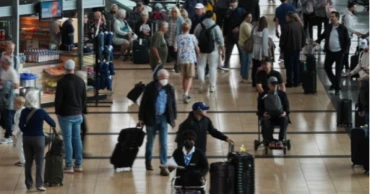
U.S. airlines canceled more than 2,500 flights over the weekend as the Federal Aviation Administration (FAA) continued to scale back air traffic operations amid the ongoing government shutdown, officials said Saturday.
The agency’s reduced capacity order — aimed at coping with unpaid and overworked air traffic controllers — has begun to disrupt some of the country’s busiest airports, deepening the fallout from what has become the nation’s longest federal shutdown.
“We all travel. We all have somewhere to be,” said Emmy Holguin, 36, waiting for a Miami-to-Dominican Republic flight. “I’m hoping the government can take care of this.”
Analysts warn that if cancellations keep growing into Thanksgiving week, the disruptions could ripple far beyond air travel, squeezing tourism, supply chains, and holiday shipping.
Cancellations surge as staffing thins
Flight-tracking site FlightAware reported more than 1,500 cancellations Saturday, following over 1,000 on Friday, with another 1,000-plus flights already canceled for Sunday.
Major airports in Atlanta, Chicago, Charlotte, and Newark were hit hardest, with delays spreading along the East Coast due to radar and tower staffing shortages.
Drone sighting briefly halts flights at Berlin airport
The FAA said the current flight reductions affect about 4% of commercial operations across 40 airports — a figure expected to rise to 10% by Friday if the shutdown drags on. Transportation Secretary Sean Duffy warned that deeper cuts could follow.
Controllers working without pay
Many controllers have gone without pay for nearly a month, forcing some to call in sick or take second jobs. Others are working mandatory six-day weeks with no pay, according to the National Air Traffic Controllers Association (NATCA).
On Saturday, the union said it delivered 1,600 handwritten letters to Congress urging lawmakers to end the shutdown.
Travelers stranded and frustrated
Although most passengers have been able to rebook, uncertainty remains about future cancellations. “Travel is stressful enough. Then you put these disruptions in place, and it really makes everything more challenging,” said Heather Xu, 46, flying home to Puerto Rico after a cruise.
Some travelers canceled plans altogether. Diana Alvear of New Jersey said her family scrapped their trip to California over safety and disruption concerns. While United Airlines refunded the airfare, she said they lost a $700 Airbnb deposit.
“This has been costly and disappointing,” Alvear said. “It’s really weighing on our hearts.”
Economic ripple effects
Experts warned that disruptions could soon hit consumers’ wallets. Nearly half of U.S. air freight travels in passenger plane cargo holds, meaning flight cuts could push up shipping costs and retail prices.
Pakistan’s PIA resumes UK flights after five-year ban
“This shutdown will impact everything — from business travel to tourism to local tax revenue,” said Greg Raiff, CEO of Elevate Aviation Group. “It’s a cascading effect.”
Patrick Penfield, a supply chain professor at Syracuse University, said the longer the shutdown lasts, “the more likely we are to see the economic pain extend beyond airports and into everyday life.”
Source: AP
8 months ago

UPS cargo plane crash toll rises to 14; no one believed missing
Fourteen people have been confirmed dead following the crash of a UPS cargo plane in Louisville, Kentucky, with no one believed to be still missing, Mayor Craig Greenberg said Saturday.
Greenberg wrote on X that the 13 victims recovered from the crash site matched the number of missing persons reported to police. “We believe the total number of victims will be 14,” he said, noting that one person had died Friday while being treated in a hospital.
The Jefferson County coroner is working to identify the victims and will release their names once confirmed, the mayor added.
The crash occurred Tuesday at UPS Worldport, killing the three pilots aboard the MD-11 aircraft bound for Honolulu. The plane caught fire after an engine separated during takeoff, crashing into nearby businesses and igniting a massive blaze.
Following the accident, the Federal Aviation Administration (FAA) on Saturday ordered all McDonnell Douglas MD-11 planes to be grounded pending inspections. UPS and FedEx had already announced similar precautionary moves on Friday.
MD-11 aircraft currently make up about 9% of the UPS fleet and 4% of the FedEx fleet, according to company data.
Source: AP
8 months ago

China’s exports dip 1.1% in October as shipments to US plunge 25%
China’s exports fell by 1.1% year-on-year in October, weighed down by a sharp 25% decline in shipments to the United States, according to government data released Friday.
Although trade tensions between Washington and Beijing have recently eased following an agreement between President Donald Trump and Chinese President Xi Jinping to de-escalate the ongoing trade war, the slowdown continues to dampen global demand.
Customs figures show that October’s decline was the weakest performance since February, following an 8.3% surge in September. Imports, meanwhile, grew 1% from a year earlier, far below September’s 7.4% increase.
Shipments to the US have now fallen by double digits for seven consecutive months, as China seeks to expand its export markets in Southeast Asia and Africa. Analysts noted that last month’s downturn was also influenced by a high base from October 2024, when exports had jumped 12.6%, the fastest growth in over two years.
Economists said China’s struggling property sector and weak domestic spending remain significant drags on growth.
Japan resumes seafood exports to China after 2 years
During their late October meeting in South Korea, Trump and Xi agreed to roll back some tariffs and delay new port fees, while China suspended export curbs on rare earths for one year and pledged to buy more US agricultural products. In response, Washington eased some sanctions on Chinese firms.
Goldman Sachs economists forecast that Chinese export volumes could grow 5%–6% annually, helping boost the country’s global trade position. Capital Economics analysts Leah Fahy and Zichun Huang said the partial tariff cuts might slightly lift exports later this year, though the real effects would likely appear in early 2026.
BNP Paribas’s Wei Li predicted that any meaningful rebound in exports to the US would begin in the first quarter of next year and accelerate in the second.
Speaking at the China International Import Expo in Shanghai this week, Premier Li Qiang reaffirmed China’s commitment to “free markets and free trade,” while criticizing protectionist policies that harm developing economies.
Source: AP
8 months ago

Japan resumes seafood exports to China after 2 years
Japan announced Friday that its seafood exports have resumed for the first time since China imposed a ban over the discharge of treated radioactive wastewater from the tsunami-hit Fukushima Daiichi nuclear power plant more than two years ago.
Chief Cabinet Secretary Minoru Kihara told reporters that 6 metric tons (6.6 tons) of scallops harvested in Hokkaido were shipped to China on Wednesday, the first shipment to that country since Beijing banned Japanese seafood in August 2023.
Beijing announced in June that it would ease the ban and prepare for the resumption of imports, following repeated negotiations between the two sides.
The ban was a major blow to Japan's seafood industry, especially scallop and seafood cucumber exports. China was the biggest overseas market for Japanese seafood.
“The government takes the development as a positive move,” Kihara said as he called on China to continue to re-register pending applications for Japanese seafood exporters.
A ban remains in place for seafood from Fukushima and nine nearby prefectures, which China imposed immediately after the plant's meltdowns.
Kihara said Japan will also continue to urge Beijing to lift the remaining bans and resume importing Japanese beef.
The Fukushima Daiichi plant suffered triple meltdowns following a massive earthquake and tsunami in 2011, causing leaks of massive radioactive wastewater that need to be stored in tanks.
The utility won Japanese government approval and support from the International Atomic Energy Agency for the gradual release of the water into the sea after treatment and dilution. Japanese officials said the wastewater would be much safer than international standards and the IAEA comprehensive report later confirmed that the discharges meet international safety standards..
8 months ago

Nissan to sell Yokohama headquarters to raise funds amid losses
Struggling Japanese automaker Nissan announced Thursday that it will sell its headquarters building in Yokohama, southwest of Tokyo, for 97 billion yen ($630 million) as part of efforts to strengthen its finances and accelerate modernization.
Under the deal, Nissan will lease back the building and continue to use it as its headquarters, while recording 73.9 billion yen ($480 million) in gains from the sale to Tokyo-based real estate operator MJI Godo Kaisha, the company said in a statement.
The proceeds will be used to upgrade internal systems at its headquarters, including the implementation of AI-driven operations and digital modernization across various departments, Nissan said. The automaker produces models including the March subcompact and Infiniti luxury cars.
MJI Godo is a special purpose trust owned by the Hong Kong-listed Minth Group, a major auto parts manufacturer. The terms of the lease were not disclosed.
Nissan, which is set to release its first-half financial results later Thursday, has been struggling to return to profitability, posting a 670.9 billion yen ($4.4 billion) loss for the fiscal year ending in March.
The company has pledged a turnaround under new CEO Ivan Espinosa, a Mexican executive with two decades of experience at Nissan who assumed the role earlier this year.
“This move reflects a disciplined approach to capital efficiency, unlocking value from non-core assets to support transformation during challenging times,” Nissan said, adding that the strategy is part of its broader efforts to innovate, stay competitive, and invest in future growth.
As part of its restructuring, Nissan is cutting about 15% of its global workforce, roughly 20,000 jobs, and closing its flagship Oppama factory in Japan.
Source: AP
8 months ago

DoorDash tops Q3 order forecasts but warns of rising costs next year
DoorDash reported stronger-than-expected orders and revenue for the third quarter but cautioned investors that spending will rise sharply next year as it ramps up product development.
Shares of the San Francisco-based food delivery giant tumbled in after-hours trading Wednesday after the company warned of higher expenses ahead.
DoorDash said total orders grew 21% year-over-year to 776 million in the July–September quarter, surpassing Wall Street’s forecast of 770 million, according to FactSet data. Revenue climbed 27% to $3.45 billion, also beating expectations of $3.35 billion. The company attributed the strong results to an increase in monthly active users and DashPass subscribers, along with growing delivery demand in new areas such as home improvement and beauty products.
However, the company acknowledged that its growth is being accompanied by mounting costs. Research and development expenses rose 23% to $355 million during the quarter — the highest level in its history. DoorDash said it has more new products under development than ever before.
In recent months, the company has expanded its offerings, including adding restaurant reservations to its app and unveiling “Dot,” an autonomous delivery robot that will soon begin operating in the Phoenix area. It is also developing a mapping platform and a “smart scale” to help retailers detect missing items before delivery.
Abu Dhabi hosts oil summit as OPEC+ pauses early 2026 output hikes
Despite solid sales, profits fell short of expectations. Net income rose 51% to $244 million, or 55 cents per share — below analysts’ projection of 68 cents.
DoorDash said it expects investments to accelerate in 2026, with spending on new initiatives set to rise by several hundred million dollars compared to 2025.
CEO Tony Xu told investors the short-term costs would pave the way for greater efficiency, saying the company is working to unify its technology platform across DoorDash and its newly acquired delivery services, Wolt and Deliveroo.
Source: AP
8 months ago