World-Business

Bangladesh-India trade to continue in consumers’ interest: Commerce Adviser
Commerce Adviser Sk Bashir Uddin on Sunday said the trade between Bangladesh and India will continue in the interest of consumers and businesses of both the countries.
“We have not yet received any official communication from the Indian side. Once we do, we will take appropriate steps. If any issues arise, both sides will work to resolve them through discussions,” he told reporters at the Secretariat.
Referring to media reports, the adviser said, “We’ve learned from social media and media outlets that India has taken certain decisions affecting specific land ports, including Akhaura and Dawki, as well as some border areas.”
Asked if these developments might negatively impact Bangladesh’s exports, Bashir Uddin said, “Not everything we export is affected. A large portion of our exports comes from the garment sector. Our focus remains on achieving competitiveness. The trade is beneficial to both countries. India also has a strong textile industry, yet they import our products based on our capabilities.”
He expressed optimism that the trade would continue, saying, “This is in the interest of consumers and production sectors on both sides.”
Bangladesh now a unique example of growth and development: Commerce Adviser
On the matter of India’s reported restrictions on transshipment and exports, the adviser remarked, “Transshipment hasn’t had any significant impact on us. We’ve managed the situation using our own capacity.”
Regarding the potential impact on Indian businesses, Bashir Uddin said, “Certainly, there will be effects. Trade is a matter of competitiveness, including transport costs. Sometimes we impose bans on agricultural imports, and so does India. This is part of the regular trade management process. Any arising issues will be addressed through dialogue.”
When asked whether Dhaka plans to hold discussions with New Delhi, he responded, “We will take all necessary measures, but as of now, we have not received any official notification.”
Addressing whether bilateral ties have influenced these decisions, the adviser said, “My responsibility is trade, and I intend to remain focused on that… I strongly support open trade. For me, trade liberalisation and inclusion are essential to building the capacity of our businesses and consumers.”
Canadian investors can benefit from investing in Mirsarai: Commerce Adviser
On how Bangladesh plans to reduce its growing trade deficit with India, he said, “This is a long-term challenge. Trade deficits cannot be eliminated overnight. What we import from India is based on proximity and necessity, and they do the same. It’s largely shaped by natural factors. Our goal is to diversify and improve competitiveness to expand trade.”
1 year ago

Trump warns Walmart: Don’t raise prices due to my tariffs but do eat the costs from those taxes
On Saturday, former President Donald Trump sharply criticized Walmart on social media, demanding that the company absorb the extra costs resulting from his tariffs.
As Trump raised import duties, he sought to reassure a doubtful public by claiming that the burden would fall on foreign exporters, not American consumers, and that businesses like retailers and car manufacturers would shoulder any additional expenses. However, most economists have cast doubt on these assertions, warning that the tariffs could fuel higher inflation. Walmart itself cautioned on Thursday that the prices of a wide range of goods — from bananas to children’s car seats — could rise.
Posting on Truth Social, Trump targeted the retail behemoth, which employs 1.6 million workers across the U.S. He argued that Walmart, headquartered in Bentonville, Arkansas, should be willing to reduce its profit margins to support his broader economic strategy, which he claims will eventually bring more manufacturing jobs back to the United States.
“Walmart should STOP trying to blame Tariffs as the reason for raising prices throughout the chain,” Trump posted. “Walmart made BILLIONS OF DOLLARS last year, far more than expected. Between Walmart and China they should, as is said, “EAT THE TARIFFS,” and not charge valued customers ANYTHING. I’ll be watching, and so will your customers!!!”
The posting by the Republican president reflected the increasingly awkward series of choices that many major American companies face as a result of his tariffs, from deteriorating sales to the possibility of incurring Trump’s wrath. Trump has similarly warned domestic automakers to not raise their prices, even though outside analyses say his tariffs would raise production costs.
So far, those tariffs have darkened the mood of an otherwise resilient U.S. economy. The preliminary reading of the University of Michigan survey of consumer sentiment on Friday slipped to its second lowest measure on record, with roughly 75% of respondents “spontaneously” mentioning tariffs as they largely expected inflation to accelerate.
In April, Walmart CEO Doug McMillon was among the retail executives who met with Trump at the White House to discuss tariffs. But the Trump administration went forward despite warnings and has attacked other companies such as Amazon and Apple that are struggling with the disruptions to their supply chains.
Walmart chief financial officer John David Rainey said he thinks $350 car seats made in China will soon cost an additional $100, a 29% price increase.
Colombia seeks to join China-based development bank as Latin America drifts away from Washington
“We’re wired to keep prices low, but there’s a limit to what we can bear, or any retailer for that matter,” he told The Associated Press on Thursday after the company reported strong first-quarter sales.
The administration recently ratcheted down its 145% tariffs on China to 30% for a 90-day period. Trump has placed tariffs as high as 25% on Mexico and Canada due to illegal immigration and drug trafficking, harming the relationship with America’s two largest trading partners.
There is a universal baseline tariff of 10% on most countries as Trump promises to reach trade deals in the coming weeks after having shocked the financial markets in early April by charging higher import taxes based on trade deficits with other countries. Trump insists he intends to preserve the tariffs as a revenue source and that a framework agreement with the United Kingdom would largely keep the 10% tariff rate in place.
Trump has also placed import taxes on autos, steel and aluminum and plans to do so on pharmaceutical drugs, among other products.
The tariffs and Trump’s own reversals on how much he should charge have generated uncertainty across the U.S. economy, such that Federal Reserve Chair Jerome Powell has held the central bank’s benchmark rates steady until there is more clarity. Powell has warned that tariffs can both hurt growth and raise prices.
1 year ago
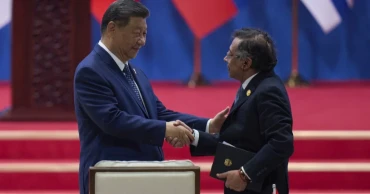
Colombia seeks to join China-based development bank as Latin America drifts away from Washington
Colombia's government has applied to join a China-based development bank, another sign of Latin America's drift away from the U.S. as the Trump administration's foreign aid cuts, trade barriers and crackdown on immigration spurs many leaders in the region to seek closer ties with Washington's geopolitical rival.
Colombian President Gustavo Petro wrapped up a visit to China this week with a stop in Shanghai, where he met with former Brazilian President Dilma Rousseff, the head of the New Development Bank.
The multilateral lender was set up a decade ago as a project of Brazil, Russia, India, China and South Africa — the so-called BRICS nations of major developing markets — as a counter to U.S.-dominated institutions like the World Bank and Inter-American Development Bank.
To date, the New Development Bank has approved loans for 122 infrastructure projects totaling more than $40 billion in areas such as transport, sanitation and clean energy, according to Rousseff.
UN forecasts slower global economic growth following Trump's tariffs and trade tensions
Petro, speaking to reporters in China on Saturday, said that Colombia is committed to purchasing $512 million worth of shares in the bank. He said that he was especially excited by the possibility of securing the New Development Bank's support for a 120-kilometer (75-mile) canal, or railway, connecting Colombia's Atlantic and Pacific Ocean coastlines that he said would position the country at the “heart” of trade between South America and Asia.
Colombia is the second Latin American country to try and join the bank after tiny Uruguay sought membership in 2021.
But Colombia's traditional role as a staunch U.S. ally and caretaker in the war on drugs is likely to raise eyebrows in Washington. The U.S. State Department this week said that it would “vigorously oppose” financing of projects linked to China's Belt and Road Initiative in Latin America. Petro signed up to the initiative during a summit with fellow leftist leaders from Brazil and China.
Petro, a former leftist guerrilla, said he wouldn't be dissuaded by U.S. pressure and reaffirmed that Colombia seeks to remain neutral in a new era of geopolitical wrangling.
American Eagle shares slide after pulling 2025 outlook, $75m inventory write-down
“We made this decision freely,” Petro told reporters from Shanghai. “With the United States we can speak face to face, with China too.”
1 year ago
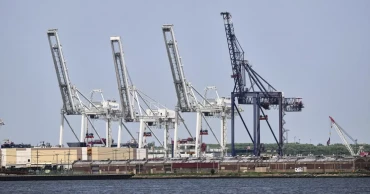
UN forecasts slower global economic growth following Trump's tariffs and trade tensions
The United Nations on Thursday forecast slower global economic growth this year and next, pointing to the impact of the surge in U.S. tariffs and increasing trade tensions.
U.N. economists also cited the volatile geopolitical landscape and threats of rising production costs, supply chain disruptions and financial turbulence.
“These days, there’s so much uncertainty in the air,” said Shantanu Mukherjee, director of the Economic Analysis and Policy Division at the U.N. Department of Economic and Social Affairs.
“It’s been a nervous time for the global economy,” he told reporters while launching the midyear forecast. “In January this year, we were expecting two years of stable — if subpar — growth, and since then, prospects have diminished, accompanied by significant volatility across various dimensions.”
The U.N. is now forecasting global economic growth of 2.4% this year and 2.5% next year — a drop of 0.4 percentage point each year from its projections in January. Last year, the global economy grew 2.9%.
Mukherjee said the slowing is affecting most countries and regions, but among the most severely hit are the poorest and least developed countries, whose growth prospects have fallen from 4.6% to 4.1% just since January.
Chinese businesses view tariff pause with caution and uncertainty
“That translates into a loss of billions in economic output for the most disadvantaged of countries,” which are home to over half the global population living in extreme poverty, he said.
The world’s developed and developing countries also are projected to suffer, according to the U.N. report.
Economic growth in the United States is now projected to drop significantly, from 2.8% last year to 1.6% this year, it said, noting that higher tariffs and policy uncertainty are expected to weigh on private investment and consumption.
China’s growth is expected to slow to 4.6% this year from 5% in 2024 as a result of subdued consumer sentiment, disruptions in its export-oriented manufacturing companies, and continuing challenges in its property sector, the report said.
The European Union’s growth is forecast to remain the same this year as it was last year — just 1%, the report said, citing weaker net exports and higher trade barriers. The United Kingdom’s economic growth of 1.1% last year is projected to fall to 0.9%.
Weakening trade, slowing investments and falling commodity prices are also forecast to erode growth in other major developing economies, including Brazil, Mexico and South Africa.
India will remain one of the world’s fastest-growing large economies, but the U.N. forecast said its growth is expected to drop from 7.1% in 2024 to 6.3% this year.
American Eagle shares slide after pulling 2025 outlook, $75m inventory write-down
The U.N.’s global economic growth forecast is lower than the International Monetary Fund’s.
On a more positive note, Mukherjee said the U.N. is expecting that bilateral negotiations will lead to lower tariffs, although he said they won’t return to the levels before U.S. President Donald Trump’s February announcement.
Nonetheless, Mukherjee said, resolving uncertainties would help individuals and businesses move forward with economic decisions and that would have a positive impact on the global economy.
1 year ago

Chinese businesses view tariff pause with caution and uncertainty
While U.S. President Donald Trump has talked of victory after reaching a weekend deal with China to reduce the sky-high tariffs levied on each other’s goods, businesses in China are reacting to the temporary deal with caution.
The U.S. and China have cut the tariffs levied on each other in April, with the U.S. cutting the 145% tax Trump imposed last month to 30%. China agreed to lower its tariff rate on U.S. goods to 10% from 125%. The lower tariff rates came into effect on Wednesday.
U.S. Treasury Secretary Scott Bessent, announcing the reduction in tariff rates this weekend in Geneva, had said, “We do want trade.” While the markets have responded to the agreement with gusto, rebounding to the levels before Trump’s tariffs, business owners remain wary.
Businesses like one kitchen utensil factory in southern Guangdong province were eager to get back to work. The business said they put at least four orders from their American clients back into production on Tuesday after the tariff pause was announced.
American Eagle shares slide after pulling 2025 outlook, $75m inventory write-down
“We thought the negotiation would bring the tariffs down a bit, but didn’t expect it would be so much,” said Margaret Zhuang, a salesperson for the utensil factory in Guangdong province, one of China’s manufacturing hubs.
Kahlee Yu, sales manager of Yangjiang Hongnan Industry and Trade Company, which also manufactures kitchen utensils, said he was reaching out to American customers again. “We’re a little bit optimistic about the trade deal between the two sides. But it is still possible the tariff policies will change again, resulting in no orders from our American clients,” he said.
However happy they were in the moment, the damage from tariffs announced in April has already been done, Zhuang added, as they are seeing fewer orders. Currently, she has orders for products up until June. Earlier this year, before Trump’s trade war began, they had orders for production extending to August.
The uncertainty also means companies are less willing to make new investments. Kelvin Liao, sales director at Action Composites, a manufacturer of carbon fiber auto parts in Dongguan, a major city in Guangdong, said he was originally planning to buy a piece of land to build a new factory, but opted instead to rent because of the tariff situation.
“It is good to reach a trade deal between the two countries. But people have already lost confidence in Trump, and we will take a wait-and-see attitude,” he said. “We believe the signing a trade deal is just a pause and the ultimate goal of the US is to curb China’s development.”
Tariffs also remain in place for some industries, which are not part of the general deal. Hong Kong businessman Danny Lau, who owns an aluminum-coating factory, said his company still faces about a 75% tariff from tariffs levied at different points since 2018 by the U.S. Still he welcomed the news from the weekend, saying he would reach out to existing American customers to gauge their views.
1 year ago
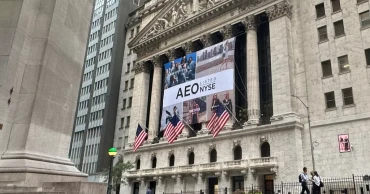
American Eagle shares slide after pulling 2025 outlook, $75m inventory write-down
Shares of American Eagle Outfitters fell sharply before the opening bell on Wednesday after the retailer withdrew its financial outlook for 2025, citing “macro uncertainty,” and announced $75 million write-down in spring and summer merchandise.
The Pittsburgh-based apparel retailer said late Tuesday that it expects first-quarter revenue to decline by five per cent, dropping below $1 billion. Same-store sales—a key indicator of retail performance—are projected to decrease by approximately three per cent, reports AP.
The company anticipates an adjusted operating loss of about $68 million for the first quarter, driven by the inventory write-down and increased promotional spending.
“Our merchandising strategies did not drive the results we anticipated, leading to higher promotions and excess inventory,” said CEO and Executive Chairman Jay Schottenstein. “As a result, we have taken an inventory write down on spring and summer goods.”
Shares of American Eagle tumbled six per cent at the market open on Wednesday following the announcement.
US-China deal to slash tariffs also eases burden on cheap packages
Schottenstein acknowledged the company's first-quarter performance fell short of expectations and said that American Eagle is working to improve going forward. “Our teams continue to work with urgency to strengthen product performance, while improving our buying principles,” he added.
American Eagle is among a growing number of companies across various sectors that have withdrawn their financial guidance this year amid ongoing economic and geopolitical uncertainty.
A shifting US trade policy, including tariff-related concerns, has contributed to unpredictability around costs for imported goods and impacted consumer confidence.
1 year ago
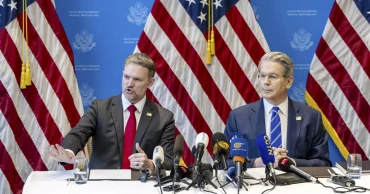
US-China deal to slash tariffs also eases burden on cheap packages
Online shoppers in the U.S. will see a price break on their purchases valued at less than $800 and shipped from China after the Trump administration reached a truce with Beijing over sky-high tariffs.
An executive order Monday from President Donald Trump said the tariffs on low-value parcels originating from China and coming through the U.S. Postal Service will be lowered to 54%, down from 120%.
It also says a per-package flat rate — as an alternative to the value-based tariff — will be kept at $100, rather than being raised to $200 on June 1 as previously decreed. Packages shipped by commercial carriers are subject to the general tariff, which also has been cut.
The new rules go into effect Wednesday.
They are part of a broader agreement by the Trump administration to drastically lower import taxes on all Chinese goods from 145% to 30% following weekend talks in Switzerland with Chinese officials. China issued a public notice on Tuesday lowering its own tariffs on U.S. goods to 10%, down from 125%.
China's exports rose a higher than expected 8% in April as new US tariffs took effect
However, the reductions are temporary, allowing the two sides to negotiate a longer-term deal in the next 90 days.
Izzy Rosenzweig, founder and CEO of the logistic company Portless, said U.S. brands are “very excited” about the broader tariff cut. The import tax is still high, but not as prohibitive as when it was 145%, which amounted to a trade embargo.
On the low-value shipments, online purchases had been coming into the U.S. duty-free for several years under the de minimis rule, which exempted them from the import tax.
Popular shopping sites such as Shein and Temu that offer ultra-low prices took advantage of the duty-free rule by shipping directly from China to U.S. buyers, bypassing more cumbersome customs paperwork.
President Donald Trump terminated the exemption on such parcels originating from China and Hong Kong on May 2, following criticism that it not only resulted in lost tariff revenue but also allowed illicit drugs and unsafe products to flow into the U.S. without adequate scrutiny.
U.S. Customs and Border Protection said as many as 4 million low-value parcels were coming into the U.S. every day — many of which originated from China.
Shortly before the exemption ended on May 2, prices on many items sold by Shein rose. Temu apparently halted shipments from China and tapped its existing inventory in the U.S.
The Bank of England is expected to cut interest rates in the face of US tariffs threat
John Lash, group vice president of product strategy at the supply chain platform e2open, said he expected the volume of low-value packages would now rise but not back to previous levels. The $100 flat rate, he said, means that higher-value packages could get less of a hit, because the effective duty rate could be as low as 13%.
Neither Shein nor Temu immediately responded to requests for comment Tuesday about the lower tariffs.
1 year ago
Japanese tech giant SoftBank records its first profit in 4yrs
Japanese technology company SoftBank Group posted its first profit in four years Tuesday, as it raked in gains from its investment portfolios.
SoftBank warned of major uncertainties ahead because of President Donald Trump’s tariff policies, tensions between the US and China, and other global conflicts, reports AP.
Tokyo-based Softbank’s profit for the fiscal year through March totaled 1.15 trillion yen ($7.8 billion), a reversal from the 227.6 billion yen loss it racked up the previous year.
Annual sales climbed 7% to 7.2 trillion yen ($49 billion).
SoftBank has a wide-ranging partnership with OpenAI, the US artificial intelligence research organisation behind ChatGPT. It said it remains focused on promoting technology related to artificial intelligence.
UN chief urges nations to pay peacekeeping dues
The company said it will continue to aggressively invest in new AI companies like Glean and Helion, both US companies.
SoftBank also recently decided to acquire the total equity of Ampere, a US cloud-and AI-focused semiconductor design company, for $6.5 billion. It expects to complete the transaction in the second half of this year.
Its investments include stakes in Chinese e-commerce giant Alibaba and T-Mobile, a European mobile communications outfit. Both gained value over the latest period.
Also helping its bottom line were strong results and royalties at Arm, a British semiconductor and software design company in which SoftBank is a major investor.
The company also logged gains from its SoftBank Vision Funds.
SoftBank invests in various companies, including ByteDance, the Chinese multinational that’s behind TikTok, and PayPay, a popular Japanese mobile payment application.
SoftBank said it was planning an IPO for PayPay. Launched in 2018, PayPay is now used by more than 68 million people, according to SoftBank. Japan's population is about 125 million.
1 year ago
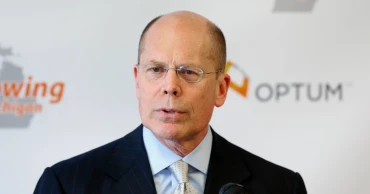
UnitedHealth Group CEO steps down
UnitedHealth CEO Andrew Witty is stepping down for personal reasons and the nation's largest health insurer suspended its full-year financial outlook due to higher-than-expected medical costs.
Chairman Stephen Hemsley will become CEO, effective immediately, the Minnesota company said.
Hemsley was UnitedHealth Group CEO from 2006 to 2017. He will remain chairman of the company’s board. Witty will serve as a senior adviser to Hemsley, AP reports.
“Leading the people of UnitedHealth Group has been a tremendous honor as they work every day to improve the health system, and they will continue to inspire me,” Witty said.
Witty joined the company in 2018 after serving about nine years as CEO of the British drugmaker GlaxoSmithKline. He was named UnitedHealth’s CEO in February 2021, replacing Dave Wichmann.
UnitedHealth became one of the nation's largest companies under Witty’s leadership. Total revenue topped $400 billion last year, a 55% increase from the $257 billion UnitedHealth brought in the year before Witty became CEO.
UN chief urges nations to pay peacekeeping dues
Shares of UnitedHealth rocketed higher under Witty, up 60.5% since he took the company's top job.
Yet in the past five months, that stock performance reversed sharply, coinciding with the fatal shooting of company executive Brian Thompson in front of a New York City hotel late last year.
The company has wrestled with the media attention focused on Luigi Mangione, who was indicted last month on a federal murder charge in the killing of Thompson.
The case has captured the American imagination, setting off a cascade of resentment and online vitriol toward US health insurers while rattling corporate executives concerned about security.
UnitedHealth cut its 2025 forecast last month following its first quarterly earnings miss in more than a decade. Shares of UnitedHealth, which have plummeted 38% since the deadly December 4 ambush of Thompson in midtown Manhattan, fell 9% before the opening bell on Tuesday.
UnitedHealth said Tuesday that it suspended its 2025 outlook as medical costs of many Medicare Advantage beneficiaries new to UnitedHealthcare were higher than expected.
1 year ago
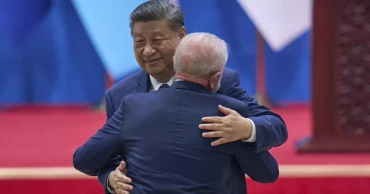
China presents a united front with Latin America, aiming to counter Trump's trade war
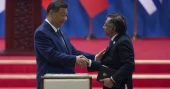
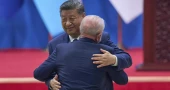
China is moving to strengthen its alliances with other countries as a counterweight to President Donald Trump’s trade war, presenting a united front with Latin American leaders at an event Tuesday in Beijing.
China's leaders have positioned the world's second-largest economy as a reliable trade and development partner, in contrast to the uncertainty and instability from Trump’s tariff hikes and other policies.
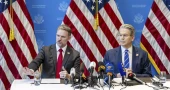
On Monday, Beijing and Washington announced a breakthrough on tariffs after weekend talks in Geneva, Switzerland, where they agreed to cut sky-high tariffs on both sides for 90 days to allow for negotiations.
Having moved to defuse antagonisms with the U.S., Chinese President Xi Jinping said China stands ready to “join hands” with Latin countries “in the face of seething undercurrents of pure political and bloc confrontation and the surging tide of unilateralism and protectionism.”
“There are no winners in tariff wars or trade wars,” Xi said, reiterating a phrase China has used repeatedly when referring to Trump's policies.
He was speaking to the China-CELAC, or Community of Latin American and Caribbean States, Forum, which began in 2015. The presidents of Brazil, Chile and Colombia were among the Latin American and Caribbean officials attending.
Xi announced five programs, focused on political exchanges, economic development, cultural and academic exchanges and global security to build closer ties between China and Latin American nations.
He promised to boost imports from the region and to encourage Chinese companies to increase their investments there. He announced a new 66 billion yuan ($9.2 billion) credit line to support Latin American and Caribbean financing.
China also plans to expand cooperation in clean energy, 5G telecommunications, the digital economy, artificial intelligence and global security.
US and China agree to 90-day pause in tariff dispute
China’s trade with the region has been growing rapidly, exceeding $500 billion for the first time last year. Much of that growth has come from increased Chinese imports of farm goods including soybeans and beef, and energy imports such as crude oil, iron ore and critical minerals.
Beijing’s investments in the region through Xi's Belt and Road Initiative, or BRI, have included installing 5G networks and building ports and hydropower plants.
Colombian President Gustavo Petro announced Monday that his country would formally join the BRI – in a vote of confidence after several Chinese projects in Latin America hit snags in recent months.
In February, Panama became the first Latin American country to quit the initiative under pressure from the U.S. And earlier this month, Chinese electric vehicle maker BYD and stainless steel producer Tsingshan announced they were abandoning plans to build lithium cathode plants in Chile due to falling lithium prices.
In other pledges, Beijing plans to invite 300 members from Latin American political parties to China annually for the next three years and facilitate 3,500 government scholarships and various other types of exchanges.
US, China agree to slash tariffs for 90 days
Five Latin American countries will receive visa exemptions for travel to China, with more to follow, Xi said. It was not immediately clear which countries would become visa exempt.
1 year ago