World-Business

Japan's trade minister fails to win US assurances on tariff exemptions
Japan’s trade minister said this week that he has failed to win assurances from U.S. officials that the key U.S. ally will be exempt from tariffs, some of which take effect on Wednesday.
Yoji Muto was in Washington for last ditch negotiations over the tariffs on a range of Japanese exports including cars, steel and aluminum.
Muto said Monday in Washington that Japan, which contributes to the U.S. economy by heavily investing and creating jobs in the United States, “should not be subject to” 25% tariffs on steel, aluminum and auto exports to America.
His meetings with U.S. Commerce Secretary Howard Lutnick, U.S. Trade Representative Jamieson Greer and White House economic advisor Kevin Hassett came just two days before the steel and aluminum tariffs are due to take effect. President Donald Trump has also said a possible 25% tariff on imported foreign autos could take effect in early April.
Muto said the U.S. officials acknowledged Japanese contributions and agreed to continue talks, but did not approve his request for Japan's exemption from the steep import duties.
“We did not receive a response that Japan will be exempt,” Muto told reporters. “We must continue to assert our position.”
Nissan tests driverless cars on busy Japan city streets
As Trump's tariff threats have triggered tensions and vows of retaliation from Canada, Mexico and China, Japan has been working to firm up ties with other countries.
Last week, the foreign and trade ministers from Japan and Britain gathered in Tokyo for their first “two-plus-two” economic dialogue. They agreed to stand up for “fair, rules-based international trade,” though nobody directly mentioned Trump.
Japan depends heavily on exports and the auto tariffs would hurt, because vehicles are its biggest export and the United States is their top destination.
“Clearly companies in Japan are very concerned,” said Rintaro Nishimura, political analyst and associate at Japan Practice of The Asia Group. “Obviously the auto is the crown jewel for Japan, especially in the context of these tariffs." He says they are concerned also because the Trump administration is carrying it out in just two months after taking office.
Trump also has criticized Japan’s contributions to the two countries’ mutual defense arrangements, adding to tensions with Tokyo.
Muto said the two sides agreed to keep discussing to find ways to establish a “win-win” relationship that would serve national interests of both countries.
Japan, Unicef sign $ 3.3mn deal to strengthen assistance for Rohingya children
The two sides also discussed energy cooperation, including joint development of liquefied natural gas reserves in Alaska, which Trump and Prime Minister Shigeru Ishiba agreed on during Ishiba's visit to the White House in February.
1 year ago

Stocks plunge as Wall Street questions Trump’s economic tolerance
The U.S. stock market's downturn deepened on Monday as Wall Street speculated on how much economic strain President Donald Trump is willing to endure through tariffs and other policies to achieve his objectives.
The S&P 500 fell 2.7%, bringing it nearly 9% below its all-time high set just last month. At one point, it was down 3.6%, heading for its worst day since 2022—when soaring inflation strained budgets and fuelled concerns about a recession that ultimately did not materialise.
Bangladesh Bank halts exchange of new notes for Eid
The Dow Jones Industrial Average dropped 890 points, or 2.1%, after recovering from an earlier loss of over 1,100 points, while the Nasdaq composite tumbled 4%.
This marked the worst day yet in a volatile period where the S&P 500 has fluctuated by more than 1% in seven of the past eight sessions due to Trump's unpredictable tariff policies. The concern is that these sharp swings could either directly harm the economy or create enough uncertainty to push U.S. companies and consumers into economic stagnation.
Signs of economic weakening have already emerged, primarily through surveys reflecting growing pessimism. Additionally, a widely monitored set of real-time indicators compiled by the Federal Reserve Bank of Atlanta suggests the U.S. economy may already be contracting.
Asked over the weekend whether he foresaw a recession in 2025, Trump told Fox News Channel: "I hate to predict things like that. There is a period of transition because what we’re doing is very big. We’re bringing wealth back to America. That’s a big thing." He then added, "It takes a little time. It takes a little time."
Trump aims to bring manufacturing jobs back to the U.S., citing this as one of the reasons for his tariff policies. His Treasury Secretary, Scott Bessent, has also indicated that the economy may undergo a "detox" period as it adjusts to reduced government spending. The White House is seeking to curb federal expenditures, cut the federal workforce, and increase deportations—moves that could impact the labour market.
For now, the U.S. job market remains stable, and the economy ended last year on solid footing. However, economists are lowering their growth projections for this year.
Goldman Sachs' David Mericle, for example, has reduced his estimate for U.S. economic growth in 2025 from 2.2% to 1.7%, largely due to the expectation that tariffs will be more extensive than previously forecasted.
He sees a one-in-five chance of a recession within the next year, raising the probability only slightly because "the White House has the option to pull back policy changes" if economic risks "begin to look more serious."
"Multiple forces are always at play in the market, but right now, almost all of them are secondary to tariffs," said Chris Larkin, managing director for trading and investing at E-Trade from Morgan Stanley.
In response to the market decline, White House spokesman Kush Desai pointed out that numerous companies have responded to Trump's "America First" economic agenda with "trillions in investment commitments that will create thousands of jobs."
On Monday, Trump met with tech industry CEOs, though the meeting was closed to the media.
Remittance inflow surges amid forex reserve crisis
The turbulence on Wall Street has been particularly damaging to some of its biggest players. Big Tech stocks and firms that benefited from the recent artificial intelligence boom have experienced sharp declines.
Nvidia dropped another 5.1% on Monday, bringing its year-to-date loss to over 20%—a stark contrast to its nearly 820% surge over 2023 and 2024.
Elon Musk's Tesla plummeted 15.4%, extending its 2025 decline to 45%. Initially, Tesla saw a post-election boost due to expectations that Musk's close ties with Trump would benefit the company. However, the stock has since slumped amid concerns that Musk’s brand has become too closely linked with the administration. Protests against the U.S. government's workforce reduction efforts and other policies have even targeted Tesla dealerships.
Companies reliant on strong consumer confidence also took significant hits. Cruise operator Carnival fell 7.6%, while United Airlines dropped 6.3%.
The sell-off has not been limited to stocks. Investors have also pulled back from other assets that previously seemed unstoppable, such as bitcoin. The cryptocurrency's value has fallen below $80,000, down from over $106,000 in December.
Instead, investors have sought refuge in U.S. Treasury bonds, which are perceived as more stable during economic uncertainty. This has driven Treasury prices sharply higher, pushing down their yields.
The yield on the 10-year Treasury fell again to 4.22% from 4.32% on Friday. Since January, when it neared 4.80%, yields have steadily declined as economic concerns have mounted—a significant shift for the bond market.
Despite the uncertainty, Wall Street dealmaking has continued. Redfin's stock soared 67.9% after Rocket announced it would acquire the digital real estate brokerage in an all-stock deal valued at $1.75 billion. However, Rocket's stock fell 15.3%.
ServiceNow declined 7.9% after the AI platform company revealed plans to acquire AI-assistant maker Moveworks for $2.85 billion in cash and stock.
Overall, the S&P 500 lost 155.64 points to close at 5,614.56. The Dow Jones Industrial Average dropped 890.01 points to 41,911.71, while the Nasdaq composite fell 727.90 points to 17,468.32.
Global markets also felt the impact, with European indexes largely declining after a mixed session in Asia.
Hong Kong’s index dropped 1.8%, and Shanghai’s edged down 0.2% after China reported a decline in consumer prices for the first time in 13 months. This was the latest sign of weakness in the world’s second-largest economy, where persistently weak demand was compounded by the early timing of the Lunar New Year holiday.
1 year ago

Canada to name a new leader while dealing with Trump trade war
Canada looks set to pick a measured former central banker to deal with the threats President Donald Trump's tariffs pose against a pillar of Western free trade.
Mark Carney, 59, could become the next prime minister when the governing Liberal Party of Canada announces a replacement for Justin Trudeau in a leadership vote Sunday.
The opposition Conservatives hoped to make the election about Trudeau, whose popularity declined as food and housing prices rose and immigration surged. Trudeau announced his resignation in January but remains prime minister until a successor is chosen. Election laws mandate a vote before October but one is expected sooner.
Trump’s trade war and his talk of making Canada the 51st state have infuriated Canadians, who are booing the American anthem at NHL and NBA games. Some are cancelling trips south and many are avoiding buying American goods when they can.
The surge in Canadian nationalism has bolstered the Liberal Party’s chances in Parliamentary elections that are expected within days or weeks, and Liberal showings have been improving steadily in opinion polls.
After decades of bilateral stability, the vote on Canada’s next leader now is expected to focus on who is best equipped to deal with the United States.
Who is Mark Carney?
Carney navigated crises when he was the head of Canada’s central bank and when he became the first non-citizen to run the Bank of England since it was founded in 1694.
Asian shares drop as investors brace for tariff uncertainty
His appointment won bipartisan praise in Britain after Canada recovered from the 2008 financial crisis faster than many other countries.
Carney is credited with keeping money flowing through the Canadian economy by acting quickly in cutting interest rates to their lowest level ever of 1%, working with bankers to sustain lending through the crisis and, critically, letting the public know rates would remain low so they would keep borrowing.
And it wasn’t just that he had good policies — he sold them to the public in a way everyone could understand. He was the first central banker to commit to keep them at a historic low for a definite time, a step the U.S. Federal Reserve would follow.
Carney has picked up one endorsement after another from Cabinet ministers and members of Parliament since declaring his candidacy in January.
The other top Liberal leadership candidate is former Deputy Prime Minister Chrystia Freeland. Trudeau told Freeland in December he no longer wanted her as finance minister, but that she could remain deputy prime minister and the point person for U.S.-Canada relations. Freeland resigned shortly after, releasing a scathing letter about the government that proved to be the last straw for Trudeau.
Three points turned the leadership race into a runaway for Carney. Freeland had a long association with the unpopular Trudeau. Carney worked hard to gather support from Liberal members of Parliament members. And Trump’s tariff fixation was also pivotal, said Nelson Wiseman, professor emeritus at the University of Toronto.
“Liberal backbenchers feared losing their seats and knew that Carney was more electable as their leader than Freeland,” Wiseman said.
What’s next for Canada?
The Liberal Party members will pick a new leader in a secret vote by about 140,000 members that will be announced on Sunday. The new leader is expected to trigger an election shortly afterward. Either the new Liberal party leader will call one, or the opposition parties in Parliament could force one with a no-confidence vote this month.
Daniel Béland, a political science professor at McGill University in Montreal, said Carney’s calm demeanor and outstanding resume make him a reassuring figure to many Canadians at a time when Trump is going after their country’s economy and sovereignty.
Béland said that style and profile stands in strong contrast to the Conservative Party's Pierre Poilievre, whom he called a true career politician who has embraced a populist rhetoric not unlike Trump's.
Poilievre, 45, for years the party’s go-to attack dog, is a firebrand populist who says he will to put “Canada first.” He attacks the mainstream media and vows to defund Canada’s public broadcaster and cut taxes.
China's trade declines in Jan-Feb amid uncertainty
“That works with his base but that is not welcomed by other Canadians, especially considering what the U.S. president is now saying about, and doing to, their country,” Béland said.
Poilievre urged Trump on Friday stop the attacks on Canada and “the monthly melodrama that is hurting our economies on both side of the border."
1 year ago

Asian shares drop as investors brace for tariff uncertainty
Asian stock markets mostly declined on Friday, with Tokyo's benchmark falling by more than 2% following a sell-off on Wall Street.
U.S. futures and oil prices saw an uptick, reports AP.
Bitcoin was trading around $88,266, dropping 3.4% according to CoinDesk, after President Donald Trump signed an executive order on Thursday to establish a government bitcoin reserve, marking a significant step in the cryptocurrency's potential mainstream acceptance.
China's trade declines in Jan-Feb amid uncertainty
China's exports and imports for January-February were below expectations, with exports rising just 2.3% and imports dropping 8.4%. These figures typically account for distortions caused by the Lunar New Year holidays.
U.S. stocks fell after President Trump granted another temporary delay to his 25% tariffs on goods imported from Mexico and Canada, highlighting the uncertainty these tariffs have created for the global economy. Investors showed less enthusiasm compared to the previous day's rally when Trump offered a one-month exemption for automakers.
In Tokyo, the Nikkei 225 dropped 2.2% to 36,887.17 due to heavy selling in tech stocks. Shares of Tokyo Electron, a chipmaker, fell 3.1%, while testing equipment maker Advantest dropped 2.3%. Both saw sharp declines in their U.S.-listed stocks overnight.
Hong Kong's Hang Seng index reversed early gains, falling 0.7% to 24,204.97, while the Shanghai Composite index dropped 0.3% to 3,372.55.
In Australia, the S&P/ASX 200 fell 1.8% to 7,948.20, and South Korea's Kospi dropped 0.5% to 2,563.48 after a court ordered the release of impeached President Yoon Suk Yeol, who had been in jail since his arrest over a short-lived martial law declaration.
Taiwan’s Taiex declined by 0.6%.
India's Sensex remained nearly unchanged, while Bangkok’s SET index rose by 0.3%.
On Thursday, U.S. stocks saw significant losses, with the S&P 500 falling 1.8% to 5,738.52, resuming its decline after a brief recovery from previous weeks. The Dow Jones Industrial Average dropped 1% to 42,579.08, and the Nasdaq composite fell 2.6% to 18,069.26, finishing more than 10% below its December record.
Stock markets have been buoyed by hopes that Trump may be using tariffs as a negotiating strategy rather than a permanent policy, potentially avoiding a full-blown trade war. However, Trump is still pushing forward with other tariffs due to take effect on April 2, and the ongoing uncertainty surrounding these moves is amplifying concerns. U.S. businesses have reported "chaos" due to the confusion, while households brace for rising inflation.
China’s foreign minister criticizes US tariffs and accuses the country of ‘meeting good with evil’
Next up for Wall Street is a report from the U.S. Labor Department on Friday detailing how many workers were hired last month. So far, a solid job market and strong consumer spending have helped prevent a recession, with economists predicting a rise in hiring for February.
Semiconductor companies and their suppliers, which had soared due to the artificial intelligence boom, led the losses. Nvidia dropped 5.7%, and Broadcom fell 6.3% ahead of its earnings report.
In other markets, U.S. benchmark crude oil rose by 44 cents to $66.80 per barrel, while Brent crude, the international standard, gained 47 cents to $69.93 per barrel.
The U.S. dollar weakened to 147.54 yen from 147.98 yen. Rising labor costs in Japan have led to expectations that the Bank of Japan may raise its interest rate soon to tackle rising inflation.
Marcel Thieliant of Capital Economics noted that Japan's trade unions are requesting a larger pay hike this year compared to last year’s spring wage negotiations, and he expects employers to comply.
The euro rose to $1.0841 from $1.0786 after the European Central Bank cut interest rates on Thursday as expected.
1 year ago
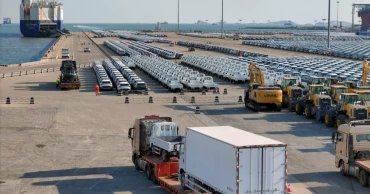
China's trade declines in Jan-Feb amid uncertainty
China's exports and imports weakened in January and February, with demand slipping amid global trade uncertainty.
Exports rose by only 2.3% compared to the previous year, falling short of the 5% growth expected by economists, while imports declined by more than 8%. This slow start to the year comes amid ongoing concerns over U.S. tariffs and other trade policies, reports AP.
China’s foreign minister criticizes US tariffs and accuses the country of ‘meeting good with evil’
China’s overall trade surplus increased to $170.52 billion in the first two months of 2025. The country’s customs agency typically releases combined trade data for January and February to avoid distortions caused by the Lunar New Year holidays.
Julian Evans-Pritchard from Capital Economics noted that export growth slowed in the first two months of the year, with less demand from tariff front-running than anticipated. He also pointed out that this slowdown occurred before any significant effects from tariffs, which are expected to cause sharp declines in shipments to the U.S.
The reduction in imports suggests that the demand boost from government stimulus spending late last year has already begun to reverse, Evans-Pritchard added.
This week, U.S. President Donald Trump’s second 10% tariff hike on Chinese imports took effect, which is likely to impact Chinese exports in the coming months. In response, both Chinese suppliers and buyers had rushed to make purchases before the tariff increases.
While Chinese officials have criticized the tariff hikes, they remain confident in the resilience of the economy and its ability to offset declines in U.S. exports through trade with other countries. They have also expressed openness to talks based on mutual respect.
Exports were a key factor in China meeting its 5% economic growth target last year, and the government has set the same growth target for this year, despite ongoing trade uncertainties.
Exports to the U.S. rose by 2.3% year-on-year in January and February, while shipments to the European Union and Japan grew by just 0.6% and 0.7%, respectively. Exports to Russia dropped by 10.9%.
The Association of Southeast Asian Nations (ASEAN) remained China’s largest trading partner, with exports growing by 5.7% year-on-year.
Global stocks mixed as Trump eases some trade tariffs
Lynn Song of ING Economics suggested that although it's premature to draw conclusions from a few months' data, the figures raise questions about future export trends, particularly as U.S. tariffs begin to have an impact. She expects the effects to be gradual in the coming months.
1 year ago
China’s foreign minister criticizes US tariffs and accuses the country of ‘meeting good with evil’
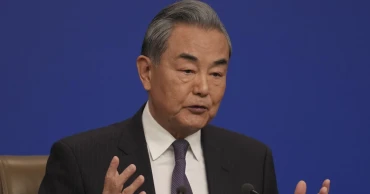
Chinese Foreign Minister Wang Yi said China will continue to retaliate to the United States’ “arbitrary tariffs” and accused Washington of “meeting good with evil” in a press conference Friday on the sidelines of the country’s annual parliamentary session.
Wang said China’s efforts to help the U.S. contain its fentanyl crisis have been met with punitive tariffs, which are straining the ties between the countries.
“No country should fantasize that it can suppress China and maintain a good relationship with China at the same time,” Wang said. “Such two-faced acts are not good for the stability of bilateral relations or for building mutual trust.”
China criticises US tariffs, warns of trade war losses
The two countries have been reengaging in tit-for-tat retaliatory tariffs since U.S. President Donald Trump’s return to office in January. The U.S. has imposed flat tariffs of 20% of all Chinese imports, while Beijing has countered with additional 15% duties on U.S. imports including chicken, pork, soy and beef, and expanded controls on doing business with key U.S. companies.
Regarding the Trump administration’s policy of safeguarding U.S. interests above international cooperation, Wang said such an approach, if adopted by every country in the world, would result in the “law of the jungle.”
‘If US wants war, we are ready’: China
“Small and weak countries will get burnt first, and the international order and rules will be under severe shock,” Wang said. “Major countries should undertake their international obligations … and not seek to profit from and bully the weak.”
1 year ago
Global stocks mixed as Trump eases some trade tariffs
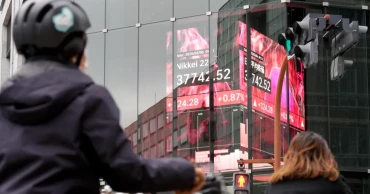
European stock markets opened mostly lower, while U.S. futures declined by over 1% on Thursday, following a positive close in most Asian markets, reports AP.
Selling pressure emerged after Wall Street’s rally, which was driven by President Donald Trump’s decision to grant U.S. automakers a one-month exemption from his 25% tariffs on imports from Mexico and Canada. This raised hopes that he might avoid triggering a severe trade war that could weaken economies and drive inflation higher.
21 factories shut in 7 months, leaving hundreds unemployed in N’ganj
Germany’s DAX increased by 0.5% to 23,194.03, whereas France’s CAC 40 fell by 0.5% to 8,135.30. Meanwhile, Britain’s FTSE 100 dropped by 1% to 8,670.99.
Futures for the S&P 500 declined by 1.2%, while those for the Dow Jones Industrial Average fell by 1%.
In Asia, Tokyo’s Nikkei 225 climbed 0.8% to 37,704.93. Shares of Japanese automakers surged in U.S. trading, although Toyota Motor Corp.’s stock later slipped by 1% in Tokyo. Honda Motor Corp. advanced by 2%, while Nissan Motor Co. rose by 1.1%.
Hong Kong’s Hang Seng index surged by 3.3% to 24,369.71 after reports presented at China’s annual legislative session indicated stronger efforts by Beijing to boost consumer spending and overall domestic demand.
The Shanghai Composite index gained 1.2% to reach 3,381.10.
South Korea’s Kospi increased by 0.7% to 2,576.16, while Australia’s S&P/ASX 200 slipped by 0.6% to 8,094.70.
Taiwan’s Taiex dropped by 0.7%, whereas Bangkok’s SET index declined by 1.4%.
On Wednesday, Ford Motor and General Motors stocks contributed to Wall Street’s gains.
The S&P 500 rose by 1.1%, the Dow climbed 1.3%, and the Nasdaq composite advanced 1.6%.
Trump announced the one-month exemption for U.S. automakers after discussions with Ford, General Motors, and Stellantis, the parent company of Chrysler. The decision provided relief on Wall Street, with both Ford and General Motors seeing their stock prices jump by over 5%, contributing to a broad market rally.
However, Trump did not revoke all the tariffs he had imposed on the United States’ largest trading partners, including China. Speaking before Congress on Tuesday night, he confirmed that additional tariffs would still take effect on April 2.
BSEC says its officers disrupt operations amid investigation
His move has heightened uncertainty in financial markets, which were already shaken after he declared on Monday that negotiations had reached an impasse. The increased tariffs took effect on Tuesday, leading to a sharp drop in U.S. stocks.
Regardless of the final outcome, the mere possibility of tariffs has already impacted U.S. households and businesses. Consumer confidence has significantly declined due to concerns that these tariffs will accelerate inflation. Amid policy shifts from Washington, U.S. manufacturers report that their growth is nearing stagnation, with fears over tariffs playing a major role.
A recent series of weaker-than-expected U.S. economic reports has raised concerns about a potential worst-case scenario: “stagflation.” This rare condition occurs when the economy stagnates while inflation remains high.
Despite the U.S. economy ending the previous year on a solid footing, any slowdown could prompt the Federal Reserve to lower its benchmark interest rate to encourage borrowing and stimulate growth. However, reducing interest rates can also drive inflation higher. If tariffs cause prices of essentials like eggs and other household goods to soar, the Fed could find itself in a difficult position.
In early Thursday trading, U.S. benchmark crude oil edged up by 2 cents to $66.33 per barrel, while Brent crude, the global benchmark, also rose by 2 cents to $69.32 per barrel.
Meanwhile, the U.S. dollar weakened to 147.90 Japanese yen from 148.89 yen, while the euro dipped slightly to $1.0789 from $1.0790.
1 year ago

CFPB drops lawsuit against Bank of America
The Consumer Financial Protection Bureau is dropping its lawsuit against the company that runs the Zelle payment platform and three U.S. banks as federal agencies continue to pull back on previous enforcement actions now that President Donald Trump is back in office.
In December a federal regulator sued JPMorgan Chase, Wells Fargo and Bank of America, claiming the banks failed to protect hundreds of thousands of consumers from rampant fraud on Zelle, in violation of consumer financial laws.
In the federal civil complaint, the CFPB asserted that the banks rushed to get the peer-to-peer payments platform to market without effective safeguards against fraud and then, after consumers complained about being defrauded on the service, largely denied them relief.
Early Warning Services, a fintech company based in Scottsdale, Arizona, that operates Zelle, was named as a defendant in the lawsuit. EWS is owned by seven U.S. banks, including JPMorgan, Wells Fargo and Bank of America. Those three banks are the largest financial institutions on the Zelle network, accounting for 73% of activity on Zelle in 2023.
But a filing in the U.S. District Court for the District of Arizona on Tuesday indicated that the CFPB was dismissing its lawsuit against EWS, Bank of America, JPMorgan Chase and Wells Fargo with prejudice.
The dismissal comes less than a week after the CFPB dropped several enforcement actions against companies like Capital One and Rocket Homes.
China keeps its economic growth target at 'around 5%' despite a looming trade war
In notices of voluntary dismissals that were filed, the CFPB dropped lawsuits it had brought against Capital One, Rocket Homes, Vanderbilt Mortgage and Finance, owned by Warren Buffett’s Berkshire Hathaway, and others.
Those suits were all filed under the agency’s previous director, Rohit Chopra, who Trump fired just weeks ago. The CPFB has since plunged into turmoil — with the White House later ordering it to halt nearly all its work. The administration also closed the agency’s headquarters and moved to fire scores of its workers.
Trump has defended his administration’s broadside against the CFPB — including recent claims about the agency being “set up to destroy people.” But supporters of the agency stress that it provides crucial oversight and protects consumers from being vulnerable to predatory business practices.
The CPFB isn’t the only federal agency to signal a pullback on previous enforcement action under the new administration. The U.S. Securities and Exchange Commission has either closed or paused legal action against several cryptocurrency platforms in recent weeks, as the regulator tries to present itself as more crypto-friendly under Trump.
Earlier this month, Binance and the SEC filed a joint motion to pause its high-profile lawsuit against the crypto exchange. And both Coinbase and Robinhood have said that cases against them have also been dismissed or closed, although the SEC declined to immediately comment further.
1 year ago
China keeps its economic growth target at 'around 5%' despite a looming trade war
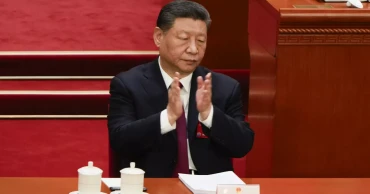
China is keeping its economic growth target at “around 5%” for 2025 despite a looming trade war with the United States and other headwinds.
The target for GDP growth was announced Wednesday in a report being presented by Premier Li Qiang at the opening session of the National People's Congress, the annual meeting of China's legislature. It reflects the government’s plans to try to stabilize growth in challenging economic times, but stop hold back on more dramatic action to supercharge it.
The 32-page report acknowledged the challenges at home and abroad.
“An increasingly complex and severe external environment may exert a greater impact on China in areas such as trade, science, and technology,” Li said, reading parts of the report to the Congress over nearly an hour. “Domestically, the foundation for China’s sustained economic recovery and growth is not strong enough. Effective demand is weak, and consumption, in particular, is sluggish.”
The IMF has projected China's economy will grow 4.6% this year, down from 5% in 2024, according to Chinese government statistics.
The report offered some details on previously announced plans to step up stimulus for the sluggish economy this year. It outlined plans for a “more proactive fiscal policy," including an increase in deficit spending from 3% to 4% of GDP, or the size of the overall economy.
Saudi’s oil giant Aramco reports decline in annual profit, cuts dividend
It said the government would issue 1.3 trillion yuan ($180 billion) in ultra-long term bonds, up from 1 trillion yuan last year, and that 300 billion yuan in such bonds would go toward a program launched last year that offers rebates to consumers who trade in automobiles or appliances for new ones.
Across-the-board tariffs imposed on Chinese products by U.S. President Donald Trump pose the latest threat to an economy already weighed down by a prolonged real estate slump and sluggish consumer spending and private business investment.
China’s ruling Communist Party signaled in December that it would boost stimulus this year. The U.S. tariffs have made that task more urgent, because they could crimp sales to one of China’s major export markets.
At the same time, Chinese leader Xi Jinping wants to wean the economy off its long-running dependence on the highly indebted real estate market. He is pushing economic resources into developing a more innovative, high-tech economy — and with growing restrictions on U.S. technology exports to China, one that isn't beholden to other countries for the most powerful semiconductors and other electronic components.
That has remained the overarching long-term economic goal of the Communist Party, though it has enacted various measures since September in a possible shift in emphasis toward shoring up growth in the short-term.
“A target of around 5% is well aligned with our mid- and long-term development goals and underscores our resolve to meet difficulties head-on and strive hard to deliver,” the government report said.
The party announced in December that the central bank would shift its monetary policy from “prudent” to “moderately loose" for the first time in more than a decade.
Giant chipmaker TSMC to spend $100B to expand chip manufacturing in US, Trump announces
The government, following the party's leadership, is expected to borrow more this year, spend more on the consumer rebate program and possibly increase pensions and health care benefits. The question is whether it will be enough to stabilize the economy and reach its target for growth.
1 year ago

Saudi’s oil giant Aramco reports decline in annual profit, cuts dividend
Saudi Arabia’s state oil giant, Aramco, has announced a decline in its net profit for 2024, reporting $106.2 billion, down from $121.3 billion in 2023.
The company also revealed a significant reduction in its dividend payouts for 2025, expecting total distributions of $85.4 billion, compared to $124.2 billion in 2024.
Aramco announces $121 billion profit for 2023, down from 2022 record
The oil producer disclosed that its base dividend for the fourth quarter of 2024 would rise to $21.1 billion, while its performance-linked payout would be significantly lower at just $200 million.
This marks a steep decline from the previous quarter, when the company had distributed a base dividend of $20.3 billion alongside a performance-linked payout of $10.8 billion.
Aramco’s declining profit comes amid falling global oil prices and slowing demand. In 2024, the average price of Brent crude oil stood at $80 per barrel, down by $2 compared to the 2023 average, according to the U.S. Energy Information Administration.
Besides, an increase in global crude production put further downward pressure on prices, impacting Aramco’s earnings.
Bangladesh to import 1.5mn metric tons of crude oil from Saudi Aramco, UAE’s Adnoc
The company also reported a decline in total revenue, which fell to $436.6 billion in 2024 from $440.8 billion in 2023. This financial performance underscores the challenges faced by the energy sector, as fluctuating oil prices and shifting market dynamics continue to shape the industry’s outlook.
Despite the decline, Aramco remains one of the world’s most profitable companies and a key driver of Saudi Arabia’s economy. The company has continued to invest in expansion projects and energy transition initiatives, positioning itself for long-term stability in an evolving energy landscape.
Industry analysts will be closely watching Aramco’s strategic decisions in the coming months, particularly regarding its approach to dividends and capital expenditure as it navigates a period of global economic uncertainty.
Source: Agencies
1 year ago