Football
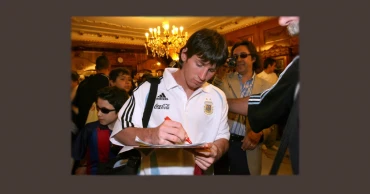
Photos of Lionel Messi at 6 World Cups from 2006
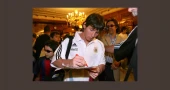
Argentina's Lionel Messi signs autographs upon his team's arrival to their hotel in Sant'Antonio Abate, near Naples, southern Italy, May 29, 2006, ahead of their pre-World Cup friendly match with Angola. Photo: AP/File
15 days ago
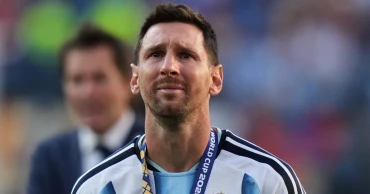
Messi can conjure no more magic as crown passes from Argentina to Spain
Lionel Messi could conjure no more magic.
Twenty years after his World Cup debut and a career that lifted him above Pelé and Diego Maradona as soccer’s greatest player, at 39 he could not will Argentina to become the first repeat champion in more than a half-century.
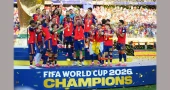
Spain outplayed the Albiceleste from the opening whistle at MetLife Stadium, where the overwhelming majority of 80,663 were hoping for a recoronation. Ferran Torres scored 37 seconds into the second extra-time period, lifting Spain to a 1-0 victory and its second World Cup title.
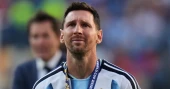
Instead of Messi becoming a two-time champion, the crown passed. He fought back tears and had a look of misery as he and teammates faced applauding and bowing Argentina fans at the stadium's south end while Spanish stars lifted the trophy on a podium at the center stripe.
After leading Argentina to victory in the 2022 final against France, sandwiched between c onsecutive Copa America championships, Messi could only bow his head, grimace and put hands on hips as Spain's Lamine Yamal, less than a week past his 19th birthday and projected as the sport's next big thing, ran to embrace Torres after the goal.
“I hope that everyone feels proud of him, of what he’s achieved because he’s the best football player ever stepping foot on a pitch,” Argentina coach Lionel Scaloni said.
Spain's dominance was thorough in the final and throughout the World Cup as they extended their unbeaten streak to 38 games, the longest by a European team.
La Furia Roja had a 20-2 advantage in shots, the second-largest difference in a World Cup final since stats exist since 1966, behind only West Germany outshooting Argentina 23-1 in 1990, according to Opta. They out-passed Argentina 845-433.
They conceded just one goal the entire tournament, the fewest by a World Cup champion, and scored 14 while compiling a 145-45 advantage in shots. Goalkeeper Unai Simon totaled 10 saves over eight games — Argentina’s Emiliano Martínez had 11 in the final alone.
When Messi left European soccer for MLS three years ago after four Champions League medals and 12 league titles with Barcelona and Paris Saint-Germain, some speculated he would be another retiree moving to Florida.
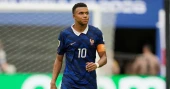
Instead, he won a Major League Soccer title with Miami and led Argentina back to the final with eight goals and four assists. He has played in a record 34 World Cup games over six tournaments and boosted career goals total to 21, the record until France's Kylian Mbappé scored twice in Saturday's third-place game to surpass him to 22.
Messi became the first player to start three World Cup finals and raised his international goals total to 125, second only to Cristiano Ronaldo's 146. He is now regularly mentioned in the same breath as Maradona and Pelé, the only three-time World Cup champion.
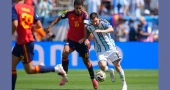
With his distinctive slow walk, arms swinging at his side as he waited for the right moment to burst into a sprint, the diminutive 5-foot-7 attacker was the center of attention any time he got the ball on the right flank. Opponents and fans waited for him to cut to the center and unleash a shot with his lethal left foot.
Messi had just 15 touches in the first half and 54 over the game at the stadium where he has been repeatedly frustrated. He famously retired from international soccer after a penalty-kicks loss to Chile in the 2016 Copa America final at MetLife only to reverse himself 47 days later and lead his nation to its third World Cup title.
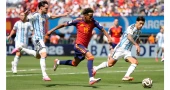
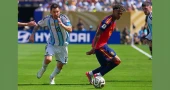
Against Spain, Messi never had the ball in position to score, and his attempts to pass to teammates didn't connect.
“The first idea was to keep Messi at bay,” Spain coach Luis de la Fuente said.
Half a dozen Spanish players walked over to Messi after the final whistle to hug and console him. Messi dropped to the grass, hands behind him, staring.
When Spain later formed a guard of honor for Argentina players to approach the podium for their second-place medals, Messi tried to smile but couldn't. He had a blank look as he walked through and a few opponents patted him on the back and chest.
Spain is now the world's soccer power, the first nation to hold the men's and women's titles at the same time, While gold confetti fluttered onto the Spaniards, Messi walked out one of the field's corner exits, a silver consolation medal hanging from is neck, his shoulders hunched, his expression glum.
15 days ago
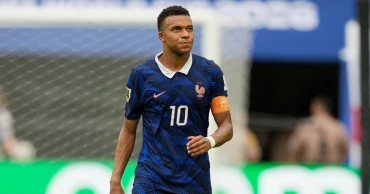
Mbappé becomes first two-time Golden Boot winner after Messi blanked in World Cup final
Kylian Mbappé is now the owner of World Cup Golden Boots.
The French striker became the first player to finish as the leading scorer at multiple World Cups, winning his second Golden Boot award when Lionel Messi was blanked in Argentina’s 1-0 loss to Spain on Sunday in the final.
Mbappé totaled 10 goals and four assists for a France team that finished fourth. Messi ended up with eight goals and four assists after going without a goal or an assist for the first time in his last 12 World Cup games.
Messi was still hoping to win a record-extending third Golden Ball as the tournament’s best player. He’s already the only player to win the award multiple times since it was first given in 1978, and sparking Argentina’s run to a second straight final at age 39 gives him a strong case for another.
The Golden Boot is one of the few things Messi has never won in his storied career, but he went into the final weekend with the lead. Both Messi and Mbappé had eight goals through the semifinals, but Messi owned the tiebreaker with one more assist.
Mbappé then scored two goals and had an assist Saturday in France’s 6-4 loss to England in the third-place game, making him the first player with 10 goals in a World Cup since Germany great Gerd Müller had 10 in 1970.
The other awards to be presented Sunday for performances at the World Cup are the Golden Glove for the top goalkeeper, and the Best Young Player Award, given to the top player 21 years old or younger.
Spain is in good shape to win at least one if not both of those, with Unai Simón allowing only one goal in eight games and 19-year-old Lamine Yamal providing the dazzle up front and showing why he is already considered one of the most promising players in the world.
Mbappé also won the Golden Boot four years ago in Qatar, when France lost to Argentina in the final. This time, he could join players such as Italy’s Salvatore Schillaci in 1990, Croatia's Davor Suker in 1998 and Germany’s Thomas Müller in 2010 as players whose goals in a third-place game carried them to the Golden Boot.
The Golden Ball, Golden Glove and the Best Young Player Award are voted on by members of the media from a list of players compiled by the FIFA Technical Study Group.
15 days ago
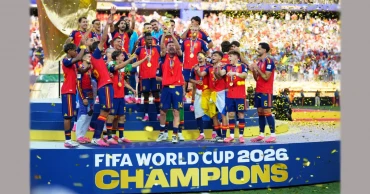
Spain claim 2nd World Cup title after beating Argentina
This is how good Spain was at the World Cup: Not even Lionel Messi had any answers.
And when it was over, Spain walked off with the trophy. Messi simply walked off in tears.
Spain is back atop the soccer world for a second time, after Ferran Torres’ first goal of this year's World Cup — unquestionably the goal of his life — gave his country a 1-0 win over now-dethroned champion Argentina in the final on Sunday.
“It was a goal scored by 47 million people,” Torres said, referring to Spain’s population.
Maybe not by them — but certainly for them.
The goal came with Argentina down to 10 men after Enzo Fernandez was sent off late in regulation following a reckless tackle. Tempers flared then, and flared again after the final whistle with Argentina coach Lionel Scaloni and players from both sides engaging in what appeared to be some pushing and shoving.
In the end, Spain denied Messi a second straight title in what he has indicated was his final World Cup match. Torres, a second-half substitute, pounced on a bouncing ball in the box and used his left foot to bury a shot just under the crossbar in the 106th minute.
From there, the airtight defense that dominated opponents throughout the tournament came through one final time. Spain — which also won the title in 2010 — allowed only one goal in eight matches in this World Cup run, setting a record for fewest goals allowed by a champion.
“I feel pride, to be honest,” said Spain coach Luis de la Fuente, who at 65 is now the oldest man to lead a team to a World Cup title. "Accompanying them on this journey is an honor.”
Spain gets a World Cup 1st
This title, combined with the Women's World Cup won by Spain in 2023, makes the European nation the first to hold both the men’s and women’s titles simultaneously. And in the streets of Madrid — probably many other places in Spain as well — countless people spilled into the streets, celebrating Sunday's victory long into the wee hours of Monday morning.
The score indicates this match was close, but only one team was in command.
Spain took the game’s first 20 shots on goal before Argentina — desperate for an equalizer — got its first attempt off in the second half of extra time. Spain took nine of the game’s first 10 corner kicks, and only a World Cup final-record 12 saves by Argentina goalkeeper Emiliano Martinez gave the 2022 champions a shot at going back-to-back.
“Dibu was nothing short of exceptional,” de la Fuente said, referring to Argentina's keeper by his nickname.
Spain is now unbeaten in its last 38 matches — 29 wins, nine draws — and is the outright holder of the longest such streak by any European men's team ever. Italy went 37 matches (28 wins, nine draws) from October 2018 through September 2021, before Spain ended that streak.
And for the last two-plus years, nobody has beaten Spain. Not even Messi. An Argentina team that was the kings of the late-game rally in this tournament had no answer this time.
“We lost the game, and we accept that,” Scaloni said. “That doesn’t mean that we will forget everything we’ve done so far, so I’d like to thank my people, my players and the country. I can tell them that we played our hearts out.”
Spain survives a late push
Messi took a corner kick with about four minutes left before the final whistle and the ball took a fortunate skip toward substitute Giuliano Simeone — who sent it high and over the crossbar, holding his head in disbelief afterward.
“When you have Messi on the other side, well, you are nervous,” Torres said. "At the end of the day, we always depended on us. We always come up with our football, and we showed it again.”
After the post-match scuffles, they also paid tribute to the former champions. Spain's players lined up to form an honor guard of sorts for Argentina's squad to walk through on its way to the stage for the runner-up medals from President Donald Trump and FIFA President Gianni Infantino.
“I think now I'm in a cloud,” said Spain midfielder Rodri, the Golden Ball winner as the tournament's best player.
Argentina was forced to finish the match down a man after Fernandez was sent off in second-half stoppage time after getting his second yellow card. Fernandez was whistled for a collision that sent Spain defender Pau Cubarsi cartwheeling into the air, and the card came out immediately.
Defense led Spain to a title
It was the 104th and last match of the biggest World Cup ever, a 48-team event that played out over the U.S., Canada and Mexico. Because there were more matches than any previous World Cup, it was no surprise that there were more goals than all other editions — more than 300, nearly three per match.
Except, of course, when Spain was involved. Spain's plan was simple and flawless: Hold the ball as much as possible, denying opponents any hint of chances.
It worked, all the way to the end.
Messi is 39 and the math certainly suggests that the Inter Miami star is at the end of his international career. There have been hints — such as Messi himself declaring that a home World Cup qualifying match against Venezuela last year would be his final competitive contest for Argentina on his nation’s soil.
“I experienced a lot of things on this pitch, good and not so good,” Messi said that night. “I’ll take the good with me.”
He retired from the national team after losing a Copa America final to Chile — in the same stadium he played in Sunday — a decade ago, then came back a few weeks later after changing his mind.
Good thing he did, because in that decade he went from superstar to absolute icon.
There was the World Cup title in 2022. There were two Copa America titles, the first in 2021 and the second in 2024. He won Argentina’s player of the year award 16 times in a span of 19 years, first winning it as a teenager and continuing to win it all the way into his late 30s.
He's a legend within the game and on all corners of the globe. But Spain was better Sunday.
“I spoke to my players, and they said: ‘Look, we’ve won everything, coach. We’ve won everything,'” de la Fuente said. “And that is beautiful.”
A final unlike any other
The spectacle was not limited to simply soccer.
Madonna, Justin Bieber, BTS and Shakira were all part of a halftime show that also featured Burna Boy, Jason Sudeikis in character as “Ted Lasso” and even some of the Muppets. Jennifer Hudson, Post Malone and Tom Cruise had roles in the closing ceremony, which actually preceded the match.
A slew of actors, athletes and other celebrities were there: Spain’s Javier Bardem left happy, Luciana Barroso Damon — the wife of actor Matt Damon — probably did not, considering she was wearing the colors of her native Argentina.
They all came to see a show. So did 80,000 other people, not to mention perhaps as many as 2 billion watching around the globe.
Spain didn't disappoint. No team has won back-to-back men's World Cups since Brazil in 1958 and 1962, and Spain kept Argentina from pulling off that repeat.
“As I told the lads before the game, we have to go for the game, we need to face them, we have to look to their eyes and say we want this game,” Rodri said. “And then, life gives you the World Cup or not.”
Spain took it instead.
15 days ago
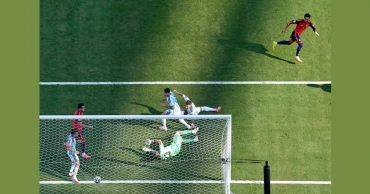
Spain finally break the deadlock
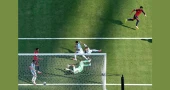
Spain’s Ferran Torres smashed the ball past Argentina goalkeeper Emiliano Martínez for his first goal of the World Cup to make it 1-0 in the 106th minute. Nico Williams had kept a long cross in play when he headed the ball toward Torres in front of the goal. It was Spain’s 20th shot of the match.
Torres was a substitute in the 62nd minute by coach Luis de la Fuente.
15 days ago
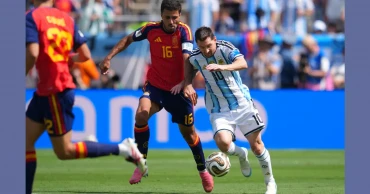
Extra time at the World Cup final
Argentina and Spain are scoreless after regulation. Spain has been the dominant side but has yet to find its way past Argentina goalkeeper Emiliano Martínez.
Lamine Yamal got a free kick late in stoppage time with the chance to give Spain a dramatic victory. Instead, Martínez dived to make his 10th save of the final.
Now comes two 15-minute periods of extra time. If the game is still undecided, it will go to a penalty shootout.
Argentina won the 2022 World Cup on penalty kicks against France. Spain’s 2010 title came on a goal in the 116th minute. Argentina is down to 10 players after a late red card to Enzo Fernández.
15 days ago
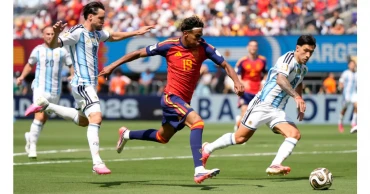
World Cup Final: Scoreless at halftime
Spain has controlled the ball and the tempo, and has put the clamps on Argentina and Lionel Messi. The 39-year-old star has had few creative chances on the ball.
Argentina may feel lucky to not be down a goal. Goalkeeper Emiliano Martínez made two saves for Argentina. Spain’s Lamine Yamal had the best chance for a goal in the opening minutes.
Argentina has already made a substitution, with Nicolás Otamendi coming on for defender Lisandro Martínez just before halftime.
15 days ago
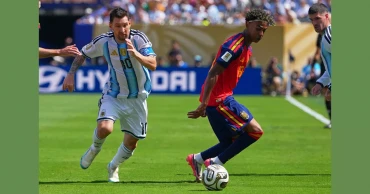
Argentina battle Spain for the World Cup title
Lionel Messi and Argentina on one side. Lamine Yamal and Spain on the other.
The World Cup final is finally underway.
Kickoff was shortly past 3 p.m. EDT at MetLife Stadium. Argentina is seeking its fourth title, Spain its second — and could become the first nation to simultaneously hold the World Cup crowns in both men's and women's soccer.
Argentina made three changes from its starting 11 for the semifinal win over England: Midfielders Rodrigo De Paul and Nico Gonzalez, along with defender Gonzalo Montiel were in, while midfielders Leandro Paredes and Nahuel Molina, along with forward Giuliano Simeone, were dropped.
Spain kept its starting 11 from the semifinal win over France untouched.
It was the 104th and last match of the biggest World Cup ever, a 48-team event that played out over the U.S., Canada and Mexico. Because there were more matches than any previous World Cup, it was no surprise that there were more goals than all other editions — 307 and counting entering Sunday.
If Argentina and Spain combine for at least two goals in the final, this World Cup will also have the highest average number of goals per game since the 1956 event saw 3.6 per contest. (If the teams score fewer than two Sunday, it'll still be the highest average per game since 1970's World Cup saw 2.97 goals per game.)
The spectacle will not be limited to simply soccer.
Post Malone headlined the closing ceremony, which started about 90 minutes before the final was set to begin and just a few minutes after Messi and Argentina arrived at the stadium. The halftime show — a first for FIFA — has Justin Bieber, Madonna, Shakira and BTS as fellow headliners, along with Burna Boy, Venezuelan conductor Gustavo Dudamel, the PS 22 Chorus featuring Coldplay, and even characters from Sesame Street and the Muppets.
President Donald Trump was present as well, with plans calling for him to be part of the trophy presentation at the conclusion of the match.
“I won't pick sides,” Trump told Fox Sports in an interview released Sunday afternoon before the final. “I just think it's very hard to bet against Messi. He's great.”
Argentina was wearing its light blue and white vertically striped jerseys for the match, while Spain was wearing predominantly red with navy sleeves. The officiating crew was from Slovenia — Slavko Vinčić is the referee, with Tomaž Klančnik and Andraž Kovačič his assistant referees.
15 days ago
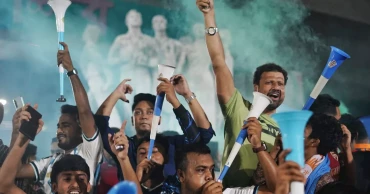
World Cup Final: DU TSC turns into football hub
Thousands of football fans gathered at the Teacher-Student Centre (TSC) of Dhaka University on Monday to watch the FIFA World Cup 2026 final between Argentina and Spain at MetLife Stadium in East Rutherford, New Jersey.
The TSC premises turned into a festive venue as supporters from different parts of the capital arrived wearing team jerseys, carrying flags and cheering for their favourite sides.
15 days ago
History points to a high-scoring Argentina-Spain World Cup final
Expect some goals in the World Cup final. At least, that’s what history says.
In the 22 previous World Cup men's finals (which would include the 1950 match between Uruguay and Brazil that technically wasn’t a final, but decided who won the World Cup), the winning team has averaged 2.6 goals in the title matchup. The losing team has averaged 1.1 goals.
The two most recent World Cup finals have been offensive slugfests, with a combined 12 goals. France beat Croatia 4-2 in 2018, while Argentina and France tied 3-3 in 2022 (before Argentina prevailed in a penalty shootout).
Teams scoring at least two goals have won the World Cup title 17 times; there have been eight instances of a team scoring at least two goals in the final and still falling short.
There have been three 1-0 wins: West Germany over Argentina in 1990, Spain over Netherlands in 2010 and Germany over Argentina in 2014. And there was one 0-0 tie in a final; Brazil wound up winning over Italy in a penalty shootout the 1994 final, which had been the only one played on U.S. soil before now.
Scaloni looking to join elite club
If Argentina wins Sunday, Lionel Scaloni — who led the team’s push to the 2022 title — would be just the second person to coach two World Cup championship clubs.
Italy went back-to-back as World Cup champions in 1934 and 1938, with both those clubs coached by Vittorio Pozzo.
Nobody else has two titles as a coach. There are three men — Brazil’s Mário Zagallo, West Germany’s Franz Beckenbauer and France’s Didier Deschamps — to have won World Cups as both a player and a coach.
Messi matters
When he takes the field Sunday, Argentina star Lionel Messi will be the oldest field player to appear in a World Cup final.
Messi is 39. Sweden’s Gunnar Gren was 37 when he played against Brazil in the 1958 final.
The only player older than Messi to play in a final was Italy goalkeeper Dino Zoff — who was 40 when his club beat West Germany for the 1982 crown. But among field players, Messi will stand alone as the oldest after Sunday.
Messi is also in position to join Brazil’s Cafu as the only person to play in three World Cup men’s finals. And since Cafu was a reserve in one of his appearances, Messi would be the first to start the title game on three occasions.
For Spain, youth may be served. Experience may, too.
Youth may be served by Spain in this World Cup final. And if La Roja prevails, experience would also have paid off.
It’s an interesting mix.
Spain is slated to have two teenagers — Lamine Yamal and Pau Cubarsí, a pair of 19-year-olds — play Sunday against Argentina in the World Cup final, and no team has ever had more than one teen in the lineup and won the title.
So, that's the power of youth.
Here’s the flip side of that: If Spain wins, coach Luis de la Fuente — who is 65 — would become the oldest World Cup-winning sideline boss, passing Vicente del Bosque, who was 59 when Spain won its first title in 2010.
For the record, teenagers enter Sunday unbeaten in World Cup finals, according to FIFA, which says only three have ever played in soccer’s biggest game. Pelé was 17 when he helped Brazil win the final over Sweden in 1958, Giuseppe Bergomi was 18 when Italy beat West Germany in 1982, and Kylian Mbappé was 19 when France beat Croatia in 2018.
Spain seeking record streak
Spain is 28-0-9 in its last 37 matches, which has tied Italy for the longest unbeaten run by a European men’s national team.
Italy also went 28-0-9 from October 2018 through September 2021 — before losing to Spain 2-1 on Oct. 6, 2021 in Milan.
Argentina has a streak worth noting as well. It has won seven consecutive World Cup matches, tied with Italy for the second-longest such run in men's tournament history. Only Brazil, which won 11 straight spanning 2002 and 2006, has a longer World Cup winning streak.
Argentina-Spain history
The game is just the second head-to-head meeting in a World Cup between Argentina and Spain. Argentina won 2-1 in the 1966 group stage.
Across all competitions and friendlies, the sides have played 14 times. Each has won six times and they tied twice.
15 days ago