Asia

Cyclone kills 3, damages homes and crops along India’s eastern coast
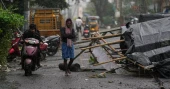
At least three people were killed as Cyclone Arnab battered India’s eastern state of Andhra Pradesh on Wednesday, damaging homes, farmland and power infrastructure after authorities evacuated around 180,000 people, officials said.
The cyclone made landfall early Wednesday as a very severe cyclonic storm before weakening as it moved inland, according to the India Meteorological Department.
Two women died from electrocution in separate incidents in the port city of Visakhapatnam, while another person was killed by a falling tree in East Godavari district.
Wind speeds reached 135 kilometres per hour, or 84 miles per hour, late Wednesday morning, state disaster management officials said. The storm was expected to weaken further as it moved inland.
Andhra Pradesh Chief Minister N Chandrababu Naidu said 14 coastal districts had been badly affected by strong winds and heavy rainfall, which damaged houses, roads, electricity poles and power supply infrastructure. He sought urgent assistance from the central government.
The cyclone damaged crops across 79,000 acres and dozens of homes, with the fertile Konaseema district among the worst-hit areas. Banana and coconut plantations suffered extensive damage, while uprooted trees and electricity poles disrupted power supplies.
The meteorological department said heavy rain and strong winds would continue in coastal Andhra Pradesh and parts of neighbouring Odisha. Rainfall also flooded several low-lying areas in Visakhapatnam.
Authorities had evacuated people from vulnerable coastal and flood-prone areas ahead of landfall and cancelled some train services as the storm approached. More than 12 million people live along the cyclone’s expected path, according to the state disaster management authority.
Officials established more than 2,000 cyclone shelters across 20 districts and sent emergency alerts to millions of mobile phone users, Press Trust of India reported, citing state disaster management authority chief Prakhar Jain.
More than 30,000 fishing boats were secured along the coast, while nearly 1,100 medical teams were deployed to provide emergency assistance, Jain said.
In neighbouring Odisha, authorities planned to evacuate around 48,000 people from areas expected to be affected by the storm.
Meanwhile, Nepal’s disaster agency warned of heavy rain, lightning and thunderstorms across much of the country, advising tourists to avoid high-altitude and Himalayan areas and cautioning about possible road and air travel disruptions.
Nepal is still recovering from devastating flash floods in August that killed more than 1,400 people and left thousands missing. Further flooding was reported in northern Nepal earlier this month.
14 minutes ago

Nepal plans flood early warning systems in river basins, risk reduction in glacial lakes
The Nepali government has unveiled plans to expand flood early warning systems across six major river basins and lower water levels in four high-risk glacial lakes as part of efforts to strengthen disaster preparedness amid growing climate-related risks in the Himalayan region.
The initiatives are part of a broader strategy to improve flood forecasting, reduce the risk of glacial lake outburst floods (GLOFs) and modernize weather forecasting through advanced technologies, according to separate documents issued by the Center for Hydrology and Water Resources Research and the Department of Hydrology and Meteorology, the secretariat of Nepal's Ministry of Energy, Water Resources and Irrigation said in a press statement on Sunday.
The plans come in the wake of devastating floods on Aug. 26 that claimed around 1,500 lives, while more than 5,000 people remain missing. The floods also caused 1.81 billion U.S. dollars in physical damage, according to the Nepali government's preliminary Rapid Damage and Needs Assessment (RDNA).
Rising temperatures have accelerated glacier melting in the Himalayas, increasing concerns over glacial lake instability, avalanches and potentially destructive floods downstream.
Under the proposed Glacial Lake Outburst Flood (GLOF) Sanjeevani Project, the government plans to lower water levels in four high-risk glacial lakes: Thulagi in Manang district, Lower Barun in Sankhuwasabha district, and Lumding Tsho and Hongu-2 in Solukhumbu district.
The project is scheduled to run from 2026 to 2033, with an estimated budget of 49.9 million dollars.
The initiative builds on previous efforts to reduce risks at Tsho Rolpa in Dolakha district and Imja Lake in Solukhumbu district, where water levels were successfully lowered to mitigate the threat of glacial lake outburst floods.
Meanwhile, the Center for Hydrology and Water Resources Research plans to install flood early warning systems across six river basins under the Priority River Basins Flood Risk Management Project, which runs from 2022 to 2028, with an investment of 7.54 million dollars.
The center will also provide round-the-clock flood forecasting and early warning services from mid-May to mid-October, covering the country's main monsoon season.
In a separate initiative to improve weather forecasting, the Department of Hydrology and Meteorology plans to prioritize artificial intelligence, machine learning and high-performance computing systems to enhance the accuracy and reliability of forecasts.
2 days ago

Floods batter Nepal, but power exports keep rising
Nepal earned 5.93 billion Nepalese rupees from electricity exports to India in the third month of fiscal year 2026/27, which began in mid-July, the Nepal Electricity Authority (NEA) said on Sunday.
Revenue from electricity exports in the month increased by 962 million rupees compared with the same month last year, according to data from the state-owned power utility. Nepal earned 4.96 billion rupees from electricity exports to India during the same period last year.
The NEA reported an increase in export earnings despite damage to several hydropower projects caused by the devastating floods of Aug. 26, which forced some plants authorized to export electricity to suspend generation.
Nepal had suspended electricity exports to Bangladesh following the floods, but shipments resumed on Friday, according to the NEA. The country has been authorized to export up to 40MW of electricity as per the tripartite agreement between Nepal, India and Bangladesh.
During the first three months of the current fiscal year, from mid-July to mid-October, Nepal recorded electricity export transactions worth a total of 16.15 billion rupees.
The Aug. 26 floods severely damaged seven operational hydropower plants, three of which had received approval to export electricity. A total of 12 hydropower projects, including operational plants and those under construction, were damaged by the floods, according to the Nepal Development Update released by the World Bank earlier this month. (1 Nepalese rupee equals to 0.0066 U.S. dollar).
3 days ago
Pakistan urges Afghanistan to act against militants, denies recruiting Afghan fighters
Pakistan urged Afghanistan’s Taliban government on Saturday to take verifiable action against militants it says operate from Afghan territory, dismissing Kabul’s assertion that Islamabad was shifting blame for its own security failures.
In a separate statement on X, Pakistan’s Information Ministry rejected allegations that it was arming Afghans to fight the Taliban or recruiting them to fight anti-Pakistan insurgents. Former U.S. envoy to Afghanistan Zalmay Khalilzad had cited reports of both activities a day earlier.
The exchanges come amid heightened tensions between the two sides over militant activity, repeated border clashes and Pakistani airstrikes in Afghanistan, deepening a longstanding dispute over responsibility for cross-border violence.
Khalilzad on Friday wrote on X that there had been reports of Pakistan arming Afghans to fight the Taliban inside Afghanistan and of the Pakistani military recruiting Afghans to fight anti-Pakistan insurgents. He offered no evidence, and did not identify the sources of those reports.
Last month, Afghanistan said its forces killed 28 fighters and captured 32 others, including alleged members of the Islamic State group said to have crossed from neighboring Pakistan.
Pakistan frequently accuses Kabul of sheltering the Pakistani Taliban, known as Tehrik-e-Taliban Pakistan, or TTP, as well as the outlawed Baloch Liberation Army, or BLA, and al-Qaida in the Indian Subcontinent, an affiliate of the global extremist network. The TTP is separate from but closely allied with Afghanistan’s ruling Taliban.
On Friday, the Afghan Taliban government spokesperson Zabihullah Mujahid said that Kabul was not responsible for insecurity in Pakistan. He accused Pakistani military and security agencies of shifting blame when they failed to maintain security at home. He said Kabul had neither an interest in destabilizing Pakistan nor the capability to foment or finance unrest in other countries.
In Islamabad, the Information Ministry on X said those assertions did not address what it described as documented security concerns. It cited attempted cross-border infiltration, the deaths of Afghan nationals and members of militant groups during Pakistani counterterrorism operations, and the recovery of foreign-origin weapons as matters requiring scrutiny.
According to the ministry, the U.S. report covering January through March 2026 estimated the strength of the Pakistani Taliban at 4,000 to 6,000 fighters.
Pakistan is currently conducting multiple operations against militants near the Afghan border.
The ministry said these security measures were aimed at targeting militant threats, not the Afghan people. It urged the Taliban government to end any tolerance, facilitation or support for militant organizations, including the TTP and the BLA, and prevent Afghan territory from being used to plan or launch attacks against Pakistan.
Militant violence has surged in Pakistan in recent years, with much of it blamed on TTP and BLA. Pakistan says many TTP leaders and BLA insurgents have found sanctuary in Afghanistan since the Taliban returned to power there in 2021, an allegation Kabul denies.
Pakistani authorities say more than 2,800 militant attacks since January have killed 3,000 people across Pakistan, mainly in the northwest and Balochistan province.
3 days ago

Kim Jong Un visits China for first time in a year
North Korean leader Kim Jong Un has arrived in China for his first visit to the country in a year, South Korea’s government said Saturday, as Pyongyang seeks to strengthen ties with Beijing amid growing alignment with Moscow.
According to South Korea’s Unification Ministry, Kim appeared to have arrived in the Chinese border city of Dandong on Saturday after crossing a newly opened bridge connecting the two countries. The ministry did not immediately provide further details.
The opening of the New Yalu River Bridge this month has been viewed by experts as a symbol of closer ties between the two countries and their efforts to expand trade. The bridge is expected to support round-the-clock traffic in both directions, including container shipments and heavy trucks.
North Korean state media had not reported the visit, while China’s Foreign Ministry press office did not immediately respond to a request for confirmation.
Japan’s Kyodo News agency, citing unnamed diplomatic sources, reported earlier Saturday that Chinese authorities had imposed strict traffic restrictions in parts of Dandong and hotel rooms in those areas were unavailable for booking.
Kim has recently moved to strengthen relations with China, Pyongyang’s traditional main ally and economic lifeline, after prioritising ties with Russia for several years. North Korea has sent thousands of troops and conventional weapons to support Russian President Vladimir Putin’s war in Ukraine, reportedly in return for possible military and economic assistance.
The visit is Kim’s sixth to China since he took power in late 2011 following the death of his father. It comes ahead of the October 25 anniversary of China’s first major victory in the Korean War, days after Chinese troops crossed the Yalu River into North Korea in October 1950.
The war began when North Korea launched a surprise attack on South Korea in June 1950, prompting a US-led United Nations coalition to intervene. Chinese forces backed North Korea, with assistance from the Soviet air force, before an armistice ended the fighting in 1953. The Korean Peninsula technically remains at war.
North Korea’s official Korean Central News Agency reported Friday that a delegation from China’s Ministry of Veterans Affairs had arrived in Pyongyang the previous day, but did not say whether the visit was connected to preparations for the anniversary.
Chinese President Xi Jinping visited Pyongyang in June for talks with Kim. During the meeting, Xi expressed Beijing’s readiness to expand cooperation in trade, agriculture, construction and technology, while Kim described relations with China as a top strategic priority.
Kim last visited Beijing in September 2025, when he met Xi and attended a military parade alongside Putin and other foreign leaders.
Kim has maintained a hard line towards Seoul and has so far rejected US President Donald Trump’s proposal to revive diplomatic talks, which collapsed in 2019 during Trump’s first term. Pyongyang has called on Washington to abandon what it describes as a “hostile policy” and drop demands for North Korea’s denuclearisation as a condition for renewed negotiations.
South Korea’s intelligence agency told lawmakers last month that there was a 50 percent possibility of a meeting between Trump and Kim on the sidelines of next month’s Asia-Pacific Economic Cooperation (APEC) summit in Shenzhen, China.
4 days ago

Xi orders all-out rescue efforts after 7.0-magnitude earthquake in Xizang
Chinese President Xi Jinping has ordered all-out search and rescue efforts for the missing and prompt medical treatment for the injured after a 7.0-magnitude earthquake struck a county in southwest China's Xizang Autonomous Region on Thursday night.
Xi, also general secretary of the Communist Party of China Central Committee and chairman of the Central Military Commission, made the remarks in an important instruction, calling for every effort to minimize casualties.
Sixteen people were killed and 46 others injured after a 7.0-magnitude earthquake struck Baqen County of Nagqu City in southwest China's Xizang Autonomous Region at 10:33 p.m. Thursday (Beijing Time), according to the city's earthquake relief headquarters.
The regional disaster prevention, reduction and relief committee activated a Level III emergency response for natural disaster relief on Friday.
As of 5:20 a.m. Friday, 11 of the injured were in serious condition, while 35 sustained minor injuries. Over 330 houses collapsed or were damaged.
5 days ago

16 killed, 46 injured after 7.0-magnitude quake hits China's Xizang
Sixteen people were killed and 65 others injured after a 7.0-magnitude earthquake struck Baqen County of Nagqu City in southwest China's Xizang Autonomous Region at 10:33 p.m. Thursday, the city's earthquake relief headquarters said on Friday.
The regional disaster prevention, reduction and relief committee activated a Level III emergency response for natural disaster relief on Friday.
Over 330 houses collapsed or were damaged.
The damage caused by the quake is being further evaluated, and disaster relief work is underway.
Quake relief supplies allocated by the authorities at various levels have been arriving at the quake-hit zone as of early Friday morning, including 1,000 sets of prefabricated houses, more than 3,200 tents, over 2,800 folding beds, and other daily necessities like quilts, stoves and clothes.
5 days ago

Six killed, dozens injured in bus crash in Central India
At least six people, including two women and a girl, were killed and 25 others injured after a passenger bus rammed into a roadside tree in India's central state of Chhattisgarh on Thursday.
The accident took place within the jurisdiction of Kelhari Police Station in the Manendragarh-Chirmiri-Bharatpur (MCB) district while the bus was travelling from the Manendragarh area to Kelhari town at a high speed.
More than 30 passengers were on board when the accident occurred, police said.
According to police, the driver suddenly lost control of the vehicle, causing it to crash into the tree.
The death toll was feared to rise, as more than 15 of the injured were reported to be in critical condition.
5 days ago

North Korea to resume propaganda broadcasts along border with South Korea
North Korea plans to resume anti-Seoul propaganda broadcasts along its heavily fortified border with South Korea, Kim Yo Jong, the sister of leader Kim Jong Un, has said, reviving a psychological warfare campaign amid rising tensions following land mine explosions that injured three South Korean front-line soldiers.
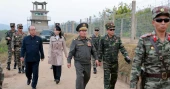
Kim Yo Jong, her brother’s key spokesperson on relations with Washington and Seoul, announced the move on Wednesday after visiting border areas where North Korean troops are strengthening fortifications. She also renewed threats of retaliation against any South Korean provocation targeting the ongoing construction work.
In a follow-up statement on Thursday, she said North Korea would place “new counter means” on alert along the border and put its loudspeakers on standby within days.
North Korea has been installing mines, barbed-wire fences, anti-tank barriers and other fortifications along the border, already one of the world's most heavily armed frontiers, as Kim Jong Un maintains a hard-line stance toward Seoul.
During the visit with Marshal Pak Jong Chon, one of her brother’s senior military officials, Kim Yo Jong described the fortification work as a “sacred and great undertaking” in support of the leader’s policy of permanently severing ties with South Korea.
Kim Jong Un has declared South Korea his most hostile adversary amid a broader diplomatic stalemate with Washington.
“Our tactical hunting teams are taking new positions, and within October, the loudspeakers for psychological warfare against the ROK will be in operation along the whole border,” Kim Yo Jong said, referring to South Korea by the initials of its official name, the Republic of Korea.
She warned that if South Korean warning shots, which Seoul says are intended to push North Korean soldiers back across the border during fortification work, cause “actual harm to our territorial security and our service persons' safety,” North Korean border guards “will show no mercy for the armed gangsters bereft of reason.”
Asked about the threat to resume loudspeaker broadcasts, South Korean Defence Ministry spokesperson Chung Binna said on Thursday that Seoul would need to take “proportionate measures” in response to North Korea’s activities along the border. She did not specify what steps the South might consider.
North Korea’s state-run Korean Central News Agency initially reported that Kim visited the border on Tuesday. However, Kim later corrected the timing in a separate statement, saying the visit took place early Wednesday.
Following an inspection with the US-led United Nations Command, South Korea formally blamed North Korean-planted mines for the September 21 explosions and called on Pyongyang to apologise and remove its remaining mines.
North Korea has denied responsibility for the blasts and warned of strong retaliation if provoked.
“Our military leadership underlined the need to make those rogues aware that our new firepower units have taken their firing positions,” Kim Yo Jong told soldiers during Wednesday’s visit, reminding them of her brother’s order to make the border with the “enemy ... eternally impregnable.”
South Korea’s military has said North Korean soldiers crossed the Military Demarcation Line 50 times this year while carrying out fortification work, prompting Seoul to respond with warning shots and loudspeaker broadcasts.
Kim Yo Jong has dismissed the South’s claims of border crossings as a “false pretext” and accused Seoul of escalating provocations “beyond the red line” since the mine explosions.
South Korea’s Joint Chiefs of Staff chairman, Jin Yong-Sung, described Kim’s threats as “intolerable” and instructed the military to respond firmly to potential North Korean provocations.
During Tuesday’s border inspection, Pak accused South Korea of making “deliberate, premeditated and absurd” claims to shift blame for the rising tensions. He also threatened an “overwhelming response” to any South Korean provocation.
Pak denied that North Korean troops had crossed the border during fortification work, saying “our army knows where our borderline is better than any others,” according to KCNA.
Loudspeaker broadcasts are among the Cold War-era psychological warfare tactics that the two Koreas have occasionally used against each other during periods of heightened tensions.
South Korea’s liberal government, led by President Lee Jae Myung, suspended its broadcasts after taking office last year in an effort to improve relations with the North. Pyongyang later halted its own broadcasts as well.
Kim Jong Un has cut off diplomatic engagement and cooperation with South Korea in recent years, declaring the country a permanent enemy as a prolonged deadlock in nuclear negotiations with Washington continues.
6 days ago

Saudi capital’s airport resumes limited flights after Houthi strikes
Saudi Arabia’s main airport in the capital Riyadh resumed limited flight operations on Wednesday, two days after airlines were notified that they could restart services with prior permission, following multiple attacks by Yemen’s Houthi rebels this month.
Only Saudi airlines were operating at King Khalid International Airport on Wednesday, according to flight-tracking data published by FlightAware.
Saudia and Flynas were operating flights, while major international carriers, including Lufthansa and Air France, had cancelled services through mid-November.
The airport was struck multiple times by Houthi rebels this month and was shut down on October 10. The decline in air traffic could have longer-term economic implications for Saudi Arabia beyond the direct damage caused by the attacks.
The Houthis have acknowledged targeting the airport, claiming, without providing evidence, that Saudi Arabia used the facility to supply military equipment to government forces.
Meanwhile, the Saudi-led coalition said it intercepted and destroyed five Houthi drones launched towards Saudi Arabia over the holy city of Medina on Wednesday.
In Yemen, Houthi military spokesman Brig. Gen. Yahya Saree said a ballistic missile struck a military camp near Aden airport. A transportation ministry official said airport operations were temporarily suspended, but the runway was undamaged and a civilian aircraft had departed before the strike.
6 days ago