Asia

Over 100 Rohingya refugees arrive in Indonesia’s Aceh
A rickety wooden boat carrying more than 100 Rohingya Muslims landed Wednesday in Indonesia as the northernmost province of Aceh continued to receive the refugees fleeing persecution and political unrest in Myanmar.
Indonesia's government blames a surge in human trafficking for the increasing number of Rohingya Muslims who have arrived over the past few years.
Local police chief Nova Suryandaru said the boat’s engine had broken down and the boat, carrying mostly women and children, ran aground near Pereulak village in East Aceh district. He said authorities were collecting information about their identities.
He said one refugee told authorities that the vessel set off from Cox’s Bazar in Bangladesh with the hope of reaching Malaysia. But Suryandaru said many suspect the boat was deliberately damaged by illegal traffickers so the refugees would not be returned to sea.
30 dead in India's Kumbh festival stampede
The government will take “firm action” against perpetrators of human trafficking, Suryandaru said.
Over 600 Rohingya refugees have landed in East Aceh in the past year, including more than 260 weak and hungry refugees, mostly women and children, who landed in Pereulak in two boats earlier this month.
Indonesia has appealed for help from the international community.
About 1 million Rohingya, who are predominantly Muslim, are in camps in Bangladesh after leaving Myanmar. They include about 740,000 who fled a brutal “clearance campaign” in 2017 by Myanmar’s security forces, who were accused of committing mass rapes and killings.
The Rohingya minority face widespread discrimination in Myanmar and most are denied citizenship.
1 year ago

30 dead in India's Kumbh festival stampede
A tragic stampede at the Maha Kumbh festival in northern India claimed the lives of at least 30 people and left many others injured early Wednesday, according to police. The incident occurred as millions of Hindu pilgrims gathered for a ritual bath at the confluence of three rivers in Prayagraj.
Police official Vaibhav Krishna reported that 60 people sustained injuries and were taken to hospitals for treatment. The stampede took place on a particularly auspicious day in the six-week-long festival, with authorities estimating a turnout of 100 million devotees seeking spiritual purification through the holy dip.
According to Uttar Pradesh Chief Minister Yogi Adityanath, the chaos began when pilgrims attempted to bypass barricades set up for a procession of revered Hindu ascetics. These processions, a major attraction of the event, feature ash-covered sadhus making their way to the sacred waters.
Passenger plane catches fire at South Korean airport, all 176 people on board are evacuated
Despite the scale of the tragedy, Indian officials took over 16 hours to release casualty figures. Prime Minister Narendra Modi expressed his grief, calling the incident "deeply saddening" and offering condolences to the victims' families.
A witness named Sarojini told the Press Trust of India that the crowd suddenly became uncontrollable. "We were trapped with people pushing from all sides. Many fell, and there was no way to escape," she recounted.
Distraught relatives gathered outside a temporary hospital, anxiously searching for missing loved ones. The aftermath of the chaos was evident at the site, where personal belongings such as clothes, blankets, and bags lay scattered.
Despite police urging people to avoid the main confluence, millions of devotees continued arriving at the 4,000-hectare festival grounds. Adityanath assured that the situation was under control but acknowledged the overwhelming number of attendees. By 8 a.m. Wednesday, around 30 million people had already completed their ritual bath.
The Maha Kumbh festival, which occurs every 12 years, began on January 13, with an estimated 400 million expected to participate throughout its duration. So far, nearly 150 million people, including top officials like Defense Minister Rajnath Singh, Home Minister Amit Shah, and international celebrities like Coldplay’s Chris Martin, have visited the site.
12 rail passengers killed in India after jumping onto tracks in fire panic
A massive tent city has been set up to accommodate pilgrims, featuring roads, electricity, water facilities, 3,000 kitchens, and 11 hospitals. Authorities have deployed 50,000 security personnel and installed 2,500 surveillance cameras to monitor crowd movements and prevent disasters.
However, critics from opposition parties blamed the tragedy on mismanagement and alleged that VIP treatment for politicians and celebrities worsened crowd control issues. Opposition leader Rahul Gandhi urged the government to improve arrangements for ordinary devotees.
The Maha Kumbh festival is one of the most significant religious events for Hindus, who make up nearly 80% of India’s 1.4 billion population. The event is also politically important for Modi’s government, which emphasizes Hindu cultural heritage.
Stampedes have occurred at previous Maha Kumbh gatherings. In 2013, a similar tragedy at a Prayagraj train station left 40 pilgrims dead. More recently, in July, at least 116 people—mostly women and children—lost their lives in a stampede at a religious event in Uttar Pradesh’s Hathras district.
1 year ago
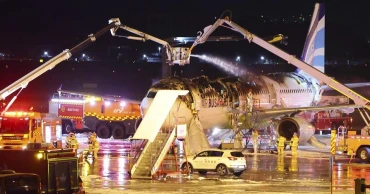
Passenger plane catches fire at South Korean airport, all 176 people on board are evacuated
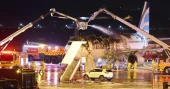
A passenger plane caught fire before takeoff at an airport in South Korea late Tuesday, but all 176 people on board were safely evacuated, authorities said.
The Airbus plane operated by South Korean airline Air Busan was preparing to leave for Hong Kong when its rear parts caught fire at Gimhae International Airport in the southeast, the Transport Ministry said in a statement.
The plane's 169 passengers, six crewmembers and one engineer were evacuated using an escape slide, the ministry said.
The National Fire Agency said in a release that three people suffered minor injuries during the evacuation. The fire agency said the fire was completely put out at 11:31 p.m., about one hour after it deployed firefighters and fire trucks at the scene.
The cause of the fire wasn't immediately known. The Transport Ministry said the plane is an A321 model.
Tuesday's incident came a month after a Jeju Air passenger plane crashed at Muan International Airport in southern South Korea, killing all but two of the 181 people on board. It was one of the deadliest disasters in South Korea’s aviation history.
The Boeing 737-800 skidded off the airport's runaway on Dec. 29 after its landing gear failed to deploy, slamming into a concrete structure and bursting into flames. The flight was returning from Bangkok and all of the victims were South Koreans except for two Thai nationals.
The first report on the crash released Monday said authorities have confirmed traces of bird strikes in the plane’s engines, though officials haven’t determined the cause of the accident.
1 year ago

North Korean leader Kim inspects nuclear facility as Pyongyang pressures Trump administration
North Korean leader Kim Jong Un has inspected a facility that produces nuclear material and called for bolstering the country’s nuclear capability, state media reported Wednesday, as the North looks to increase pressure on the United States following the inauguration of U.S. President Donald Trump.
Kim’s visit suggests a continued emphasis on an expansion of North Korea’s nuclear arsenal, though Trump has said he’s willing to talk to Kim again to revive diplomacy. Many analysts view North Korean weapons moves as part of a strategy to win diplomatic talks with Washington that could result in aid and political concessions.
The official Korean Central News Agency reported that Kim visited the nuclear-material production base and the Nuclear Weapons Institute. It didn’t say where those facilities are located, but North Korean photos of Kim’s visit indicated that he likely visited a uranium-enrichment facility that he went to last September. That visit was North Korea’s first disclosure of a uranium-enrichment facility since it showed one to visiting American scholars in 2010.
During the latest visit, Kim praised scientists and others for "producing weapons-grade nuclear materials and in strengthening the nuclear shield of the country.”
On Sunday, North Korea said it tested a cruise missile system, its third known weapons display this year, and vowed “the toughest” response to what it called the escalation of U.S.-South Korean military drills.
North Korea views U.S. military training with South Korea as invasion rehearsals, though Washington and Seoul have repeatedly said their drills are defensive in nature. In recent years, the United States and South Korea have expanded their military exercises in response to North Korea’s advancing nuclear program.
The start of Trump’s second term raises prospects for the revival of diplomacy between the United States and North Korea, as Trump met Kim three times during his first term. The Trump-Kim diplomacy in 2018-19 fell apart due to wrangling over U.S.-led economic sanctions on North Korea.
During a Fox News interview broadcast Thursday, Trump called Kim “a smart guy” and “not a religious zealot.” Asked whether he will reach out to Kim again, Trump replied, “I will, yeah.”
Many experts say Kim likely thinks he has greater bargaining power than in his earlier round of diplomacy with Trump because of his country’s enlarged nuclear arsenal and deepening military ties with Russia.
1 year ago
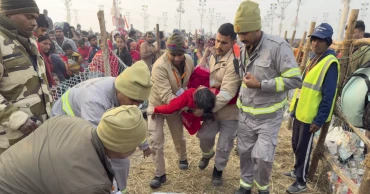
Several people feared dead in stampede at India's massive Maha Kumbh festival
Several people were feared dead and many more injured in a stampede early Wednesday as tens of thousands of Hindus rushed to take ritual baths in sacred rivers at the massive Maha Kumbh festival in northern India.
Several pilgrims were injured, some seriously, in the stampede between 1 a.m. and 2 a.m. as they tried to jump barricades erected for the movement of religious saints, Uttar Pradesh state’s top elected official, Yogi Adityanath, said in a televised statement.
He made no mention of any deaths even eight hours after the crush of pilgrims at the site. Some local news websites said 10 people had died.
Distressed families lined up outside a makeshift hospital inquiring about their missing relatives, rescuers were helping the injured and police tried to manage the crowds. People’s belongings like clothes, blankets and backpacks were strewn around the scene of the stampede. It was not immediately clear what triggered the panic.
“The situation is now under control, but there is a massive crowd of pilgrims,” Adityanath said, adding that 90 million to 100 million pilgrims had congregated there.
“About 30 million people had taken the holy bath by 8 a.m. Wednesday,” he said.
Stampede at Jashore religious assembly; 20 injured
Wednesday was a sacred day during the six-week festival, and authorities were expecting a record 100 million devotees to engage in a ritual bath at the confluence of the Ganges, the Yamuna and the mythical Saraswati rivers. Hindus believe that a dip at the confluence will cleanse them of their past sins and end their process of reincarnation. The main draw are thousands of ash-smeared Hindu ascetics who make massive processions toward the confluence to bathe.
Millions continued to throng the site even as police officials urged them over megaphones to avoid the confluence. Adityanath urged people to instead take baths at other riverbanks.
The Maha Kumbh festival, held every 12 years, started on Jan. 13 and is the world’s largest religious gathering. Authorities expect more than 400 million people to throng the pilgrimage site in total.
Nearly 150 million people have already attended, including the likes of Defense Minister Rajnath Singh and Home Minister Amit Shah and celebrities like Coldplay’s Chris Martin.
A sprawling tent city was built on the riverbanks to accommodate visitors. It has roads, electricity and water, 3,000 kitchens and 11 hospitals.
Stampedes in Nigeria kill 32 during Christmas food distribution
About 50,000 security personnel are stationed in the city to maintain law and order and manage crowds, and more than 2,500 cameras monitor crowd movement and density so officials can try to prevent such crushes.
Deadly stampedes are relatively common around Indian religious festivals, where large crowds gather in small areas. In 2013, at least 40 pilgrims who were taking part in the same festival were killed in a stampede at a train station in Prayagraj.
1 year ago
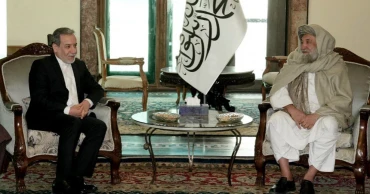
Iran's foreign minister meets Taliban in first visit to Kabul in 8 years
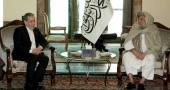
Top Taliban officials met Iran’s foreign minister on Sunday to discuss tensions along their shared border, the treatment of Afghan refugees in Iran and water rights.
It was the first visit by an Iranian foreign minister to the Afghan capital since 2017, AP reports.
Foreign Minister Abbas Aragchi said Iran was committed to the return of some 3.5 million Afghan refugees and had no intention of interfering in its neighbor’s domestic politics, according to a statement from the Afghan government’s deputy spokesman Hamdullah Fitrat.
He also called for the full implementation of the Helmand River water treaty, which envisions shared water resources, the statement said.
Acting Prime Minister Hassan Akhund asked Iran to treat Afghan refugees with respect and said it was not feasible to manage a large-scale repatriation within a short period. He also said incidents such as the execution of Afghans in Iran provoked public sentiment.
Houthis release 153 detainees, Red Cross says unilateral move
Aragchi also met Afghanistan's foreign minister, Amir Khan Muttaqi, and Defense Minister Mohammad Yaqoob.
Earlier Sunday, Iran’s official IRNA news agency quoted Aragchi as saying he hoped for more economic ties and improved relations with Afghanistan, citing some “ups and downs.”
Iran doesn’t formally recognize the Taliban government in Afghanistan, which seized power in 2021 as US and NATO forces withdrew from the country following two decades of war.
But Tehran maintains political and economic ties with Kabul and has allowed the Taliban to manage Afghanistan’s embassy in Iran's capital.
1 year ago

Afghanistan's central bank to inject $25m to keep local currency stable
Afghanistan's central bank announced that it will inject 25 million US dollars on Monday in a bid to maintain the stability of the national currency, the afghani.
"The bidders, including moneychangers and private banks, should deposit the necessary money in cash in the form of afghani in the central bank Da Afghanistan Bank," the central bank said in a statement posted on social media Sunday.
Afghanistan welcomes Saudi Arabia’s decision to reopen embassy in Kabul
Over the past month, the bank has injected millions of US dollars into the nation's currency exchange market to stabilize the afghani and prevent its decline against foreign currencies.
The bank also auctioned 20 million US dollars on Saturday.
In recent weeks, the afghani has experienced a depreciation against the US dollar. Currently, the exchange rate stands at about 80.50 afghani for one US dollar, compared to about 69.30 afghani a month ago.
1 year ago
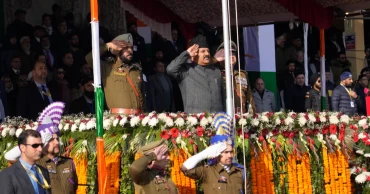
India celebrates Republic Day with Indonesian president as chief guest
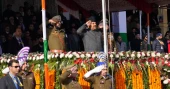
India celebrated its 76th Republic Day on Sunday with a colourful parade displaying its military might and cultural diversity on a boulevard in the heart of country’s capital. Indonesian president was the guest of honour.
Tens of thousands of people lined the road on a cold Sunday morning to watch the long parade to mark the anniversary of the official adoption of India’s Constitution on January 26, 1950, nearly three years after independence from British colonial rule.
Soldiers from India’s military and paramilitary, along with their bands, marched as the country’s leaders and other guests watched. Various floats displayed India’s cultural diversity with one showcasing the Maha Kumbh festival, the ongoing massive Hindu festival touted as the world’s largest religious gathering.
30 killed in Pakistan in military drive
The parade took place on Rajpath Avenue, built by India’s former British rulers and lined by huge lawns, canals and rows of trees. The avenue was redeveloped as part of the celebrations of the 75th anniversary of Indian independence and renamed Kartavayapath, or the Boulevard of Duty, in 2022.
Visiting Indonesian President Prabowo Subianto attended the event as the chief guest and was flanked by India’s president and prime minister. A 342-member band and marching contingent from the Indonesian National Armed Forces joined the parade, the first time the ASEAN country's troops have joined any foreign parade.
India traditionally invites foreign leaders to witness the spectacle. French President Emmanuel Macron was the guest of honour last year and former US President Barack Obama in 2015. Ten Southeast Asian leaders watched the parade in 2018.
Sukarno, Indonesia’s first president and the leader of the country’s independence struggle, was the chief guest at India’s first Republic Day celebration in 1950.
Thousands of men and women in colourful costumes played marches, performed traditional dances and pulled motorbike stunts during the 90-minute parade. It also showcased India’s domestically built defence equipment and military systems, including tanks, infantry combat vehicles, radar systems and missile systems.
8 dead in India's Maharashtra ordnance factory explosion
Some 5,000 artists, carrying traditional props like spears, swords and drums, performed over 40 dance forms from different parts of India in a cultural performance that lasted about 10 minutes. The parade ended with a fly-past by air force fighters, including Rafale jets, transport planes and helicopters.
The parade was broadcast live by television networks. Republic Day parades also took place in state capitals and other cities across India amid massive security arrangements.
In Srinagar, the main city of disputed Kashmir, armed police and soldiers patrolled as regional officials celebrated Republic Day. Hundreds of people braved winter chills to witness the parade amid additional security, with police and soldiers checking vehicles and frisking pedestrians.
India and Pakistan each administer a part of Kashmir, but both claim the territory in its entirety. Militants in the Indian-controlled portion of Kashmir have been fighting New Delhi’s rule since 1989.
1 year ago

30 killed in Pakistan in military drive
Thirty terrorists were killed in three separate operations in Pakistan's northwest Khyber Pakhtunkhwa province, the military said on Saturday.
The security forces conducted intelligence-based operations in Lakki Marwat, Karak and Khyber districts of the province, the Inter-Services Public Relations (ISPR), the media wing of the Pakistan Army, said in a statement.
During the operation in Lakki Marwat, 18 terrorists were killed and six others injured, said the ISPR statement. Another eight terrorists were killed in the Karak district, the ISPR said.
In the third encounter, four terrorists were killed including ring leaders, and two others got wounded, the ISPR said.
According to the ISPR, a huge cache of weapons and ammunition was also recovered in the operations.
Read: Bodies of 11 workers who died in a Pakistan coal mine blast recovered
A clearance operation is being carried out to eliminate the presence of other terrorists in the area.
The military said the security forces of Pakistan are determined to wipe out the menace of terrorism from the country.
1 year ago
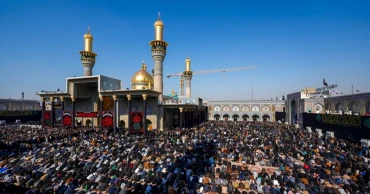
Shiite pilgrims in Iraq maintain annual journey despite regional turmoil
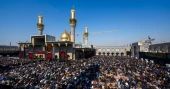
On Saturday, thousands of Shiite pilgrims, dressed in black, began walking towards the golden shrine of Imam Moussa al-Kadhim in the al-Kadhimiyah district of northwestern Baghdad, reports AP.
The shrine holds immense religious significance for Shiite Muslims, as it is the final resting place of Imam al-Kadhim, the seventh of the Twelve Imams, who passed away in the late eighth century.
Gunmen kill 42 Shiites in northwest Pakistan
This year's pilgrimage comes amid significant regional changes, leaving many Shiites feeling vulnerable. The fall of Bashar Assad's government in Syria, which had Iran’s backing, marked a pivotal shift. Iran’s support helped Assad maintain power throughout a brutal civil war, but the regime was recently toppled during a swift offensive led by the Sunni Islamist group Hayat Tahrir al-Sham.
Other Iran-backed groups, such as Hamas in Gaza and Hezbollah in Lebanon, have also been severely impacted by over a year of conflict with Israel. Ceasefires are now in place in both Gaza and Lebanon.
25 people killed in days of clashes between Shiites and Sunni Muslims in Pakistan
Mohammed al-Waswasi, a 28-year-old pilgrim from Wasit province, reached Baghdad after walking for two days while carrying a black banner of mourning. "We are deeply disheartened by the wars in Gaza and Lebanon, where we lost irreplaceable leaders," he said. "We come to Imam al-Kadhim today to mourn."
Iraqi authorities closed major streets in Baghdad to accommodate the large number of pilgrims, mostly from southern and central regions. Tents were set up along the way to offer services and a place to rest. Iraqi security forces were deployed in large numbers to ensure the safety of the event, which usually attracts hundreds of thousands of visitors from within Iraq and beyond.
In al-Kadhimiyah, traffic was halted, and security checkpoints were established at all city entrances to control the flow of visitors.
1 year ago