Asia

South Korea's impeached President Yoon Suk Yeol arrested over martial law declaration
South Korean authorities arrested impeached President Yoon Suk Yeol on Wednesday, marking the first time in the nation’s history that a sitting president has been detained. Yoon faces insurrection charges related to his brief declaration of martial law on December 3, which led to political chaos and an unprecedented crisis in one of Asia's most vibrant democracies.
Reports indicate that Yoon, who had been holed up in his heavily fortified hillside residence in central Seoul for weeks, left his home in a convoy bound for the offices of the Corruption Investigation Office (CIO) after a joint operation by investigators and police executed the arrest warrant. He had previously resisted efforts to detain him, citing legal challenges and fears of public humiliation.
Yoon’s lawyer, Seok Dong-hyeon, announced that the president had agreed to cooperate with investigators, stating on Facebook, “President Yoon has decided to personally appear at the Corruption Investigation Office today to prevent a serious incident.” Yoon also confirmed he would deliver a speech as part of his voluntary appearance.
More than 3,000 police officers and anti-corruption investigators gathered at his residence before dawn, clashing with supporters and members of Yoon's ruling People Power Party who staged protests against the arrest. Investigators finally confirmed the arrest of the suspended president at 10:33 AM local time.
Following the arrest, Yoon can be held for up to 48 hours under the existing warrant. However, authorities would need to seek a further warrant to extend his detention. This marks the second attempt to arrest Yoon. A previous attempt on January 3 had failed after a tense standoff with members of the Presidential Security Service (PSS), who blocked the investigators from carrying out the warrant.
Yoon's declaration of martial law in December triggered widespread protests and political turmoil, prompting South Korea’s lawmakers to vote for his impeachment on December 14. The impeachment removed him from office, but the Constitutional Court is still deliberating whether to uphold the decision and permanently remove him from power.
Separately, Yoon's impeachment trial began on Tuesday, but the proceedings were adjourned after his failure to attend. His legal team blamed purported safety concerns for his absence, but the hearings will continue without him, with the next session scheduled for Thursday.
As South Koreans await further developments, the nation is left grappling with the fallout from an unprecedented political crisis and the potential ramifications of the first-ever presidential arrest in the country’s history.
1 year ago

Massive gold discovery in Pakistan: What's the truth?
Reports of a gold discovery worth an estimated Rs800 billion in Attock, Punjab, have sparked widespread excitement on social media.
However, Pakistan’s federal government and the Foreign Office have yet to confirm the news.
The claims stem from a tweet by Ibrahim Hassan Murad, a former Punjab provincial Minister for Mines and Minerals, who announced the Geological Survey of Pakistan (GSP) had confirmed the discovery of 2.8 million tolas of gold spanning a 32-kilometer area.
"This revelation underscores the immense potential of Punjab’s mineral wealth, which could play a pivotal role in the region’s economic growth," Murad stated.
He termed the discovery as a milestone that could open new opportunities for future generations.
Bodies of 11 workers who died in a Pakistan coal mine blast recovered
The current provincial Minister for Mines and Minerals, Sardar Sher Ali Gorchani, corroborated the claim, affirming the presence of the gold reserves.
Speaking to Urdu daily Jang, Gorchani said the provincial government had been collaborating with the GSP to study the deposits since last year.
To determine the reserves' full value, Gorchani disclosed plans to involve firms like Nespak for additional evaluations. Based on global gold prices, he estimated the reserves’ market value at Rs600-800 billion.
Securing the Area and Next Steps
To protect the valuable resource, the provincial government has increased security around the mining sites. Gorchani also revealed that an international auction for the gold deposits is scheduled for the coming month.
The discovery, if verified, could significantly boost Pakistan's mining sector, offering transformative economic benefits, job creation, and the development of new industries.
With input from Gulf News
1 year ago
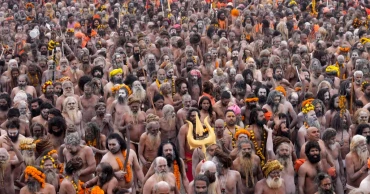
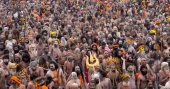
Millions of pilgrims, ascetics take holy dips at India’s Maha Kumbh festival
Millions of Hindu pilgrims and ascetics gathered in northern India on Tuesday for the first major bathing ritual of the Maha Kumbh festival, the world’s largest religious gathering.
Pilgrims took dips in the freezing waters at the confluence of the Ganges, Yamuna, and mythical Saraswati rivers in Prayagraj, marking the beginning of the grand event, AP reports.
At sunrise, large groups of ash-smeared Hindu holy men, known as Naga Sadhus, marched and rode in chariots toward the river.
Holding tridents, swords, and drums, they chanted hymns in praise of Lord Shiva as they made their way to the bathing site in a festive procession. Their followers, millions of devotees, joined them in the river, seeking spiritual cleansing.
India's Modi marks the opening of a strategic tunnel in disputed Kashmir
The Maha Kumbh festival, held once every 12 years, began on Monday, attracting over 15 million pilgrims for the first major bath. Over the next six weeks, officials expect more than 400 million people to visit Prayagraj, participating in religious rituals and bathing in the holy rivers.
Hindus believe that immersing in the confluence purifies the soul, washing away sins and freeing individuals from the cycle of rebirth. Venkatesh Ramaling, a tech specialist from Pune, spoke of the inspiring faith of the pilgrims.
“People have such strong belief here. It’s amazing how they dive into such cold water,” he said, sharing his own feeling of positivity after the ritual.
The Kumbh festival is rooted in a Hindu myth involving the god Vishnu, who is said to have wrested a golden pitcher containing the nectar of immortality from demons. A few drops of this nectar are believed to have fallen at four sacred sites — Prayagraj, Nasik, Ujjain, and Haridwar — where the Kumbh festival is held.
1 year ago
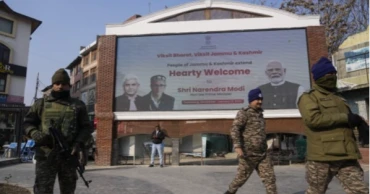
India's Modi marks the opening of a strategic tunnel in disputed Kashmir
Indian Prime Minister Narendra Modi inaugurated a strategic tunnel on Monday in the northeast region of disputed Kashmir, ensuring year-round access to a town previously isolated by heavy winter snowfall.
The $932 million project includes a newly opened 6.5-kilometer (4-mile) Z-Morh tunnel and plans for a second, 14-kilometer (9-mile) tunnel expected by 2026. The development aims to connect Kashmir with Ladakh, a region with longstanding territorial disputes involving India, Pakistan, and China.
India begins a massive Hindu festival touted as the world's largest religious gathering
The Z-Morh tunnel ensures all-season connectivity to Sonamarg, a town marking the transition between the Kashmir Valley's forests and the rugged Zojila mountain pass leading to Ladakh. Severe snowfalls have historically cut off this area from neighboring regions for half the year.
During the high-security visit, Modi addressed the public and emphasized the tunnel's significance for both civilians and the military. Enhanced security measures included police deployment, checkpoints, sharpshooters, and drone surveillance.
In October, insurgents targeted the project, killing seven workers and injuring five others. Authorities attributed the attack to militants opposing Indian rule in the region.
The project is expected to strengthen military logistics in Ladakh, a sensitive area bordering China and Pakistan, while also improving civilian mobility between the Kashmir Valley and Ladakh.
Freed by India 90 Bangladeshi fishermen are due to arrive in Ctg this afternoon
The opening comes amidst ongoing tensions in Kashmir, following the Indian government’s controversial 2019 decision to revoke the region’s semi-autonomous status and divide it into two federally governed territories.
Kashmir remains a focal point of conflict between India and Pakistan, with both nations claiming the region in its entirety. The decades-long insurgency has resulted in significant loss of life among civilians, militants, and security forces.
1 year ago

Suggestion for 90-Hour workweek in India sparks debate
An undated video of SN Subrahmanyan, Chairman of Larsen & Toubro (L&T), suggesting a 90-hour workweek has sparked widespread debate online.
In the clip, he remarked, “I regret I am not able to make you work on Sundays. If I can make you work on Sundays, I will be more happy because I work on Sundays. What do you do sitting at home? How long can you stare at your wife? How long can the wife stare at the husband?”
The comments quickly drew backlash on social media, reigniting discussions about work-life balance and mental health.
L&T’s Controversial ClarificationL&T later issued a clarification that only intensified the debate. The statement read:“At L&T, nation-building is at the core of our mandate. For over eight decades, we have been shaping India’s infrastructure, industries, and technological capabilities. We believe this is India’s decade, a time demanding collective dedication and effort to drive progress and realise our shared vision of becoming a developed nation. The Chairman’s remarks reflect this larger ambition, emphasizing that extraordinary outcomes require extraordinary effort. At L&T, we remain committed to fostering a culture where passion, purpose, and performance drive us forward.”
Similar Remarks from Infosys Co-founderThis incident follows a similar controversy in October 2023, when Infosys co-founder N R Narayana Murthy suggested a 70-hour workweek to help India compete with rapidly growing nations like China and Japan.
Public and Celebrity BacklashActor Deepika Padukone expressed her disapproval on Instagram, calling the remarks “shocking” and emphasizing the importance of mental health. After L&T’s clarification, she added, “And they just made it worse…”
Former badminton champion Jwala Gutta also criticized the remarks, stating on X, “Why shouldn’t he stare at his wife? And why only on a Sunday? It’s sad and sometimes unbelievable that educated people in leadership positions dismiss mental health and rest so casually while making misogynistic statements. It’s disappointing and scary.”
Professional and Psychological PerspectivesIndustry professionals have weighed in on the debate. Vijetha Shenoy, an HR Business Partner at an IT firm, dismissed the comment as frivolous, suggesting, “He would be better off pursuing a hobby if he has so little to occupy his time.”
Ranjay Kumar, another HR professional, offered a more nuanced view: “The younger generation values work-life balance and prioritizes taking breaks to recharge. However, some professionals willingly commit to longer hours due to job insecurity or financial responsibilities.”
Clinical psychologist Pulkit Kumar highlighted the impact of overworking on mental and physical health. “Chasing goals constantly leads to stress, and we’ve observed rising cases of heart problems, high blood pressure, and diabetes among younger individuals, some in their 20s and 30s. We need to optimize work with AI to support well-being, not compromise it.”
With input from Hindustan Times
1 year ago
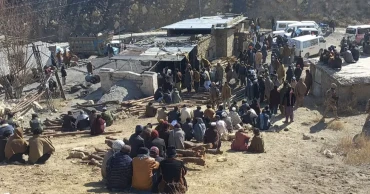
Bodies of 11 workers who died in a Pakistan coal mine blast recovered
Rescuers recovered the bodies of 11 coal miners who died last week after a methane gas explosion caused a coal mine to collapse in southwestern Pakistan, officials said Monday.
An operation is still underway to find a 12th worker who has been missing since Thursday, when the mine collapsed in Singidi city in Balochistan province, said Abdul Ghani, a mines inspector.
Two more coal miners were killed on Sunday when another mine collapsed in Harnai, a district in Balochistan, he said.
Safety standards are commonly ignored in the coal mining industry in Pakistan, leading to accidents and explosions that kill dozens of mine workers every year. Miners often complain that owners fail to install safety equipment.
Read: 3 Pakistani soldiers, 19 insurgents killed in separate raids in northwest
Last week, Pakistani security forces also rescued at least eight of 16 mine workers who had been kidnapped by local militants in the restive northwest, and an operation is still underway to rescue the remaining miners.
1 year ago
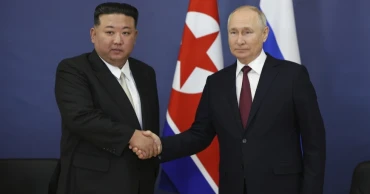
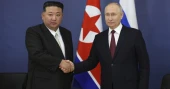
NKorean soldiers captured in Ukraine haven't shown desire to defect: Seoul spy
South Korea’s spy agency told lawmakers on Monday that two North Korean soldiers who were captured by Ukrainian forces while fighting alongside Russian forces in Russia’s Kursk border region haven’t expressed a desire to seek asylum in South Korea.
Ukrainian President Volodymyr Zelenskyy said on the social media platform X that he’s willing to hand over the soldiers to North Korea if the country’s authoritarian leader, Kim Jong Un, arranges for an exchange with Ukrainian prisoners of war in Russia. Zelenskyy added that “there may be other options” for North Korean soldiers who do not wish to return home, and a video released by his government indicated that at least one of the captured soldiers expressed a desire to remain in Ukraine.
In a closed-door briefing at South Korea’s National Assembly, the National Intelligence Service confirmed its participation in the questioning of the North Korean soldiers by Ukrainian authorities. The agency said the soldiers haven’t expressed a request to resettle in South Korea, according to two lawmakers who attended the meeting.
The agency said it was willing to discuss the matter with Ukrainian authorities if the soldiers eventually do ask to go to South Korea. About 34,000 North Koreans have defected to capitalist rival South Korea to avoid economic hardship and political suppression at home, mostly since the late 1990s.
Koo Byoungsam, spokesperson of South Korea’s Unification Ministry, which handles inter-Korean affairs, said facilitating the asylum of the North Korean soldiers would require “legal reviews, including on international law, and consultations with related nations.”
“There’s nothing we can say at the current stage,” Koo said.
Read: Ukraine claims to have captured 2 North Korean soldiers fighting for Russia
Seoul’s spy agency believes that about 300 North Korean soldiers have died and another 2,700 have been injured while fighting against Ukrainian forces, in what represents North Korea's first involvement in large-scale conflict since the 1950-53 Korean War.
The agency assessed that the North Koreans are struggling to adapt to drones and other elements of modern warfare. They are further disadvantaged by the crude tactics of their Russian commanders, who have thrown them in assault campaigns without providing rear-fire support, according to Lee Seong Kweun, a lawmaker who attended the agency’s briefing.
The agency said memos found on dead North Korean soldiers indicated that they had been ordered to commit suicide before being captured, according to Lee. The agency said one North Korean soldier, facing the threat of being captured by Ukrainian forces, shouted “General Kim Jong Un” and tried to detonate a hand grenade before he was shot and killed.
Zelenskyy confirmed the capture of the North Korean soldiers on Saturday, days after Ukraine, facing a slow Russian onslaught in the east, began pressing new attacks in Kursk to retain ground captured in a lightning incursion in August — the first occupation of Russian territory since World War II.
Moscow’s counterattack has left Ukrainian forces outstretched and demoralized, killing and wounding thousands and retaking more than 40% of the 984 square kilometers (380 square miles) of Kursk that Ukraine had seized.
Moon Seong Mook, a retired South Korean brigadier general, said the high death toll for North Korean soldiers was predictable, as they would not have been sufficiently prepared for an unfamiliar mission in the terrain of the Kursk region, which is vastly different from North Korea’s mountainous landscape.
Read more: North Korea tests hypersonic missile aimed at remote Pacific areas
Another disadvantage for the North Koreans is that they are not conducting independent operations but are being thrust into combat under Russian commanders, possibly struggling with unfamiliar tactics and communication issues due to language barriers, said Moon, who has taken part in numerous military talks with North Korea. The North Korean forces could be operating special surveillance teams to arrest or execute attempted deserters, he said.
“The current battlefield environment, combined with drones and other technologies, have created situations North Korean soldiers have never encountered before,” Moon said. “They are also being deployed in large numbers in wide-open fields, where there is no place to hide, in continuous battles to retake the area, and that seems to be where the casualties are coming from.”
North Korea’s decadeslong financial troubles, which have forced many soldiers to grow their own food or spend long hours deployed in construction and other work to sustain the national economy, could also have impacted the quality of training they receive at home, Moon said.
Still, there are concerns in Seoul that North Korea’s participation in the Ukraine crisis poses a significant threat to South Korea, as North Korean forces may gain crucial combat experience and Russia may provide technology transfers that could enhance North Korea’s nuclear-armed army.
1 year ago

Student suspected in hammer attack arrested at Tokyo university
A student suspected of carrying out a hammer attack at a university in Tokyo has been arrested, with local media reporting that several people were injured in the incident, reports AP.
The 22-year-old South Korean sociology student was apprehended at the scene for allegedly assaulting a male student during a class at Hosei University’s Tama campus, located in Tokyo’s western suburbs on Friday. The attack resulted in minor injuries to the victim, according to the Tokyo metropolitan police.HAISON, UNIDO ITPO Tokyo to host Bangladeshi business mission to Japan in 2025
Reports indicated that seven additional students were also injured, with the suspect believed to have struck them one after the other. It remains unclear whether the attack was premeditated.
Kyodo News reported that the suspect told authorities she was “frustrated” after experiencing bullying and being ignored by her peers, and that she used a hammer she found on campus.
Approximately 150 students were in class at the time, and one witness told Kyodo that the attacker appeared to swing the hammer without any clear intention, hitting people seated in the back rows. The witness described how everyone in the classroom fled, while another said the assailant's face appeared emotionless, and she did not seem to be targeting anyone specifically.
The police are continuing their investigation, though no further details have been provided.
There remains lingering discrimination against Koreans in Japan due to the troubled history between the two nations, particularly related to Japan’s brutal colonisation of Korea, which ended in 1945 with Japan’s defeat in World War II.
While violent crime is rare in Japan, there have been isolated incidents of random stabbings and shootings in recent years.
In December, a junior high school student was fatally stabbed, and her friend injured, while waiting in line at a McDonald's in Kitakyushu, a city in the southwest of Japan. The attacker was later arrested.
Tokyo park faces environmental protests over cutting trees
In 2022, three people, including two students heading to entrance exams, were stabbed outside the University of Tokyo. A 17-year-old student was apprehended and later convicted of attempted murder.
1 year ago
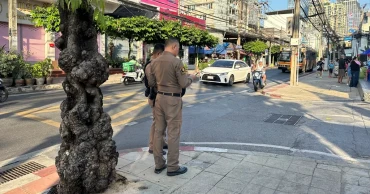
Uyghurs in Thailand fear deportation, persecution in China
A group of Uyghur men detained in Thailand for over a decade claim that Thai authorities are planning to deport them to China, reports AP.,
Activists and family members warn that these men face a high risk of persecution, including abuse and torture, if returned.
House China panel turns focus to plight of Uyghurs
In a letter obtained by the Associated Press, 43 Uyghur men in detention in Bangkok issued a public plea to prevent what they described as an imminent deportation. "We could be imprisoned, and we might even lose our lives," the letter stated, urging international organisations and nations to act swiftly to prevent a "tragic fate."
The Uyghurs, a Turkic, predominantly Muslim ethnic group native to China's Xinjiang region, have long faced discrimination and suppression from Beijing. A sweeping crackdown by the Chinese government, described as genocide by some Western nations, has led to the detention of hundreds of thousands of Uyghurs in camps and prisons, where reports of abuse, disease, and deaths have emerged.
In 2014, Thai authorities detained over 300 Uyghurs fleeing China near the Malaysian border. In 2015, 109 were forcibly returned to China, sparking international condemnation, while 173 women and children were sent to Turkey. Fifty-three Uyghurs remained in Thai detention, with five dying over the years, including two children.
UK people s tribunal hears claims China abused Uyghurs
Currently, 48 detainees remain in custody, five of whom are serving sentences after a failed escape attempt. Advocates describe dire conditions in detention, including overcrowding, inadequate food, poor sanitation, and restrictions on contact with families, lawyers, and international organisations. The treatment may violate international law, according to a 2024 letter from UN human rights experts to the Thai government.
Thai immigration police claim they are doing their best to care for the detainees. However, records obtained by the AP show that on January 8, officials asked the detainees to sign voluntary deportation papers, reminiscent of documents presented to those deported in 2015. The detainees refused.
Sources told the AP that Thai authorities are discussing deportations, with some officials reportedly favouring the move due to the 50th anniversary of diplomatic relations with China and expectations of muted backlash from the U.S. amid its presidential transition. Neither the Thai nor Chinese foreign ministries responded to requests for comment.
China accuses the Uyghurs of being jihadists but has provided no evidence. Rights groups and Uyghur activists insist the detainees are innocent and warn that deportation could lead to imprisonment or death in China. "There’s no evidence that these 43 Uyghurs have committed any crime," said Peter Irwin of the Uyghur Human Rights Project. "They have the right not to be deported."
Relatives and advocates express growing concern. Bilal Ablet, whose brother is among the detainees, described constant fear and frustration. "World governments know about this but seem to ignore it due to Chinese pressure," he said. Despite Thai claims that no other country is willing to accept the Uyghurs, an April 2023 letter from Thailand's Human Rights Commission noted that some countries are ready to resettle them.
China rejects UN report on Uyghur rights abuses in Xinjiang
Abdullah Muhammad, a Uyghur in Turkey, shared his anguish over his father, one of the detainees. "My father crossed into Thailand illegally but has committed no other crime," he said. "Why are they doing this? We have no connection to terrorism."
Although all detainees have submitted asylum applications to the UN refugee agency, the Thai government has barred UN access to them. The UNHCR did not respond to requests for comment.
On Saturday, the detention centre where the Uyghurs are held was quiet, with a guard stating it was closed until Monday. Meanwhile, concerns over their safety continue to grow.
1 year ago
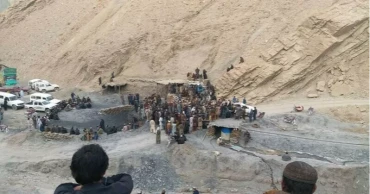
12 workers trapped after coal mine collapses in Pakistan
At least 12 miners remain trapped after a methane gas explosion caused a mine to collapse in a remote area of southwest Pakistan, officials said Friday as authorities launched an operation to rescue the miners.
Abdul Ghani, a mines inspector, said the blast happened on Thursday night in Singidi, a town in Balochistan province. He said rescuers have been carefully removing debris from the mine as part of a rescue effort. None of the miners have been reached yet, he added.
Italy’s foreign minister visits Syria to promote a peaceful transition after Assad’s regime
Shahid Rind, a Balochistan government spokesman, said all available resources are being used in the rescue operation. An investigation has also been ordered to determine the cause of the collapse, he said in a statement.
Safety standards can be poor in the coal mining industry, leading to accidents and fatalities in recent years.
On Thursday, Pakistani security forces rescued at least eight of 16 mine workers who had been kidnapped by local militants.
In neighboring India's northeastern Assam state, hopes are fading as the search resumed for a fifth day on Friday for several people trapped in a flooded coal mine.
Russian worker found dead at Rooppur Power Plant
At least nine miners became trapped on Monday morning after water gushed in from a nearby unused mine in the Umrangso area, in Dima Hasao district, about 125 miles (200 kilometers) south of the state capital, Guwahati. On Wednesday, army divers retrieved the body of a miner.
“There has been no success after army divers” found the victim as the “ill-fated mine is flooded, with water level not receding despite efforts to pump out the water,” said Kaushik Rai, a local government minister.
1 year ago