Asia
North Korea tests hypersonic missile aimed at remote Pacific areas
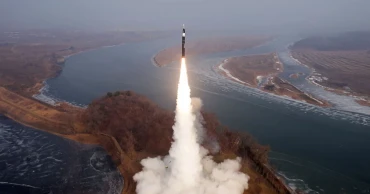
North Korea said Tuesday its latest weapons test was a new hypersonic intermediate-range missile designed to strike remote targets in the Pacific as leader Kim Jong Un vowed to further expand his collection of nuclear-capable weapons to counter rival nations.
The North Korean state media report came a day after South Korea’s military said it detected North Korea launching a missile that flew 1,100 kilometers (685 miles) before landing in waters between the Korean Peninsula and Japan. The launch, conducted weeks before Donald Trump returns as U.S. president, came off a torrid year in weapons testing.
North Korean troops suffering heavy battlefield losses: Ukraine's military
North Korea demonstrated multiple weapons systems last year that can target its neighbors and the United States, including solid-fuel intercontinental ballistic missiles, and there are concerns that its military capabilities could advance further through technology transfers from Russia, as the two countries align over the war in Ukraine.
North Korea in recent years has flight tested various intermediate-range missiles, which if perfected, could reach the U.S. Pacific military hub of Guam. In recent months, North has been testing combining these missiles with purported hypersonic warheads to improve their survivability.
North Korea since 2021 has been testing various hypersonic weapons designed to fly at more than five times the speed of sound. The speed and maneuverability of such weapons aim to withstand regional missile defense systems. However, it’s unclear whether these missiles are consistently flying at the speeds the North claims.
North Korea's Kim vows steadfast support for Russia’s war in Ukraine
The North’s state media said Kim supervised Monday’s launch, and that the weapon traveled 1,500 kilometers (932 miles), during which it reached two different peaks of 99.8 kilometers (62 miles) and 42.5 kilometers (26.4 miles) and achieved a speed amounting to 12 times the speed of sound, before accurately striking a sea target.
Lee Sung Joon, spokesperson of South Korea’s Joint Chiefs of Staff, said the South Korean military believes North Korea was exaggerating capabilities of the system, saying the missile covered less distance and that there was no second peak.
Lee said the test was likely a followup to another hypersonic intermediate-range ballistic missile test last April and said it would be difficult to use such systems in a relatively small territory like the Korean Peninsula. He said the South Korean and U.S. militaries were continuing to analyze the missile.
Kim described the missile as a crucial achievement in his goals to bolster the North’s nuclear deterrence by building an arsenal “no one can respond to,” according to the official Korean Central News Agency.
“The hypersonic missile system will reliably contain any rivals in the Pacific region that can affect the security of our state,” the agency quoted Kim as saying.
Kim reiterated that his nuclear push was aimed at countering “different security threats the hostile forces posed to our state,” but KCNA didn’t mention any direct criticism toward Washington, Seoul or Tokyo.
The launch took place while U.S. Secretary of State Antony Blinken was visiting Seoul for talks with South Korean allies over the North Korean nuclear threat and other issues.
North Korean leader calls for expanding his nuclear forces in the face of alleged US threats
In a news conference with South Korean Foreign Minister Cho Tae-yul on Monday, Blinken condemned North Korea’s launch, which violated U.N. Security Council resolutions against the North's weapons programs. He also reiterated concerns about the growing alignment between North Korea and Russia in Moscow’s war on Ukraine. He described the military cooperation between Pyongyang and Moscow as a “two-way street,” saying Russia has been providing military equipment and training to the North and “intends to share space and satellite technology.”
According to U.S., Ukrainian and South Korean assessments, North Korea has sent more than 10,000 troops and conventional weapons systems to support Moscow’s war campaign. There are concerns that Russia could transfer to North Korea advanced weapons technology in return, which could potentially enhance the threat posed by Kim’s nuclear-armed military.
At a year-end political conference, Kim Jong Un vowed to implement the “toughest” anti-U.S. policy and criticized the Biden administration’s efforts to strengthen security cooperation with Seoul and Tokyo, which he described as a “nuclear military bloc for aggression.”
North Korean state media did not specify Kim’s policy plans or mention any specific comments about Trump. During his first term as president, Trump met Kim three times for talks on the North’s nuclear program.
North Korea tests exploding drones as Kim calls for mass production
Even if Trump returns to the White House, a quick resumption of diplomacy with North Korea could be unlikely. Kim’s strengthened position — built on his expanded nuclear arsenal, deepening alliance with Russia and the weakening enforcement of U.S. international sanctions — presents new challenges to resolving the nuclear standoff, experts say.
1 year ago
Ex-Malaysian PM Najib Razak wins appeal to serve his corruption sentence at home
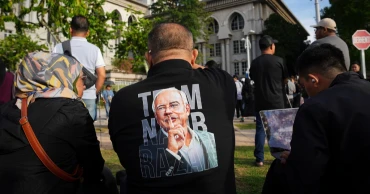
Malaysia's imprisoned former Prime Minister Najib Razak on Monday won an appeal to pursue his bid to serve his remaining corruption sentence under house arrest.
In an application in April last year, Najib said he had clear information that then-King Sultan Abdullah Sultan Ahmad Shah issued an addendum order allowing him to finish his sentence under house arrest. Najib claimed the addendum was issued during a pardons board meeting on Jan. 29 last year chaired by Sultan Abdullah that also cut his 12-year jail sentence by half and sharply reduced a fine. But the High Court threw out his bid three months later.
The Court of Appeals, in a 2-1 ruling on Monday, ordered the High Court to hear the merits of the case. The decision came after Najib's lawyer produced a letter from a Pahang state palace official confirming that Sultan Abdullah had issued the addendum order.
“We are happy that finally Najib has got a win,” his lawyer Mohamad Shafee Abdullah said. “He is very happy and very relieved that finally they recognized some element of injustice that has been placed against him.”
He said it was “criminal” for the government to conceal the addendum order. Shafee said that a new High Court judge will hear the case.
In his application, Najib accused the pardons board, home minister, attorney-general and four others of concealing the sultan’s order “in bad faith.” Sultan Abdullah hails from Najib’s hometown in Pahang. He ended his five-year reign on Jan. 30 last year under Malaysia’s unique rotating monarchy system. A new king toverok office a day later.
Home Minister Saifuddin Nasution Ismail said his ministry and the prisons department only received the pardons board's order to commute Najib's sentence. He said he wasn't disputing that an addendum order exists but that he has no knowledge of it.
Najib, 71, served less than two years of his sentence before it was commuted by the pardons board. His sentence is now due to end on Aug. 23, 2028. He was found guilty in a corruption case linked to the multibillion-dollar looting of state fund 1Malaysia Development Berhad.
The pardons board didn’t give any reason for its decision and wasn’t required to explain. But the move has prompted a public outcry over the appearance that Najib was being given special privileges compared to other prisoners.
Najib set up the 1MDB development fund shortly after he took office in 2009. Investigators allege at least $4.5 billion was stolen from the fund and laundered by Najib’s associates through layers of bank accounts in the United States and other countries, financed Hollywood films and extravagant purchases that included hotels, a luxury yacht, art and jewelry. More than $700 million landed in Najib’s bank accounts.
Najib is still fighting graft charges in the main trial linking him directly to the scandal.
1 year ago
Afghans arrive in the Philippines to complete visa processing for resettlement in US
A group of Afghan nationals arrived in the Philippines on Monday to process special immigrant visas for their resettlement in the United States, as part of an agreement between Manila and Washington.
The Philippines agreed last July to temporarily host a U.S. immigrant visa processing center for a limited number of Afghan nationals aspiring to resettle in America.
Department of Foreign Affairs spokesperson Teresita Daza said the Afghan nationals who landed in the Philippines on Monday were provided entry visas. She said they had completed extensive security vetting and undergone full medical screenings prior to their arrival.
The U.S. government will cover the costs for the Afghan nationals' stay in the Philippines, including their food, housing, security, medical and transportation expenses, she said.
She didn't specify how many Afghans arrived or how long the visa processing will take. Under the Philippines' rules, visa applicants can stay for no longer than 59 days.
A senior Philippine official told The Associated Press last year that only 150 to 300 applicants would be accommodated in the Philippines under the “one-time” deal. The official who had knowledge of the negotiations agreed to speak on condition of anonymity because of a lack of authority to speak publicly.
The Afghan nationals seeking resettlement primarily worked for the U.S. government in Afghanistan or were deemed eligible for U.S. special immigrant visas but were left behind when Washington withdrew from the country and Taliban militants took back power in a chaotic period in 2021.
Read: FS requests Canadian envoy to expedite visa processing for Bangladeshi nationals
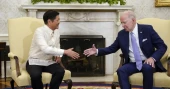
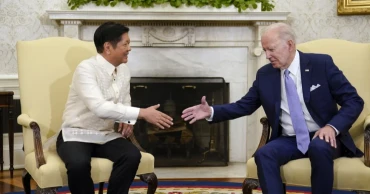
U.S. Secretary of State Antony Blinken first relayed the request to his Philippines counterpart in 2022, and President Joe Biden discussed the request with Philippines leader Ferdinand Marcos Jr. when he visited the U.S. last year, Philippine officials said.
Marcos has rekindled relations with the U.S. since winning the presidency by a landslide margin two years ago. In February last year, he allowed an expansion of the American military presence under a 2014 defense agreement in a decision that upset China.
1 year ago
South Korean anti-graft agency asks police to measures to detain impeached Yoon
South Korea’s anti-corruption agency has requested that police take over efforts to detain impeached President Yoon Suk Yeol after its investigators failed to bring him to custody following a standoff with the presidential security service last week.
The agency and police confirmed the discussion on Monday, hours before the one-week warrant for Yoon’s detention was to expire.
The Seoul Western District Court last Tuesday issued a warrant to detain Yoon and a separate warrant to search his residence after the embattled president defied authorities by refusing to appear for questioning over his short-lived martial law decree on Dec. 3. But executing those warrants is complicated as long as Yoon remains in his official residence.
Yoon has described his power grab as a necessary act of governance against a liberal opposition bogging down his agenda with its legislative majority and has vowed to “fight to the end” against efforts to oust him. While martial law lasted only several hours, it set off turmoil that has shaken the country’s politics, diplomacy and financial markets for weeks and exposed the fragility of South Korea’s democracy while society is deeply polarized.
The Corruption Investigation Office for High-Ranking Officials will likely seek a new court warrant to extend the window for Yoon’s detention, according to police, which said it was internally reviewing the agency’s request. It wasn’t immediately clear whether the anti-corruption agency will make another attempt to detain Yoon on Monday before the deadline expires at midnight.
The anti-corruption agency has faced questions about its competence after failing to detain Yoon on Friday, and police have the resources to possibly make a more forceful attempt to detain him.
Yoon’s legal team claimed in a statement that the agency’s move to delegate execution of the detainment warrant to police is illegal, saying there’s no legal grounds for it to delegate certain parts of an investigation process to another agency. Yoon’s lawyers had submitted an objection to the warrants against the president on Thursday, but the Seoul Western District Court dismissed the challenge on Sunday.
Yoon’s legal team has said it will file complaints against the anti-corruption agency’s chief prosecutor, Oh Dong-woon, and approximately 150 investigators and police officers involved in Friday’s detention attempt, which they claim was unlawful. The team said it will also file complaints with public prosecutors against the country’s acting defense minister and police chief for ignoring the presidential security service’s request to provide additional forces to block the detention attempt.
South Korean investigators attempt to detain impeached President Yoon
The anti-corruption agency, which leads a joint investigation with police and military investigators, has been weighing charges of rebellion after Yoon declared martial law and dispatched troops to surround the National Assembly. Lawmakers who managed to get past the blockade voted to lift martial law hours later.
Yoon’s presidential powers were suspended after the opposition-dominated National Assembly voted to impeach him on Dec. 14, accusing him of rebellion, and his fate now lies with the Constitutional Court, which has begun deliberations on whether to formally remove Yoon from office or reinstate him.
Dozens of anti-corruption agency investigators and assisting police officers attempted to detain Yoon on Friday but retreated from his residence in Seoul after a tense standoff with the presidential security service that lasted more than five hours.
After getting around a military unit guarding the residence’s grounds, the agency’s investigators and police were able to approach within 200 meters (about 218 yards) of Yoon’s residential building but were stopped by a barricade comprising around 10 vehicles and approximately 200 members of the presidential security forces and troops. The agency said it wasn’t able to visually confirm whether Yoon was inside the residence.
The agency has urged the country’s acting leader, Deputy Prime Minister Choi Sang-mok, to instruct the presidential security service to comply with their execution of the detainment warrant. Choi has yet to publicly comment on the issue.
In a video message on Sunday, Park Jong-joon, chief of the presidential security service, hit back against criticism that his organization has become Yoon’s private army, saying it has legal obligations to protect the incumbent president. Park said he instructed his members to not use violence during Friday’s standoff and called for the anti-corruption agency and police to change their approach.
Warrant to detain impeached South Korean President Yoon sought
Park and his deputy defied summonses on Saturday from police, who planned to question them over the suspected obstruction of official duty following Friday’s events. Staff from the presidential security service were seen installing barbed wire near the gate and along the hills leading up to Yoon’s residence over the weekend, possibly in preparation for another detention attempt.
Yoon’s lawyers argued the detention and search warrants against the president cannot be enforced at his residence due to a law that protects locations potentially linked to military secrets from search without the consent of the person in charge — which would be Yoon. They also argue the anti-corruption office lacks the legal authority to investigate rebellion charges.
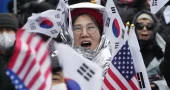
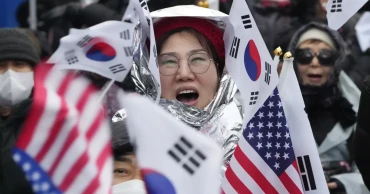
Hundreds of South Koreans rallied near Yoon’s residence for hours into early Monday, wrapping themselves in silver-coated mats against the freezing temperatures. It was their second consecutive night of protests, with demonstrators calling for his ouster and arrest.
1 year ago
Nagasaki atomic bomb survivor, who devoted his life for peace, dies at 93
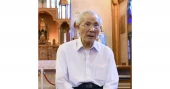
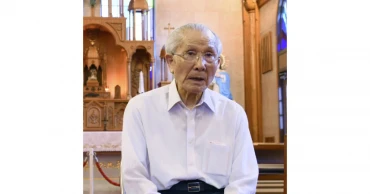
Shigemi Fukahori, a survivor of the 1945 Nagasaki atomic bombing, who devoted his life to advocating for peace has died. He was 93.
Fukahori died at a hospital in Nagasaki, southwestern Japan, on Jan. 3, the Urakami Catholic Church, where he prayed almost daily until last year, said on Sunday. Local media reported he died of old age.
The church, located about 500 meters from ground zero and near the Nagasaki Peace Park, is widely seen as a symbol of hope and peace, as its bell tower and some statues and survived the nuclear bombing.
Fukahori was only 14 when the U.S. dropped the bomb on Nagasaki on Aug. 9, 1945, killing tens of thousands of people, including his family. That came three days after the nuclear attack on Hiroshima, which killed 140,000 people. Japan surrendered days later, ending World War II and the country's nearly half-century of aggression across Asia.
Japanese atomic bomb survivors say Nobel Peace Prize gives fresh impetus to disarmament push
Fukahori, who worked at a shipyard about 3 kilometers (2 miles) from where the bomb dropped, couldn’t talk about what happened for years, not only because of the painful memories but also how powerless he felt then.
About 15 years ago, he became more outspoken after encountering, during a visit to Spain, a man who experienced the bombing of Guernica in 1937 during the Spanish Civil War when he was also 14 years old. The shared experience helped Fukahori open up.
“On the day the bomb dropped, I heard a voice asking for help. When I walked over and held out my hand, the person’s skin melted. I still remember how that felt,” Fukahori told Japan’s national broadcaster NHK in 2019.
He often addressed students, hoping they take on what he called “the baton of peace,” in reference to his advocacy.
When Pope Francis visited Nagasaki in 2019, Fukahori was the one who handed him a wreath of white flowers. The following year, Fukahori represented the bomb victims at a ceremony, making his “pledge for peace,” saying: “I am determined to send our message to make Nagasaki the final place where an atomic bomb is ever dropped.”
A wake is scheduled for Sunday, and funeral services on Monday at Urakami Church, where his daughter will represent the family.
1 year ago
Myanmar releases thousands of prisoners to mark Independence Day
Myanmar’s military government has released more than 6,000 prisoners and has reduced other inmates’ sentences as part of a mass amnesty marking the 77th anniversary of independence from Britain on Saturday.
They included just a small proportion of hundreds of political detainees jailed for opposing army rule since the military seized power in February 2021 from the elected government of Aung San Suu Kyi. That takeover was met with massive nonviolent resistance, which has since become a widespread armed struggle.
State-run MRTV television reported that Senior Gen. Min Aung Hlaing, the head of the military government, granted amnesties covering 5,864 prisoners from Myanmar, as well as 180 foreigners who will be deported. Mass prisoner releases are common on holidays and other significant occasions in Myanmar.
The terms of release warn that if the freed detainees violate the law again, they will have to serve the remainder of their original sentences in addition to any new sentence.
In a separate report, it said Min Aung Hlaing had commuted the life sentences of 144 prisoners to 15 years' imprisonment. The report provided no details about them.
The report also said that all other prisoners will have their sentences reduced by one sixth, except those convicted under the Explosive Substances Act, the Unlawful Associations Act, the Arms Act and the Counterterrorism Law, all laws which are often used against opponents of military rule.
Maj. Gen. Zaw Min Tun, the spokesperson for the military government, said in an audio note to journalists that those being released included about 600 prisoners who were prosecuted under Section 505(A) of Myanmar’s penal code, which makes it a crime to spread comments that create public unrest or fear or spread false news.
He said Khet Aung, a former chief minister of the southern Kachin state, was among those freed. Khet Aung was arrested soon after the army takeover and was sentenced in April 2022 to 12 years in prison on corruption charges.
Zaw Min Tun also said most of the freed foreigners are Thais who were arrested for gambling in the border town of Tachileik in eastern Myanmar. He said Indonesians who were arrested for fishing in Myanmar’s territorial waters were also among those freed.
He did not mention whether four Thai fishermen, who were arrested by Myanmar’s navy in late November after patrol boats opened fire on Thai fishing vessels in waters close to their maritime border in the Andaman Sea, were among the released. Thailand’s prime minister had said she expects the four to be released on Independence Day.
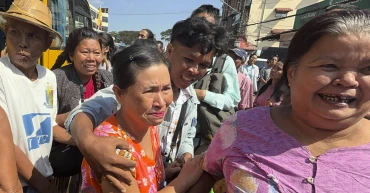
Prisoner releases began on Saturday but can take a few days to be completed. In the country’s largest city, Yangon, buses took prisoners out of Insein Prison, where friends and families of detainees had waited since morning for the announced releases, at around 11:30 a.m.
There was no sign that the prisoner release would include Aung San Suu Kyi, who has been held virtually incommunicado by the military since its seizure of power.
The 79-year-old Suu Kyi is serving a 27-year sentence after being convicted in a series of politically tinged prosecutions brought by the military.
Her supporters and independent analysts say the cases against her are an attempt to discredit her and legitimize the military’s seizure of power while keeping her from taking part in the military’s promised election, for which no date has yet been set.
According to the Assistance Association for Political Prisoners, a rights monitoring organization, 28,096 people have been arrested on political charges since the army takeover.
Of those arrested, 21,499 were still in detention as of Friday, the AAPP reported. At least 6,106 civilians have been killed by security forces in the same period, the group says. Its tally does not include all casualties from combat.
Myanmar became a British colony in the late 19th century and regained its independence on Jan. 4, 1948.
In the capital Naypyitaw, Myanmar’s military government celebrated the anniversary with a flag-raising ceremony at City Hall.
1 year ago

Fire at food market in northern China kills 8
A fire erupted at a food market in northern China on Saturday, resulting in the deaths of at least eight people and injuries to 15 others, according to state media reports.
The incident occurred at the Liguang market in Zhangjiakou city and began around midday. Firefighters managed to bring the blaze under control by 2:00 p.m. (0600 GMT), the Xinhua News Agency reported, citing officials from Qiaoxi District, where the market is situated.
Authorities are currently investigating the cause of the fire, the report stated.
South Korean fire fighters tackle blaze in commercial building in Seongnam
Traditional markets like this one are typically crowded with shoppers drawn by lower prices compared to supermarket chains.
Potential fire hazards in such markets include gas cylinders, charcoal used for roasting meat, and discarded cigarettes. Additionally, aging infrastructure, including underground gas pipelines, has previously been identified as a factor in fires and explosions.
Zhangjiakou, located in Hebei province near Beijing, was one of the host cities for events during the 2022 Winter Olympic Games.
1 year ago
Taiwan says China is redoubling efforts to undermine democracy with disinformation
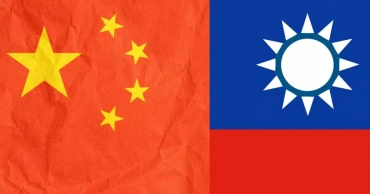
Taiwan ’s government says China is redoubling efforts to undermine confidence in the self-governing island’s democracy and close ties with the United States through the spread of disinformation, especially online.
The National Security Bureau said the number of pieces of false or biased information distributed by China increased 60% last year, to 2.16 million from 1.33 million in 2023.
The brief report issued Friday tallied "pieces of controversial information,” but did not further define the term. Facebook and X, formerly known as Twitter, were the main conduits for disinformation, along with platforms that explicitly target young people such as TikTok, the report said.
China created “inauthentic accounts” to distribute its propaganda on Youtube, used technology such as AI to create fake videos and flooded comments sections with pro-China statements, the report said. China has for years used global social media platforms to spread both official messages and misinformation even while banning them inside the country.
Myanmar to release prisoners to mark Independence Day
Beijing already has considerable influence with Taiwanese newspapers and other traditional media through their owners' business interests in mainland China.
China claims Taiwan as its own territory to be brought under its control by force if necessary, with Chinese leader Xi Jinping renewing a declaration in his New Year's address that unification with Taiwan was inevitable and could not be blocked by outside forces, a likely reference to the U.S., Taiwan’s most important ally.
China regularly sends warplanes, ships and balloons into areas controlled by Taiwan and holds military drills to simulate a blockade or invasion of the island. Beijing has also been building up its navy and missile forces to hit key targets and fend off American military support.
Taiwan's President Lai Ching-te said in his own New Year's address that the island would continue to strengthen its defenses in the face of escalating Chinese threats. Taiwan, he said, was a crucial part of the global “line of defense of democracy” against authoritarian states such as China, Russia, North Korea and Iran.
1 year ago
Myanmar to release prisoners to mark Independence Day
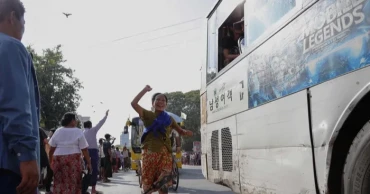
Myanmar’s military government will release more than 6,000 prisoners and has reduced other inmates’ sentences as part of a mass amnesty on Saturday marking the 77th anniversary of independence from Britain.
It wasn’t immediately clear if those released would include any of the thousands of political detainees locked up for opposing army rule since the military seized power in February 2021 from the elected government of Aung San Suu Kyi. That takeover was met with massive nonviolent resistance, which has since become a widespread armed struggle.
State-run MRTV television reported that Senior Gen. Min Aung Hlaing, the head of the military government, granted amnesties covering 5,864 prisoners from Myanmar, as well as 180 foreigners who will be deported. Mass prisoner releases are common on holidays and other significant occasions in Myanmar.
The foreigners to be released could include four Thai fishermen who were arrested by Myanmar’s navy in late November after patrol boats opened fire on Thai fishing vessels in waters close to their maritime border in the Andaman Sea. Thailand's prime minister has said she expects the four to be released on Independence Day.
Myanmar's Military introduces cybersecurity law with extensive censorship clauses
The terms of release warn that if the freed detainees violate the law again, they will have to serve the remainder of their original sentences in addition to any new sentence.
In a separate report, it said Min Aung Hlaing had commuted the life sentences of 144 prisoners to 15 years imprisonment. The report provided no details about them.
The report also said that all other prisoners will have their sentences reduced by one sixth, except those convicted under the Explosive Substances Act, the Unlawful Associations Act, the Arms Act and the Counter-terrorism Law, all laws which are often used against opponent military rule.
Myanmar did not release many details of the prisoners being freed, but many were held on charges related to protests, including Section 505(A) of Myanmar’s penal code, which makes it a crime to spread comments that create public unrest or fear or spread false news.
Prisoner releases began on Saturday but can take a few days to be completed. At Insein Prison in the country’s biggest city of Yangon, which is notorious for decades for housing political detainees, relatives of prisoners gathered at the gates from early morning.
There was no sign that the prisoner release would include Aung San Suu Kyi, who has been held virtually incommunicado by the military since its seizer of power.
The 79-year-old Suu Kyi is serving a 27-year sentence after being convicted of a series of politically tinged prosecutions brought by the military.
Her supporters and independent analysts say the cases against her are an attempt to discredit her and legitimize the military’s seizure of power while keeping her from taking part in the military’s promised election, for which no date has yet been set.
According to the Assistance Association for Political Prisoners, a rights monitoring organization, 28,096 people have been arrested on political charges since the army takeover.
Of those arrested, 21,499 people were still in detention as of Friday, the AAPP reported. At least 6,106 civilians have been killed by security forces in the same period, the group says. Its tally does not include all casualties from combat.
US reaffirms support for Rohingya amid concern over Myanmar
Myanmar became a British colony in the late 19th century and regained its independence on Jan. 4, 1948.
In the capital Naypyitaw, Myanmar’s military government celebrated the anniversary with a flag-raising ceremony at City Hall.
1 year ago
Myanmar's Military introduces cybersecurity law with extensive censorship clauses
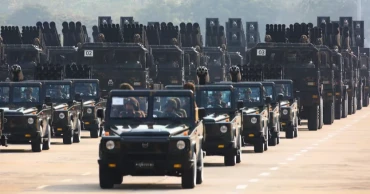
Military-ruled Myanmar, already notorious for cracking down on free speech, has enacted a new cybersecurity law with wide-ranging controls on the flow of information, according to a text of the measure published Friday in state-run newspapers.
Existing restrictions on freedom of expression under the ruling military have generally involved charges under broadly defined national security laws concerning online content.
There have also been actions to block websites and apps at the network level, keeping end-users from accessing content the army doesn’t want them to see. Technology from China and Russia, the ruling military’s top allies, is used for monitoring and censorship purposes.
10 people wounded in shooting outside New York City nightclub
The new law, which came into effect on Wednesday, has extensive provisions mainly targeting means of communications and providers of services such as virtual private networks — VPNs — that can help evade network blockages. VPNs connect users to their desired sites through third-party computers, effectively masking from internet service providers and snooping governments what content they are accessing.
Many otherAsiannations also have cybersecurity laws with restrictive aspects that free speech advocates charge are meant to silence dissenting voices.
The military government that took power in Myanmar in February 2021 after ousting the elected government of Aung San Suu Kyi has made several previous attempts to throttle traffic on the internet, especially in the months immediately after their takeover.
Resistance to the takeover relied heavily on social media, especially Facebook, to organize street protests.
As nonviolent resistance escalated into armed struggle and other independent media were shut down or forced underground, there was an expansion of online content about and by the f orces resisting military rule. The Telegram chat and social networking app is particularly active.
Italy summons Iran's ambassador to release arrested Italian journalist
The new law calls for sanctions including warnings, fines, suspensions and blacklisting for digital platform service providers who fail to comply with rules to prevent, remove, and cease circulation of “disinformation” and “rumors” that might cause hate or destroy unity or disrupt stability. Posting any information that might violate existing law, and incite violence, also is subject to penalties.
The law also requires digital platform service providers to keep the names and other personal data and records of their users for up to three years, and to disclose them to the authorities if asked.
It says the authorities can investigate, control, block and shut down digital platform services and electronic information if necessary for the public good and state’s security, and that action will also be taken against Myanmar citizens abroad who violate any of the law's provisions.
It also says those who establish a VPN or provide VPN services without obtaining the permission of the ministry shall be imprisoned for one month to six months or a fine of 1 million kyats ($476) to 10 million kyats ($4,760).
Any equipment used in violating provisions of the law is subject to seizure.
Users of most free VPN services already found themselves unable to connect in May last year, and there were reports that people stopped by security forces whose phones were found to have VPN apps were fined and detained.
Operators of Myanmar’s top telecom companies and internet service providers told The Associated Press at the time that access to Facebook, Instagram, X, WhatsApp and VPN services was banned nationwide at the end of May on the order of the Transport and Communications Ministry.
The new law also says anyone who builds an online gambling system without obtaining official permission shall be imprisoned for six months to one year or a fine of 5 million kyats ($2,380) to 20 million kyats ($9,520) or both. Online gambling has been connected with organized crime in Myanmar and other Southeast Asia countries, sometimes linked to online scam centers that are staffed by victims of human trafficking.
1 year ago