asia
SKoreans turn funeral wreaths, K-pop light sticks into political protest tools
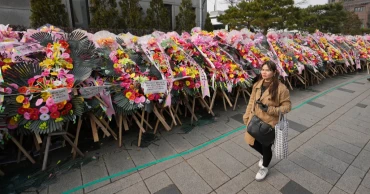
South Koreans are using flower wreaths and K-pop light sticks as symbols of political protest during the country’s most significant political crisis in decades, triggered by President Yoon Suk Yeol’s brief declaration of martial law in December.
Thousands of flower wreaths, many criticizing Yoon and other officials involved in the martial law controversy, have been sent to his residence and government buildings linked to the impeachment process, AP reports.
Local media estimate the number of wreaths delivered to government offices at several thousand. Messages range from moderate to extreme, reflecting the deepening political divide.
Funeral wreaths with black ribbons and white chrysanthemums, as well as celebratory arrangements of roses and orchids, cost up to $75 and carry messages of both support and condemnation.
South Korea's impeached president arrested over martial law declaration
This protest tactic has seen growing media attention. Analysis from Big Kinds, a database of over 100 local news outlets, shows that media coverage of wreath protests in 2024 was four times higher than in 2023. Though the exact origin of this method is unclear, it first appeared in the early 2010s.
While many flower shops deny receiving orders for protest wreaths, some have become central to the movement. Yoon Miyoung, owner of Dongsung Flower in Seoul, said her shop has delivered over 1,000 wreaths since December, primarily for pro-Yoon supporters.
“Seoul is running out of flowers,” she remarked, noting that about a third of her customers are in their 20s and 30s, with orders also coming from Japan, the United States, and the Netherlands.
Experts view wreath protests as a unique but polarizing form of demonstration. Sociology professor Choi Hang-sub from Kookmin University compared the messages on wreaths to offline hate speech, akin to malicious online comments.
Jungwon University’s Kim Hern Sik described the method as confined to certain political groups, limiting its broader appeal.
Environmental concerns have also been raised, as most wreaths use non-eco-friendly materials. However, Kim highlighted younger generations’ innovative protest methods, such as using K-pop light sticks at rallies.
During pro-impeachment protests last December, demonstrators wielded light sticks from bands like BIGBANG and NCT, valued at around $50, to express their views.
The crisis began on December 3 when Yoon imposed martial law and deployed troops to the National Assembly, leading to his impeachment on December 13.
Arrested on January 19, Yoon now faces rebellion charges as the Constitutional Court deliberates his fate within the next 180 days.
1 year ago
8 dead in India's Maharashtra ordnance factory explosion
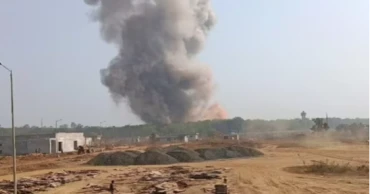
An explosion at an ordnance factory at Maharashtra’s Bhandara district in India claimed the lives of eight workers and left seven others injured on Friday morning.
Union Minister Nitin Gadkari confirmed the casualties during an event later in the day. “In Bhandara, at the ordnance factory, a major mishap has taken place, resulting in the death of eight people and injuries to seven others. This is preliminary information,” he said, urging attendees to observe a minute’s silence to honor the victims of the "unfortunate incident."
The blast occurred in the factory’s LTP section around 10:30am, according to District Collector Sanjay Kolte. Firefighters and medical teams were dispatched to manage the situation.
The explosion caused the roof to collapse, trapping more than a dozen workers. In the initial rescue efforts, three workers were pulled out alive, while one was found dead. An excavator was deployed to clear the debris, the official added.
12 rail passengers killed in India after jumping onto tracks in fire panic
The intensity of the blast was so severe that it was heard up to 5 km away. Videos from the site showed thick smoke billowing from the factory.
Chief Minister Devendra Fadnavis assured that senior officials were on-site and rescue teams from Nagpur were en route to assist.
Source: with inputs from Indian media
1 year ago
Afghan women's group praises court's move against Taliban leaders
An Afghan women’s organisation on Friday applauded the International Criminal Court’s decision to issue arrest warrants for Taliban leaders over their persecution of women, reports AP.
Karim Khan, the ICC’s chief prosecutor, announced on Thursday that he had sought arrest warrants for two senior Taliban officials, including their leader, Hibatullah Akhundzada.
Afghans fleeing Taliban urge Trump to lift refugee ban
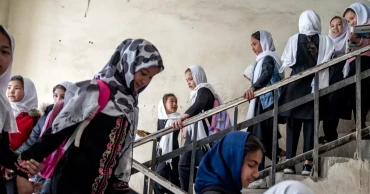
Since reclaiming control of Afghanistan in 2021, the Taliban have imposed restrictions barring women from employment, most public spaces, and education beyond the sixth grade.
In a statement, the Afghan Women’s Movement for Justice and Awareness welcomed the ICC’s move, describing it as a “significant historical milestone.”
“We view this as a testament to the resilience and determination of Afghan women, and we believe this action marks the beginning of a new era of accountability and justice in the country,” the group stated.
The Taliban government has not yet commented on the court’s decision.
A former official from the Western-backed administration cautioned that the Taliban might use the ruling for propaganda purposes, portraying it as evidence of their unwavering faith and strength.
“They could tell their followers that their convictions are so formidable they have provoked unified global opposition,” Mohammad Halim Fidai posted on the X platform. Fidai, a former governor of four provinces before the Taliban takeover, now resides outside Afghanistan. “This decision might inadvertently enhance their credibility or serve as a badge of honour.”
Meanwhile, the U.N. mission in Afghanistan described the ongoing denial of education to girls as a “tragedy and travesty.”
Indian and Afghan officials meet again, despite no formal ties
“It has been 1,225 days — almost four years — since authorities imposed a ban preventing girls over the age of 12 from attending school,” said Roza Otunbayeva, head of the United Nations Assistance Mission in Afghanistan. “Millions of Afghan girls have been denied their fundamental right to education, which is both a tragedy and a travesty.”
Afghanistan remains the only country globally to explicitly prohibit women and girls from all levels of education, Otunbayeva added.
1 year ago

Taiwan plans to cull 120,000 green iguanas over agricultural damage
Taiwan plans to cull up to 120,000 green iguanas, with supporters urging humane methods to bring down the animal's population, which is wreaking havoc on the island's agricultural sector.
Around 200,000 of the reptiles are believed to be in the island's southern and central areas, which are heavily dependent on farming, according Chiu Kuo-hao of the Forestry and Nature Conservation Agency.
Specially recruited hunting teams killed about 70,000 iguanas last year, with bounties of up to $15 each. Local governments have asked the public to help identify iguana nests and they recommend fishing spears as the most humane means of killing the animals.
“A lot of people bought them as cute little pets, not realizing how big and long-lived they would become, so they set them free in the wild, where they’ve really taken to the Taiwanese environment,” said Lee Chi-ya of the agricultural department in the southern county of Pingtung. “That's allowed them to reproduce at a considerable rate, necessitating us to cull them and restore the balance of nature."
Magnitude 6.4 Earthquake in Taiwan Injures 27
Green iguanas have no natural predators in Taiwan and have moved into areas that can be difficult to access, mostly forests and the edges of towns.
Males can grow to 2 feet (6.6 feet) long, weigh 5 kilograms (11 pounds) and live up to 20 years, while females can lay up to 80 eggs at a time.
Mainly native to Central America and the Caribbean, they are not aggressive despite possessing sharp tails and jaws and razor-like teeth. The reptiles subsist on a diet of mostly fruit, leaves and plants, with the occasional small animal thrown in.
Though popular as pets, they are difficult to keep healthy in captivity and many die within a year.
Hsu Wei-chieh, secretary general of the Reptile Conservation Association of Taiwan, said his group wants to teach farmers how to stay safe, protect their property and treat the iguanas in a humane manner.
Taiwan says China is redoubling efforts to undermine democracy with disinformation
“We're here to help see that this project is carried out smoothly,” said Hsu.
Tsai Po-wen, a vegetable farmer in Pingtung, said the training was paying off.
“We used to attack them, but it wasn't any use. Now we're learning more effective, safer methods,” Tsai said.
1 year ago

Pakistani government proposes sweeping controls on social media
Pakistan's opposition said Thursday the government is seeking to further suppress freedom of speech a day after it proposed sweeping controls on social media that could include blocking platforms and sending users to prison for spreading disinformation.
The Prevention of Electronic Crimes Act, introduced in the National Assembly by Law Minister Azam Nazeer Tarar on Wednesday, would create an agency with the power to order “unlawful and offensive content” blocked from social media, and to ban individuals and organizations from social media, AP reports.
Social media platforms would be required to register with the new Social Media Protection and Regulatory Authority, and those failing to comply with the law could face temporary or permanent bans.
The law also makes spreading disinformation a criminal offense, punishable by three years in prison and a fine of 2 million rupees ($7,150).
Landslides, flash floods in Indonesia kill 17, missing 8
The move comes nearly a year after Pakistan blocked the X platform ahead of an election that the opposition party of imprisoned former Prime Minister Imran Khan says was rigged. X is still blocked in the country, although many people use virtual private networks to access it, like in other countries with tight internet controls.
Khan has a huge following on social media, especially X, where supporters frequently circulate demands for his release. Khan has been behind bars since 2023, when he was arrested for graft. Khan's party also uses social media to organize demonstrations.
The leader of the opposition denounced the proposed legislation, saying it was aimed at further suppressing freedom of speech. Omar Ayub Khan, who is not related to the imprisoned former premier, said the bill could “lay a foundation for the suppression of voices advocating for constitutional rights”.
Man sentenced to life for rape, murder of doctor in India
The new agency would be able to order the immediate blocking of unlawful content targeting judges, the armed forces, parliament or provincial assemblies. The law also forbids uploading remarks from parliament that have been struck from the record.
Pakistani media has faced growing censorship in recent years. Journalists have said they face state pressure to avoid using Imran Khan's name, and most TV stations have begun referring to him only as the “founder of the PTI" party.
Human rights defenders and journalists' unions have vowed to oppose the law, but with the government holding a majority, its passage is all but assured.
Afzal Butt, president of the Federal Union of Journalists, said the law was an attempt to suppress the media, social media and journalists.
The government says the law is necessary to limit the spread of disinformation.
1 year ago
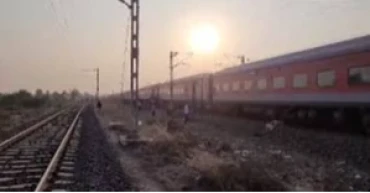
12 rail passengers killed in India after jumping onto tracks in fire panic
At least 12 train passengers were killed on Wednesday after being hit by another service on an adjacent track in western India after they jumped from their coaches in panic to escape a rumored fire incident, the Press Trust of India reported.
At least six other people were injured and taken to nearby hospitals, the news agency cited police officer Dattatraya Karale as saying, AP reports.
The accident occurred in Maharashtra State, near the Pardhade railroad station, 410 kilometers (255 miles) southwest of Mumbai, India’s financial capital.
PTI said the victims jumped off the Pushpak Express train, which had stopped after some passengers pulled an emergency chain. Those who disembarked were hit by another express train on the adjacent railroad track, PTI quoted railway spokesman Swapnil Nila as saying.
Man sentenced to life for rape, murder of doctor in India
“Our preliminary information is that there were sparks inside one of the coaches of Pushpak Express due to either ‘hot axle’ or ‘brake-binding’ (jamming), and some passengers panicked. They pulled the chain, and some of them jumped down on the tracks. At the same time, Karnataka Express was passing on the adjoining track,” a senior railway official told PTI.
Despite government efforts to improve rail safety, hundred of accidents occur every year on India’s railways, which is the largest train network under one management in the world.
In 2023, two passenger trains collided after derailing in eastern India, killing more than 280 people and injuring hundreds in one of the country’s deadliest rail crashes in decades.
Prime Minister Narendra Modi is focussing on the modernization of the British colonial-era railroad network in India, which has become the world’s most populous country with 1.42 billion.
1 year ago
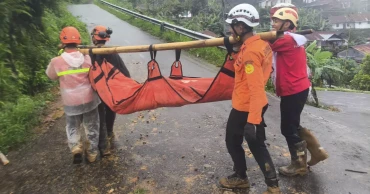
Search resumes after deadly flooding and landslides in Indonesia
Indonesian rescuers retrieved two more bodies after they resumed their search Wednesday for people missing after floods and landslides on Indonesia’s main island of Java, bringing the death toll to 19.
Waters from flooded rivers tore through nine villages in Pekalongan regency of Central Java province and landslides tumbled onto mountainside hamlets after the torrential rains Monday.
Videos and photos released by National Search and Rescue Agency showed workers digging desperately in villages where roads and green-terraced rice fields were transformed into murky brown mud and villages were covered by thick mud, rocks and uprooted trees.
National Disaster Management Agency spokesperson Abdul Muhari said flooding triggered a landslide that buried two houses and a cafe in the Petungkriyono resort area. The disasters all together destroyed 25 houses, a dam and three main bridges connecting villages in Pekalongan. At least 13 people injured and nearly 300 people were forced to flee to temporary government shelters.
The search and rescue operation that was hampered by bad weather, mudslides and rugged terrain was halted Tuesday afternoon due to heavy rain and thick fog that made devastated areas along the rivers dangerous to rescuers.
On Wednesday, they searched in rivers and the rubble of villages for bodies and, whenever possible, survivors in worst-hit Kasimpar village, said Budiono, who heads a local rescue office.
Scores of rescue personnel recovered two mud-caked bodies as they searched a Petungkriyono area where tons of mud and rocks buried two houses and a café. Rescuers are still searching for seven people reported missing.
Read: Landslides, flash floods in Indonesia kill 17, missing 8
Landslides and floods were also reported in many other provinces, Muhari said. On Monday, a landslide hit five houses in Denpasar on the tourist island of Bali, killing four people and leaving one missing.
Heavy seasonal rain from about October to March frequently causes flooding and landslides in Indonesia, an archipelago of 17,000 islands where millions of people live in mountainous areas or near fertile floodplains.
The British Geological Survey defines a landslide as a mass movement of material, such as rock, earth, or debris moving down a slope. Landslides can happen suddenly or slowly and can be caused by rain, erosion, or changes to the slope’s material.
Rain adds weight to the slope, making it more unstable. The slope’s steepness or erosion at the base can make landslides more likely. They can be caused by the movement of nearby bodies of water or vibrations from earthquakes, mining or traffic. The types and sizes of the rocks and soils can determine how much water land can absorb before weakening and collapsing.
Studies have found that landslides could become more frequent as climate change increases rainfall.
1 year ago
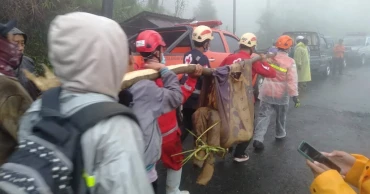
Landslides, flash floods in Indonesia kill 17, missing 8
Indonesian rescuers recovered the bodies of at least 17 people who were swept away in flash floods or buried under tons of mud and rocks that hit hilly villages on the country’s main island of Java, officials said Tuesday. Eight people were missing.
Torrential rains on Monday caused rivers to burst their banks, tearing through nine villages in Pekalongan regency of Central Java province, as mud, rocks and trees tumbled down on mountainside hamlets, said Bergas Catursasi, who heads the local Disaster Management Agency.
He said rescue workers by Tuesday had recovered at least 17 bodies in the worst-hit village of Petungkriyono, and were searching for eight villagers who were reported missing. Eleven injured people managed to escape and were rushed to nearby hospitals, Catursari said, AP reports.
Television reports showed police, soldiers and rescue workers using excavators, farm equipment and their bare hands to search through the rubble in devastated villages. Others carried victims on bamboo stretchers or in body bags to ambulances or trucks.
Magnitude 6.4 Earthquake in Taiwan Injures 27
“Bad weather, mudslides and rugged terrain hampered the rescue operation,” Catursari said, adding that people who were fishing in the river or taking shelter from the rain were swept away by the floods.
The search was suspended Tuesday afternoon due to heavy rain and thick fog and will be resumed early Wednesday, said Budiono, head of the provincial Search and Rescue Office.
National Disaster Management Agency spokesperson Abdul Muhari said flash floods swept away villagers and vehicles passing through devastated villages and triggered a landslide that buried two houses. The floods also destroyed two main bridges connecting villages in Pekalongan district.
On Monday, a landslide hit five houses in Denpasar on the tourist island of Bali, killing four people and leaving one missing, Muhari said. The landslide also injured three people. Floods were also reported in many other provinces.
Smoke from California Lithium Battery Plant fire sparks air quality concerns
Heavy seasonal rain from about October to March frequently causes flooding and landslides in Indonesia, an archipelago of 17,000 islands where millions of people live in mountainous areas or near fertile floodplains.
Last month, a landslide, flash floods and strong winds hit Sukabumi district of West Java province, killing 12 people. In November, a landslide and flash floods triggered by heavy downpours hit North Sumatra province, leaving 20 dead and two missing. A landslide in the region also hit a tourist bus, killing nine people.
1 year ago
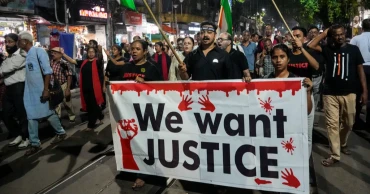
Man sentenced to life for rape, murder of doctor in India
An Indian court sentenced a police volunteer to life imprisonment on Monday after he was found guilty of raping and murdering a trainee doctor last year, an incident that sparked nationwide protests over women's safety and led to a swift trial in the country’s slow-moving justice system, reports AP.
Sanjay Roy, 33, who has maintained his innocence throughout, has the option to appeal the ruling in a higher court.
The death of the 31-year-old doctor, who was on duty at a hospital in Kolkata, brought attention to the persistent issue of violence against women in India. The woman's bloodied body was discovered on August 9 last year in the seminar hall of the R.G. Kar Medical College and Hospital. An autopsy revealed she had been strangled and sexually assaulted.
A trainee doctor is raped and killed in India, sparking protests and an attack at a medical college
Federal police, who took over the investigation, argued that the crime warranted the death penalty. The victim’s parents also demanded the death penalty for Roy, expressing concerns that others may have been involved in the crime.
Initially, Kolkata police handled the investigation, but it was later transferred to federal authorities after allegations that state officers mishandled the case.
Following the attack, doctors and medical students across India staged protests, calling for enhanced security. Thousands of women took to the streets, demanding quick justice for the victim.
Roy was arrested the day after the crime, and court proceedings began in November. In response to the assault, India’s Supreme Court established a national task force to explore ways to improve safety in government hospitals.
In India, many crimes against women go unreported due to the stigma surrounding sexual violence and a lack of trust in the police. Women’s rights advocates highlight that the issue is especially severe in rural areas, where victims of sexual assault often face community shaming and families worry about their reputation.
The 2012 gang rape and murder of a 23-year-old student on a New Delhi bus sparked widespread protests across the country. This led to tougher penalties for such crimes, the creation of fast-track courts for rape cases, and the introduction of the death penalty for repeat offenders. Four men convicted for the 2012 crime were executed in 2020.
In 2013, rape laws were revised to criminalise stalking and voyeurism and to lower the age at which individuals could be tried as adults from 18 to 16.
Sanjay Roy found guilty in RG Kar Medical College rape-murder case
However, activists argue that the tougher sentencing requirements have not deterred rapes, as the number of reported rape cases continues to rise. In 2022, police recorded 31,516 rape cases, marking a 20% increase from the previous year, according to the National Crime Records Bureau.
1 year ago
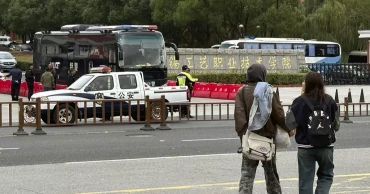
China executes 2 for deadly 'revenge on society' attacks
China has carried out the executions of two men involved in deadly attacks that claimed dozens of lives in November, raising concerns about a rise in "revenge on society crimes," according to state media reports on Monday, reports AP.
Fan Weiqu, 62, was executed after ramming his car into a crowd outside a sports stadium in Zhuhai, southern China, killing at least 35 people. This attack was the deadliest in the country in over ten years. Police stated that Fan was angered by his divorce settlement.
Southeast Asian foreign ministers seek breakthrough in Myanmar conflict and South China Sea disputes
In a separate incident, 21-year-old Xu Jiajin killed eight people and injured 17 others in a stabbing spree at his vocational school in Wuxi, eastern China. Authorities revealed that Xu, frustrated with his failed examinations and unsatisfactory internship pay, carried out the attack. He was also executed on Monday, as reported by CCTV.
The killings prompted Chinese President Xi Jinping to call for local governments to implement measures to prevent such "revenge on society crimes."
The death sentences for both men were handed down by the intermediate people’s courts in Zhuhai and Wuxi in December and later approved by the Supreme People’s Court.
China's economy grows 5% in 2024
China is believed to carry out more executions annually than the rest of the world combined, though the exact figures remain a state secret. While executions were traditionally carried out by gunshot, lethal injections have been increasingly used in recent years.
1 year ago