asia
South Korea's impeached president arrested over martial law declaration
South Korea’s impeached President Yoon Suk Yeol was formally arrested early on Sunday, days after being apprehended at his presidential compound in Seoul. He faces possible imprisonment over his ill-fated declaration of martial law last month.
Yoon’s arrest could mark the beginning of an extended period in custody, lasting months or more.
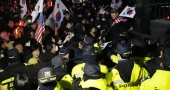
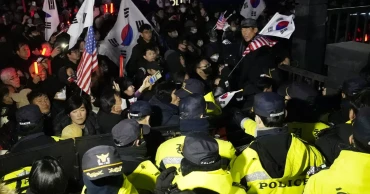
The decision to arrest Yoon triggered unrest at the Seoul Western District Court, where dozens of his supporters broke in and rioted, destroying the main door and windows. They used plastic chairs, metal beams and police shields that they managed to wrestle away from officers. Some were seen throwing objects and using fire extinguishers, destroying furniture and glass doors. They shouted demands to see the judge who had issued the warrant, but she had already left.
Hundreds of police officers were deployed and nearly 90 protesters were arrested. Some injured police officers were seen being treated at ambulance vans. The court said it was trying to confirm whether any staff members were injured and assess the damage to its facilities.
A court deliberated for 8 hours
Following eight hours of deliberation, the court granted law enforcement’s request for an arrest warrant for Yoon, saying he was a threat to destroy evidence. Yoon and his lawyers on Saturday appeared before the court and argued for his release.
Yoon, who has been in detention since he was apprehended Wednesday in a massive law enforcement operation at his residential compound, faces potential rebellion charges linked to his declaration of martial law on Dec. 3, which set off the country’s most serious political crisis since its democratization in the late 1980s.
While South Korean presidents have wide-ranging immunity from prosecution while in office, the protection does not extend to allegations of rebellion or treason.
The Corruption Investigation Office for High-Ranking Officials, which is leading a joint investigation with police and the military, can now extend Yoon’s detention to 20 days, during which they will transfer the case to public prosecutors for indictment.
Yoon’s lawyers could also file a petition to challenge the court’s arrest warrant.
Yoon’s appearance in court triggered chaotic scenes in nearby streets, where thousands of his fervent supporters rallied for hours calling for his release. Even before the court issued the warrant for Yoon’s arrest, protesters repeatedly clashed with police who detained dozens of them, including about 20 who climbed over a fence in an attempt to approach the court. At least two vehicles carrying anti-corruption investigators were damaged as they left the court after arguing for Yoon’s arrest.
Yoon’s lawyers said he spoke for about 40 minutes to the judge during the nearly five-hour closed-door hearing Saturday. His legal team and anti-corruption agencies presented opposing arguments about whether he should be held in custody.
Read: Impeached South Korean president seeks release amid court review
Yoon’s defense minister, police chief and several top military commanders have already been arrested and indicted for their roles in the enforcement of martial law.
Yoon’s lawyer decries his arrest
The crisis began when Yoon, in an attempt to break through legislative gridlock, imposed military rule and sent troops to the National Assembly and election offices. The standoff lasted only hours after lawmakers who managed to get through a blockade voted to lift the measure. The opposition-dominated assembly voted to impeach him on Dec. 14.
His political fate now lies with the Constitutional Court, which is deliberating whether to formally remove him from office or reinstate him.
Seok Dong-hyeon, one of Yoon’s lawyers, called the court’s decision to issue the warrant “the epitome of anti-constitutionalism and anti-rule of law,” maintaining Yoon's claim that his martial law decree was a legitimate act of governance. He pointed to the chaos at the Seoul Western Court and said Yoon’s arrest would inspire more anger from his supporters.
Yoon’s People Power Party regretted his arrest but also pleaded for his supporters to refrain from further violence.
The liberal opposition Democratic Party, which drove the legislative effort to impeach Yoon on Dec. 14, said his arrest would be a “cornerstone for restoring the collapsed constitutional order.” Kim Sung-hoi, a party lawmaker and spokesperson, called for stern punishment of Yoon’s supporters who stormed the court.
“I urge police to firmly enforce the law so that forces supporting rebellion will never even think of causing turmoil again,” he said.
The country’s acting leader, Deputy Prime Minister Choi Sang-mok, expressed “strong regret” about the violence at the court, saying it “directly undermines democracy and the rule of law.” He asked for heightened security at the sites related to Yoon’s case and measures to ensure order during protests.
Yoon was transported to the court from a detention center in Uiwang, near Seoul, in a blue Justice Ministry van escorted by police and the presidential security service, to attend the hearing at the court ahead of its warrant decision.
Read more: South Korea's impeached President Yoon Suk Yeol arrested over martial law declaration
The motorcade entered the court’s basement parking space as thousands of Yoon’s supporters gathered in nearby streets amid a heavy police presence. Following the hearing, Yoon was transported back to the detention center, where he awaited the decision. He did not speak to reporters.
After its investigators were attacked by protesters later on Saturday, the anti-corruption agency asked media companies to obscure the faces of its members attending the hearing.
Yoon insists his martial law decree was legitimate
Yoon and his lawyers have claimed that the martial law declaration was intended as a temporary and “peaceful” warning to the liberal opposition, which he accuses of obstructing his agenda with its legislative majority. Yoon says the troops sent to the National Election Commission offices were to investigate election fraud allegations, which remains unsubstantiated in South Korea.
Yoon has stressed he had no intention of stopping the functioning of the legislature. He stated that the troops were sent there to maintain order, not prevent lawmakers from entering and voting to lift martial law. He denied allegations that he ordered the arrests of key politicians and election officials.
Military commanders, however, have described a deliberate attempt to seize the legislature that was thwarted by hundreds of civilians and legislative staff who helped lawmakers enter the assembly, and by the troops’ reluctance or refusal to follow Yoon’s orders.
If prosecutors indict Yoon on rebellion and abuse of power charges, which are the allegations now being examined by investigators, they could keep him in custody for up to six months before trial.
If the first court convicts him and issues a prison term, Yoon would serve that sentence as the case possibly moves up to the Seoul High Court and Supreme Court. Under South Korean law, orchestrating a rebellion is punishable by life imprisonment or the death penalty.
1 year ago
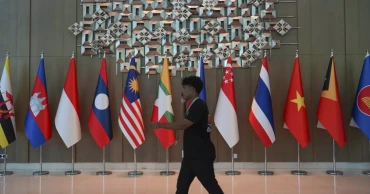
Southeast Asian foreign ministers seek breakthrough in Myanmar conflict and South China Sea disputes
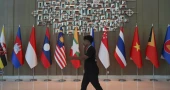
Southeast Asian foreign ministers gathered Sunday for their first meeting this year under the regional bloc's new chair, Malaysia, seeking a breakthrough over Myanmar’s drawn-out civil war and territorial disputes in the South China Sea.
The retreat on the idyllic northern resort island of Langkawi was the first major meeting of the 10-member Association of Southeast Asian Nations hosted by Malaysia. Officials said it aims to chart the bloc’s direction for the year as it tries to resolve Myanmar's deadly four-year crisis and tensions over China’s increasing assertiveness in the South China Sea.
Malaysian Foreign Minister Mohamad Hasan said ASEAN must bolster unity and make economic integration a top priority amid global uncertainties and the U.S.-China rivalry in the region. He said the second term of incoming U.S. President Donald Trump has also raised questions on how it will shape dynamics in the region.
“There is much to prepare for. Above all, what we need to anticipate are the potential challenges to ASEAN centrality,” he told the opening of the meeting. "We must ensure that ASEAN remains our central go-to platform for solution seeking... We are the speakers and not the spoken-for. We must drive our own path forward.”
The crisis in Myanmar has emerged as one of the bloc’s biggest challenges since a military coup ousted an elected civilian government in February 2021, plunging the country into conflict. It has sparked an armed resistance movement, with rebel forces now controlling large parts of the country. The war has killed tens of thousands of people, and displaced millions.
ASEAN’s peace plan and other efforts to seek a solution have been futile as Myanmar’s junta has not been compliant. ASEAN banned Myanmar’s military leaders from formal ASEAN meetings but the bloc’s non-interference policy has hampered its role. The military government plans an election this year to legitimize its rule but critics say polls are unlikely to be free or fair.
Read: South Asian nations, China must work together to ensure stability, development in region: Foreign Adviser
Malaysia, which brought Myanmar into ASEAN during its chairmanship of the bloc in 1997, is expected to take a more proactive stance as the Myanmar crisis has led to the flourishing of criminal activities, online scams and human trafficking along Myanmar's border.
Hasan last month said Malaysia had appointed Othman Hashim, a former foreign ministry senior official, as its special envoy to Myanmar to engage various factions in the country to find a way forward.
Tensions in the South China Sea, one of the world's vital shipping lanes, are also high on the agenda Sunday following violent confrontations in the waters last year. ASEAN members Vietnam, the Philippines, Malaysia and Brunei along with Taiwan have overlapping claims with China, which asserts sovereignty over virtually all of the South China Sea.
Chinese and Philippine vessels clashed repeatedly last year. Chinese forces also assaulted Vietnamese fishermen and Chinese patrol vessels ventured into areas that Indonesia and Malaysia claim as exclusive economic zones.
The Philippines has pushed for negotiations between ASEAN and China for a code of conduct in the waterway but talks have stalled over disagreements including whether the pact should be binding and its scope of coverage. ASEAN has not openly criticized China, which is the bloc's top trading partner.
Read more: 6-team 2nd South Asian Lawyers Cricket taking place Dec 23-26
As chair, Malaysia is likely to push for quiet diplomacy as it balances security challenges with economic gains, analysts say.
“It would be pragmatism on Malaysia’s side, as the country — as well as ASEAN as a whole — lack the diplomatic and military heft to confront China on the South China Sea,” said Muhamamd Faizal Abdul Rahman, a research fellow at Singapore's S.Rajaratnam School of International Studies.
1 year ago
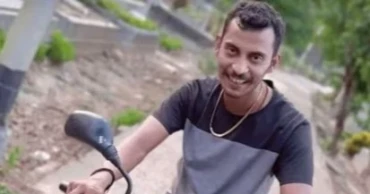
Sanjay Roy found guilty in RG Kar Medical College rape-murder case
A Kolkata court has found Sanjay Roy guilty of the brutal rape and murder of a junior doctor at RG Kar Medical College and Hospital, a case that sparked nationwide outrage over women’s safety.
The decision came just 57 days after the in-camera trial began on November 12.
In a verdict delivered by Anirban Das, additional district and sessions judge of Sealdah court, Roy was convicted on Saturday under Sections 64, 66, and 103 (1) of the Bharatiya Nyaya Sanhita.
These provisions address rape and prescribe punishments, including the death penalty or life imprisonment, for murder.
Roy, a police volunteer, claimed during the hearing that he had been framed.
The judge allowed him to speak before the sentence is officially pronounced today.
Meanwhile, the victim’s parents expressed gratitude for the verdict, saying it upheld their faith in the judiciary.
The incident occurred on August 9, 2024 when the 28-year-old postgraduate trainee doctor’s body was discovered in a hospital seminar room.
The crime led to widespread protests, with doctors at public hospitals demanding improved security and justice for their colleague.
Roy was arrested a day after the body was found.
While investigators asserted that Roy acted alone, the victim’s family and junior doctors’ groups suspected a larger conspiracy.
The Central Bureau of Investigation (CBI) presented evidence, including CCTV footage, linking Roy to the crime, and sought the harshest punishment.
However, the victim’s parents have raised concerns about the thoroughness of the investigation, urging authorities to dig deeper.
“This couldn’t have been done by one person alone. We demand a broader investigation to uncover the full truth,” said the victim’s parents.
The case has galvanized medical professionals nationwide, with the Junior Doctors’ Front (JDF) planning a demonstration outside the court on Saturday afternoon. They are joined by several other medical associations, emphasizing that the fight for justice transcends this single case.
With input from Hindustan Times
1 year ago
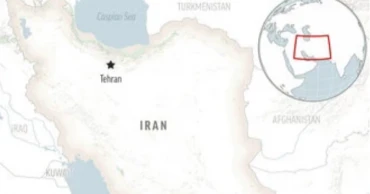
Gunman kills 2 judges in Iranian capital
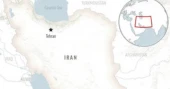
A gunman fatally shot two high-profile hard-line judges in Iran’s capital on Saturday in a rare attack targeting the judiciary, according to state media. Both judges were reportedly involved in the 1988 mass execution of dissidents, reports AP.
No organisation immediately claimed responsibility for the killings of clerics Mohammad Mogheiseh and Ali Razini. However, Razini’s alleged role in the 1988 executions has previously made him a target, including surviving an assassination attempt in 1999.
Iranian president arrives in Russia for partnership treaty signing
The attack occurred amid economic challenges in Iran, the growing impact of its regional conflicts with Israel, and the impending return of Donald Trump to the White House on Monday.
Both clerics were members of Iran’s Supreme Court, the state-run IRNA news agency reported. A bodyguard for one of the judges was also injured in the incident. The gunman reportedly took his own life, according to IRNA.
“Preliminary investigations indicate that the individual involved did not have a case pending in the Supreme Court nor any connection to its branches,” the judiciary's Mizan news agency stated. “Investigations are underway to identify and apprehend those responsible for this terrorist act.”
Razini had previously been targeted in January 1999 when attackers on motorcycles threw an explosive device at his vehicle, injuring him as he left his office as the judiciary’s head in Tehran.
Both judges had been accused by activists and exiles of participating in the 1988 mass executions, which followed the conclusion of Iran’s war with Iraq. After Iran’s then-Supreme Leader Ruhollah Khomeini accepted a U.N.-mediated ceasefire, armed members of the opposition group Mujahedeen-e-Khalq (MEK), supported by Saddam Hussein, launched a surprise incursion across the Iranian border.
Iran denies plot to kill Trump, rejects U.S. assassination claims
Although Iran repelled the attack, it led to the establishment of so-called "death commissions," which carried out hasty retrials of political prisoners, militants, and others.
International rights groups estimate up to 5,000 executions, while MEK claims the number is closer to 30,000. Iran has never fully acknowledged these executions, allegedly ordered by Khomeini, though some suggest other officials wielded significant influence in the months preceding his 1989 death.
The MEK has not yet responded to requests for comment.
1 year ago
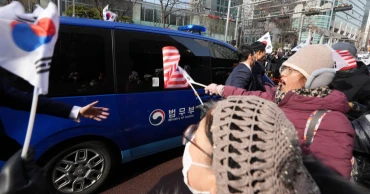
Impeached South Korean president seeks release amid court review
On Saturday, South Korea's impeached president presented arguments for his release before a Seoul judge as the court assessed a law enforcement request for his formal arrest, reports
Yoon, detained since his capture on Wednesday in a large-scale operation at his home, faces potential rebellion charges related to his December 3 declaration of martial law, which triggered the nation’s most serious political crisis since its democratization in the 1980s.
South Korea's impeached President Yoon Suk Yeol arrested over martial law declaration
The Corruption Investigation Office for High-Ranking Officials, leading a joint probe with the police and military, asked the Seoul Western District Court to approve an arrest warrant for Yoon.
During a nearly five-hour private hearing, Yoon’s lawyers said he spoke to the judge for approximately 40 minutes. His legal team and anti-corruption agencies presented opposing views on whether he should remain in custody, but the lawyers did not disclose his specific remarks.
The judge is expected to announce a decision by late Saturday or early Sunday. Yoon’s motorcade was seen leaving the court on Saturday evening for a detention center, where he will await the ruling.
Should Yoon be arrested, investigators can detain him for up to 20 days, after which they would hand the case to public prosecutors for indictment. If the court denies the request, Yoon will be released and return home.
South Korean special envoy to pay “goodwill” visit to Bangladesh Jan 22-23
Yoon was transported to court from a detention center in Uiwang, near Seoul, in a blue Justice Ministry van, accompanied by police and the presidential security service.
The motorcade entered the court’s basement parking lot as thousands of Yoon’s supporters gathered on nearby streets, waving banners and chanting slogans demanding his release. Some protesters briefly breached police lines and tapped on the van's windows as the motorcade slowed near the court. Yoon did not speak to the media before entering the hearing.
It was unclear until Saturday morning whether Yoon would attend the hearing.
His defense attorneys met him at the detention center, and he agreed to follow their advice to attend personally, according to one of Yoon’s lawyers, Yoon Kab-keun. The president argued that his decree was a legitimate exercise of authority and that the rebellion charges would not stand in a criminal or constitutional court, which is also deciding whether to formally remove or reinstate him.
South Korea presidential security chief questioned amid tensions
Nine individuals, including Yoon’s defense minister, police chief, and top military commanders, have already been arrested and indicted for their roles in enforcing martial law.
The crisis began when Yoon imposed military rule in an attempt to break legislative deadlock, sending troops to the National Assembly and election offices. The standoff lasted only hours after lawmakers bypassed the blockade and voted to rescind the measure. The opposition-dominated assembly voted to impeach him on December 14.
If Yoon is arrested, it could lead to an extended period of custody, potentially lasting months or longer.
Should prosecutors indict Yoon on charges of rebellion and abuse of power, they could detain him for up to six months before trial.
South Korean law mandates life imprisonment or the death penalty for orchestrating rebellion.
Yoon’s lawyers argue that detention is unnecessary during the investigation, as he poses no flight risk or threat to destroy evidence.
Investigators counter that Yoon ignored multiple requests for questioning, and that the presidential security service blocked an attempt to detain him on January 3. His refusal has raised concerns about whether he would comply with legal proceedings without being in custody.
1 year ago
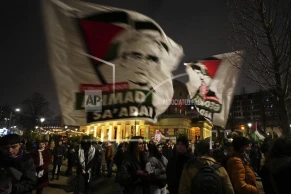
Ceasefire between Israel, Hamas to go into effect at 6:30 GMT Sunday: Qatar foreign ministry
Qatar’s foreign ministry has announced that a ceasefire between Israel and Hamas will take effect at 6:30 GMT on Sunday.
The ceasefire will pause the fighting after 15 months of war and see the release of dozens of hostages held by the militants in the Gaza Strip and hundreds of Palestinians imprisoned by Israel.
Israel’s Cabinet approved a deal early Saturday, paving the way for a ceasefire in Gaza. This move aims to facilitate the release of hostages held by Hamas and halt the 15-month-long war, the deadliest and most devastating conflict between the two sides.
The government confirmed the ceasefire’s timing after a lengthy Cabinet session that extended beyond the start of the Jewish Sabbath—an unusual occurrence highlighting the matter’s urgency.
Traditionally, Israeli government activities are paused during the Sabbath unless emergencies arise.
The ceasefire agreement was brokered by mediators Qatar and the United States and initially announced on Wednesday.
However, its finalization faced delays as Israeli Prime Minister Benjamin Netanyahu cited last-minute challenges, attributing the complications to Hamas.
On Friday, Israel’s smaller security Cabinet recommended approving the deal, moving it forward.
1 year ago
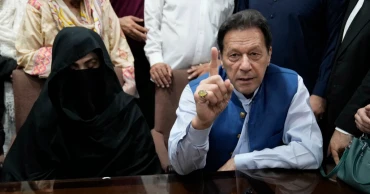
Pakistan court sentences ex-PM Imran Khan, wife in graft case
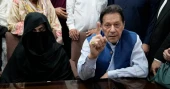
A Pakistan court on Friday sentenced former Prime Minister Imran Khan and his wife to 14 and seven years in prison, respectively, after finding them guilty of corruption, according to officials and his lawyer.
This marks another setback for the former leader, who has been imprisoned since 2023, reports AP.
The charges stem from allegations that the couple accepted a land gift from real estate tycoon Malik Riaz in return for laundered money during Khan's tenure as prime minister.
US, UK criticise Pakistan military court convictions of Imran Khan supporters
Prosecutors claim Khan allowed Riaz to pay fines imposed on him in a separate case using £190 million ($240 million) of laundered funds returned to Pakistan by British authorities in 2022. The money, intended for the national exchequer, was allegedly misappropriated.
Khan has denied any wrongdoing and maintains that the charges are part of a conspiracy by political opponents to prevent his return to power.
Following the court's decision, Khan's wife, who had been released on bail in October after serving time in another corruption case, was taken into custody. Recently, she had led a rally calling for her husband's release.
Pakistan court indicts ex-PM Imran Khan, wife
Defence lawyer Faisal Chaudhry stated that the verdict would be challenged in higher courts. Meanwhile, members of Khan’s Pakistan Tehreek-e-Insaf (PTI) party protested outside the parliament in Islamabad, claiming the ruling was unjust. Senior PTI leader Omar Ayub Khan, unrelated to the former prime minister, dismissed the case as fabricated and pledged to seek justice through an appeals court.
Imran Khan, ousted in a parliamentary no-confidence vote in April 2022, has faced multiple convictions. These include charges of corruption, revealing official secrets, and violating marriage laws, resulting in sentences of 10, 14, and seven years, respectively. Under Pakistani law, these sentences are to be served concurrently, meaning the longest term applies.
Supporters of Khan gathered outside Rawalpindi’s Adiala prison, chanting slogans against the government and demanding his release.
New cases have been filed against Imran Khan and his wife
Information Minister Attaullah Tarar claimed on Thursday that there was "irrefutable evidence" against Khan and his wife in the corruption case. Tarar accused Khan of withholding details about the returned funds from his cabinet and using the money to build a lavish home in Lahore without disclosing its source.
The verdict coincides with heightened tensions between Khan’s PTI party and Prime Minister Shehbaz Sharif’s government. A day earlier, PTI held talks with government representatives, calling for the release of political detainees, including Khan and other party leaders. Sharif assumed office after the February 2024 election, which PTI alleges was rigged.
1 year ago
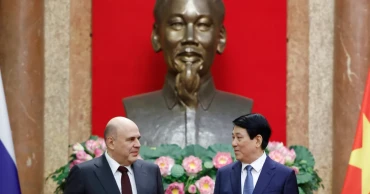
Russia will help Vietnam to join BRICS bloc of developing nations
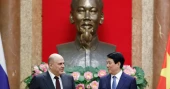
Russia will facilitate Vietnam's participation in the BRICS bloc of developing economies as a “partner country,” the countries said in a joint statement on Wednesday after Russian Prime Minister Mikhail Mishustin’s two-day visit to Hanoi.
“The Russian side welcomed Vietnam’s active participation in BRICS events in 2024 and expressed its readiness to create favorable conditions if Vietnam joins BRICS as a partner country,” the statement said, AP reports.
BRICS was formed by Brazil, Russia, India and China in 2009, with South Africa added in 2010, as a counterweight to the Group of Seven leading industrialized nations. Last year, the bloc added Iran, Egypt, Ethiopia and the United Arab Emirates. Saudi Arabia has been invited to join. Turkey, Azerbaijan and Malaysia have formally applied to become members, and a few others have expressed interest.
Vietnam's Southeast Asian neighbor Indonesia was admitted as a full BRICS member this month.
Russia forms an emergency task force over oil spill
But Vietnam remains reticent to join the bloc, said Nguyen Khac Giang, a visiting fellow in the Vietnam Studies Program at Singapore’s ISEAS–Yusof Ishak Institute.
“Hanoi is still cautious of what the Trump administration will think about BRICS and the potential consequences of becoming a full member in the worst-case scenario. Meanwhile, the benefits are not that substantial for Hanoi to take such a risk,” he said.
Vietnam needs support from the US to advance its economic ambitions and diversify its defense ties.
Russia has been trying to bolster ties in Asia to offset its growing international isolation over its war in Ukraine.
NKorean troops in Ukraine gain battlefield experience, cementing alliance with Russia
During Mishustin’s visit to Hanoi, the countries agreed to expand their cooperation on nuclear power.
“Russia is ready to participate in building a national nuclear power industry in Vietnam,” the joint statement said.
1 year ago
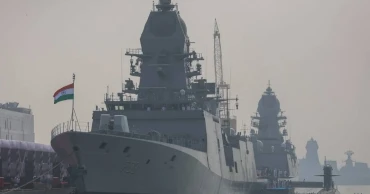
India's navy launches submarine, warships to counter China's presence
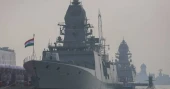
In a significant move to bolster its presence in the Indian Ocean, India’s navy simultaneously launched a submarine, a destroyer, and a frigate at a state-owned shipyard on Wednesday. This step highlights the strategic importance of the Indian Ocean, through which 95% of India’s trade passes, amid increasing Chinese naval activities.
Defense Minister Rajnath Singh emphasized the shifting focus from the Atlantic Ocean to the Indian Ocean, describing the region as a pivotal center of global power competition. "India is prioritizing the enhancement of its navy to safeguard national interests," he stated.
Two private lunar landers embark on roundabout moon journey
Prime Minister Narendra Modi, while commissioning the vessels at the Mazagon dockyard in Mumbai, called the development a milestone in India's quest to become a global leader in defense manufacturing and maritime security.
Defense expert Rahul Bedi noted that China’s rapidly expanding navy presents challenges in the Indian Ocean. The newly launched submarine, INS Vagsheer, is the sixth in the French-designed Kalvari (Scorpene)-class diesel-electric series. It aims to replace India's aging submarine fleet and address critical capability gaps. Currently, India operates 16 submarines.
The P75 Scorpene project, developed in partnership with France's Naval Group, marks India's growing competence in submarine construction. The defense ministry is expected to finalize a deal for three more Scorpene submarines during Prime Minister Modi's anticipated visit to Paris next month for the Artificial Intelligence Action Summit hosted by French President Emmanuel Macron. However, the first of these submarines is not expected to be operational until 2031.
Blue Origin attempts rocket launch again after last-minute delay
India’s indigenous defense efforts received a boost in 2022 with the commissioning of its first home-built aircraft carrier, INS Vikrant, to counter China's larger naval fleet and enhance local shipbuilding expertise. The INS Vikrant, meaning "powerful" or "courageous" in Sanskrit, is India’s second operational carrier, joining the INS Vikramaditya, which was purchased from Russia in 2004.
1 year ago
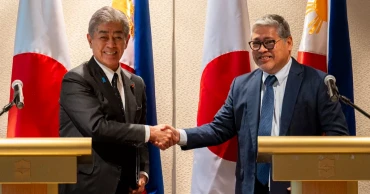
Japan, Philippines to urge Trump: Maintain US engagement in Asia
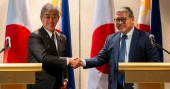
Japan and the Philippines intend to emphasise to President-elect Donald Trump the critical importance of continued U.S. involvement in upholding the rule of law in Asia, particularly amid escalating security concerns, Japan's Foreign Minister said on Wednesday, reports AP.
Under President Joe Biden, the U.S., Japan, and the Philippines have been fostering a strategic alliance to address China's increasingly assertive actions in the contested South China Sea and East China Sea. However, Trump's "America First" policy has raised doubts about the future extent of U.S. engagement in the region.
Blinken heads to Asia, Europe on last expected trip as top US diplomat
Japanese Foreign Minister Takeshi Iwaya, speaking at a news conference alongside his Philippine counterpart Enrique Manalo in Manila, stated, "We will communicate to the next U.S. administration that constructive U.S. engagement in this region is not only crucial for us but also beneficial for the U.S. itself."
Iwaya confirmed his plans to attend Trump’s inauguration on January 20 as Japan remains a close treaty ally of the U.S., alongside the Philippines.
Musk hiring cheaper tech servants from Asia: Alleges Bernie Sanders
"Given the increasingly severe strategic environment in the region, Japan prioritises both bilateral cooperation with the Philippines and strengthening trilateral collaboration with the United States," Iwaya noted.
Rising tensions between Chinese and Philippine coast guards in the heavily trafficked South China Sea have heightened fears of a larger conflict, potentially drawing in the U.S. The U.S. has reiterated its commitment to defend Philippine forces under their mutual defence treaty if they face armed attacks in the region.
"The South China Sea issue is a legitimate international concern as it directly impacts regional peace and stability," Iwaya remarked. He added that Japan firmly opposes any unilateral attempts to alter the status quo through force and urged for a de-escalation of tensions.
Jonathan Malaya, assistant director-general of the Philippine National Security Council, cautioned that China’s actions are becoming increasingly provocative, stating, "China is pushing us to the wall," and noting that "all options are on the table," including new international legal challenges.
Zelenskyy, Macron discuss Western troop deployment in Ukraine
The Philippine coast guard reported that a large Chinese coast guard vessel recently patrolled the contested Scarborough Shoal and approached the northwestern Philippine coast, coming within 77 nautical miles (143 kilometres).
Meanwhile, a Chinese official in Beijing reiterated that the South China Sea falls under China’s established sovereignty, asserting that their coast guard’s activities are lawful and justified. China has consistently accused the Philippines, Vietnam, and Malaysia of encroaching on what it considers its territorial waters.
Philippine Foreign Minister Manalo said the latest developments would be discussed during a scheduled meeting on Thursday in Xiamen between Chinese and Philippine diplomats. The two nations have engaged in ongoing talks through the Bilateral Consultation Mechanism, aiming to manage disputes and prevent them from escalating into armed conflict.
1 year ago