asia
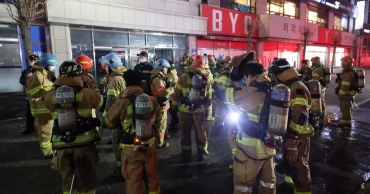
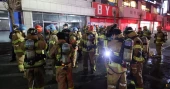
South Korean fire fighters tackle blaze in commercial building in Seongnam
Hundreds of people were rescued or evacuated after a fire broke out at a large commercial building in the South Korean city of Seongnam on Friday, fire officials said.
More than 260 firefighters and 80 vehicles were deployed to the scene of the blaze, which was extinguished about an hour and a half after it was first reported at around 4:30 p.m., according to the Gyeonggi provincial fire department.
South Korean investigators attempt to detain impeached President Yoon
The department said emergency workers have so far rescued 240 people, while another 70 managed to exit the eight-story building unaided.
About 28 people sustained light injuries, including smoke inhalation, but there were no reports of serious injuries. The department said emergency workers were still searching the site to ensure no one was trapped inside.
The department said the fire started at a restaurant on the first floor. The cause wasn’t immediately known.
1 year ago
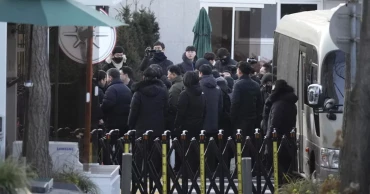
South Korean investigators attempt to detain impeached President Yoon
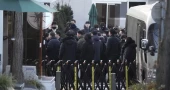
South Korean investigators arrived at the presidential residence with a warrant to detain impeached President Yoon Suk Yeol over his short-lived imposition of martial law, but faced resistance from presidential security staff as hundreds of Yoon’s supporters gathered outside vowing to protect him.
It’s the latest confrontation in a political crisis that has paralyzed South Korean politics and seen two heads of state impeached in under a month. It began on Dec. 3 when Yoon, apparently frustrated that his policies were blocked by an opposition-dominated parliament, declared martial law and dispatched troops to surround the National Assembly.
Parliament overturned the declaration within hours in an unanimous vote and impeached Yoon himself on Dec. 14, while South Korean authorities opened a criminal investigation into the events. Yoon has remained defiant, ignoring requests for questioning and vowing to fight to remain in office.
Four hours after dozens of investigators and police officers were seen entering the gate of the residence in Seoul to execute a warrant for Yoon’s detention, the dramatic scene appeared to have developed into a standoff.
The anti-corruption agency didn’t immediately reply to questions about whether investigators successfully entered Yoon’s residential building, but South Korea’s YTN television reported scuffles as investigators and police confronted the presidential security forces.
Seok Dong-hyeon, one of several lawyers on Yoon’s legal team, confirmed that the investigators arrived at the building but said it was unlikely that they would be able to detain the president on Friday. He said the agency’s efforts to detain Yoon were “reckless” and showed an “outrageous discard for law.”
South Korea’s Defense Ministry confirmed that the investigators and police officers got past a military unit guarding the residence’s grounds before arriving at the building. The presidential security service, which controls the residence itself, refused to comment on whether its members were confronting investigators and whether they planned to block the detention attempt.
The hourslong standoff prompted the liberal opposition Democratic Party to call on the country’s acting leader, Deputy Prime Minister Choi Sang-mok, to order the presidential security service to stand down. Choi, who also serves as finance minister, didn’t immediately comment on the situation.
“We warn presidential security service chief Park Jong-joon not to further participate in a rebellion. Do not drag the upright staff of the presidential security service and other public officials into the depths of crime,” said Jo Seung-lae, a Democratic lawmaker. Choi must “remember that swiftly addressing the rebellion and preventing further chaos is your responsibility,” Jo said.
Read: Warrant to detain impeached South Korean President Yoon sought
In a defiant New Year’s message to conservative supporters rallying outside his residence, Yoon said he will “fight to the end” against “anti-state forces.” His lawyers have described the warrant as “invalid” and “illegal,” and said that the presidential security force could arrest police trying to execute it.
Thousands of police officers gathered at Yoon’s residence and formed a perimeter around a growing group of pro-Yoon protesters, who braved subfreezing temperatures for hours, waving South Korean and American flags while chanting slogans in his support. There were no immediate reports of major clashes.
A Seoul court issued a warrant for Yoon’s detention on Tuesday after he evaded multiple requests to appear for questioning and blocked searches of his office in Seoul, hindering an investigation into whether his ill-conceived power grab on Dec. 3 amounted to rebellion.
The warrant is valid for one week, and investigators may make another attempt to detain Yoon if they are unable to do so on Friday.
Investigators from the anti-corruption agency were earlier seen loading boxes into several vehicles before leaving their building in the city of Gwacheon early in the morning. Television footage later showed some of those vehicles weaving between police buses that tightly packed and barricaded the streets near Yoon’s residence.
If Yoon is detained, the anti-corruption agency will have 48 hours to either request a warrant for his formal arrest or release him. Yoon’s defense minister, police chief and several top military commanders have already been arrested over their roles in the period of martial law.
Yoon Kap-keun, another lawyer representing the president, described the investigators’ efforts to detain him as illegal and said they would plan to pursue unspecified legal steps against the anti-corruption agency.
Read more: Motion to impeach South Korea’s acting president submitted
Yoon Suk Yeol’s lawyers have argued the court’s detainment warrant is invalid, claiming that the anti-corruption agency lacks the legal authority to investigate rebellion charges. They also accuse the court of bypassing a law that says locations potentially linked to military secrets cannot be seized or searched without the consent of the person in charge.
The lawyers have said police officers would be exceeding their legal authority if they assist in detaining Yoon, and could face arrest by either the “presidential security service or any citizens.” They didn’t elaborate further on the claim.
Critics accused Yoon of inciting his supporters to obstruct attempts to detain him. South Korean law permits anyone to make an arrest to stop an active crime.
The Democratic Party, which drove the legislative vote that impeached Yoon Suk Yeol on Dec. 14 over his imposition of martial law, accused the president of trying to mobilize his supporters to block his detention and called for law enforcement authorities to execute the warrant immediately.
Yoon Kap-keun, the president’s lawyer, filed a challenge with the Seoul Western District Court on Thursday to block both the detention warrant for Yoon Suk Yeol and a related search warrant for his residence. The lawyer argued that both warrants violate criminal laws and the constitution.
Yoon’s presidential powers were suspended following a National Assembly vote to impeach him on Dec. 14 over his imposition of martial law, which lasted only hours but has triggered weeks of political turmoil, halted high-level diplomacy and rattled financial markets. Yoon’s fate now lies with the Constitutional Court, which has begun deliberations on whether to uphold the impeachment and formally remove Yoon from office or reinstate him.
To formally end Yoon’s presidency, at least six justices on the nine-member Constitutional Court must vote in favor.
The National Assembly voted last week to also impeach Prime Minister Han Duck-soo, who became acting president after Yoon’s powers were suspended, over his reluctance to fill three Constitutional Court vacancies ahead of the court’s review of Yoon’s case.
Facing growing pressure, the new acting president, Choi, appointed two new justices on Tuesday, which could increase the chances of the court upholding Yoon’s impeachment.
Yoon’s imposition of martial law ended after only six hours when the National Assembly voted 190-0 to lift it despite attempts by heavily armed soldiers to prevent them from voting.
Yoon has defended his martial law decree as a necessary act of governance, portraying it as a temporary warning against the Democratic Party, which he has described as an “anti-state” force obstructing his agenda with its legislative majority.
1 year ago
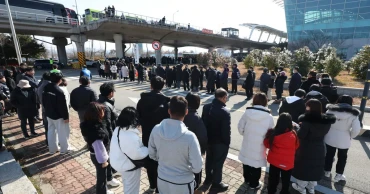
SKorea air crash investigators extract black box data as grieving families mourn the victims
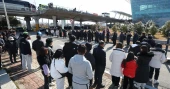
Grieving relatives of the victims of the South Korea plane crash gathered at the site to pay respects to their loved ones on New Year’s Day, as officials said they've extracted data from one of the retrieved black boxes to find the exact cause of the crash.
All but two of the 181 passengers and crew on board the Boeing 737-800 operated by Jeju Air died when it crashed at Muan International Airport, in southern South Korea, on Sunday.
Video showed the aircraft without its landing gear deployed landing on its belly at high speed and then skidding off the end of the runaway into a concrete fence and bursting into flames. The footage showed the plane was experiencing an apparent engine problem in addition to the landing gear malfunction.
Investigators say the pilot received a warning from air traffic controllers of possible bird strikes and the plane issued a distress signal before the crash.
The Transport Ministry said in a statement Wednesday that it has completed works to extract data from the cockpit voice recorder — one of the two black boxes recovered from the wreckage. It said the data would be converted into audio files. A damaged flight data recorder will be sent to the United States for an analysis, the ministry added.
All of the victims were South Korean, except for two Thais nationals, with many returning from Bangkok after Christmas holidays.
Romania and Bulgaria celebrate full Schengen membership with ceremonies
The bereaved families visited the site on Wednesday for the first time since the crash for an emotional memorial service. They were bused to the site where they took turns laying white flowers. Many knelt and bowed deeply before a memorial table laid with food, including “ddeokguk,” a Korean rice cake soup eaten on New Year's Day.
The Transport Ministry said authorities have completed the complicated process of identifying all 179 victims. It said the government has so far handed over 11 bodies to relatives.
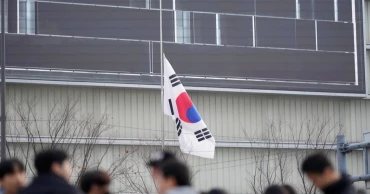
The country is observing seven days of national mourning following the deadliest disaster in South Korea’s aviation history in decades.
The government has begun safety inspections of all 101 Boeing 737-800s operated by the country's domestic airlines. On Tuesday, a team of U.S. investigators, including representatives from Boeing, examined the crash site.
10 killed, 30 injured as car drives into crowd in New Orleans
Officials have said they will consider whether the airport’s localizer — a set of antennas housed in a concrete fence at the end of the runway designed to guide aircraft during landings — should have been constructed with lighter materials that would break more easily upon impact.
1 year ago
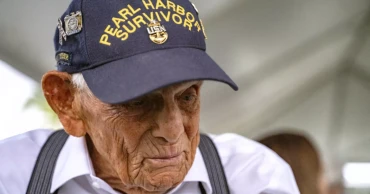
Harry Chandler, Navy medic who survived Japan's attack on Pearl Harbor, dies at 103
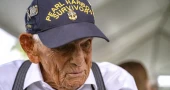
Harry Chandler, a Navy medic who helped pull injured sailors from the oily waters of Pearl Harbor after the 1941 Japanese attack on the naval base, has died. He was 103.
Chandler died Monday at a senior living center in Tequesta, Florida, according to Ron Mahaffee, the husband of his granddaughter Kelli Fahey. Chandler had congestive heart failure, but Mahaffee said doctors and nurses noted his advanced age when giving a cause of death.
The third Pearl Harbor survivor to die in the past few weeks, Chandler was a hospital corpsman 3rd class on Dec. 7, 1941, when waves of Japanese fighter planes dropped bombs and fired machine guns on battleships in the harbor and plunged the U.S. into World War II.
He told The Associated Press in 2023 that he saw the planes approach as he was raising the flag that morning at a mobile hospital in Aiea Heights, which is in the hills overlooking the base.
“I thought they were planes coming in from the states until I saw the bombs dropping,” Chandler said. His first instinct was to take cover and ”get the hell out of here.”
“I was afraid that they’d start strafing,” he said.
His unit rode trucks down to attend the injured. He said in a Pacific Historic Parks oral history interview that he boarded a boat to help pluck wounded sailors from the water.
The harbor was covered in oil from exploding ships, so Chandler washed the sailors off after lifting them out. He said he was too focused on his work to be afraid.
“It got so busy you weren't scared. Weren’t scared at all. We were busy. It was after you got scared,” Chandler said.
He realized later that he could have been killed, “But you didn’t think about that while you were busy taking care of people.”
Read: Remains of Utah sailor killed at Pearl Harbor to return home
The attack killed more than 2,300 U.S. servicemen. Nearly half, or 1,177, were sailors and Marines on board the USS Arizona, which sank nine minutes after it was bombed.
Chandler's memories came flowing back when he visited Pearl Harbor for a 2023 ceremony commemorating the 82nd anniversary of the bombing.
“I look out there, and I can still see what’s going on. I can still see what was happening,” Chandler told The Associated Press.
Asked what he wanted Americans to know about Pearl Harbor, he said: “Be prepared.”
“We should have known that was going to happen. The intelligence has to be better,” he said.
After the war Chandler worked as a painter and wallpaper hanger and bought an upholstery business with his brother. He also joined the Navy reserves, retiring as a senior chief in 1981.
Chandler was born in Holyoke, Massachusetts, and lived for most of his adult life in nearby South Hadley, Mahaffee said. In recent decades he split his time between Massachusetts and Florida.
An avid golfer, he shot five hole-in-ones during his lifetime, his grandson-in-law added.
Chandler had one biological daughter and adopted two daughters from his second marriage, to Anna Chandler, who died in 2004. He is survived by one daughter, nine grandchildren, 17 great-grandchildren and five great-great-grandchildren.
Read more: 3 dead after Pearl Harbor sailor shoots civilians, himself
Military historian J. Michael Wenger has estimated that there were some 87,000 military personnel on the island of Oahu the day of the attack. With Chandler’s death only 15 are still living, according to a tally maintained by Kathleen Farley, the California state chair of the Sons and Daughters of Pearl Harbor Survivors.
Bob Fernandez, who served on the USS Curtiss, also died this month, at age 100, and Warren Upton, 105, who served on the USS Utah, died last week.
1 year ago

China's manufacturing activity slows in December as trade risks grow
China's factory activity expanded at a slower pace in December, official data showed on Tuesday, despite recent stimulus measures and in the face of increasing trade risks.
The Purchasing Managers’ Index, based on a survey of factory managers, slipped to 50.1 in December from 50.3 the previous month, the National Bureau of Statistics said Tuesday.
It was the third straight monthly reading above 50, a level that indicates an expansion of manufacturing activity.
The slowdown in factory activity was due to a “decline in the output component,” according to a note by Capital Economics' Gabriel Ng.
Adani Enterprises to sell entire Adani Wilmar
“That said, the output price component fell, suggesting downward pressure on prices remains,” he said.
Overall, new orders rose to an eight-month high, while the exports order index rose to the highest level in four months, likely helped by US importers rushing to beat higher tariffs that incoming US President Donald Trump may impose on Chinese goods, Ng said.
Trump has pledged to impose 10% tariffs on Chinese goods, raising trade risks for China, the world's largest exporter of goods. China is already grappling with a lagging economy, weighed down by reduced consumption and a real estate crisis.
A parallel purchasing managers’ index for the non-manufacturing sector, which covers construction and services, rose to 52.2 points up from 50 points in November.
The World Bank last week raised forecasts for China's economy growth to 4.9% but warned that reduced confidence among households and businesses, an aging population as well as issues like low consumption and high debt will continue to weigh on China's future growth.
1 year ago
SKorea to inspect Boeing as it struggles to find cause of plane crash
South Korea will conduct safety inspections of all Boeing 737-800 aircraft operated by the country’s airlines following a deadly crash on Sunday that killed 179 people.
The crash, which is South Korea’s worst aviation disaster in decades, has raised national concerns as the government struggles to address the situation amid a leadership vacuum.
New acting President Choi Sang-mok led a task force meeting on Monday, instructing authorities to review the country’s aircraft operations systems.
“The essence of a responsible response would be renovating the aviation safety systems on the whole to prevent recurrences of similar incidents and building a safer Republic of South Korea,” Choi, also the finance minister, said.
The Boeing 737-800, operated by Jeju Air, had aborted its first landing attempt for unclear reasons. During its second attempt, it received a bird strike warning before the pilot issued a distress signal.
The plane landed without its front landing gear deployed, overshot the runway, hit a concrete fence, and burst into flames.
Alan Price, a former chief pilot at Delta Air Lines, stated the Boeing 737-800 is a “proven airplane,” unlike the Boeing 737 Max, which was linked to fatal crashes in 2018 and 2019.
South Korea's Transport Ministry announced it would inspect all 101 Boeing 737-800s in the country, focusing on Jeju Air, which operates 39 of these planes. Representatives from the US National Transportation Safety Board and Boeing are set to join the investigation.
Officials are also reviewing the design of Muan airport's localizer, a concrete fence with antennas meant to guide planes during landings.
The Transport Ministry confirmed similar structures exist at other airports in South Korea, as well as in the US, Spain, and South Africa.
Warrant to detain impeached South Korean President Yoon sought
Video footage of the crash indicated a possible hydraulic failure, with the pilots failing to deploy flaps or slats to slow the plane. Retired pilot John Cox said the aircraft was still under control, and the close proximity of the barrier likely worsened the damage.
Another Jeju Air 737-800 experienced a landing gear issue earlier on Monday but returned to Seoul as a precaution. Authorities are also investigating potential communication problems between the pilot and air traffic controllers during the crash.
The crash, which is South Korea’s deadliest since 1997, has prompted a seven-day national mourning period. The Transport Ministry has identified 146 bodies and continues to collect DNA and fingerprint samples from the remaining 33 victims.
1 year ago

Adani Enterprises to sell entire Adani Wilmar
Adani Enterprises Ltd (AEL) has announced its decision to sell its entire 44% stake in Adani Wilmar Ltd (AWL) in a move valued at approximately $2 billion.
The stake sale, which will occur in two phases, is part of a broader strategy to refocus on the company’s core business sectors.
The first phase will see Adani Enterprises, along with its wholly-owned subsidiary Adani Commodities LLP (ACL), divest shares to Lence Pte Ltd, a fully-owned subsidiary of Wilmar International.
Lence Pte Ltd is set to acquire up to 31.06% of AWL’s paid-up equity shares through a call or put option mechanism. The second phase will involve a partial divestment of approximately 13% of AWL shares to meet the minimum public shareholding requirements, completing Adani Enterprises’ exit from the fast-moving consumer goods (FMCG) business.
As of December 27, 2024, Adani Wilmar had a market capitalisation of approximately Rs 42,785 crore (roughly $5 billion). Following the announcement, shares of Adani Enterprises saw a sharp rise of 7%, closing at Rs 2,585, while Adani Wilmar’s stock dropped by 1.81%, settling at Rs 323.25 per share.
In line with the agreement, the nominee directors of Adani Commodities LLP on the board of AWL will step down. The companies have also announced plans to rebrand Adani Wilmar under a new name.
Among the options being considered are “AWL Limited,” “AWL Agri Business Limited,” and “Fortune Agri Business Limited.” The final choice will require approval from the Ministry of Corporate Affairs.
Adani Enterprises has indicated that the proceeds from the stake sale will be reinvested into its key infrastructure sectors, including energy, utilities, transport, logistics, and other industrial verticals.
This move aligns with the company’s ongoing efforts to strengthen its position in critical infrastructure areas.
The transaction remains subject to regulatory approvals and other customary conditions, but once completed, it will mark the restructuring of AWL’s ownership.
The FMCG joint venture, established between the Adani Group and Wilmar International, will undergo significant changes as a result of the deal.
Source: With inputs from Indian media
1 year ago
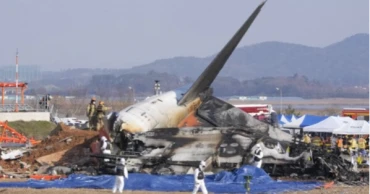
Jet crash disaster in South Korea marks another setback for Boeing
A machinists strike. Another safety problem involving its troubled top-selling airliner. A plunging stock price.
2024 was already a dispiriting year for Boeing, the American aviation giant. But when one of the company's jets crash-landed in South Korea on Sunday, killing all but two of the 181 people on board, it brought to a close an especially unfortunate year for Boeing.
The cause of the crash remains under investigation, and aviation experts were quick to distinguish Sunday's incident from the company’s earlier safety problems.
Alan Price, a former chief pilot at Delta Air Lines who is now a consultant, said it would be inappropriate to link the incident Sunday to two fatal crashes involving Boeing’s troubled 737 Max jetliner in 2018 and 2019. In January this year, a door plug blew off a 737 Max while it was in flight, raising more questions about the plane.
The Boeing 737-800 that crash-landed in Korea, Price noted, is “a very proven airplane. "It’s different from the Max ...It’s a very safe airplane.’’
For decades, Boeing has maintained a role as one of the giants of American manufacturing. But the the past year's repeated troubles have been damaging. The company's stock price is down more than 30% in 2024.
The company's reputation for safety was especially tarnished by the 737 Max crashes, which occurred off the coast of Indonesia and in Ethiopia less than five months apart in 2018 and 2019 and left a combined 346 people dead. In the five years since then, Boeing has lost more than $23 billion. And it has fallen behind its European rival, Airbus, in selling and delivering new planes.
Last fall, 33,000 Boeing machinists went on strike, crippling the production of the 737 Max, the company's bestseller, the 777 airliner and 767 cargo plane. The walkout lasted seven weeks, until members of the International Association of Machinists and Aerospace Workers agreed to an offer that included 38% pay raises over four years.
In January, a door plug blew off a 737 Max during an Alaska Airlines flight. Federal regulators responded by imposing limits on Boeing aircraft production that they said would remain in place until they felt confident about manufacturing safety at the company.
In July, Boeing agreed to plead guilty to conspiracy to commit fraud for deceiving the Federal Aviation Administration regulators who approved the 737 Max. Acting on Boeing’s incomplete disclosures, the FAA approved minimal, computer-based training instead of more intensive training in flight simulators. Simulator training would have increased the cost for airlines to operate the Max and might have pushed some to buy planes from Airbus instead. (Prosecutors said they lacked evidence to argue that Boeing’s deception had played a role in the crashes.)
But the plea deal was rejected this month by a federal judge in Texas, Reed O’Connor, who decided that diversity, inclusion and equity or DEI policies in the government and at Boeing could result in race being a factor in choosing an official to oversee Boeing’s compliance with the agreement.
Boeing has sought to change its culture. Under intense pressure over safety issues, David Calhoun departed as CEO in August. Since January, 70,000 Boeing employees have participated in meetings to discuss ways to improve safety.
1 year ago
Warrant to detain impeached South Korean President Yoon sought
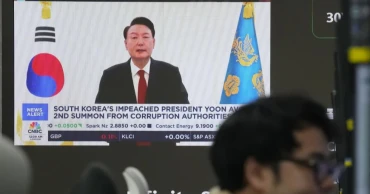
South Korean law enforcement officials on Monday requested a court warrant to detain impeached President Yoon Suk Yeol as they investigate whether his short-lived martial law decree on Dec. 3 amounted to rebellion.
The Corruption Investigation Office for High-Ranking Officials, which is leading a joint investigation with police and military authorities into the power grab that lasted only a few hours, confirmed it requested the warrant from the Seoul Western District Court. They plan to question Yoon on charges of abuse of authority and orchestrating a rebellion.
Yoon has dodged several requests by the joint investigation team and public prosecutors to appear for questioning and has also blocked searches of his offices.
It’s not clear whether the court will grant the warrant or whether Yoon can be compelled to appear for questioning.
Under the country’s laws, locations potentially linked to military secrets cannot be seized or searched without the consent of the person in charge, and it’s unlikely that Yoon will voluntarily leave his residence if he faces detainment.
Yoon’s presidential powers were suspended after the National Assembly voted to impeach him on Dec. 14 over his imposition of martial law that lasted only hours but has triggered weeks of political turmoil, halted high-level diplomacy and rattled financial markets. Yoon’s fate now lies with the Constitutional Court, which has begun deliberations on whether to uphold the impeachment and formally remove Yoon from office or reinstate him.
Yoon has defended the martial law decree as a necessary act of governance, describing it as a warning against the liberal opposition Democratic Party, which has been bogging down his agenda with its majority in the parliament.
Parliament voted last week to also impeach Prime Minister Han Duck-soo, who had assumed the role of acting president after Yoon’s powers were suspended, over his reluctance to fill three Constitutional Court vacancies ahead of the court’s review of Yoon’s case.
The country’s new interim leader is Deputy Prime Minister Choi Sang-mok, who is also finance minister.
1 year ago

Netanyahu is getting his prostate removed as he faces crises on multiple fronts
Israeli Prime Minister Benjamin Netanyahu is having his prostate removed on Sunday, his office said, a procedure that comes as he manages multiple crises at once, including the ongoing war in Gaza and his own trial for alleged corruption.
Netanyahu, 75, is among a cohort of older world leaders, including U.S. President Joe Biden, 82, and President-elect Donald Trump, 78, whose health and physical fitness are under deep scrutiny both at home and abroad because of their advanced age and the effect that could have on their leadership.
Netanyahu, who has had a string of health issues in recent years, has gone to great lengths to bolster a public image of himself as a fully healthy, energetic leader. During his trial this month he boasted about working 18-hour days, even if those long hours are accompanied by a cigar. But as Israel's longest-serving leader, such a grueling workload over a total of 17 years in power could also take a toll on his well-being.
The procedure has already had a fallout: Netanyahu’s lawyer Amit Hadad said in a letter to the court the Israeli prime minister would be fully sedated for the procedure and would be hospitalized for “a number of days," asking that his three days of testimony this week be canceled. The court agreed.
An acting prime minister will take over for Netanyahu while he is undergoing the procedure, according to an official familiar with the arrangements, although it wasn’t immediately clear who will step in. The official spoke on condition of anonymity because they weren’t authorized to discuss the details behind the procedure with the media.
With so much at stake in the turbulent region, Netanyahu’s health in wartime is a concern for both Israelis and the wider world.
Prostate issues are common for older men, and recovery can be quick
According to Netanyahu’s office, the Israeli leader was diagnosed with a urinary tract infection on Wednesday stemming from a benign enlargement of his prostate. The infection was treated successfully with antibiotics but a procedure on Sunday will remove his prostate.
Complications from prostate enlargement are common in men in their 70s and 80s, Dr. Shay Golan, head of the oncology urology service at Israel’s Rabin Medical Center, told Israeli Army Radio. Golan spoke in general terms about the procedure and was not involved in Netanyahu's care or treatment.
He said that an enlarged prostate can block proper emptying of the bladder, leading to a build-up of urine that can then lead to an infection or other complications. After medicinal treatment, doctors can recommend a procedure to remove the prostate to prevent future blockages, Golan said.
In Netanyahu’s case, because the prostate is not cancerous, Golan said doctors will likely perform an endoscopic surgery, which is carried out by inserting small instruments into a body cavity, rather than making any surgical cuts in the abdomen to reach the prostate.
The procedure lasts about an hour, Golan said, and recovery is quick. Golan also said that aside from catheter use for one to three days after the procedure, patients can return to normal activity without any significant limitations.
Netanyahu has had some health issues before, including a heart condition
Netanyahu insists he is in excellent health and his office has worked to craft a public image that backs that up. It releases footage of him touring war zones in full protective gear flanked by gruff military officers, or meeting with defense officials on windswept hilltops in youthful dark shades and puffer jackets.
But that image was shattered last year when Netanyahu’s doctors revealed that he had a heart condition, a problem that he had apparently long known about but concealed from the public.
A week after a fainting spell, Netanyahu was urgently fitted with a pacemaker to control his heartbeat. Only then did staff at the Sheba Medical Center reveal that Netanyahu has for years experienced a condition that can cause irregular heartbeats.
That revelation came at a time when Netanyahu was dealing with massive anti-government protests. The news about a chronic heart problem stoked further anger and distrust at a time of extreme political polarization in Israel.
Last year, Netanyahu was rushed to the hospital for what doctors said likely was dehydration, where he stayed overnight, prompting his weekly Cabinet meeting to be delayed.
Earlier this year, Netanyahu underwent hernia surgery, during which he was under full anesthesia and unconscious. His close confidant, Justice Minister Yariv Levin, served as acting prime minister during the operation.
The surgery comes at a turbulent time in the region
As Israel’s leader, Netanyahu is at the center of major global events that are shifting the Middle East. With the dizzying pace of the past 14 months, being incapacitated for even a few hours can be risky in the current regional maelstrom.
Netanyahu will be in hospital at a time when international mediators are pushing Israel and Hamas to reach a ceasefire in Gaza as violence there rages on and fighting between Israel and Yemen's Iran-backed Houthi rebels intensifies.
The health issue also shines a new light on Netanyahu’s age. Prostate issues are common and in many cases easily treatable. But they are prominent especially among older men.
The procedure puts a dent in Netanyahu’s image of vigor at a time when he would want to project strength more than ever, both to an Israeli audience navigating constant threats as well as to Israel's enemies looking to expose Israel's weaknesses.
1 year ago