asia

Pakistan mosque bombing kills 21, injures 80
A vehicle bomb exploded Friday at a mosque near police offices in Kohat district of northwestern Pakistan as gunmen attempted to storm the compound, killing at least 21 people and injuring 80 others, police and rescue officials said.
Most of those killed were police officers attending prayers at the mosque, according to hospital officials. Provincial police chief Zulfiqar Hameed said an attacker apparently rammed an explosives-laden vehicle into the mosque.
At least seven armed gunmen also tried to enter the police compound and exchanged fire with officers. Police said six attackers were killed, while a suicide bomber targeted a nearby intelligence agency office.
The blast badly damaged the mosque and collapsed part of the police offices' outer wall. Residents reported hearing the explosion from far away, followed by gunfire that continued for hours.
Prime Minister Shehbaz Sharif condemned the attack and ordered authorities to speed up rescue operations.
No group immediately claimed responsibility, but suspicion was likely to fall on the Pakistani Taliban, or TTP.
The attack followed a roadside bomb in Hangu that killed six soldiers and military raids that killed 10 suspected TTP militants.
TTP attacks have increased in recent years. Pakistan accuses Afghanistan's Taliban government of sheltering TTP, which Kabul denies.
1 month ago

2 students, gunman killed in Philippines school shooting
A school shooting in the southern Philippines on Friday killed two 14-year-old students and the teenage attacker, while at least eight others were injured, according to local government and police officials.
The incident occurred at Banga National High School in the town of Banga, South Cotabato, in the southern Philippines.
Banga Mayor Albert Palencia told media that the shooter told friends after lunch to go home before entering an adjacent classroom and opening fire on 10 students. Two students-a boy and a girl-died, while eight were injured. Another person was hospitalized for hyperventilating.
The gunman then changed the magazine of his 9 mm firearm and shot himself.
The gun belonged to his father, a Department of Education employee, who had stored it in a vault that the teenager destroyed, police said.
South Cotabato Governor Reynaldo Tamayo and police said the shooter was part of an online "true crimes community" idolizing school shooters, where he had posted. Palencia added that the boy's mother had planned to take him to a psychiatrist. The Philippine National Police are investigating.
1 month ago
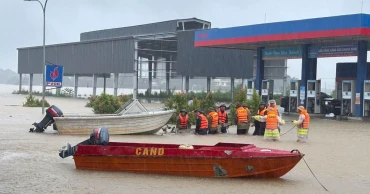
Heavy rain, floods inundate northern Vietnam, disrupt travel and economy
Heavy rainfall triggered flooding across parts of northern Vietnam on Thursday, disrupting transportation, inundating homes and pushing several rivers to dangerous levels, authorities and state media reported.
Northern and north-central Vietnam have experienced heavy rain throughout the week, with some areas recording more than 50 centimeters (19.7 inches) of rainfall, according to the disaster prevention department.
More than 2,000 homes have been inundated, while many major transportation routes have been blocked and more than 1,000 households remain isolated. Ninh Binh and Thanh Hoa provinces, which cover lowland and hilly areas south of Hanoi, have been among the worst affected.
Vietnam is one of the world’s most climate-vulnerable countries and is frequently affected by flooding. A series of severe storms last year prompted the country to seek new ways to prepare for and manage floods.
In Thanh Hoa province, authorities advised students to stay home as flooding made travel to schools unsafe, state media reported.
Heavy rain and flooding have submerged or damaged about 10,014 hectares (24,745 acres) of rice and other crops, with the biggest losses reported in Ninh Binh, Thanh Hoa and Nghe An provinces. Thousands of livestock and poultry have also died.
“The flood happens every year,” Ninh Binh resident Tran Ngoc Tai told national broadcaster VTV, saying that residents had prepared supplies of fresh water and food.
Several streets in Hanoi were heavily flooded Thursday morning, with water reaching nearly a meter (3.2 feet) in some areas. The flooding disrupted traffic and made it difficult for residents to travel to work, take children to school or leave their homes.
State media reported that rainfall between Wednesday night and Thursday morning exceeded 15 centimeters (5.9 inches) in some areas.
Many high schools and universities in Hanoi remained closed or shifted to online classes Thursday afternoon as heavy rain caused widespread flooding.
Rising water levels in the Bui River on the southwestern outskirts of Hanoi threatened nearby homes, prompting authorities to deploy hundreds of soldiers to help residents move their belongings to higher ground, state media reported.
A cold air mass moving south is expected to bring five days of heavy rain to southern Vietnam, including flood-prone Ho Chi Minh City, the country’s financial hub, from Sept. 17, according to the Southern Regional Hydro-Meteorological Center.
Forecasters expect widespread rainfall through Sept. 21, while authorities have warned of flooding in low-lying areas and along waterways. Ho Chi Minh City is forecast to receive 10 to 20 centimeters (4 to 8 inches) of rain, with some areas expected to receive higher amounts.
Vietnam experienced repeated severe flooding in 2025. Tropical Storm Wipha brought heavy rain and flooding in July, followed by further flooding and landslides in August when Tropical Storm Kajiki struck. Typhoon Bualoi killed at least 26 people in September.
In October, the historic central Vietnamese cities of Hue and Hoi An were flooded, along with large parts of northern Vietnam.
1 month ago
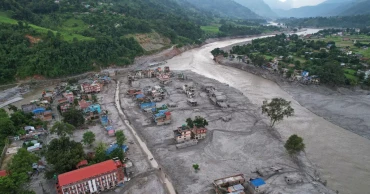
Climate change likely increased risk of deadly Nepal glacier and rock collapse
Human-driven global warming has caused glaciers to thin and mountain permafrost to thaw, likely contributing to the destabilization of a Himalayan slope that collapsed last month and triggered catastrophic flooding in Nepal, according to an analysis released Thursday.
The analysis by World Weather Attribution said climate change was not the only factor behind the Aug. 26 disaster. Researchers found that a major earthquake in Nepal in 2015 may have weakened the rock in the area years before the collapse.
“This disaster was not an extreme weather event, but the fingerprints of climate change are still clear to see in long-term changes,” said Ben Clarke, a climate researcher at Imperial College London who contributed to the analysis, in a press statement.
More than 1,300 people were killed and more than 5,000 remained missing after a huge section of rock and an overlying glacier collapsed near Nepal’s border with China. The resulting surge of water, ice, boulders and sediment swept through communities along the Trishuli River corridor, causing billions of dollars in damage.
Scientists said rising temperatures across the Himalayas are causing glaciers to retreat and permanently frozen ground to thaw. Such permafrost helps hold fractured mountain rock together.
As a result, climate change can affect not only weather-related hazards such as extreme heat and heavy rainfall but also the stability of mountains, posing risks to communities concentrated in narrow river valleys below.
The analysis did not establish whether the collapse would have occurred without climate change, which is primarily driven by greenhouse gas emissions from burning fossil fuels such as oil, gas and coal. However, researchers concluded that warming had intensified several processes over decades that contributed to making the slope less stable.
Global warming weakening high mountain slopes
One of the clearest climate-related changes identified in the report was the rise in the elevation of the freezing threshold.
According to the analysis, warming has raised the altitude at which the ground remains consistently frozen by about 100 meters (328 feet) per decade. This has exposed rock at increasingly higher elevations to longer periods above freezing, causing permafrost to thaw and cracks to develop in the ice, ultimately weakening the rock beneath it.
Jakob Steiner, a geoscientist at the University of Graz who has worked in the Himalayan region since 2006 but was not involved in Thursday’s report, said monitoring equipment around 5,000 meters (16,404 feet) now shows that some rock and ground no longer remain frozen year-round.
“This means that the ground that was sitting below ice for hundreds and thousands of years is now becoming exposed,” Steiner said.
Glacier retreat was identified as another factor contributing to instability.
Glaciers in the region have been losing mass for decades at a rate equivalent to more than half a meter (about 1.6 feet) of thinning each year, the report said. The Langtang Lirung glacier, located in the area where last month’s disaster occurred, has retreated by about half a kilometer (0.3 miles) since the 1990s, exposing rock that had previously been covered by ice.
The Himalayan region holds the world’s largest volume of snow and ice outside the polar regions. More than 63,000 glaciers there feed at least 10 major Asian river systems and support the food, water, energy and livelihood security of billions of people.
However, studies have found that about 78% of the glacier area located between 4,500 and 6,000 meters (14,763 to 19,685 feet) above sea level is highly exposed to warming. United Nations reports have found that glaciers lost 267 billion tons of ice annually between 2000 and 2019, roughly equal to the mass of 46,500 Great Pyramids of Giza.
As glaciers retreat, they can reduce pressure that once helped support nearby rock walls while also generating additional meltwater.
The period preceding the Aug. 26 collapse was also unusually warm. July and August 2026 were the warmest such months recorded locally, according to the analysis.
“Apart from potential geological factors like earthquakes that are weakening the bedrock, all these other factors are made worse by human-induced climate change,” said Friederike Otto, a climate scientist at Imperial College London and one of the report’s authors.
Disaster highlights limits of adaptation
The catastrophe also illustrates how some climate-related risks in the world’s highest mountains may surpass the protection offered by early warning systems and other adaptation measures, the report said.
Nepal has introduced disaster risk reduction plans and warning systems, but researchers said the scale and speed of the collapse overwhelmed those safeguards.
Unlike rainfall-triggered floods, which can sometimes be predicted hours or days in advance, major slope failures in remote high-altitude areas can happen suddenly and remain extremely difficult to forecast.
Otto said mountain ecosystems and communities are more vulnerable to climate impacts than people living in the plains.
“Small changes in temperatures affect the stability of the land itself,” she said.
The report said improved high-altitude monitoring, earth observation and warning systems could help reduce some risks. However, researchers cautioned that adaptation has limits in Himalayan valleys where settlements, roads, hydropower facilities and other infrastructure are concentrated along rivers.
Because glaciers and permafrost respond to temperature changes over decades, some of the mountain destabilization caused by warming has already been set in motion, according to the report.
“The most important thing to minimize the risk in this region is to rapidly stop using fossil fuels that lead to increasing global temperatures,” Otto said. “All these drivers that we’ve talked about, permafrost melting, glacial melting, etc., will just become worse. And that means that events like this become more frequent.”
1 month ago

Philippine ferry fire: Death toll rises to 77, 8 still missing
The death toll from the vessel fire on Sept. 9 off the waters of the tourist hotspot Palawan Province of the Philippines rose to 77, with eight still missing and 43 survivors, said the Philippine Coast Guard (PCG) on Wednesday.
The PCG explained that the revised casualty figures stem from a crew member who initially survived the incident and later died in hospital. Meanwhile, four passengers listed on the ticket manifest did not board the vessel prior to its departure.
Footage released by the PCG shows the passenger ferry heavily charred, with ashes and burnt metal visible at the scene.
The ferry with 128 people on board departed Manila and caught fire near waters off Coron Municipality, a well-known tourist destination.
The ferry is a frequent mode of transport across the Philippine archipelago. Due to bad weather, poor vessel maintenance, and weak enforcement of safety regulations, maritime accidents occur from time to time.
1 month ago

Former Philippine president Duterte appears at ICC hearing in The Hague
Former Philippine President Rodrigo Duterte appeared before the International Criminal Court (ICC) in The Hague on Wednesday, attending a hearing on his crimes-against-humanity case for the first time in more than a year.
The 81-year-old former leader, dressed in a black suit and white shirt, smiled and waved to supporters as he attended the pretrial hearing, which mainly focused on scheduling issues ahead of the formal start of his trial, expected in November.
Duterte is facing charges of murder and attempted murder over his alleged role in dozens of killings linked to his administration's so-called war on drugs. He has denied the allegations.
Duterte was arrested in the Philippines in March 2025 and transferred to The Hague. He initially appeared before the ICC through a video link from the court's detention centre and had not attended another hearing in person until Wednesday.
His lawyers had sought to have the case dismissed on medical grounds. However, ICC judges rejected his request for release and later ruled that he was medically fit to stand trial.
The ICC has been investigating killings linked to anti-drug operations carried out during Duterte's tenure as mayor of Davao and later as president of the Philippines.
Estimates of the number of people killed during his presidential term vary widely. Philippine police put the figure at more than 6,000, while human rights groups have estimated that as many as 30,000 people may have been killed.
Prosecutors allege that police and government-backed hit squads carried out dozens of killings on Duterte's orders, motivated either by financial rewards or fear of becoming targets themselves.
In June, Judge Joanna Korner, who is presiding over the case, told Duterte's lawyers that she expected him to attend the proceedings unless there was a medical reason preventing him from doing so.
His lawyers requested additional medical examinations earlier this week.
Meanwhile, relatives of people killed in the anti-drug crackdown gathered in Manila to watch the hearing together, chanting for justice for the victims.
A small group of protesters also gathered outside the ICC to express support for the proceedings.
The Philippines announced its decision to withdraw from the ICC in 2018, about a month after the court launched a preliminary examination into the alleged killings linked to Duterte's anti-drug campaign.
Last year, ICC judges rejected a bid by Duterte's legal team to have the case dismissed on the grounds that the Philippines had withdrawn from the court. The judges said a country could not use withdrawal from the Rome Statute to shield individuals from accountability for alleged crimes already under consideration by the court.
The ICC has also issued an arrest warrant for Ronald Marapon dela Rosa, who served as Duterte's national police chief, over his alleged connection to the drug-related killings. An attempt to arrest him earlier this year led to a gunfire incident at the Philippine Senate in May, though no one was injured. Dela Rosa subsequently went into hiding and remains at large.
Separately, the Philippine Senate began an impeachment trial in July against Duterte's daughter, Vice President Sara Duterte. She faces allegations including unexplained wealth and publicly threatening the family of President Ferdinand Marcos Jr. She has denied the charges.
If convicted, Sara Duterte could be permanently barred from holding public office.
1 month ago
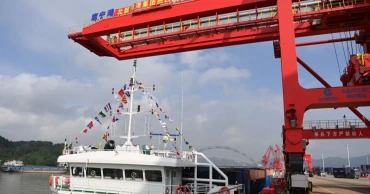
China opens major river-to-sea canal, creating trade shortcut to Southeast Asia
China on Wednesday opened the Pinglu Canal, providing the country's landlocked southwestern region with a shorter route to the coast and overseas markets, particularly those in the Association of Southeast Asian Nations (ASEAN), China's largest trading partner.
Constructed at a cost of 72.7 billion yuan (about $10.75 billion), the 134.2-kilometer canal connects Nanning, capital of south China's Guangxi Zhuang Autonomous Region, with the Beibu Gulf, the nearest maritime outlet for much of southwestern China.
The canal forms part of the New International Land-Sea Trade Corridor, a strategic route linking China's inland areas with ASEAN and other international markets.
It is the first river-to-sea canal project to have been planned and coordinated at the national level since the founding of the People's Republic of China in 1949.
The canal can accommodate vessels weighing up to 5,000 tonnes and cuts more than 560 kilometers from the inland waterway journey between southwestern China and the sea compared with traditional routes through ports in Guangdong Province.
It is expected to lower overall logistics costs by 18 to 30 percent and save more than 5 billion yuan in transportation expenses annually.
Lu Xinning, vice chairperson of the Guangxi regional government, said the canal establishes a new connection between China's market of 1.4 billion people and nearly 700 million consumers in ASEAN.
Its benefits could go beyond transporting goods by encouraging cross-border investment and further integrating regional supply chains, Lu said.
The canal took more than four years to construct. Most of the project involved widening, deepening and straightening existing waterways, while a smaller section was excavated through dry land and mountainous areas.
A major engineering challenge was overcoming a 65-meter difference in water levels, roughly equivalent to the height of a building more than 20 stories tall.
Three navigation hubs, each equipped with twin-line ship locks, were constructed to allow vessels to move between different water levels along the canal.
Environmental protection was also prioritized during the project. More than 98 percent of the approximately 315 million cubic meters of earth and rock excavated during construction was reused.
The canal also features a fish passage extending more than 480 meters and a dedicated wildlife crossing for land animals, including leopard cats and squirrels.
The canal has become operational in the first year of China's 15th Five-Year Plan period, covering 2026-2030, as the world's second-largest economy seeks to promote more balanced regional development and expand high-standard opening up.
These priorities are outlined in the plan.
The new trade route is particularly important for southwestern China, which has historically lagged behind the more prosperous eastern coastal regions and faced higher costs in transporting goods to seaports.
Coal, ore, grain, new-energy materials and auto parts from the region can now be transported more directly to overseas markets.
China's trade with ASEAN surpassed $1 trillion for the first time last year.
During the first seven months of 2026, trade between China and ASEAN reached $744.41 billion, up 24.7 percent year on year and accounting for 21.8 percent of China's total foreign trade during the period.
For Boonsub Panichakarn of the Faculty of Logistics and Digital Supply Chain at Naresuan University in Thailand, the importance of the canal extends beyond the distance it saves.
The canal's significance lies in its potential to reduce logistics costs, time variability and uncertainty throughout the ASEAN-southwestern China supply chain, he said.
1 month ago
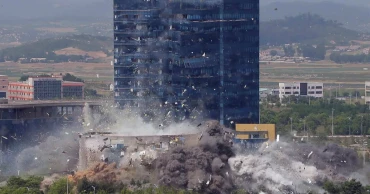
South Korean court orders North Korea to pay $32.5m over liaison office demolition
A South Korean court has ordered North Korea to pay 44.6 billion won ($32.5 million) in compensation for destroying a joint liaison office between the two Koreas in 2020, when relations sharply deteriorated following the collapse of nuclear negotiations between Pyongyang and Washington.
The Seoul Central District Court's ruling Wednesday is largely symbolic, as South Korea has no practical means of compelling North Korea to make the payment amid the continuing diplomatic breakdown.
North Korean leader Kim Jong Un has in recent years halted virtually all meaningful engagement with South Korea and described it as his most hostile adversary. At the same time, he has continued expanding North Korea's nuclear weapons program and strengthened ties with Moscow and Beijing as part of what he calls a "new Cold War."
Although individuals have previously brought lawsuits against the North Korean government over human rights abuses and other matters, the case involving the liaison office marked the first time that the South Korean government itself sued Pyongyang.
South Korea's Unification Ministry, which is responsible for inter-Korean affairs, said it respects the court's decision and urged the two sides to resume diplomacy so that "all issues between the South and North can be resolved through dialogue and cooperation."
North Korean state media did not immediately respond to the ruling.
South Korea filed the lawsuit in 2023, arguing that North Korea's demolition of the building in the border city of Kaesong was an unlawful and violent act that violated previous agreements between the two countries and seriously undermined "mutual respect and trust."
At the time, South Korea was under a conservative government that adopted a tougher position toward North Korea's nuclear and missile programs and its military assistance to Russia in the war in Ukraine. Seoul also strengthened security cooperation with the United States and Japan in response to the North Korean threat.
The tone shifted under current liberal President Lee Jae Myung, who took office last year after his conservative predecessor, Yoon Suk Yeol, was removed following his brief declaration of martial law in December 2024.
North Korea, however, has so far ignored Lee's appeals for a resumption of inter-Korean dialogue.
In June 2020, North Korea used explosives to destroy the South Korean-built liaison office in Kaesong after accusing Seoul of failing to prevent North Korean defectors from sending anti-Pyongyang propaganda leaflets across the border by balloons.
North Korea had already closed the liaison office in January 2020 as it sealed its borders over concerns about the coronavirus. The building was unoccupied when it was blown up.
The destruction was widely viewed at the time as a deliberate show of anger intended to pressure Seoul over stalled nuclear negotiations between Pyongyang and Washington.
Former South Korean liberal President Moon Jae-in held three meetings with Kim in 2018 and helped arrange Kim's first summit with then-US President Donald Trump in June of that year.
The diplomatic process collapsed after Kim and Trump held their second summit in 2019, when the United States rejected North Korea's demand for significant sanctions relief in return for partially giving up its nuclear capabilities.
Kim has since accelerated the development of North Korea's nuclear weapons and missile programs while deepening relations with Russia.
North Korea has sent thousands of troops and large quantities of weapons to support Russian President Vladimir Putin's war in Ukraine.
Trump has expressed interest in restarting diplomacy with Kim during his second term. Last month, he also ordered the Pentagon to "substantially reduce" a major military exercise with South Korea, citing what he described as a "good relationship" with Kim.
Kim's government, however, has so far rejected Trump's offers of dialogue and urged Washington to abandon its demand for North Korea's denuclearization as a condition for restarting negotiations.
1 month ago

China can restrict citizens from leaving over security, tech export violations
China’s new border control regulations taking effect Tuesday allow authorities to prevent citizens from leaving the country if they engage in illegal activities that threaten national or industrial security.
The measures are part of a wider revision of China’s border rules and come amid growing government concerns over the transfer of sensitive technology as competition with the United States intensifies in artificial intelligence and other emerging fields.
The regulation says its purpose includes protecting China’s sovereignty, security and development interests.
Under the new rules, Chinese citizens involved in criminal activities overseas that threaten national security may be barred from leaving the country again for between six months and three years after returning.
Citizens who violate technology import or export regulations may also face travel restrictions if their actions are deemed to endanger industrial or technological security.
“The new regs are another indication of just how serious China is about preventing the transfer of key tech and technical knowledge,” consultancy Trivium said after the rules were announced about six weeks ago.
China has already taken steps to limit the overseas transfer of advanced technology. In April, Beijing blocked US tech giant Meta from acquiring artificial intelligence startup Manus after the deal reportedly raised government concerns over the transfer of advanced technology. Manus is a Singapore-based company with Chinese roots.
The revised border rules also allow authorities to prevent foreigners from entering China for one to five years if they provide false information on visa applications or at border checkpoints.
The regulations further target schemes in which people are deceived into traveling abroad and then forced to take part in illegal gambling or online and telephone scam operations, which have remained a major concern in recent years.
China’s Cyberspace Administration sought to ease concerns that the new measures could make international travel more difficult for ordinary people.
The agency said in an online post last week that the rules are aimed at people involved in illegal cross-border activities and would not affect citizens traveling abroad for legitimate reasons.
1 month ago

Xi's article on advancing basic research to be published Wednesday
An article by Xi Jinping, general secretary of the Communist Party of China (CPC) Central Committee, on strengthening basic research will be published on Wednesday.
The article by Xi, also Chinese president and chairman of the Central Military Commission, will be published in this year's 18th issue of the Qiushi Journal, a flagship magazine of the CPC Central Committee.
Noting that basic research is the bedrock of the entire scientific system and a frontier area of global sci-tech competition, the article emphasizes further efforts to develop the country's basic research to build China into a leading country in science and technology.
Compared with global leaders in science and technology, China still lags behind in basic research, the article says, calling for stronger efforts and more concrete measures to strengthen basic research, enhance the country's capacity for original innovation, and accelerate efforts toward greater self-reliance and strength in science and technology.
The layout of basic research should be optimized, with the main directions and priority areas for basic research further clarified based on the country's urgent and long-term needs, the article says.
It also underscores the importance of promoting coordinated development of applied disciplines and basic disciplines, while encouraging integration among different disciplines and interdisciplinary research.
The article calls for efforts to expand the basic research talent pool and provide greater support for young talent.
It also stresses the importance of inspiring the imagination and curiosity of young people, so that more of them will regard pursuing basic research as a lifelong aspiration.
On ramping up support for basic research, the article calls for gradually raising the proportion of funding for basic research while strengthening the systematic development of major scientific and technological infrastructure.
Attention should also be paid to AI-empowered basic research and the development of a system of intelligent research platforms, it adds.
The article also urges the country's active integration into the global innovation network, boosting original innovation capacity through openness and cooperation.
It also emphasizes the need to further open up national science and technology programs, take the lead in initiating and participating in international big science programs and projects, and take an active part in global scientific and technological governance.
1 month ago