europe
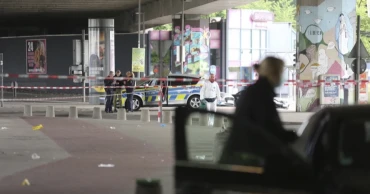
German police arrest a suspect, injured 5 people outside bar attack
A man suspected of attacking and injuring five people outside a bar in Bielefeld, a city in western Germany, has been arrested following an intensive two-day search, the German news agency dpa reported on Tuesday.
Herbert Reul, the interior minister of North Rhine-Westphalia, confirmed the arrest, stating, “The detailed work paid off and we were able to arrest the surprised perpetrator.” The suspect was apprehended late Monday evening in Heiligenhaus, a town near Düsseldorf in western Germany.
Police identify victim and gunman in Las Vegas gym shooting
Police identified the suspect as a 35-year-old Syrian national residing in Germany. The attack took place early Sunday morning when five men, aged between 22 and 27, were assaulted with a sharp object outside a downtown Bielefeld bar. Four of the victims sustained serious injuries.
Reul described the incident as a “shocking crime” and noted that investigators had pursued every possible lead using all available resources. He added that authorities are now focused on determining the motive behind the attack.
Ulanhad Volcano Cluster boosts rural revitalization and cultural tourism in North China
1 year ago
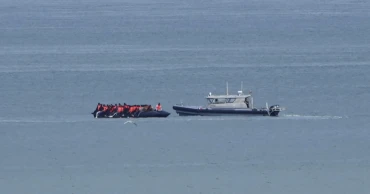
1 dies, another goes missing as migrant-loaded boat sinks in English Channel
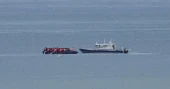
One person died and another is missing after a boat overloaded with migrants broke apart during an attempted overnight crossing of the English Channel, French maritime authorities said Monday — bringing the death toll this year in the perilous waterway to at least 12.
Palm tree falls on a person at Cannes Film Festival
French and British rescue services pulled 61 survivors from the sea off the coast of Pas-de-Calais overnight into Monday. Among them were a woman and her child suffering from hypothermia who were flown to a hospital in Boulogne-sur-Mer, according to a statement from the maritime prefecture.
A French Navy helicopter later spotted a body floating in the water, which was recovered by a British lifeboat. One person remains missing.
A Russian drone strike in northeastern Ukraine kills 9 people, officials say
French maritime authorities said they sent out an emergency message for assistance when the boat sank, prompting British boats and an aircraft to join the rescue operation with French vessels and the French helicopter carrying a medical team.
1 year ago
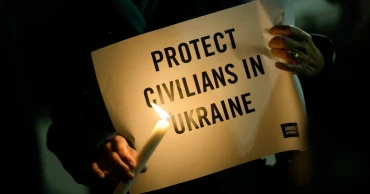
Russia outlaws Amnesty International in latest crackdown on activists
The Russian authorities on Monday outlawed Amnesty International as an “undesirable organization,” a label that under a 2015 law makes involvement with such organizations a criminal offense.
The decision by the Russian Prosecutor General’s office, announced in an online statement, is the latest in the unrelenting crackdown on Kremlin critics, journalists and activists that intensified to unprecedented levels after Moscow invaded Ukraine in February 2022.
Russia launches biggest drone attack on Ukraine since start of war
The designation means the international human rights group must stop any work in Russia, and it subjects those who cooperate with it or support it to prosecution, including if anyone shares Amnesty International’s reports on social media.
Amnesty International did not immediately comment on the move.
Russia's list of “undesirable organizations” currently covers 223 entities, including prominent independent news outlets and rights groups. Among those are prominent news organizations like Radio Free Europe/Radio Liberty or Russian independent outlet Meduza, think tanks like Chatham House, anti-corruption group Transparency International, and Open Russia, an opposition group founded by Mikhail Khodorkovsky, an exiled tycoon who became an opposition figure.
After Open Russia was declared undesirable in 2021 and disbanded to protect its members, its leader, Andrei Pivovarov, was arrested and convicted on charges of carrying out activities of an undesirable organization. He was sentenced to four years in prison and released in 2024 in the largest prisoner exchange with the West since Soviet times.
Ukraine-Russia political theatrics underscore stark realities on the ground as war grinds on
Amnesty International was launched in 1961. The group documents and reports human rights violations around the globe and campaigns for the release of those it deems unjustly imprisoned. It has released reports on Russia's war in Ukraine, accusing Moscow of crimes against humanity, and has spoken out against the Kremlin's crackdown on dissent that has swept up thousands of people in recent years.
Amnesty International's recent statements on Russia included decrying a prison sentence handed to prominent election monitoring activists Grigory Melkonyants as a “brazen and politically motivated clampdown on peaceful activism.”
It also spoke out against a series of arrests of publishing professionals in Russia last week over alleged “LGBTQ+ propaganda” in books. “This shameless heavy-handed use of state apparatus against literature is as absurd as it is terrifying,” said Natalia Zviagina, Amnesty International’s Russia director.
In its statement, the Prosecutor General's office accused the group of running “Russophobic projects" and activities aimed at Russia's “political and economic isolation.”
1 year ago
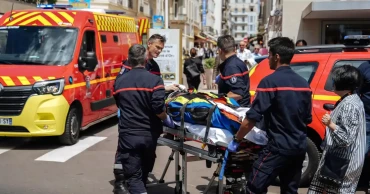
Palm tree falls on a person at Cannes Film Festival
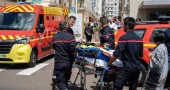
A palm tree fell on a man at the Cannes Film Festival who was walking along the Croisette on Saturday in the seaside French town.
Authorities sped through festivalgoers to tend to the person who laid injured and bleeding on the sidewalk. No information was immediately available on their condition.
Trump and US administration used power for massacre in Gaza: Ayatollah Khamenei
Representatives for the festival didn't immediately respond to requests for comment.
The incident happened midday at the festival. Cannes, which runs until May 24, is about halfway through.
Poland votes for a new president Sunday as worries grow about the future
1 year ago
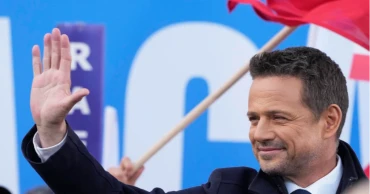
Poland votes for a new president Sunday as worries grow about the future
With war raging next door in Ukraine, rising migration pressure on its borders, Russian sabotage in the region, and growing uncertainty over the United States' long-term commitment to European security, Poland heads to the polls Sunday for a pivotal presidential election.
Voters will not only be choosing a new head of state, but also weighing in on the strength of Poland's democracy and its role within the European Union. A key responsibility for the next president will be preserving close ties with the U.S., seen by many as vital to Poland’s stability in an increasingly turbulent geopolitical environment.
Crowded Field Points to Likely Runoff
The election is taking place in a Central European nation of 38 million, as conservative incumbent Andrzej Duda prepares to leave office at the end of his second and final five-year term in August.
With 13 candidates in the running, a clear winner in the first round appears unlikely. Some contenders have drawn criticism for extreme or unserious positions, including openly pro-Putin or antisemitic rhetoric. A recent televised debate lasted nearly four hours, prompting calls for stricter rules to enter the race.
Polls suggest a likely runoff on June 1 between two frontrunners: Rafał Trzaskowski, the liberal mayor of Warsaw, and Karol Nawrocki, a conservative historian backed by the Law and Justice party, which ruled Poland from 2015 to 2023.
A nation at the front line
Poland’s geography gives the election added importance. Bordering Russia’s Kaliningrad exclave, Belarus and war-torn Ukraine — as well as several Western allies — Poland occupies a critical position along NATO’s eastern flank and serves as a key logistics hub for military aid to Ukraine.
There are growing fears that if Russia prevails in its full-scale invasion of Ukraine, it could target other countries that freed themselves from Moscow’s control some 35 years ago. Against that backdrop, the election will shape Warsaw’s foreign policy at a moment of mounting strain on trans-Atlantic unity and European defense.
Both leading candidates support continued U.S. military engagement in Europe. Trzaskowski puts greater emphasis on deepening ties with the European Union, while Nawrocki is more skeptical of Brussels and promotes a nationalist agenda.
When Law and Justice held power, it repeatedly clashed with EU institutions over judicial independence, media freedom and migration.
Why the presidency matters
While Poland is a parliamentary democracy, the presidency wields significant influence. The president serves as commander-in-chief of the armed forces, holds veto power, shapes foreign policy and plays a symbolic role in national discourse.
Under Duda, the office largely advanced the conservative agenda of Law and Justice. Since Prime Minister Donald Tusk’s centrist coalition came to power in late 2023, Duda has blocked key reforms aimed at restoring judicial independence and repairing relations with the EU.
India cuts ties with Turkey amid growing boycott calls over Pakistan row
“The stakes are enormous for the ruling coalition and for those concerned with the future of Polish democracy,” said Jacek Kucharczyk, president of the Institute of Public Affairs, a Warsaw think tank. “This is about democratic reform and restoring the rule of law — and that can only happen with cooperation from the next president.”
The election is also pivotal for Law and Justice, Kucharczyk noted: “Its future as a dominant political force may hinge on the outcome.”
Two visions for Poland
Both Trzaskowski and Nawrocki have pledged to support Ukraine and maintain strong defense ties, but their visions for Poland diverge sharply on the role of the EU and domestic social policy.
Trzaskowski, 52, is a former presidential contender and a senior figure in Civic Platform, the centrist party led by Tusk. He is running on a pro-European platform and has pledged to defend judicial independence and rebuild democratic institutions.
Supporters describe him as a modernizer who represents a cosmopolitan, outward-facing Poland. He speaks foreign languages, has marched in LGBTQ+ parades and appeals to younger, urban voters. Trzaskowski’s progressive views highlight an evolution of the once more conservative Civic Platform.
Nawrocki, 42, represents how the party backing him, Law and Justice, is turning further to the right as support for the hard right grows.
Nawrocki, who is not a Law and Justice party member, heads the state-backed Institute of National Remembrance, which investigates Nazi and communist-era crimes. He has drawn praise from conservatives for dismantling Soviet monuments and promoting patriotic education, but he faces criticism for inexperience and playing on anti-German and other resentments. He has also been embroiled in some scandals.
Earlier this month, Nawrocki met with U.S. President Donald Trump at the White House — a symbolic moment welcomed by Law and Justice-friendly media as proof that he would be the best man for keeping the relationship with the United States strong. Critics viewed it as interference by Trump’s administration.
This week Nawrocki was joined on the campaign trail by Romanian nationalist George Simion, who faces a runoff vote for the presidency on Sunday. Simion is viewed by critics as pro-Russian, leading Tusk to tweet: “Russia is pleased. Nawrocki and his pro-Russian Romanian counterpart George Simion on the same stage five days before the presidential elections in Poland and Romania. Everything is clear.“
1 year ago
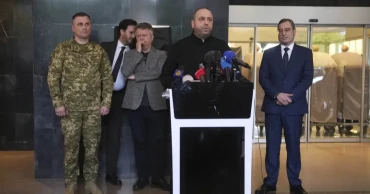
A Russian drone strike in northeastern Ukraine kills 9 people, officials say
A Russian drone attack on a passenger bus in Ukraine’s northeastern Sumy region on Saturday killed nine people and wounded four others, according to Ukrainian officials. The strike occurred just hours after Moscow and Kyiv held their first direct peace talks in years, which ended without a ceasefire agreement.
Ukraine’s national police shared images of the scene in Bilopillia, a city located about 10 kilometers (6 miles) from the Russian border and near the front line.
The Associated Press was unable to independently confirm the details of the incident, and there has been no official response from Moscow.
“This is another war crime by Russia — a deliberate strike on civilian transport that posed no threat,” the Sumy regional administration said in a post on the Telegram messaging app.
A period of mourning has been declared in Bilopillia from Saturday through Monday. with local community chief Yurii Zarko calling the day of the attack “Black Saturday.”
The local media outlet Suspilne said the passengers on the bus were being evacuated from Bilopillia when the strike occurred. Authorities are working to identify some of the victims, most of them elderly women. The injured were taken to a hospital in Sumy, the regional capital.
It wasn’t immediately clear how the strike would affect peace efforts.
On Friday, Russian and Ukrainian officials met in Turkey in an attempt to reach a temporary ceasefire, but the talks ended after less than two hours without a breakthrough. It was the first face-to-face dialogue between the two sides since the early weeks of Moscow’s February 2022 full-scale invasion of Ukraine.
And while both sides agreed on a large prisoner swap, they clearly remained far apart on key conditions for ending the fighting.
One such condition for Ukraine, backed by its Western allies, is a temporary ceasefire as a first step toward a peaceful settlement. The Kremlin has pushed back against such a truce, which remains elusive.
Ukrainian President Volodymyr Zelenskyy said he discussed the talks with U.S. President Donald Trump and the leaders of France, Germany, the U.K. and Poland. In a post on X from a European leadership meeting in Albania, he urged “tough sanctions” against Moscow if it rejects “a full and unconditional ceasefire and an end to killings.”
Kyiv and Moscow agreed in Istanbul to exchange 1,000 prisoners of war each, according to the heads of both delegations, in what would be their biggest such swap. Both sides also discussed a ceasefire and a meeting between their heads of state, according to chief Ukrainian delegate, Defense Minister Rustem Umerov.
Medinsky, an aide to President Vladimir Putin, said both sides also agreed to provide each other with detailed ceasefire proposals, with Ukraine requesting the heads of state meeting, which Russia took under consideration.
Police probe theft of Melania Trump statue in her Slovenian hometown
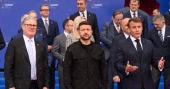
Zelenskyy was in Tirana, Albania, on Friday, meeting with leaders of 47 European countries to discuss security, defense and democratic standards against the backdrop of the war.
He met with French President Emmanuel Macron, German Chancellor Friedrich Merz, U.K. Prime Minister Keir Starmer and Polish Prime Minister Donald Tusk.
“Pressure on Russia must be maintained until Russia is ready to end the war,” Zelenskyy said on X, posting a photo of the leaders during the call, the second for the group since May 10.
1 year ago
Ukraine-Russia political theatrics underscore stark realities on the ground as war grinds on
Since U.S.-mediated negotiations began in March, Ukraine has focused on persuading the Trump administration that Vladimir Putin is untrustworthy and that Kyiv is genuinely committed to achieving peace.
According to analysts and officials, Ukrainian President Volodymyr Zelenskyy has limited options. His main strategy involves trying to provoke U.S. President Donald Trump’s frustration with Putin while relying on strong and unified backing from European allies.
In the most recent developments, Zelenskyy not only agreed to Putin’s proposal for direct talks in Turkey—an idea supported by the U.S.—but also intensified the situation by publicly challenging the Russian president to a face-to-face meeting. However, the move did not sway Putin. The talks in Istanbul were downgraded to a technical session on Friday, which produced no significant progress toward ending the conflict.
The U.S. has expressed frustration with the stalled talks and threatened to withdraw if results aren’t achieved. On Friday, Trump told reporters after boarding Air Force One to return to Washington from Abu Dhabi that he may call Putin soon.
“He and I will meet, and I think we’ll solve it, or maybe not,” Trump said. “At least we’ll know. And if we don’t solve it, it’ll be very interesting.”
All along, Zelenskyy’s message, directed at the Trump administration, has been: The Russian leader cannot be trusted.
It’s a rhetorical game of pingpong in which both Kyiv and Moscow try to outmaneuver the other vis-à-vis the U.S. But the political theatrics are underscored by stark realities on the ground. In this war of attrition against Russia’s invasion, Ukraine’s position is poised to grow weaker as time goes on, unless powerful sanctions are imposed against Moscow and the U.S. continues arms deliveries.
“He is in a difficult situation because behind him is a whole nation of people who are suffering,” said Oleksandr Merezkho, a lawmaker in Zelenskyy’s party. “We are playing (along), we are trying to do everything we can because we don’t want to lose the support of the U.S. We don’t want to be accused that it was our fault.”
Putin’s no-show did not result in a strong reaction from Trump, which frustrated Ukrainian officials.
“It looks surreal, weird when Ukraine is complying to everything required from us, and Putin ignores, rejects,” said Merezhko. “It looks very imbalanced, it looks unfair for Ukraine.”
Ukraine hopes for sanctions, while Russia stalls
Since March, Zelenskyy has made a point of showing Ukraine’s willingness to acquiesce to U.S. demands to avoid alienating Trump, his most powerful ally.
Kyiv hoped Russia’s unwillingness to do the same would, in time, provoke the U.S. to unleash powerful sanctions and cripple Moscow’s war machine — the most likely scenario in which Ukraine can hope to weaken Russia and negotiate an advantageous peace deal, analysts said.
Russia’s position has remained mostly consistent. The Kremlin kept repeating that it was ready for peace talks with Ukraine — while making demands that were politically untenable for Zelenskyy, and would require Ukraine to make territorial concessions, neutralize its army and vow never to join NATO.
Throughout the war, Moscow has also accused Kyiv and its Western allies of seeking to prolong the fighting and derailing peace efforts.
Most recently, the Kremlin pushed back against a proposed 30-day ceasefire, countering with two brief unilateral ones, and then accused Ukraine of failing to stop the fighting, painting it as unwilling to silence the guns. At the same time, Russian officials underscore the effort to resolve the conflict is complex.
“We understand that Washington wants to achieve quick success in this process, but at the same time we hope that there is an understanding that the settlement of the Ukrainian crisis is too complicated, there are many questions and details that need to be addressed before the settlement,” Kremlin spokesman Dmitry Peskov told reporters last month.
Police probe theft of Melania Trump statue in her Slovenian hometown
Ukraine is asking for an unconditional temporary ceasefire, during which time future diplomatic talks can take shape. Zelenskyy also asked for a trust-building gesture, such as the release of prisoners of war, something the two sides agreed to Friday. The exchange of 1,000 prisoners would be their largest swap yet.
But Ukraine has also maintained flexibility in its negotiating position by accepting Trump’s proposals to avoid alienating the U.S. president.
“They’re desperate to keep the Americans on their side,” said Balazs Jarabik, an analyst specializing in Eastern Europe and Ukraine.
In March, Kyiv agreed to the U.S. proposal for an immediate 30-day ceasefire, which Putin effectively rejected by imposing conditions impossible for Ukraine. In April, Kyiv signed a landmark minerals deal sought by Trump after months of fraught negotiations and a brief pause in military aid.
That is why agreeing to send a delegation to Istanbul, after Trump supported the idea, was a risky move for Zelenskyy. It played into Putin’s aim of drawing Kyiv into talks that had been stalled since the early weeks of Moscow’s 2022 invasion.
“We showed that we are for peace negotiations and support Trump’s plan,” said Mykola Davydiuk, a Ukrainian political scientist. “Now the ball is with Trump.”
Despite verbal threats from Europe and the U.S., sanctions of the kind that could devastate Russia’s energy sector have not been forthcoming.
Zelenskyy has expressed support for a sanctions package pushed in the U.S. Congress by Republican Sen. Lindsay Graham that could impose 500% tariffs on Russian energy imports. Graham has said he has enough support in the House to bring the sanctions bill to the floor.
Russia likely gearing up for summer fighting campaign
For now, Zelenskyy has few options but to continue to highlight Putin’s disinclination to engage in meaningful talks and keep the U.S. engaged.
“If it turns out that the Russian delegation really is just theatrical and can’t deliver any results today, the world must respond,” the Ukrainian leader said at a European summit in Albania on Friday. “There needs to be a strong reaction, including sanctions against Russia’s energy sector and banks. Pressure must continue to rise until real progress is made.”
For Ukrainian soldiers fighting along the 1,000-kilometer (600-mile) front line the theatricality of the week’s political developments stood in harsh contrast with the grinding war.
“Better to call it a circus,” said a Ukrainian drone operator with the 68th brigade who, like other soldiers, gave only his call sign Goose in line with military protocol.
1 year ago
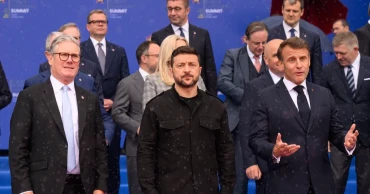
Ukraine urges EU to hit Russia hard over truce delays
Ukrainian President Volodymyr Zelenskyy said Friday that his country is committed to ending the war with Russia but he urged dozens of European leaders to ramp up sanctions if President Vladimir Putin continues to play for time in talks aimed at securing a truce.
Russia and Ukraine were holding their first direct peace talks in three years, in the Turkish port city of Istanbul, but officials and observers expected them to yield little immediate progress on stopping the more than three-year war, AP reports.
Russia-Ukraine war is top of the agenda as European leaders meet in Albania on security concerns
“Ukraine is ready to take all realistic steps to end this war,” Zelenskyy told leaders gathered for a summit of the European Political Community. But he warned: “If it turns out that the Russian delegation really is just theatrical and can’t deliver any results today, the world must respond.”
That reaction, he said, should include "sanctions against Russia’s energy sector and banks.”
British Prime Minister Keir Starmer backed his call, saying in a summit speech that “Russia is dragging its feet and playing games.”
“We must be prepared to follow through because if Russia won’t come to the negotiating table, Putin must pay the price,” he said, at the summit in the Albanian capital, Tirana.
Zelenskyy's remarks came after Putin declined to attend face-to-face talks.
“I think Putin made a mistake by sending a low level delegation,” NATO Secretary-General Mark Rutte said as he arrived for the summit under a steady drizzle. “The ball is clearly in his part of the field now, in his court. He has to play ball. He has to be serious about wanting peace," Rutte added.
European Union foreign chief Kaja Kallas said Putin was “playing games, which shows that they are not serious about peace.”
European Commission President Ursula von der Leyen said it was clear that “President Zelenskyy was ready to meet but President Putin never showed up, and this shows his true belief. So we will increase the pressure.”
Von der Leyen said the EU is preparing a new package of sanctions. She said that the measures will target the shadow fleet of aging cargo vessels that Russia is using to bypass international sanctions and the Nord Stream pipeline consortium.
Russia’s financial sector would also be targeted, she said. EU envoys have been working on the new sanctions package for several weeks, and the bloc’s foreign ministers could enact them as soon as Tuesday.
Delegations from Russia and Ukraine are set to hold their first peace talks in 3 years
Italian Premier Giorgia Meloni stressed that efforts to reach a deal on Ukraine must continue.
“I think ... that we must not throw in the towel. I think we must insist, we must insist for an unconditional ceasefire and a serious peace agreement that includes guarantees of security for Ukraine,” she said.
1 year ago
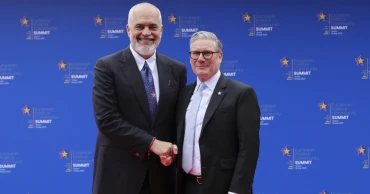
Russia-Ukraine war is top of the agenda as European leaders meet in Albania on security concerns
Ukrainian President Volodymyr Zelenskyy joined the leaders of dozens of European countries and organizations for a one-day summit in Albania's capital Friday to discuss security and defense challenges across the continent, with Russia's full-scale invasion of Ukraine at the top of the agenda.
On the eve of the summit in Tirana, Russian President Vladimir Putin spurned an offer by Zelenskyy to meet face-to-face in Turkey to try to secure a ceasefire with Moscow, sending a low-level delegation instead.
European leaders criticize Putin's decision not to met Zelenskyy
“I think Putin made a mistake by sending a low level delegation,” NATO Secretary-General Mark Rutte said as he arrived for the summit under a steady drizzle. “The ball is clearly in his part of the field now, in his court. He has to play ball. He has to be serious about wanting peace. So I think all the pressure is now on Putin,” Rutte added.
Zelenskyy did not make any comments as he arrived for the summit, walking with Albanian Prime Minister Edi Rama along the red carpet past the gathered media.
European Union foreign chief Kaja Kallas said Putin was “playing games, which shows that they are not serious about peace.”
European Commission President Ursula von der Leyen said it was clear that “President Zelenskyy was ready to meet but President Putin never showed up, and this shows his true belief. So we will increase the pressure.”
Von der Leyen said the EU is preparing a new package of sanctions. She said that the measures will target the shadow fleet of aging cargo vessels that Russia is using to bypass international sanctions and the Nord Stream pipeline consortium.
Russia’s financial sector would also be targeted, she said. EU envoys have been working on the new sanctions package for several weeks, and the bloc’s foreign ministers could enact them as soon as Tuesday.
Italian Premier Giorgia Meloni stressed that efforts to reach a deal on Ukraine must continue.
Delegations from Russia and Ukraine are set to hold their first peace talks in 3 years
“I think ... that we must not throw in the towel. I think we must insist, we must insist for an unconditional ceasefire and a serious peace agreement that includes guarantees of security for Ukraine,” she said.
The spurning of the offer for direct talks with Zelenskyy “is clear evidence that Putin doesn’t seriously want peace. He’s dragging his heels,” said U.K. Prime Minister Keir Starmer. “And that’s why today is a really important opportunity, to work with colleagues to make sure that we are absolutely united.”
Summit a chance for bilateral meetings
The theme of the European Political Community, or EPC, summit in Tirana is “New Europe in a new world: unity — cooperation — joint action.” The gathering of leaders from about 50 nations and organizations will also address ways to improve the continent’s competitiveness and tackle unauthorized migration.
But the EPC will also be a setting for leaders to meet bilaterally, or in small groups, to weigh in on major security issues. The inaugural summit in Prague in 2022 saw the leaders of Azerbaijan and Armenia holding rare talks in an effort to ease tensions between the longtime adversaries.
Last weekend, Zelenskyy hosted French President Emmanuel Macron, Starmer, German Chancellor Friedrich Merz and Polish Prime Minister Donald Tusk in Kyiv, where they made a joint call for a 30-day end to hostilities.
“As Russia’s war of aggression against Ukraine continues, its consequences stretch far beyond Ukraine’s borders, straining our security and testing our collective resilience,” Albania's Rama and European Council President António Costa wrote in their EPC summit invitation letter.
The last summit, hosted by Hungarian Prime Minister Viktor Orbán, an ardent supporter of U.S. President Donald Trump, was dominated by the concerns and opportunities that might arise in the wake of Trump's reelection.
The leaders arrived in Tirana’s central Skanderbeg Square on a rainy morning and were to be greeted by a brief performance by dancers in folk costumes before heading into the temporary conference hall, set up at the foot of a monument to Albania's national hero Gjergj Kastrioti Skenderbeu, or Skanderbeg, who fought against the Ottoman Empire.
Albania hosts a major summit days after election
Rama's governing Socialist Party won Albania’s May 11 parliamentary election, attracting voters who support the country’s long and somewhat uphill effort to join the European Union. The vote secured a fourth term for Rama.
The prime minister said that the summit is a point of pride for Albania, and an “inspiration and motivation to continue further on.”
His Socialist Party says it can deliver EU membership in five years.
The EPC forum is Macron's brainchild, and was backed by former German Chancellor Olaf Scholz, aiming to boost security and prosperity across the continent. But critics claimed it was an attempt by them to put the brakes on EU enlargement.
The 2022 inaugural summit involved the EU's 27 member countries, aspiring partners in the Balkans and Eastern Europe, as well as neighbors like the U.K. — the only country to have left the EU — and Turkey.
Russia is the one major European power not invited, along with Belarus, its neighbor and supporter in the war with Ukraine.
The next EPC meeting will take place in Denmark later this year.
54 people killed in overnight airstrikes on southern Gaza city amid Trump's Mideast trip
1 year ago
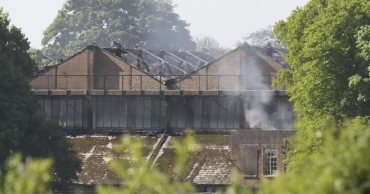
Fire at a former UK military base kills 2 firefighters and a civilian
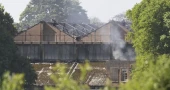
Two firefighters and a civilian were killed in a blaze at a former British military base that is now used to commemorate the history of aviation and motor sports, officials said Friday.
The fire broke out Thursday in a large warehouse at the former Royal Air Force base in Bicester, near Oxford. Giant plumes of smoke could be seen for miles and witnesses reported hearing explosions.
Leaders of ICAB, ICAEW meet in UK
Two other firefighters were hospitalized with serious injuries, Oxfordshire County Council said.
Crews had the fire under control Friday morning but remained at the scene.
UK becomes fastest-growing G7 economy after strong first quarter
1 year ago