europe
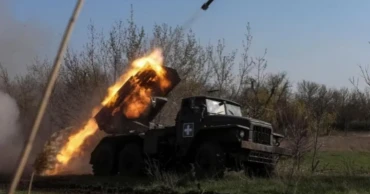
Trump says Zelenskyy is prolonging war in Ukraine by resisting calls to cede Crimea to Russia
President Donald Trump on Wednesday sharply criticized Ukrainian President Volodymyr Zelenskyy, accusing him of prolonging the violence by refusing to consider territorial concessions, particularly Crimea, in ongoing peace discussions with Russia.
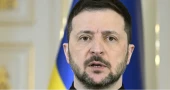
Zelenskyy, speaking a day earlier, firmly rejected the idea of giving up any Ukrainian land as part of a deal. “There is nothing to negotiate — this is our land, the land of the Ukrainian people,” he stated ahead of planned talks in London involving U.S., European, and Ukrainian representatives.
In previous negotiations held in Paris last week, U.S. officials reportedly floated a peace proposal that would allow Russia to retain control of some occupied Ukrainian territories, according to a European source with knowledge of the discussions. The source, who spoke anonymously due to not being authorized to speak publicly, shared the controversial detail.
Trump called Zelenkyy’s pushback “very harmful” to talks.
“Nobody is asking Zelenskyy to recognize Crimea as Russian Territory but, if he wants Crimea, why didn’t they fight for it eleven years ago when it was handed over to Russia without a shot being fired?” he wrote on social media.
Russia annexed Crimea in 2014 after sending troops to overrun it. Weeks later, Moscow-backed separatists launched an uprising in eastern Ukraine, battling Kyiv’s forces.
Trump also asserted they were close to a deal and that Ukraine’s leader can have peace or “he can fight for another three years before losing the whole Country,” adding that Zelenskyy’s statement “will do nothing but prolong the ‘killing field,’ and nobody wants that!”
‘A very fair proposal’
Wednesday’s meeting was pared back at the last minute, while Vice President JD Vance said negotiations are reaching a moment of truth.
“We’ve issued a very explicit proposal to both the Russians and the Ukrainians, and it’s time for them to either say ‘yes’ or for the United States to walk away from this process,” Vance told reporters during a visit to India.
He said it was “a very fair proposal” that would “freeze the territorial lines at some level close to where they are today,” with both sides having to give up some territory they currently hold. He did not provide details.
Trump, who is set to travel to Rome for Pope Francis’s funeral on Saturday, told reporters later on Wednesday that he did not know if he would meet with Zelenskyy or other European leaders to discuss the war while in Italy. He also said that has found dealing with Zelenskyy harder than dealing with the Russians.
Trump who is set to travel to the Middle East next month said it was “possible” that he could meet with Putin while in Saudi Arabia, but that it is more likely he will meet with the Russian leader soon after that trip.
A senior European official familiar with the ongoing talks involving the American team said a proposal the United States calls “final” was initially presented last week in Paris, where it was described as “just ideas” — and that they could be changed.
When those “ideas” surfaced in media reports, Ukrainian officials were surprised to find that Washington portrayed them as final, according to the official, who was not authorized to comment publicly and spoke on condition of anonymity.
Zelenskyy said Wednesday that Ukraine is ready for any format of negotiations that might bring a ceasefire and open the door to full peace negotiations, as he mourned nine civilians killed when a Russian drone struck a bus earlier in the day.
“We insist on an immediate, complete and unconditional ceasefire,” Zelenskyy wrote on social media, in accordance with a proposal he said the U.S. tabled six weeks ago.
Ukraine and some Western European governments have accused Russian President Vladimir Putin of dragging his feet on that proposal as his army tries to capture more Ukrainian land. Western analysts say Moscow is in no rush to conclude peace talks because it has battlefield momentum.
Doubts over negotiations
U.K. Foreign Secretary David Lammy said the talks in London to find an end to the more than three-year war would involve only lower-ranking officials, after the U.S. State Department said Tuesday that Secretary of State Marco Rubio was unable to attend because of a scheduling issue.
Rubio’s abrupt cancellation raised doubts about the direction of negotiations. He had indicated that Wednesday’s meeting could be decisive in determining whether the Trump administration remains engaged.
1 year ago
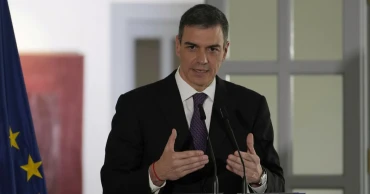
Spain to meet NATO's defence spending goal of 2% of GDP this year
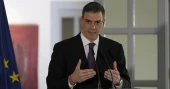
Spain will meet NATO's defence spending target this year, Spanish Prime Minister Pedro Sánchez said Tuesday, as pressure grows on the eurozone's fourth-largest economy to boost its military expenditure.
Sánchez said the government will raise defence spending by 10.5 billion euros ($12 billion) to reach NATO's target of 2% of GDP, AP reports.
The spending will go toward telecommunications, cybersecurity and buying military equipment, he said, as well as raising salaries and adding troops.
Spain spent the least of all NATO members last year on defence as a share of GDP. It previously committed to reaching the 2% target by 2029. But it has come under pressure for not spending enough amid a widening chasm in the transatlantic alliance as the Trump administration says its security priorities lie elsewhere.
US President Donald Trump has repeatedly taken European allies to task for not spending enough on their own defence and has pushed NATO allies to raise defence spending to as much as 5% of GDP.
Trump’s tariffs and uncertainty dampen US, global economic prospects: IMF
Facing what he called a “changing era," Sánchez said it was time for Spain to “take control of our own destiny” and contribute to Europe's rearmament.
“If you asked me years ago about my government's investment priorities in security and defence, it's obvious my response would have been different,” Sánchez said. “That's not because our values have changed ... it's because the world has.”
The Socialist leader heads a minority government with hard-left coalition partners that oppose defence and military increases. Sánchez said his plan to boost defence spending would not go through Parliament.
1 year ago
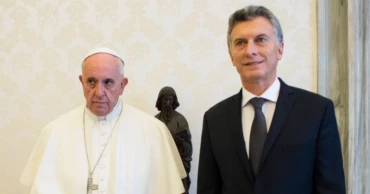
Pope Francis was source of controversy and spiritual guidance in his Argentine homeland
As candles flickered in the church where he first felt the call to priesthood, and crowds gathered at the cathedral he once led, Argentines across the country mourned the passing of Pope Francis — a native son whose life and legacy sparked both deep admiration and controversy.
Jorge Mario Bergoglio, who became the first Latin American pope in 2013, died Monday at the age of 88. In his homeland, the news prompted an outpouring of grief, especially in the poorer neighborhoods of Buenos Aires where he had earned the affectionate nickname “the slum bishop.”
Vance and Modi meet in New Delhi to discuss trade deal and avoid US tariffs
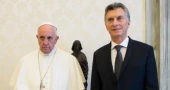
While beloved by many for his commitment to the marginalized and his calls for social justice, Francis also drew sharp criticism from conservative voices who saw his close ties with Argentina’s populist left as politically divisive. His warm relationship with former President Cristina Fernández de Kirchner, a figure widely blamed for the country’s economic woes, stood in stark contrast to his brief and frosty 2016 meeting with her center-right successor, Mauricio Macri.
“He was rebellious like most Argentines,” said Catalina Favaro, 23, who came to pay her respects at the Buenos Aires cathedral. “Yes, he was contradictory, but that made him human.”
On Monday, Kirchner praised their connection, calling Francis “the face of a more humane church,” while Macri remembered him as “a stern politician” but ultimately “a good pastor.”
A Champion of the Poor
At a morning Mass in the capital, Archbishop Jorge Ignacio García Cuerva honored Francis’ devotion to those living on society’s margins. “The pope of the poor, of the excluded, of those forgotten, has passed away,” he said. “He was the pope we didn't always understand, but whom we loved.”
Dialogue calls for stronger research, policy integration to build greener, resilient South Asia
Despite traveling extensively throughout the world — including visits to neighboring Latin American nations — Francis never returned to Argentina after becoming pope. Many believed his absence was a conscious choice to avoid the deep political divides at home, a theory reinforced by his fraught relationship with current libertarian President Javier Milei, who once publicly derided him as “the representative of evil.”
Although the two appeared to reconcile during a Vatican meeting in 2024, tensions flared again when Francis criticized Milei’s harsh austerity measures. “Instead of paying for social justice, they paid for pepper spray,” he said, after police clashed with elderly pension protesters.
Still, Milei offered condolences following the pope’s death, noting, “Despite differences that seem minor today, knowing him in his kindness and wisdom was a true honor.”
Tributes and Turmoil
As Masses were held throughout the country, emotions ran high — especially during a large open-air service near the church where Francis first heard his calling. The scene turned chaotic when Vice President Victoria Villarruel, a polarizing figure with ties to Argentina’s former dictatorship, attempted to pass through the crowd and was met with jeers, shoving, and chants of “Get her away from here!”
Despite the unrest, heartfelt tributes poured in from those in neighborhoods where Francis left a lasting mark. In Villa 21-24, one of Buenos Aires’ most impoverished districts, residents recalled his regular visits — sharing maté with recovering addicts and leading barefoot processions through the streets. His influence helped transform their modest church into a thriving community hub.
“He was the most humble person in all of Buenos Aires,” said Sara Benitez Fernandez, a longtime parishioner. “He never used a car. He took the subway. He walked like the rest of us. We’ll never see another pope like him.”
Legacy of Compassion
In the Flores district, just blocks from his childhood home, mourners gathered at the Basilica of San Jose de Flores — the very place where a 16-year-old Bergoglio felt his divine calling. “He was a father to us,” said Gabriela Lucero, 66. “His greatest teaching was that the church doors stay open to everyone.”
For the priests continuing Francis’ mission in Argentina’s poorest neighborhoods, his death was both a profound loss and a renewed call to serve. “It’s a day of pain,” said Rev. Lorenzo de Vedia, better known as Padre Toto. “But we’re not stopping. We’ll keep his spirit alive. His mission is now ours.”
With national flags flying at half-staff and a week of mourning declared, Argentina bids farewell to a complex and deeply influential figure — a pope who never returned home, yet never left his people behind.
1 year ago
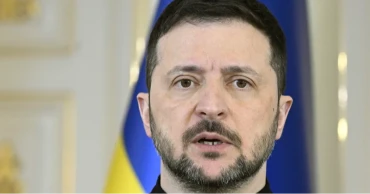
Zelenskyy says Russia is trying to create an ‘impression of a ceasefire’ as attacks continue
Ukrainian President Volodymyr Zelenskyy has accused Russia of staging a false impression of an Easter ceasefire, despite continued military aggression across the front line. Speaking on Sunday, Zelenskyy said Russian forces were still launching attacks even after President Vladimir Putin had publicly announced a unilateral truce for the holiday.
"On Easter morning, it's clear the Russian army is trying to project an image of a ceasefire," Zelenskyy posted on X. "But in reality, they continue attempts to advance and inflict losses."
Ukrainian forces recorded at least 59 shelling incidents and five assaults by Russian units, along with dozens of drone strikes, all taking place after Putin’s ceasefire declaration. Zelenskyy added that, although Ukraine reciprocated the ceasefire gesture, Russia has ramped up the use of heavy weaponry. He did, however, note that Easter morning passed without air raid sirens—an unusual and welcome pause.
In one particularly deadly incident, several Ukrainian troops were killed in an ambush in the Donetsk region. Zelenskyy vowed that the Russian soldiers responsible would be “eliminated.”
Russia's Defense Ministry, meanwhile, claimed Ukrainian forces launched overnight attacks in the Donetsk area and flew 48 drones into Russian territory, causing civilian casualties. The ministry insisted Russian troops were fully observing the ceasefire.
In Kherson, a Russian-occupied region in southern Ukraine, Moscow-installed officials also accused Ukraine of continuing attacks.
Zelenskyy says Putin's vow on Ukraine's energy infrastructure unrealistic
Zelenskyy called for Russia to honor the ceasefire in full and reiterated Ukraine’s offer to extend the truce for an additional 30 days beyond its scheduled end at midnight Sunday. According to Ukrainian Foreign Minister Andrii Sybiha, there has been no response from Moscow.
“Either Putin lacks control over his army, or Russia simply doesn’t intend to end the war,” Zelenskyy said. “This is just a PR stunt.”
Just hours after announcing the ceasefire, President Putin attended an Easter service in Moscow at the Cathedral of Christ the Saviour, led by Patriarch Kirill—a vocal supporter of the war.
Putin gave no specifics on how the ceasefire would be enforced, nor whether it included airstrikes or ground operations.
His announcement came shortly after U.S. President Donald Trump commented that peace talks between Ukraine and Russia are “coming to a head,” and said both sides were taking negotiations seriously.
The U.S. State Department on Sunday reaffirmed its support for “a full and comprehensive ceasefire.” Officials highlighted recent peace discussions in Paris and confirmed that Secretary of State Marco Rubio shared encouraging developments in a call with Russian Foreign Minister Sergey Lavrov.
1 year ago
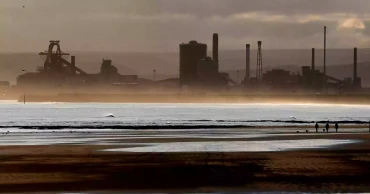
UK Parliament holds emergency session to save British Steel
British lawmakers returned to Parliament on Saturday during their Easter recess to approve an emergency intervention aimed at saving the nation’s last factory that still produces steel from raw materials.
Prime Minister Keir Starmer convened the rare Saturday session to discuss a bill designed to prevent British Steel’s Chinese owners, Jingye Group, from shutting down the blast furnaces at its Scunthorpe site in northern England.
If, as expected, the legislation is approved, Business Secretary Jonathan Reynolds will be authorised to oversee the company’s board and workforce, ensure staff are paid, and secure the raw materials needed to keep the two giant blast furnaces operational.
On Friday, Starmer stated that the plant’s future was “hanging in the balance,” prompting the urgent legislation and the extraordinary recall of Parliament.
While he did not explicitly mention “nationalisation,” Starmer said all options remain under consideration for the steelworks, which directly employs around 2,700 people.
The move to introduce emergency legislation became more pressing after Jingye recently halted orders for iron pellets required for the blast furnaces. Without those pellets and other essential raw materials, the furnaces could be forced to shut down permanently within days.
It remains unclear what involvement Jingye, which has owned British Steel since 2020, will retain in the plant’s daily operations once the bill becomes law.
Jingye has argued that the Scunthorpe plant is no longer financially viable due to “challenging market conditions” and rising environmental costs. The company had been seeking government support for months, but negotiations have so far failed to yield a deal. The situation was further complicated by last month’s decision by U.S. President Donald Trump to impose a 25% tariff on imported steel.
Although Starmer expressed disappointment over the tariff decision, he has not taken retaliatory measures and is instead pursuing negotiations to have the tariffs lifted.
Trade unions have welcomed the government’s intervention and expressed hope that it might eventually lead to public ownership of the plant.
“It is in the national interest to find a solution that secures the future of British Steel as a critical strategic industry,” said Roy Rickhuss, general secretary of the Community union. “We must not allow the UK to become the only G7 country without primary steelmaking capacity.”
British steel production was once a global powerhouse, employing over 300,000 workers during the post-war era, before lower-cost imports from China and elsewhere eroded its dominance. The sector now employs roughly 40,000 people and contributes only 0.1% to the UK economy.
The remaining steel producers in the UK are under increasing pressure to cut carbon emissions. Most have adopted electric arc furnaces using recycled materials, leaving Scunthorpe as the sole plant with blast furnaces capable of producing virgin steel from iron ore.
“The steel industry is part of our national story,” Starmer said.
The last time Parliament was recalled during a recess for a Saturday session was in 1982, following Argentina’s invasion of the Falkland Islands in the South Atlantic.
1 year ago
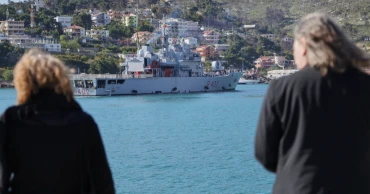
Italy sends rejected migrants to detention centres in Albania
Italian authorities on Friday transferred 40 migrants with no permission to remain in the country to Italian-run migration detention centres in Albania.
It was the first time a European Union country sent rejected migrants to a nation outside the EU that is neither their own nor a country they had transited on their journey, migration experts said, AP reports.
A military ship with the migrants departed the Italian port of Brindisi and arrived hours later in the Albanian port of Shengjin, about 65 kilometres (40 miles) northeast of the capital, Tirana. The migrants were seen being transferred in buses and minivans under heavy security to an Italian-run centre in Shengjin, where they will be processed before being transferred to a second centre in Gjader, also run by Italian authorities.
The Italian government has not released their nationalities or further details.
China, ASEAN media and think tanks urged to embrace AI, address its challenges
Both facilities in Shengjin and in Gjader were originally built to process asylum requests of people intercepted in the Mediterranean Sea by Italy. But since their inauguration in October, Italian courts have stopped authorities from using them and small groups of migrants sent there have returned to Italy.
Italy’s far-right-led government of Premier Giorgia Meloni approved a decree last month that expanded the use of the Albanian fast-track asylum processing centers to include the detention of rejected asylum-seekers with deportation orders.
It is not clear how long the migrants may be held in Albania. In Italy they can be detained for up to 18 months pending deportation.
Meloni's novel approach to expel the migrants echoes US President Donald Trump’s recent deportations of migrants of various nationalities to Panama. It's also in line with a recent EU Commission proposal that, if passed, would allow EU members to set up so-called “return hubs” abroad.
1 year ago
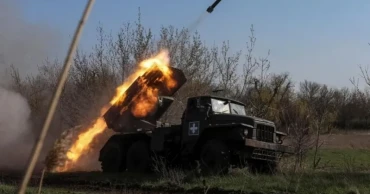
Ukraine’s allies commit €21bn in military support
European allies of Ukraine have announced a fresh military aid package worth €21 billion (£18bn; $24bn), underlining their commitment to supporting Kyiv during what they termed “a critical year” in the ongoing war.
The pledges were made during a meeting of the Ukraine Defence Contact Group (UDCG) at NATO headquarters in Brussels, where ministers from 50 nations gathered to coordinate further assistance.
The summit marked the group’s 27th session and focused heavily on strengthening Ukraine’s air defences, artillery capacity and drone warfare capabilities, BBC reports.
Germany is contributing over half the total with a €11bn commitment spread across four years. German Defence Minister Boris Pistorius said Berlin would deliver a substantial package, including 100,000 artillery shells, 25 infantry fighting vehicles, 15 battle tanks, 100 ground surveillance radars and 120 man-portable air defence systems. Additionally, four IRIS-T air defence systems and 300 associated missiles will be dispatched to Ukraine.
“Ukraine requires robust military capabilities. Only then can negotiations lead to a just and lasting peace,” Pistorius said.
The United Kingdom and Norway also pledged a joint £450 million package to fund radar systems, anti-tank mines, vehicle repairs and an estimated hundreds of thousands of drones. This forms part of the UK's wider £4.5bn military commitment announced earlier this year.
Spanish PM in China to boost ties amid Trump tariffs
UK Defence Secretary John Healey emphasised that drones have transformed the battlefield. “In our assessment, 70 to 80 percent of combat casualties are now caused by drones,” he said, adding that Russia had dropped 10,000 glide bombs and launched up to 100 attack drones daily during the first quarter of 2025.
European leaders framed the new aid as vital to countering any reduction in US involvement amid shifting priorities under Donald Trump. While US Defence Secretary Pete Hegseth joined the meeting remotely, Pistorius clarified that this was due to scheduling conflicts, not diminished interest.
Ukrainian President Volodymyr Zelensky also joined virtually, while Defence Minister Rustem Umerov was present in Brussels. Umerov expressed gratitude to Europe for “assuming leadership on security assistance”.
1 year ago
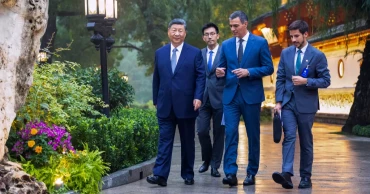
Spanish PM in China to boost ties amid Trump tariffs
Spanish Prime Minister Pedro Sánchez is in China on Friday for his third visit in two years, as his government aims to attract greater investment from the Asian economic powerhouse amid widespread uncertainty caused by the erratic U.S. tariff policy.
Sánchez held talks with Chinese President Xi Jinping and was also scheduled to meet executives from several Chinese firms, many of which specialise in electric battery production and renewable energy technologies.
As Trump imposes tariffs, China moves to fill the void left by alienated US allies
The visit takes place at a sensitive juncture for China and the European Union. Tariffs announced — and subsequently suspended — by U.S. President Donald Trump last week may encourage the EU to increase trade with China, the world’s third-largest consumer market after the U.S. and the EU. At the same time, there is mounting concern within the EU that U.S. tariffs could prompt China to flood the European market with low-cost products, to the detriment of European manufacturers.
The Spanish government has reiterated its intention to strengthen economic relations with China.
“Trade wars benefit no one. We all stand to lose,” Sánchez stated during his visit to Hanoi on Thursday, where he signed several commercial deals before departing for Beijing.
Government spokesperson Pilar Alegría earlier emphasised the significance of the trip, describing it as a key opportunity to “diversify markets,” noting that as much as 80% of Spanish exports to the U.S. could be affected by Trump’s tariff measures.
Warnings from Washington
U.S. Treasury Secretary Scott Bessent criticised Spain’s efforts to draw closer to China, warning on Tuesday that countries aligning themselves with China were effectively “cutting their own throat” due to the likelihood that Chinese manufacturers would attempt to offload unsellable goods into other markets.
However, Spain’s Agriculture Minister Luis Planas, who is accompanying Sánchez, defended the move on Wednesday in Vietnam, stating: “Broadening our trade relations with partners like China does not run counter to anyone’s interests.”
“Every nation must protect its own interests,” Planas added.
Spain Forges Its Own Path in the EU
Spain — the eurozone’s fourth-largest economy and among the fastest growing — has adopted a more conciliatory stance towards China in recent years than many of its EU counterparts. Although Spain initially supported EU tariffs on Chinese electric vehicles last year, citing unfair competitive advantages, it later abstained from voting on those levies.
Planas asserted that Spain’s stance on China is part of a broader European effort to navigate current economic challenges.
“Spain’s position has shifted to be more favourable towards China compared to the average EU country,” said Alicia García-Herrero, a senior economist for Asia Pacific at the French investment bank Natixis and a specialist in EU-China relations.
China reaches out to others as Trump layers on tariffs
Clean Energy and Agricultural Trade
Spain is one of China’s primary pork suppliers, accounting for around 20% of Chinese pork imports, according to Interporc, a Spanish pork producers’ association.
“China is our top market,” said Daniel de Miguel, Interporc’s deputy director.
Spain, which generated 56% of its electricity from renewable sources in 2024, also depends on Chinese supplies of critical raw materials, solar panels, and clean energy technologies, in line with other European nations transitioning from fossil fuels.
In December, Chinese battery maker CATL announced a €4.1 billion ($4.5 billion) joint venture with Stellantis to build a battery plant in northern Spain. That deal followed other agreements between Spain and Chinese companies Envision and Hygreen Energy to develop green hydrogen infrastructure.
Sánchez’s trip had already been planned prior to the Trump administration’s tariff announcements.
Spain, as part of the EU, had initially been hit with a 20% general tariff — now reduced to 10% for most non-Chinese nations for a 90-day period. However, EU countries still face 25% U.S. tariffs on cars, steel, and aluminium.
China, on the other hand, is facing an overall 145% tariff. While Trump stated China would face 125% tariffs on Wednesday, he did not mention an earlier 20% levy linked to the country’s role in fentanyl production.
Sánchez, who has visited China more frequently than the leaders of Germany or Italy, last travelled there in September for discussions with Xi during a period of heightened EU-China trade tensions. Despite increasing Chinese investment, Spain’s trade volume with China remains lower than that of Germany or Italy.
According to García-Herrero of Natixis, Sánchez’s visit also carries political weight, particularly as his left-leaning minority coalition struggles to pass legislation domestically, and as the EU considers mending ties with Beijing.
For Spain, she noted, the goal is “to secure a leadership role within Europe at a time when the transatlantic alliance is not just fragile but disintegrating.”
1 year ago
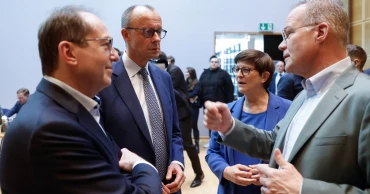
German parties reach a deal to form new government
Conservative and centre-left parties reached a deal to form a new German government on Wednesday after weeks of negotiations. The agreement paves the way for new leadership in Europe’s biggest economy after months of political drift.
Friedrich Merz, the leader of the centre-right Christian Democratic Union, is expected to become Germany’s next leader under the agreement, replacing outgoing Chancellor Olaf Scholz. The parties involved sent an invitation to a news conference on the coalition deal at 3pm. (1300 GMT).
Merz’s two-party Union bloc emerged as the strongest force from Germany’s election on February 23. Merz turned to the Social Democrats, Scholz’s center-left party, to put together a coalition with a parliamentary majority.
It’s still going to be a little while before parliament can elect Merz as chancellor, perhaps in early May. Before that can happen, the coalition deal will need approval in a ballot of the Social Democrats’ membership and by a convention of Merz’s CDU.
Details of the agreement weren’t immediately available.
But already last month, the two sides pushed plans through parliament to enable higher defense spending by loosening strict rules on incurring debt and to set up a huge infrastructure fund that’s aimed at boosting the stagnant economy.
That was an about-turn for Merz, whose party had spoken out against running up new debt before the election without entirely closing the door to future changes to Germany's self-imposed “debt brake.”
Iran’s president pledges no nuclear bomb, invites U.S. investment talks
The election took place seven months earlier than planned after Scholz’s unpopular coalition collapsed in November, three years into a term that was increasingly marred by infighting and widespread discontent.
The market turbulence caused by US President Donald Trump’s announcement of sweeping tariffs added to pressure for Merz’s Union and the Social Democrats to bring their coalition talks to a conclusion.
So have polls showing support for the Union slipping from its election showing and that of the far-right Alternative for Germany, which finished a strong second in February, gaining as the political vacuum persisted.
The prospective new coalition brings together what have been post-World War II Germany’s traditional big parties, but the Union’s election-winning performance in February was lackluster and the Social Democrats dropped to their worst postwar showing in a national parliamentary election.
Together, they have 328 seats in the 630-member lower house of parliament, the Bundestag.
1 year ago
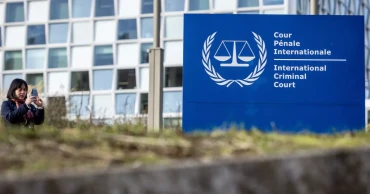
Hungary plans to withdraw from International Criminal Court as Netanyahu arrives despite warrant
Hungary said Thursday it will begin the procedure of withdrawing from the world’s only permanent global tribunal for war crimes and genocide.
“Hungary will withdraw from the International Criminal Court,” Gergely Gulyás, who is Prime Minister Viktor Orbán chief of staff wrote in a brief statement. “The government will initiate the withdrawal procedure on Thursday, in accordance with the constitutional and international legal framework.”
The announcement came as Israeli Prime Minister Benjamin Netanyahu arrived in the Hungarian capital, Budapest, despite an international arrest warrant against him over his conduct of the war in the Gaza Strip.
Israel’s parliament approves key part of Netanyahu’s judicial overhaul
Hungary’s government, led by right-wing populist Orbán, extended the invitation to Netanyahu in November after the ICC, based in the Hague, Netherlands, issued the warrant accusing him of crimes against humanity.
Orbán, a close Netanyahu ally, has called the arrest warrant “outrageously impudent” and “cynical.” Member countries of the ICC, such as Hungary, are required to detain suspects facing a warrant if they set foot on their soil, but the court has no way to enforce that and relies on states to comply with its rulings.
1 year ago