europe

Pope rests with ventilation mask as he battles pneumonia
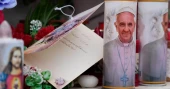
Pope Francis was resting on Wednesday, marking the beginning of the Lenten season leading up to Holy Week, after sleeping through the night while wearing a ventilation mask during his hospital treatment for double pneumonia, reports AP.
Pope rests after double pneumonia, needs ventilation
In its latest update, the Vatican confirmed that the pope had a good night’s sleep, waking shortly after 8 a.m. He remained in stable condition, though his prognosis remained cautious, meaning he was still not out of danger. In the morning, he resumed supplemental oxygen via a nasal tube, alternating with the ventilation mask at night to assist with his breathing and allow for better rest.
At 88 years old, Pope Francis, who suffers from chronic lung disease and had part of his lung removed when younger, experienced two respiratory crises on Monday, which delayed his recovery.
On Tuesday, he was only receiving supplemental oxygen following the previous day’s respiratory issues but resumed using a ventilation mask overnight, according to the Vatican.
The pope’s hospitalisation, which began on February 14, marks the longest of his 12-year papacy.
As Lent begins with Ash Wednesday, the Vatican is continuing preparations for the season, despite the pope's absence. A cardinal has been appointed to take his place during Vatican celebrations, including the traditional service and procession in Rome.
On Ash Wednesday, Catholics receive the sign of the cross in ashes on their foreheads, symbolising human mortality. It is a day of fasting and abstinence, marking the start of the most penitential season in Christianity.
Preparations for Lent proceed without the pope, who had initially planned to attend a spiritual retreat this coming weekend with the rest of the Holy See hierarchy. However, the Vatican confirmed on Tuesday that the retreat would still take place, with the theme of “Hope in eternal life,” which had been chosen weeks before his illness.
Pope Francis, who uses a wheelchair due to limited physical activity and is overweight, had been undergoing respiratory physiotherapy to improve his lung function. His inability to expel fluid from his lungs due to weak muscle tone was contributing to his condition.
Doctors frequently use noninvasive ventilation to prevent the need for more invasive procedures such as intubation. The pope has not been intubated during this hospitalisation. It is unclear whether he has provided any directives regarding the limits of his care in the event of a serious decline or loss of consciousness.
Italian Premier visits Pope Francis in hospital
Catholic teaching asserts the importance of defending life from conception until natural death. It maintains that chronically ill patients, even those in vegetative states, should receive “ordinary” care like hydration and nutrition, but “extraordinary” or disproportionate care may be suspended if it no longer benefits the patient or merely prolongs suffering.
1 year ago
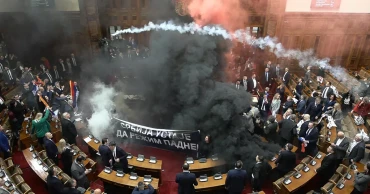
Serbian lawmakers injured as smoke bombs, flares thrown in parliament
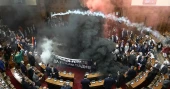
At least three lawmakers were injured on Tuesday, one of them seriously, after chaotic scenes in Serbia ’s parliament, during which smoke bombs and flares were thrown, further fueling political tensions in the Balkan country.
Lawmakers were scheduled to vote on a law that would increase funding for university education, but opposition parties said the ruling majority was also planning to approve dozens of other decisions. They said that was illegal and that lawmakers should first confirm the resignation of Prime Minister Milos Vucevic and his government.
Chaos erupted about an hour after the parliamentary session started, with opposition lawmakers blowing whistles and holding up a banner reading “Serbia has risen so the regime would fall!” Hundreds of opposition supporters rallied outside the parliament building during the session.
Video footages from the assembly hall showed clashes between lawmakers and flares and smoke bombs being thrown. Serbian media said eggs and water bottles also were thrown.
Austria's new government takes office after a record 5-month wait
Officials later said three people were injured in the disturbance, including lawmaker Jasmina Obradovic who was taken to hospital. Parliament speaker Ana Brnabic, who accused the opposition of being a “terrorist gang.”
Defense Minister Bratislav Gasic described those behind the incident as “a disgrace to Serbia.”
“The vandalism of opposition MPs has exposed the nature of their personalities and the essence of their political agenda,” Gasic said.
Serbia’s populist President Aleksandar Vucic visited Obradovic in hospital. “Jasmina will win, Serbia will win,” Vucic said in a post on Instagram, showing him holding the lawmaker's hand in an emergency room.
1 year ago
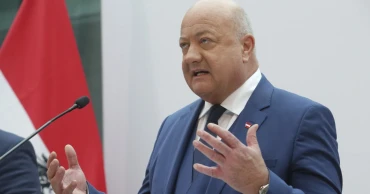
Austria's new government takes office after a record 5-month wait
Austria’s new government took office on Monday, with Christian Stocker taking over as chancellor at the head of a previously untried three-party coalition after a record five-month wait for a new administration.
The new government will have to deal with rising unemployment, a recession and a creaking budget. Its coalition agreement, reached on Thursday after the longest negotiations in post-World War II Austria, foresees strict new asylum rules in the European Union country of 9 million people.
“I stand in front of you today with great respect for the tasks that await, and I am very well aware of the great responsibility that comes with these tasks,” Stocker said at a handover ceremony. “I aspire to be a chancellor for everyone.”
The end of a long road
This is the country’s first three-party government, bringing together Stocker’s conservative Austrian People’s Party, the center-left Social Democrats and the liberal Neos. The alliance in the political center came together only at the second attempt, after the far-right, anti-immigration and euroskeptic Freedom Party emerged as the strongest political force in a parliamentary election on Sept. 29.
Austrian FM Schallenberg appointed as interim govt leader
A first attempt collapsed in early January, prompting the resignation of then-Chancellor Karl Nehammer, who had said that his party wouldn’t work under Freedom Party leader Herbert Kickl.
Stocker took over from Nehammer as leader of the People’s Party and went into negotiations with Kickl on a possible coalition, but those collapsed on Feb. 12 amid mutual finger-pointing.
The three parties in the center then renewed their effort to find common ground, heading off the possibility of an early election. On Sunday, the coalition deal received strong backing from members of Neos, which is entering a federal government for the first time — the final step before the government could take office.
“One could say ‘good things come to those who wait’ — that, in any case, is my hope in view of the many days it took to form this government,” President Alexander Van der Bellen said as he swore in the new government.
“This process certainly took a long time; whether it will turn out well now isn't yet decided, but we are positive and optimistic," he added. "That is down to us all.”
A new team with some familiar faces
Stocker, 64, becomes chancellor although he wasn’t running for the job when Austrians voted in September and has not previously served in a national government. Social Democratic leader Andreas Babler became the new vice chancellor.
Neos leader Beate Meinl-Reisinger took over as foreign minister from Alexander Schallenberg, who also served as interim chancellor for the past two months after Nehammer’s resignation.
Schallenberg says he is leaving politics, at least for now. He told Stocker that it would have been hard to imagine such a friendly handover when he took over temporarily in January, at a time when a Kickl-led government with a more skeptical attitude toward the EU looked likely
Talks on a new 3-party Austrian government collapse as the smallest party pulls out
“We have a strong, pro-European government with you at the helm that understands clearly that pulling up bridges and closing hatches isn't a policy that makes sense for our country,” he said.
Some conservative ministers from the old government kept their jobs, notably Interior Minister Gerhard Karner and Defense Minister Klaudia Tanner. But the important Finance Ministry went from the People's Party to the Social Democrats, with Markus Marterbauer taking the job.
1 year ago
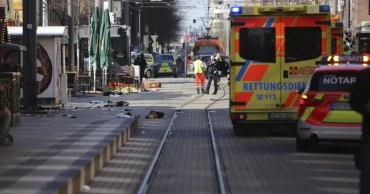
Major law enforcement operation underway in German city of Mannheim as public told to stay inside
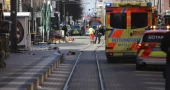
Police in the western German city of Mannheim have asked the public to stay away from the downtown area and keep inside their homes. Mannheim is a city of about 300,000 people located south of Frankfurt.
Police would not disclose what prompted the large law enforcement presence in the city center but a spokesperson said the incident had been reported as “a life-threatening deployment situation.”
4 candidates want to be Germany's next chancellor. Who are they?
Police spokesperson Stefan Wilhelm told n-tv television that an “incident” occurred at around 12:15 p.m. in the Paradeplatz area of downtown Mannheim that triggered a large police deployment. He said he couldn’t give details. Authorities pushed an alert on the Katwarn app telling people in Mannheim to avoid the city’s downtown area due to a big police deployment. Katwarn is used by officials to communicate information about major emergencies such as thunderstorms, militant attacks or fires.
1 year ago

Pope rests after double pneumonia, needs ventilation
Pope Francis had coffee and read newspapers on Saturday following a concerning setback in his two-week recovery from double pneumonia, reports AP.
Doctors placed him on noninvasive mechanical ventilation after he suffered a coughing fit, during which he inhaled vomit that had to be extracted.
Italian Premier visits Pope Francis in hospital
Medical experts stated that it would take a day or two to assess whether Friday afternoon’s incident had affected the pope’s overall condition. His prognosis remained guarded, meaning he was still not out of danger.
In a Saturday morning update, the Vatican confirmed that the 88-year-old pope experienced no further respiratory crises overnight: “The night has passed quietly, the pope is resting.” He had coffee with breakfast, indicating he was not reliant on a ventilation mask for breathing and continued to eat independently.
In its late Friday update, the Vatican described the incident as an “isolated crisis of bronchial spasm,” where a coughing fit caused the pope to inhale vomit, leading to a “sudden worsening of the respiratory picture.” Doctors aspirated the vomit and placed him on noninvasive mechanical ventilation.
Pope Francis diagnosed with pneumonia
Throughout the episode, Pope Francis remained conscious, alert, and cooperative with the necessary medical interventions. He responded well, maintaining good oxygen exchange levels and continuing to use a mask for supplemental oxygen, according to the Vatican.
The incident marked a setback after two consecutive days of increasingly positive updates from doctors treating him at Rome’s Gemelli hospital since his admission on 14 February. The pope, who had part of one lung removed in his youth, suffers from lung disease and was hospitalised when a case of bronchitis worsened into pneumonia affecting both lungs.
Doctors express concern
The Vatican noted that this episode differed from the prolonged respiratory crisis reported on 22 February, which had caused discomfort for the pope.
Dr John Coleman, a pulmonary critical care physician at Northwestern Medicine in Chicago, described the event as alarming, highlighting the pope’s fragility and the rapid changes in his condition.
“I find this extremely concerning, given that the pope has been hospitalised for over two weeks and continues to experience respiratory episodes, now including an aspiration event that requires greater support,” Coleman told The Associated Press.
“Considering his age, fragile state, and prior lung resection, this is very concerning,” he added, though he is not involved in Francis’ treatment.
Dr William Feldman, a pulmonary specialist at Brigham and Women’s Hospital in Boston, agreed that while it was reassuring the pope remained alert during the episode, it still marked “a worrying turn.”
“Often, we use noninvasive ventilation to prevent the need for intubation or invasive mechanical ventilation,” Feldman explained.
Types of noninvasive ventilation include a BiPAP machine, which assists breathing by pushing air into the lungs. Doctors typically monitor whether a patient’s blood gas levels improve with its use before transitioning back to oxygen therapy alone. Friday’s statement indicated Francis showed a “good response” to gas exchange through ventilation.
Doctors have not resumed describing Francis as being in “critical condition,” a term absent from statements for the past three days. However, they caution that he remains at risk due to the complexity of his health situation.
Prayers continue worldwide
Francis’ hospitalisation coincides with the Vatican’s Holy Year, drawing pilgrims to Rome from around the world. Many are walking through the Holy Door at St Peter’s Basilica and making pilgrimages to Assisi, the hometown of his namesake, St Francis.
“Every day, we’re praying for the pope,” said the Rev. Jacinto Bento, a priest visiting Assisi on Saturday with 30 Jubilee pilgrims from the Azores Islands. “We’re very sad about his condition.”
Veronica Abraham, a catechist and Argentine native, visited Assisi on Saturday with her two children and other parish kids from Lake Garda. She shared that the group had prayed for the pope at every church they had visited.
“I’m sure he’s hearing our prayers, that he feels our closeness,” she said.
Serena Barbon, visiting Assisi from Treviso with her husband and three children, expressed hope that if Francis does not recover, his successor will carry on his legacy.
“He’s been very charismatic, and we pray for him and that any new pope might also be someone who puts the poor at the centre. Because in some way, we are all the poor,” she said.
1 year ago
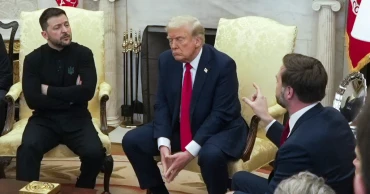
Ukrainians back Zelenskyy as defender after Oval incident
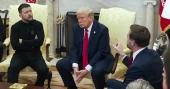
Following a heated Oval Office confrontation between Ukrainian President Volodymyr Zelenskyy and U.S. President Donald Trump, Ukrainians have rallied behind their leader, viewing him as a steadfast defender of the nation's interests, reports AP.
The tense exchange, which occurred in the final moments of their highly anticipated meeting, appeared to undermine hopes that the United States would remain a steadfast ally in helping Ukraine resist and ultimately end Russia’s three-year-long invasion.
Trump’s thrashing of Zelenskyy shows limits of Western allies’ ability to sway US leader
During the discussion, Trump and Vice President JD Vance criticised Zelenskyy for what they perceived as insufficient gratitude for previous U.S. support, a moment that was welcomed by officials in Moscow, who saw it as a significant deterioration in Washington-Kyiv relations.
Ukrainians unfazed by the disputeDespite the confrontation, many Ukrainians expressed little concern, believing that Zelenskyy had defended Ukraine’s dignity and interests by standing firm against some of the world’s most powerful leaders.
Nataliia Serhiienko, a 67-year-old retiree from Kyiv, said she felt Ukrainians approved of Zelenskyy’s performance in Washington. “He fought like a lion,” she remarked.
“They had a heated discussion, a very intense one,” she added. “But Zelenskyy was defending Ukraine’s interests.”
The meeting had originally been intended to finalise a bilateral agreement to establish a joint investment fund for Ukraine’s reconstruction—an initiative seen as a step towards ending the war and fostering long-term economic ties between the two nations. However, with the meeting ending on a sour note, the deal remained unsigned, and Ukraine’s prospects for securing further U.S. security guarantees appeared more uncertain than ever.
Nevertheless, despite Zelenskyy leaving Washington empty-handed, his support at home remained strong.
Zelenskyy departs White House without signing minerals deal following heated exchange in Oval Office
Regional leader praises Zelenskyy’s resilienceAs two drone strikes hit the northeastern city of Kharkiv on Friday night, the region’s governor, Oleh Syniehubov, commended Zelenskyy for standing firm against pressure, insisting that any peace agreement must include security guarantees to prevent future Russian aggression.
“Our leader, despite the pressure, stands firm in defending the interests of Ukraine and Ukrainians… We need only a just peace with security assurances,” Syniehubov stated.
Kyiv resident Artem Vasyliev, 37, was critical of the U.S. response, describing the Oval Office exchange as “complete disrespect” towards Ukraine, despite the country's role in resisting Russian aggression.
“We are striving for democracy, and yet we are met with utter disregard—for our warriors, our soldiers, and our people,” said Vasyliev, who hails from Russian-occupied Luhansk in eastern Ukraine.
He also criticised Trump for failing to grasp the human toll of the war. “He doesn’t understand that people are dying, that cities are being destroyed, that people—mothers, children, soldiers—are suffering. He is just a businessman, and for him, money is sacred,” Vasyliev said.
Social media praise for ZelenskyyUkrainian social media was flooded with messages of support for Zelenskyy, with officials at various levels of government voicing solidarity with him.
The reaction mirrored a previous surge of unity after Trump falsely claimed that Ukraine was led by a “dictator” who had initiated the war with Russia—a statement that prompted even some of Zelenskyy’s critics to rally behind him.
Oleksandr Prokudin, governor of the southern Kherson region—partially occupied by Russia early in the war before being retaken by Ukrainian forces—stressed that years of conflict had strengthened Ukrainians’ resilience.
“We understand pressure—on the battlefield, in politics, and in daily life,” Prokudin stated. “It has made us stronger. It has made the president stronger. Determination drives us forward, and I am confident we will persevere.”
While the Trump administration framed the Oval Office confrontation as part of its “America First” policy, accusing Zelenskyy of lacking gratitude for U.S. assistance, the Ukrainian leader’s supporters praised his unwavering commitment to the nation’s interests—even at the cost of clashing with Washington.
“Unyielding dedication to Ukraine’s interests and loyalty to his country. That’s what we witnessed today in the United States. Support for the President of Ukraine,” Vice Prime Minister Oleksii Kuleba wrote on Telegram.
Calls for diplomacyNot all Ukrainian political figures were entirely supportive of how the meeting unfolded. Kyiv Mayor Vitali Klitschko expressed concern that the rift with Washington could cost Ukraine vital U.S. support.
“We must not lose the backing of the United States, which is critically important to us,” Klitschko cautioned.
“Now is not the time for emotions, from either side. We need to find common ground,” he urged in a Telegram post.
1 year ago
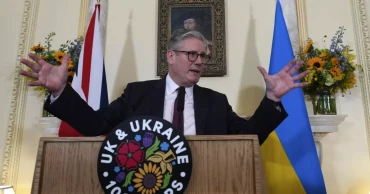
UK’s Starmer will meet with Trump as Europe’s leaders worry about drifting US support for Ukraine
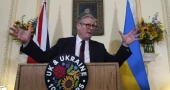
British Prime Minister Keir Starmer will visit the White House on Thursday to try to convince President Donald Trump that a lasting peace in Ukraine will endure only if Kyiv and European leaders are at the table as negotiations move forward with Moscow.
Starmer’s trip, coming a few days after French Prime Minister Emmanuel Macron’s own visit, reflects the mounting concern felt by much of Europe that Trump’s aggressive push to find an end to Russia’s war in Ukraine signals his willingness to concede too much to Russian President Vladimir Putin.
“We’re going to do the best we can to make the best deal we can for both sides,” Trump said Wednesday as he held the first Cabinet meeting of his second term. “For Ukraine, we’re going to try very hard to make a good deal so that they can get as much (land) back as possible.”
But the president’s rapprochement with Russia has unsettled America’s historic allies in Europe, who have found themselves on their heels with Trump returning to the White House with a determination to dramatically make over U.S. foreign policy to correspond with his “America First” world view.
The Trump administration held talks last week with Russia without Ukrainian or other European allies represented. And this week this U.S. refused to sign on to resolutions at the U.N. blaming Russia for the war. The drifting White House view of Ukraine under Trump is leading to a tectonic shift in transatlantic relations.
But the administration is pushing back on the notion that Trump is ignoring Europe or that Trump is too eager in his push for settlement talks with Putin.
“He hasn’t conceded anything to anyone,” Vice President JD Vance said. “He’s doing the job of a diplomat.”
There's no honeymoon for new UK leader Keir Starmer after a summer of unrest
Trump’s meeting with Starmer comes a day before he is to meet with Ukrainian President Volodymyr Zelenskyy. In that meeting Friday, the two are expected to sign off on a contentious agreement that would give the U.S. access to Ukraine’s critical minerals, which are used in the aerospace, defense and nuclear industries. Zelenskyy had chafed at signing off on an agreement without specific security guarantees from the U.S.
But Trump, in announcing plans for the leaders to sign the agreement, was noncommittal about any coming American security guarantees.
“I’m not going to make security guarantees ... very much,” Trump said. “We’re going to have Europe do that.”
Indeed, if a truce can be reached, Starmer and Macron have agreed to dispatch troops for a potential peacekeeping mission to Ukraine to ensure that fighting between Ukraine and Russia doesn’t flare up again.
The British prime minister confirmed Wednesday that he will host a meeting of international leaders in the U.K. on Sunday, focused on Ukraine. Zelenskyy is expected to attend.
Starmer also announced plans this week for the U.K. to bolster defense spending — an issue that should sit well with Trump, who has been critical that European allies are spending too little on defense.
The U.K. government will boost military spending to 2.5% of gross domestic product by 2027, years earlier than expected, and will aim to hit 3% by 2035.
Beyond the war in Ukraine, Starmer said the talks will home in on “a stable economy, secure borders and national security,” as well as cooperation on AI and other cutting-edge technology.
He’ll stress that Europe must “play its part on global defense and step up for the good of collective European security.”
A NATO summit and mending EU relations are among first tasks for new UK leader Keir Starmer
“The world is becoming ever more dangerous, and it is more important than ever that we are united with our allies,” Starmer said. “There are huge opportunities for us to deepen our special relationship, deliver growth and security, and improve the lives of working people in both our great nations.”
Starmer is also keen to discuss “the opportunities that further technology and AI partnerships could deliver,” his office said, including ambitious but vague “shared moonshot missions across top technologies including quantum and AI, and a deeper partnership on space.”
Britain has signaled it aims to eschew the European Union’s high-regulation approach to AI as it seeks to become a leader in the field.
The U.K. joined the U.S. in refusing to sign a joint declaration at an artificial intelligence summit hosted by Macron in Paris this month in what was seen as an attempt to curry favor with Washington and seek investment from American tech firms. Starmer’s office said the prime minister “will make the case for further integration between the two countries’ tech sectors to make them the most efficient, ambitious technology sectors in the world.”
1 year ago
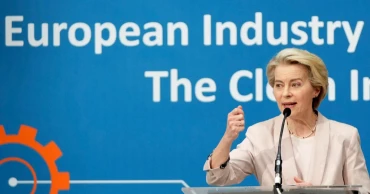
EU executive plans major reset of economy as critics fear climate will suffer
The European Union executive on Wednesday announced plans for a major revamp of its economic strategy to meet demands of the bloc's captains of industry who have long complained about excessive taxation, sky high energy prices and an overbearing bureaucracy that makes the bloc unattractive.
At the same time, environmental groups say that far-reaching deregulation and the boosting of conditions for energy-intensive companies will come at the cost to the EU's ambitious climate targets.
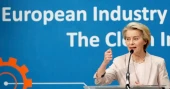
Speaking to a conference of industrial leaders in the Belgian port city of Antwerp, EU Commission President Ursula von der Leyen said that “we want to cut the ties that still hold you back. So that Europe can be not only a continent of industrial innovation, but also a continent of industrial production.”
EU Commissioner Wopke Hoekstra called it “a game changer for Europe’s economy," adding the package of plans was the reaction needed to reverse years of decline in the global marketplace.
“We’re all too aware that our slow economic growth, our dependencies and the fragmented market we still operate in are increasingly a problem, particularly against a backdrop of volatile geopolitics,” he said.
EU Commission Vice President Valdis Dombrovskis said that with the United States becoming a more uncertain ally by the week, the plan should be seen as a “call to action” to set EU industries free from excessive constraints and provide them with aid where necessary.
Trump warns Zelenskyy to quickly negotiate war's end with Russia or risk not having a nation to lead
"Put simply, we cannot hope or expect to successfully compete in a perilous world with one hand tied behind our backs," Dombrovskis said.
Under such conditions there are fears climate commitments could suffer, but Belgian Prime Minister Bart De Wever, who spoke ahead of von der Leye,n insisted choices had to be made.
“There is no point in subjecting our industries to regulations that push them out of the markets, forcing them to relocate to regions with less strict climate policies. Neither our economy nor the climate benefits from such an outcome,” he said.
In the package of plans ranging from cutting red tape to containing energy prices, the executive commission came up with investments totaling hundreds of billions and savings totaling ten of billions of euros (dollars).
For example, Hoekstra said, plans include a “industrial decarbonization” bank, which could raise up to 100 billion euros in the next 10 years. “But then, if you leverage that, if you put private sector money next to that, you could easily add up to a number of 400 billion.”
The plans will now go to the EU parliament and the capitals of the 27 member states for further assessment before they can be turned into laws and regulations.
Environmental groups already rang the alarm, arguing the plans stand to profit especially fossil fuel intensive companies like steel plants and cement factories.
Migrant groups report surge in racist attacks across German city
The European Environmental Bureau, which groups 180 nongovernmental organizations in 41 countries, said that Commission President Ursula von der Leyen had effectively reneged on her 2019 European Green Deal, which was long seen as a global standard-bearer.
“The European Green Deal was hailed as a ‘man on the moon’ moment,” the EEB said in a statement. “Today, the narrative seems tailored primarily to energy-intensive industries and big corporations. But industrial policy should prioritise public interest, not just industry demands.”
Von der Leyen said she would make sure that the environment, or social justice, wouldn't suffer from her deregulation plans.
“Let me be clear. Our climate and social goals do not change. Because our commitment to the social market economy is unwavering,” she said.
1 year ago
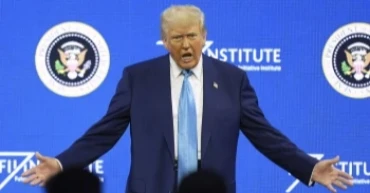
Trump warns Zelenskyy to quickly negotiate war's end with Russia or risk not having a nation to lead
President Donald Trump on Wednesday warned Ukrainian President Volodymyr Zelenskyy that he “better move fast” to negotiate an end to Russia's invasion of Ukraine or risk not having a nation to lead.
The rhetoric from Trump toward Ukraine comes amid an escalating back-and-forth between the two presidents and rising tensions between Washington and much of Europe over Trump's approach to settling the biggest conflict on the continent since World War II.
Trump's harsh words for Zelenskyy drew criticism from Democrats and even some Republicans in the United States, where Ukraine’s defense against Russian aggression has had bipartisan support. Zelenskyy said Trump was falling into a Russian disinformation trap — and was quickly admonished by Vice President JD Vance about the perils of publicly criticizing the new president.
Trump, who is trying to bring the fighting to a close on terms that Kyiv says are too favorable to Moscow, used an extended social media post on his Truth Social platform to lash out at Zelenskyy and call the Ukrainian a “dictator without elections."
“Think of it, a modestly successful comedian, Volodymyr Zelenskyy, talked the United States of America into spending $350 Billion Dollars, to go into a War that couldn’t be won, that never had to start, but a War that he, without the U.S. and ‘TRUMP,’ will never be able to settle,” Trump said of Zelenskyy, who was a popular television star in Ukraine before running for office.
The U.S. has obligated about $183 billion since Russia invaded Ukraine in February 2022, according to the U.S. special inspector general, conducting oversight of American assistance to Ukraine.
Trump accused Zelenskyy of being “A Dictator without Elections!!" Due to the war, Ukraine did delay elections that were scheduled for April 2024.
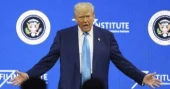
He later repeated many of the criticisms of Zelenskyy, who he said has done a “terrible job," during an address before a meeting in Miami of business executives hosted by Saudi Arabia’s sovereign wealth fund.
Trump also contended that Zelenskyy was misusing American aid intended for the war effort and had taken advantage of Democrat Joe Biden's administration.
The Republican president was riled by Zelenskyy's charge that Trump "lives in this disinformation space” fostered by Moscow. “We have seen this disinformation. We understand that it is coming from Russia,” Zelenskyy said.
US top diplomat Rubio visits the UAE after landmark talks with Russia over Ukraine war
Vance told the Daily Mail that Zelenskyy's criticism of Trump was not helping his cause. “The idea that Zelenskyy is going to change the president’s mind by bad mouthing him in public media, everyone who knows the president will tell you that is an atrocious way to deal with this administration,” Vance said.
Ukrainian officials, however, continue to raise their concerns about Trump's approach.
“Why should dominance be handed over to a country that is an aggressor, a violator of international law, and the author of aggression against Ukraine?” said Mykhailo Podolyak, an adviser to Zelenskyy. “We still do not understand this strategy.”
U.S. and Russian officials meeting in Saudi Arabia on Tuesday agreed to negotiate a settlement to an end to the war. Ukrainian and European officials were not included.
Trump said Zelenskyy should have worked out a deal earlier. “Zelenskyy better move fast or he is not going to have a Country left,” Trump said.
"In the meantime, we are successfully negotiating an end to the War with Russia, something all admit only ‘TRUMP,’ and the Trump Administration, can do. Biden never tried, Europe has failed to bring Peace, and Zelenskyy probably wants to keep the ‘gravy train’ going,” Trump wrote.
The rhetoric from Trump went even further than the false charges he made Tuesday against the Ukrainians when he suggested Kyiv was responsible for starting the war. Russia invaded its smaller neighbor.
Senate Democratic leader Chuck Schumer of New York was appalled that Trump was blaming Ukraine for Russian President Vladimir Putin's invasion.
“It’s disgusting to see an American president turn against one of our friends and openly side with a thug like Vladimir Putin,” Schumer said.
Sen. John Kennedy, R-La., said he disagreed with Trump's suggestion that Ukraine was responsible.
“I think Vladimir Putin started the war," Kennedy said. “I also believe, from bitter experience, that Vladimir Putin is a gangster. He’s a gangster with a black heart” who has Soviet dictator Josef Stalin's "taste for blood.”
Trump labels Zelenskyy a 'dictator' amid rising tensions over Russia-Ukraine war
Sen. Dick Durbin, D-Ill., said Trump's words were insulting to the thousands of Ukrainians who have died in the war and he accused the president of parroting Putin. “I would call on President Trump to apologize to the people of Ukraine, but it would be a waste of breath," Durbin said. “Donald Trump is a pushover for Putin.”
Senate Majority Leader John Thune of South Dakota is among the Republican lawmakers who have supported Ukraine over the course of the war. He said the Trump administration needed space as it seeks a resolution. “The president speaks for himself,” Thune said about Trump's sharpening rhetoric toward Zelenskyy. "What I want to see is a peaceful result, a peaceful outcome.”
The administration has also shown frustration with Zelenskyy for directing his ministers last week not to sign off on a proposed agreement to give the United States access to Ukraine’s rare earth minerals. The Ukrainians said the document was too focused on U.S. interests.
The proposal, a key part of Zelenskyy’s talks with Vance on the sidelines of the Munich Security Conference, did not offer any specific security guarantees in return. Trump during his speech in Miami fumed about the Ukrainians walking away from an agreement. “They broke that deal,” Trump charged.
Trump, speaking with reporters aboard Air Force One after his speech Wednesday evening, said the U.S. believed it had a deal on accessing Ukraine's critical minerals when Treasury Secretary Scott Bessent travelled to Kyiv last week.
Trump added the Ukrainians "agreed to it more or less and then Scott Bessent went there and was treated rather rudely because essentially they told him no.”
Ukrainian officials met Wednesday in Kyiv with retired U.S. Lt. Gen. Keith Kellogg, Trump's special envoy to Ukraine and Russia.
Trump living in Russian-made disinformation space: Ukraine's Zelenskyy
“It’s an egregious war in the sense of the length of time and casualties there and he understands the human suffering,” Kellogg said of Trump's thinking. “He understands the damage that we can see and we want to see an end to it.”
1 year ago
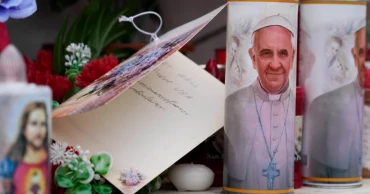
Italian Premier visits Pope Francis in hospital
Italian Premier Giorgia Meloni visited Pope Francis in the hospital Wednesday and reported he was “alert and responsive” and full of good humor, despite his diagnosis of pneumonia and a complicated bronchial infection that has sidelined the 88-year-old pontiff for six days.
Meloni said she wanted to bring get-well wishes to the pope on behalf of the government and the entire nation. ”We joked around as always. He has not lost his proverbial sense of humor,” she said in a statement issued by her office.
Meloni's visit marked the first confirmed outside visitor known to have called on the pope, beyond his secretaries and medical team, since his admission Friday at Rome's Gemelli hospital, where popes have their own suite on the 10th floor.
The Vatican has said Francis, who had part of one lung removed as a young man, was up, eating and had gotten out of bed after a tranquil night, a day after tests confirmed he had pneumonia in both lungs on top of asthmatic bronchitis. The visit by Meloni appeared aimed at sending a reassuring message, especially to Italians who haven't seen even a photograph of Francis since Friday.
The Italian premier, who came to power in 2022 with a message touting her Christian credentials, has referred in glowing terms to Pope Benedict XVI, who was a reference point for European conservatives like herself. She also has teamed up constructively with Francis on a campaign to reverse Italy’s low birthrate, though they don’t necessarily see eye-to-eye on her government's crackdown on migrants.
Her visit came as prayers were pouring in for Francis' recovery. On Wednesday, Francis' vicar for Rome urged all the faithful to devote an hour of silent prayer for the pope before evening vespers services, some visitors to Gemelli lit a candle in his honor and pilgrims who had planned to attend his weekly general audience came to St. Peter's Square anyway to offer a prayer after it was cancelled.
“I think many people are disappointed but I think more importantly we really have to pray for his health," said Sister Charlene, a nun from Singapore who was in the piazza.
Francis also received another get-well wish from U.S. Vice President JD Vance, whom Francis has recently targeted in criticizing the Trump administration’ s plans for mass deportations of migrants.
“Let’s all say a prayer for Pope Francis, who appears to have some serious health issues,” Vance, a Catholic, posted on X from his private account.
Double pneumonia shows a more serious infection
Francis was admitted to the Gemelli hospital Friday after a weeklong bout of bronchitis worsened. On Monday, medical personnel determined that he was suffering from a polymicrobial respiratory tract infection, meaning a mix of viruses, bacteria and possibly other organisms had colonized in his respiratory tract. Late Tuesday, the Vatican said a chest CT scan showed the onset of bilateral pneumonia on top of asthmatic bronchitis, which is being treated with cortisone and antibiotics.
“I think the key will be how how well and quickly he responds to treatment,” said Dr. Andrew Chadwick, a respiratory and intensive care specialist at Oxford University Hospitals.
Bronchitis can lead to pneumonia, which is a deeper and far more serious infection of the lungs’ air sacs. Pneumonia can develop in part or all of one lung or in both lungs. It tends to be more serious when both lungs are affected because there isn’t healthy tissue to compensate.
Treatment varies by severity but can include providing oxygen through a nasal tube or mask, intravenous fluids — and treatment of the underlying cause of the infection. To date, Francis is breathing on his own and his heart function is said to be good. He has eaten breakfast every day, gotten out of bed, read the newspapers and done some work from his hospital room.
“Pope Francis is a strong man who does not let difficulties get him down,” said the Rev. Enzo Fortunato, who heads a new Vatican committee on children. The fact that Francis is keeping up with his ordinary routine, including receiving the Eucharist, “is a sign of a man who wants to experience the ordinariness of illness in the hospital.”
Pope at risk of complications
The Vatican hasn't provided any information about how Francis is responding to any of the drugs he has been given other than to say he isn't running a fever. The Argentine pope, who has previously admitted to being a non-compliant patient, has a number of conditions that make him particularly at risk for complications: Aside from his age, he is not physically active and uses a wheelchair, limiting his ability to clear the fluids building up in his lungs.
Dr. Meredith McCormack, director of pulmonary and critical care medicine at Johns Hopkins University, said doctors will be looking to see if Francis responds to the therapy, which can include physiotherapy to help clear the lungs. Severe cases of pneumonia are typically treated for about one to two weeks, but recovery in an older person could extend beyond that.
"Lack of worsening would be an encouraging sign,” said McCormack, who is not involved in Francis' care.
The Vatican has given no indication of how long the pope might remain hospitalized, only saying that the treatment of such a “complex clinical picture” would require an “adequate” stay.
Pilgrimages continue despite pope's canceled engagements
Despite the less than positive news about Francis' condition, Francis was receiving get-well drawings and cards from children being treated in the hospital's oncology ward. And at the Vatican on Wednesday, Holy Year pilgrimages continued, with groups of faithful walking through the Holy Door of St. Peter's Basilica on a chilly and cloudy day.
“We are very happy to be here but we are also sad for the pope’s sickness," said Amparo Alcala’, who was leading a large group of pilgrims from Valencia, Spain. "He is doing great things, most of all for the women in the church, and this gives us a lot of joy. We are praying for his recovery and that he might come back, if this is God’s will.”
A group of South Korean pilgrims in traditional costumes had planned to attend Francis' weekly Wednesday general audience and show off their national dress, as pilgrims often do for the pope's weekly appointment. When it was cancelled, they came anyway.
“The Lunar New Year was very recent so we also wanted to bow traditionally and formally in front of him," said Junhee Christina Kim, a pilgrim from Seoul, South Korea. "It was too good of a chance to pass up so we came anyway so that we can be in the Vatican in our traditional costumes.”
1 year ago