middle-east
Israeli airstrikes hit Gaza cafe, school, and aid centres, 95 Palestinians dead
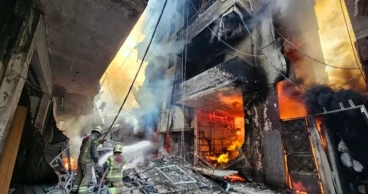
Israeli airstrikes on Monday targeted a café, a school, and humanitarian aid centers in Gaza, killing at least 95 Palestinians and injuring many others. Among the dead were women, children, and journalist Ismail Abu Hatab.
The most lethal strike occurred at Al-Baqa café in northern Gaza City, where 39 people were killed. Witnesses say the area, which had no political or military affiliation, was full of displaced civilians, including children celebrating a birthday. The bombing caused massive destruction and left a crater where the café once stood.
Al Jazeera's Hani Mahmoud reported that the attack came without warning, hitting a place considered a haven for displaced families. Elsewhere in Gaza City, Israeli forces also bombed the Yafa school, which had been housing hundreds of displaced Palestinians. Witnesses say they were given just five minutes to evacuate.
In central Gaza, Israeli strikes hit the courtyard of Al-Aqsa Hospital in Deir el-Balah. Footage verified by Al Jazeera showed chaos as tents sheltering displaced families were damaged. Reporter Tareq Abu Azzoum said this was at least the 10th time Israeli forces targeted that hospital. Gaza’s Government Media Office condemned the attack as a direct threat to the fragile healthcare system.
In Khan Younis, southern Gaza, at least 15 more Palestinians were killed while waiting for food at aid distribution centers operated by the Gaza Humanitarian Foundation (GHF), and 50 others were wounded.
Israeli airstrike on Iran’s Evin Prison raises fears for political prisoners
These hubs, supported by the U.S. and Israel, have seen nearly 600 deaths since GHF began overseeing aid in late May. The Israeli military admitted civilians were harmed and said it is reviewing its actions. A Haaretz report cited Israeli soldiers claiming they were ordered to shoot civilians at these sites.
The attacks happened as Israeli officials traveled to Washington for renewed ceasefire talks, with U.S. officials reportedly pushing for a truce. Qatar, a key mediator, confirmed U.S. interest but warned about the ongoing humanitarian crisis. Talks are also expected to address broader regional issues, including Iran.
Meanwhile, Israeli Prime Minister Netanyahu’s cabinet is reviewing its Gaza strategy. Military officials claim the current operation is nearing its goals, and there may be new opportunities to recover hostages still held by Palestinian groups. Hamas, however, stated that no new ceasefire proposals have been received and reiterated its commitment to ending the suffering of Gazans through negotiations.
Source: Al Jazeera
5 months ago
22 Palestinians killed as Israeli troops fire on Gaza crowds near aid points
At least 22 Palestinians were killed and 20 others injured on Monday after Israeli forces opened fire on people near food aid sites in southern and northern Gaza, according to witnesses, hospitals, and the territory’s Health Ministry.
Nasser Hospital in Khan Younis reported receiving the bodies of 11 individuals shot while returning from an aid distribution center operated under the Israeli and U.S.-supported Gaza Humanitarian Fund (GHF). The program, aimed at addressing severe food shortages, has seen over 500 Palestinians killed in incidents during aid distributions in the past month, health officials say.
Additionally, 10 more Palestinians were killed in an Israeli strike on a U.N. aid warehouse in Gaza City, according to Gaza’s Health Ministry.
Witnesses describe troops firing on civilians
The southern Gaza incident occurred roughly 3 kilometers from the GHF aid site in Khan Younis. Witnesses said Israeli forces fired at crowds traveling along one of the few accessible routes to reach the center.
“They shot at us without warning,” said Yousef Mahmoud Mokheimar, who sustained a leg injury during the incident. He claimed troops initially fired warning shots before targeting the crowd directly. Mokheimar also reported seeing Israeli forces detain six people, including three children, though their fate remains unknown.
Another survivor, Monzer Hisham Ismail, said those returning from the aid hub faced artillery fire. One more person was killed near a GHF center in Rafah, hospital officials added.
The Israeli military acknowledged the reports and said it was reviewing the incidents. The army maintains it fires warning shots when individuals approach troops suspiciously, including near aid sites.
Israel, backed by the U.S., seeks to replace U.N. and international aid efforts with the GHF system, accusing Hamas of diverting aid for its own use—an allegation the U.N. denies.
Israel’s military says it has introduced new measures, including additional routes, fences, and signage, to better organize aid distribution.
Israeli settlers attack military base in the West Bank
Escalating strikes across northern Gaza
In northern Gaza, at least 10 Palestinians were killed when Israeli forces struck a U.N. aid warehouse in Gaza City. It is unclear whether aid was present at the facility during the attack.
The Gaza City strike coincided with intensified Israeli bombardment of the city and the Jabaliya refugee camp. Israeli authorities issued sweeping evacuation orders on Sunday and Monday, warning residents of military operations targeting Hamas command centers.
Palestinians reported heavy airstrikes overnight, describing the offensive as a “scorched earth” campaign against buildings and infrastructure.
“They’re destroying everything left,” said Gaza City resident Mohamed Mahdy, who fled his damaged home early Monday.
Israeli airstrikes kill at least 72 in Gaza as ceasefire hopes grow
Emergency officials said vast parts of Gaza City and Jabaliya are inaccessible due to the strikes, preventing ambulances from reaching people trapped under rubble.
The Israeli military says its operations focus on targeting Hamas militants and command centers, and blames civilian casualties on the group’s use of densely populated areas for military purposes.
5 months ago
Trump calls for Gaza ceasefire deal as Palestinians express doubts
U.S. President Donald Trump on Sunday urged progress on a ceasefire agreement to end the ongoing Gaza war, though many Palestinians remain skeptical after months of stalled negotiations and continued violence. Meanwhile, Israel issued fresh mass evacuation orders for parts of northern Gaza.
An Israeli official confirmed that Ron Dermer, a senior adviser to Prime Minister Benjamin Netanyahu, will travel to Washington this week for ceasefire talks. Plans are also underway for Netanyahu to visit the U.S. in the coming weeks, signaling potential movement toward a deal.
Netanyahu was meeting with his security cabinet Sunday evening to discuss ceasefire efforts and military operations, according to the official, who spoke on condition of anonymity.
“MAKE THE DEAL IN GAZA. GET THE HOSTAGES BACK!!!” Trump wrote on social media early Sunday, expressing optimism after suggesting on Friday that an agreement could be reached within a week.
Palestinians wary of latest ceasefire effortsEarlier this year, an eight-week ceasefire was in place as Trump took office, but Israel resumed its military campaign in March after Hamas rejected proposed new terms.
“Since the war began, they have kept making promises like this — release the hostages, stop the war,” said Palestinian resident Abdel Hadi Al-Hour. “But the war hasn’t stopped.”
Israeli strikes continued Sunday, with an airstrike hitting a house sheltering displaced families in Jabaliya al-Nazla, northern Gaza, killing at least 15 people, including women and children, according to Fares Awad, head of Gaza’s emergency services. The area was covered by the latest Israeli evacuation order.
During a visit to Israel’s Shin Bet internal security agency, Netanyahu said the Gaza war and Israel’s ongoing conflict with Iran have created new opportunities. “First, to bring the hostages home. Of course, we also need to solve the Gaza issue and defeat Hamas — I believe we will succeed in both,” he said.
Major obstacle to ceasefire deal remainsNegotiations between Israel and Hamas have repeatedly stalled over one key issue — whether a ceasefire agreement should end the war entirely.
Israeli airstrikes kill at least 72 in Gaza as ceasefire hopes grow
Hamas official Mahmoud Merdawi accused Netanyahu of blocking progress by only agreeing to a limited deal that would release just 10 hostages. Roughly 50 hostages remain in Gaza, though fewer than half are believed to be alive.
Netanyahu’s spokesperson Omer Dostri blamed Hamas for obstructing peace efforts but did not directly address Merdawi’s claims.
Hamas has proposed freeing all hostages in exchange for a full Israeli military withdrawal and an end to the war. Israel has rejected this, demanding that Hamas surrender, disarm, and go into exile — conditions the group refuses to accept.
The Gaza war erupted after the Hamas-led attack on southern Israel on October 7, 2023, which killed around 1,200 people and saw approximately 250 taken hostage.
According to Gaza’s Health Ministry, 88 more Palestinians were killed by Israeli attacks in the past 24 hours, bringing the death toll to 56,500. The ministry, under Hamas control, does not distinguish between militants and civilians but says over half of the casualties are women and children.
The war has displaced most of Gaza's population multiple times, devastated urban areas, and left people dependent on aid — which Israel has restricted since the last ceasefire ended.
The UN reports fewer than half of Gaza’s hospitals are partially functional, with over 4,000 children requiring medical evacuation abroad.
“We are exhausted. We pray the war ends,” said Mahmoud Wadi, a Palestinian resident.
Israel orders mass evacuation from northern GazaIsrael’s military issued new evacuation orders for large areas of northern Gaza, including parts of Gaza City and Jabaliya refugee camp, where hundreds of thousands had returned during the earlier ceasefire.
Trump suggests Gaza ceasefire could happen within a week
Residents were seen loading belongings onto donkey carts as they prepared to flee once again.
The military plans to expand operations toward central Gaza City, urging civilians to move south to the Muwasi area, military spokesperson Col. Avichay Adraee said.
The campaign aims to clear civilians from northern Gaza to allow Israeli forces to target militants more freely, though rights groups warn such actions may constitute forced displacement.
Trump criticizes Netanyahu’s trialTrump also renewed his criticism of Netanyahu’s corruption trial, calling it “a POLITICAL WITCH HUNT” and claiming it interferes with ceasefire efforts.
In a social media post Saturday, Trump alleged the trial complicates hostage negotiations and called for its cancellation — a rare direct intervention in Israel’s domestic affairs that unsettled some Israelis despite his popularity there.
Netanyahu’s trial has faced repeated delays at his request, citing national security concerns. The court postponed two more days of scheduled testimony on Sunday.
Source: Agency
5 months ago
66 children die from malnutrition in Gaza as Israel’s siege tightens
The ongoing Israeli siege of Gaza has led to the deaths of at least 66 children due to malnutrition, according to officials in the Palestinian enclave, as restrictions continue to block essential supplies like milk, nutritional supplements, and food aid.
Gaza’s Government Media Office issued a statement on Saturday condemning Israel’s escalating blockade and military operations, which they say are deliberately using hunger as a weapon against civilians. Israeli airstrikes have intensified across the territory, killing at least 60 Palestinians, including 20 in Gaza City’s Tuffah neighbourhood.
The media office described the blockade as a "war crime" and accused Israel of committing an "ongoing crime against children in Gaza," criticising what it called the international community’s "shameful silence" over the suffering of children facing hunger, illness, and slow death.
The statement also blamed Israel and its allies—including the United States, United Kingdom, France, and Germany—for the worsening humanitarian crisis and called on the United Nations to immediately facilitate the opening of Gaza's border crossings to allow life-saving aid in.
The announcement comes as UNICEF warns of a sharp rise in child malnutrition in Gaza. The UN agency reported that in May alone, at least 5,119 children between six months and five years old were treated for acute malnutrition—a nearly 50% increase from April and a 150% spike compared to February, when a temporary ceasefire allowed significant humanitarian aid to enter.
UNICEF’s Regional Director for the Middle East and North Africa, Edouard Beigbeder, said over 16,700 children were treated for malnutrition between January and May—an average of 112 children each day.
“These cases are entirely preventable,” Beigbeder said. “The food, water, and nutrition supplies they desperately need are being deliberately blocked. These are man-made decisions costing lives. Israel must immediately allow large-scale delivery of aid through all crossings.”
Israeli attacks intensify in northern Gaza
Meanwhile, Israeli bombardments have continued, killing 60 Palestinians on Saturday alone. In the Tuffah neighbourhood of Gaza City, two consecutive airstrikes destroyed several residential buildings, killing at least 20 people, including nine children.
“We were sitting peacefully when we received a phone call from a private number ordering us to evacuate immediately,” said Mahmoud al-Nakhala, a local resident. “Moments later, the entire block was reduced to rubble. We still don’t understand why our homes were targeted.”
Airstrikes also hit tents sheltering displaced families in Gaza City, killing at least 13 more people, many of them children. In southern Rafah, a person was shot dead near an aid distribution site run by the Gaza Humanitarian Foundation (GHF), a US-backed group operating in the besieged enclave.
Gazan officials say Israeli forces have killed over 550 people at or near GHF distribution points since the organisation began operations on May 19. Despite criticism, GHF remains the only major source of food for many in Gaza as Israel continues to heavily restrict the entry of aid from other organisations.
Al Jazeera’s Hani Mahmoud, reporting from Gaza, said many residents fear approaching GHF sites due to repeated shootings targeting civilians, but the dire food shortages leave them with little choice.
“There’s real danger going to these centres, but if people don’t risk it, their children will go hungry,” Mahmoud explained.
Aid groups have condemned the militarisation of humanitarian aid, with UN Secretary-General Antonio Guterres calling the GHF's approach "unsafe" and saying it is "killing people." Israeli newspaper Haaretz reported that Israeli soldiers have been ordered to fire on unarmed Palestinians at GHF distribution sites, with one soldier describing the scene as a "killing field," though the Israeli military has denied these allegations.
Chris Doyle, director of the Council for Arab-British Understanding, called the aid distribution system a "disgrace" and an "inversion of all humanitarian principles."
“Hundreds have died simply trying to get food,” Doyle said. “Families face long, dangerous journeys for basic necessities, uncertain if they’ll return home.”
He added that Israel’s actions are yet another example of its "complete impunity" regarding international law and urged for an immediate overhaul of the aid system to ensure proper, safe delivery to Gaza’s starving population.
5 months ago
Massive crowds mourn Iranian military leaders, scientists killed in Israeli strikes
Vast crowds gathered in downtown Tehran on Saturday for the funeral of Iran’s top Revolutionary Guard commanders and nuclear scientists killed during the recent 12-day conflict with Israel.
The funeral procession saw the coffins of Revolutionary Guard chief Gen. Hossein Salami, ballistic missile program head Gen. Amir Ali Hajizadeh, and other prominent figures transported along Azadi Street on trucks. The streets were filled with mourners chanting slogans such as “Death to America” and “Death to Israel.”
Both Salami and Hajizadeh were killed on June 13, the first day of the fighting, when Israel launched a military campaign aimed at crippling Iran’s nuclear capabilities by targeting senior military officials, scientists, and critical infrastructure.
According to state media, over one million people attended the funeral, though independent verification of the figure was not possible. Images showed a dense sea of people lining the 4.5-kilometer (nearly 3-mile) route through central Tehran.
There was no public appearance by Iran's Supreme Leader Ayatollah Ali Khamenei during the ceremonies which were broadcast on state television.
Traditionally, Khamenei leads prayers over the coffins of high-ranking officials, although those moments are often aired separately. Khamenei has not been seen publicly since before the conflict began.
Among those present were Iranian Foreign Minister Abbas Araghchi, Quds Force commander Gen. Esmail Qaani, and senior adviser Gen. Ali Shamkhani, who appeared leaning on a cane after being wounded in Israel's initial strike.
Established after Iran's 1979 Islamic Revolution, the Revolutionary Guard has evolved from a domestic paramilitary force to a key regional player, backing Tehran’s allies across the Middle East, including in Syria, Lebanon, and Iraq. The Guard also commands Iran’s ballistic missile arsenal, which has been used against Israel during the recent Gaza conflict.
Iran says chief military commander dies of injuries from Israeli attack
During the 12 days of fighting that ended with a ceasefire on Tuesday, Israel reported killing around 30 Iranian commanders and 11 nuclear scientists, as well as striking eight nuclear facilities and over 720 military targets. Human Rights Activists, a Washington-based group, reported more than 1,000 deaths, including at least 417 civilians.
In retaliation, Iran fired over 550 ballistic missiles at Israel. While most were intercepted, several managed to strike targets, causing casualties and damage, with 28 people confirmed dead.
Saturday’s funeral was the first for high-ranking officials since the ceasefire. State media said ceremonies were held for 60 victims in total, including four women and four children. Government offices were closed to allow employees to attend.
Many in the crowd voiced anger and a desire for revenge. “This is not a ceasefire, this is just a pause,” said Ahmad Mousapoor, 43, waving an Iranian flag. “Whatever they do, we will definitely give a crushing response.”
State television also showed the grave prepared at Tehran’s Behesht-e-Zahra cemetery for army chief of staff Gen. Mohammad Bagheri, who died on the first day of the conflict. He will be buried next to his brother, a Guards commander killed during the Iran-Iraq war in the 1980s. Other fallen officials will be laid to rest in their hometowns.
Meanwhile, Iran's judiciary confirmed that Ali Ghanaatkar, the chief prosecutor at the notorious Evin prison, was killed in an Israeli strike earlier this week. Ghanaatkar, known for his role in prosecuting dissidents, had faced widespread criticism from human rights groups. He will be buried in Qom at a revered shrine.
Iran has repeatedly maintained that its nuclear program is for peaceful purposes. However, Israel views Tehran’s nuclear ambitions as a direct threat and has justified its military campaign as necessary to prevent Iran from acquiring atomic weapons.
Khamenei's last in-person appearance was on June 11, two days before the fighting began. He resurfaced Thursday in a pre-recorded video — his first public message since the ceasefire — in which he issued warnings to the U.S. and Israel and declared Iran victorious.
The 86-year-old leader dismissed the damage from U.S. strikes on three Iranian nuclear sites, saying they failed to “achieve anything significant.” However, Rafael Grossi, head of the U.N.'s nuclear watchdog, described the damage to Iran’s Fordo nuclear facility — built deep inside a mountain — as “very, very, very considerable.”
5 months ago
Houthis claim missile attack on southern Israel
Yemeni armed group Houthi has confirmed that they launched a ballistic missile targeting a “sensitive” location in Beersheba, a city in southern Israel.
The confirmation came after Israel claimed that a missile launched from Yemen was “most likely successfully intercepted.”
In a statement, the group said its missile unit carried out the strike using a Dhu al-Fiqar ballistic missile. “The operation successfully achieved its goal,” the statement read.
Israel-Iran war exposes Asia’s Middle East energy dependence
The group also claimed they carried out multiple operations last week, targeting locations in Beersheba, Jaffa, and Haifa with ballistic missiles and drones.
Since November 2023, the Houthis have been launching attacks on Israeli cities and vessels linked to Israel, aiming to force Israel to end its nearly 21-month-long war on Gaza.
With inputs from Al Jazeera
5 months ago
Iran says US strikes on nuclear sites complicate prospects for talks
Iran’s foreign minister has said that the possibility of new negotiations with the United States over Tehran's nuclear program has been complicated by recent American military strikes that caused “serious damage” to Iranian nuclear sites.
The United States was among the original parties to the 2015 nuclear agreement, under which Iran agreed to curb its uranium enrichment activities in return for sanctions relief and other benefits. However, the deal collapsed after then-U.S. President Donald Trump unilaterally withdrew from the agreement during his first term.
Trump, who has expressed interest in renewed talks with Iran, recently claimed that negotiations between the two sides would take place next week.
In an interview aired on Iranian state television late Thursday, Foreign Minister Abbas Araghchi said Iran had not agreed to resume talks but did not rule out the possibility entirely.
“No agreement has been made for resuming the negotiations,” Araghchi said. “No time has been set, no promise has been made, and we haven't even talked about restarting the talks.”
Araghchi noted that the recent U.S. military intervention “made it more complicated and more difficult” to restart discussions on Iran’s nuclear program.
The development comes after a wave of Israeli strikes on Iran that began on June 13. Israel targeted nuclear facilities, air defense systems, senior military officials, and atomic scientists in an intense 12-day assault.
According to Israeli officials, the attacks killed approximately 30 Iranian commanders and struck eight nuclear-related sites and over 720 pieces of military infrastructure. The Washington-based Human Rights Activists group reported that more than 1,000 people were killed, including at least 417 civilians.
Iran capable of rebuilding nuclear infrastructure after strikes: IAEA chief
In response, Iran fired over 550 ballistic missiles at Israel. Most were intercepted, but those that hit their targets caused widespread damage and left 28 people dead.
The United States later intervened, launching a wave of cruise missiles and bunker-buster bombs from B-2 bombers on Sunday. The attacks focused on three of Iran's most critical sites, using weapons designed to penetrate heavily fortified underground facilities.
Following the strikes, Iran retaliated by firing missiles at a U.S. military base in Qatar on Monday, though no casualties were reported.
Trump has claimed the U.S. attacks “completely and fully obliterated” Iran's nuclear program. However, Iran’s Supreme Leader Ayatollah Ali Khamenei dismissed the claim as an exaggeration, stating the strikes did not “achieve anything significant.”
There is also speculation that Iran relocated much of its stockpile of highly-enriched uranium ahead of the strikes. Iran had previously informed the International Atomic Energy Agency (IAEA) of plans to move the material.
Despite this, IAEA Director Rafael Grossi told Radio France International that the damage to Iran’s Fordo nuclear site, which is built deep into a mountain, was “very, very, very considerable.”
Grossi said that centrifuges used for uranium enrichment are delicate and that “it’s not possible” for them to remain undamaged after multiple 30,000-pound bombs struck the facility.
“These centrifuges are no longer operational,” Grossi stated.
Araghchi acknowledged the severity of the damage. “The level of damage is high, and it’s serious damage,” he said.
He added that Iran had not yet decided whether to allow IAEA inspectors to visit the damaged sites, saying they would be barred “for the time being.”
5 months ago
Israel-Iran war exposes Asia’s Middle East energy dependence
The recent conflict between Israel and Iran has underscored Asia's heavy dependence on oil and gas from the Middle East, exposing the region to potential energy supply disruptions, experts say.
The Strait of Hormuz, which borders Iran, is a critical chokepoint for global energy shipments, handling roughly 20% of the world’s oil and liquefied natural gas (LNG) trade. Four Asian countries — China, India, Japan, and South Korea — account for 75% of these imports, according to research by Zero Carbon Analytics, as reported by AP.
Japan and South Korea are considered the most vulnerable, followed by India and China, largely due to their slower transition to renewable energy sources.
In 2023, renewable energy accounted for just 9% of South Korea's electricity mix, far below the 33% average among member countries of the Organization for Economic Cooperation and Development (OECD). Japan, meanwhile, remains the most reliant on fossil fuels among the Group of Seven (G7) nations.
Although a truce appears to be holding after the recent 12-day Israel-Iran war, analysts say the only long-term solution for Asia is to accelerate the transition to clean, domestic energy sources.
“These are very real risks that countries should be alive to - and should be thinking about in terms of their energy and economic security,” said Murray Worthy, a research analyst at Zero Carbon Analytics.
Japan, South Korea most at risk
While China and India are the largest importers of oil and LNG passing through the Strait of Hormuz, Japan and South Korea face greater vulnerability due to their higher dependency on imported fossil fuels. Japan imports 87% of its total energy needs, and South Korea 81%, compared to 20% for China and 35% for India, according to the global energy think tank Ember.
“When you bring that together — the share of energy coming through the strait and how much oil and gas they rely on — that’s where you see Japan really rise to the top in terms of vulnerability,” Worthy explained.
Three-quarters of Japan’s oil imports and over 70% of South Korea’s oil imports, along with about a fifth of its LNG, pass through the strait, said Sam Reynolds of the Institute for Energy Economics and Financial Analysis (IEEFA). Both countries have focused more on diversifying their fossil fuel supply chains rather than transitioning to renewable energy.
Japan plans to rely on fossil fuels for 30-40% of its energy mix by 2040, with ongoing construction of new LNG facilities. South Korea plans to reduce LNG's share in its electricity generation from 28% today to 25.1% by 2030, and further down to 10.6% by 2038.
However, experts say both countries need to dramatically ramp up renewable energy capacity to meet their 2050 net-zero targets. Think tank Agora Energiewende estimates Japan must add 9 gigawatts of solar power and 5 gigawatts of wind power annually by 2030, while South Korea requires similar solar capacity growth and an additional 6 gigawatts of wind power each year.
Japan’s energy policies remain inconsistent, with continued subsidies for gasoline and diesel, increased LNG import plans, and support for overseas oil and gas projects. Regulatory hurdles have also slowed offshore wind development.
“Has Japan done enough? No, they haven’t. And what they do is not really the best,” said Tim Daiss of APAC Energy Consultancy, citing Japan’s strategy to expand hydrogen fuel use, much of which is produced from natural gas.
In South Korea, low electricity prices discourage investment in renewable energy projects, a “key factor” limiting the expansion of solar and wind, according to Kwanghee Yeom of Agora Energiewende. He called for fair energy pricing, stronger policy support, and structural reforms to boost clean energy development.
Israeli law enabling forcible transfer of Palestinians a war crime: UN
China and India making progress, but challenges remain
China and India have taken more aggressive steps to insulate themselves from global energy market disruptions.
China led global renewable energy growth in 2024, increasing wind power capacity by 45% and solar power by 18%. It has also expanded domestic gas production, though reserves are depleting. While China remains the world’s largest oil importer, nearly half of its 11 million barrels per day come from the Middle East, with Russia and Malaysia among other key suppliers.
India, meanwhile, continues to rely heavily on coal, with plans to increase coal production by 42% by 2030. Nonetheless, renewable energy is expanding rapidly, with an additional 30 gigawatts of clean power capacity added last year — enough to supply nearly 18 million homes.
India has also diversified its oil sources, increasing imports from the U.S., Russia, and other Middle Eastern nations to mitigate risks.
“But India still needs a huge push on renewables if it wants to be truly energy secure,” said Vibhuti Garg of IEEFA.
Southeast Asia also exposed
A potential blockade of the Strait of Hormuz would affect energy supplies across Asia, making renewable energy development a “crucial hedge” against oil and gas market volatility, Reynolds of IEEFA warned.
Southeast Asia has already become a net oil importer as demand in Indonesia and Malaysia surpasses domestic production, according to the ASEAN Centre for Energy. While the region remains a net LNG exporter — thanks to Brunei, Indonesia, Malaysia, and Myanmar — rising consumption means ASEAN is projected to become a net LNG importer by 2032, consulting firm Wood Mackenzie forecasts.
At the same time, renewable energy deployment is struggling to keep pace with demand growth, and oil and gas production is declining as older fields mature.
The International Energy Agency (IEA) has warned that without stronger clean energy policies, ASEAN’s oil import bill could surge from \$130 billion this year to over \$200 billion by 2050.
“Clean energy is not just an imperative for the climate — it’s an imperative for national energy security,” Reynolds emphasized.
5 months ago
Tehran, Washington issue contradictory statements on Iran’s nuclear status
Iran and the United States have presented opposing narratives regarding the current state of Iran’s nuclear programme following recent developments.
In his first remarks since the ceasefire announcement, Iran's Supreme Leader Kahmenei said that US military strikes have failed to damage Iran's nuclear capabilities. He reiterated Iran's determination to continue its uranium enrichment activities and dismissed US claims, particularly from President Trump, as exaggerated.
While US officials have described their recent attacks as having dismantled or crippled Iran's nuclear infrastructure, Iran's leadership insists this portrayal does not reflect the reality on the ground.
The International Atomic Energy Agency (IAEA) remains the only authority capable of independently verifying the true condition of Iran's nuclear facilities.
However, that possibility has been complicated after the Iranian parliament passed legislation on Wednesday prohibiting cooperation with the IAEA.
The law was swiftly approved by Iran's Guardian Council, the country’s top governing body, making the decision official.
Source: With inputs from Al Jazeera
5 months ago
Khamenei claims victory, says US gained nothing
Iran’s Supreme Leader Ayatollah Ali Khamenei on Wednesday declared a symbolic victory over Israel, marking his first public comments since a ceasefire was reached following a series of military confrontations involving the United States and Israel.
He also said the US gained nothing from its strikes.
Speaking in Tehran, Khamenei said Iran had “defeated the enemy's intentions,” even as he acknowledged the country had lost senior military leaders and sustained damage to critical nuclear infrastructure.
His remarks came amid ongoing questions about the full extent of damage from the recent strikes and the broader strategic consequences for the region.
In a notable development, CIA Director John Ratcliffe told reporters that the agency had gathered “a body of credible evidence” indicating that Iran’s nuclear programme had been severely crippled by the targeted US strikes.
Trump says US-Iran talks expected next week as ceasefire holds
Echoing that assessment, an unnamed Iranian official conceded that key nuclear installations had been “badly damaged” by both US and Israeli attacks during the conflict.
Meanwhile, Iran’s foreign ministry declined to confirm whether Iranian and US delegations would meet next week, despite US President Donald Trump suggesting such a possibility during a news conference at the NATO summit. The uncertainty underscores the fragile state of diplomatic engagement between the two adversaries.
In Washington, the Biden administration has reportedly moved to limit the sharing of classified information with Congress, in what officials described as an effort to reduce the risk of leaks. This decision has already drawn criticism from some lawmakers who argue it undermines democratic oversight of military operations.
Turkey welcomes Iran-Israel ceasefire, condemns Israeli attacks on Gaza
Looking ahead, US Secretary of Defense Pete Hegseth is scheduled to hold a news conference at 8 a.m. ET, where he is expected to address the scope and objectives of the US strikes on Iranian military and nuclear targets.
The recent flare-up has raised concerns across global capitals about a renewed cycle of escalation in the Middle East, with international observers calling for restraint on all sides.
# With inputs from CNN
5 months ago