arts-culture
Maine's hidden 'Sistine Chapel' inspires artists with 70-year-old frescoes
From the outside, it looks like any other New England church building: a boxy, white structure with a single steeple surrounded by an old stone wall, set against rolling hills and pine forest.
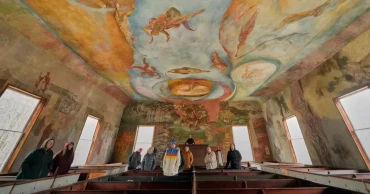
Inside, though, the South Solon Meeting House has a secret unknown even to some who drive through the tiny Maine town every day. The interior of the building is covered in 70-year-old fresco murals that encourage some in the state's art community to describe it as “Maine's Sistine Chapel.”
The murals were painted by artists in the 1950s and, while they have long been appreciated by visitors, the recent creation of a website dedicated to them by students at Colby College in Waterville, Maine, has generated new interest in the paintings.
Véronique Plesch, a Colby professor of art, hopes the building inspires more appreciation of frescoes.
“I fell in love with the place, because I have studies frescoes all my life,” said Plesch, who is a member of the board of the historical society that cares for the meeting house. She added that the paintings should stay in public places and not be in private institutions.
The meeting house was built in 1842 and hosted church services until the 1940s, though there were periods of closure, such as times of war. A decade later, Margaret Day Blake found the building in a state of disuse and the former student at the nearby Skowhegan School of Painting and Sculpture put out a call for young artists to paint frescoes under the school's supervision in 1951.
The artists were given creative freedom and told there would be no limits to subject matter, but that Biblical scenes would “offer rich and suitable” imagery. The interior was covered in such scenes from 1952 to 1956 and the walls remain adorned with frescoes, including one that references Leonardo da Vinci's “The Last Supper."
Another fresco depicts the binding of Isaac, in which a hooded Abraham prepares to sacrifice his son on God's orders. The Great Flood is depicted as it was by Michelangelo at the Sistine Chapel at the Vatican.
Two of the 13 artists — Sigmund Abeles of New York City and Sidney Hurwitz of Newton, Massachusetts — both in their 90s, are still living. Both spoke fondly about their time at the meeting house.
“We would go out there and paint and then take a lunch break in the cemetery behind the building. It was a very idyllic time,” Hurwitz said. “I very much enjoyed it.”
Guatemalan artisans handcraft velvet robes for Holy Week Celebrations
Today, the meeting house, which is open to the public without locks on its doors, serves as a community gathering and performance space. Many of its old features, including box pews made for smaller people of a different time, are still intact.
Abeles recalled painting the scene of Jacob wrestling with the angel from the Book of Genesis.
“It's a very, very special place, and it was a unique experience" to work on the frescoes, Abeles said.
On a recent Sunday morning, Plesch gave a lecture at the meeting house before a group of members of the Maine Art Education Association as part of the group's spring conference. Long ago, attendants of the building might have been preparing for an Easter service, but on this day it was full of teachers fascinated by the frescoes.
Suzanne Goulet, an art teacher at a nearby high school, said she was previously aware of the frescoes and confessed she had peeked into the windows of the old building, adding that it's great the paintings are still inspiring art lovers decades later.
“The inspiration is that we bring it back to our students,” Goulet said.
1 year ago
Guatemalan artisans handcraft velvet robes for Holy Week Celebrations
In workshops across Guatemala, artisans have spent months meticulously hand-stitching intricate garments that will be unveiled this week during Holy Week processions throughout the country and beyond.
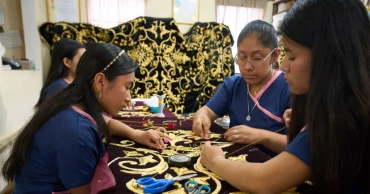
These ornate velvet cloaks, embroidered with gold thread, will adorn wooden statues of the Virgin Mary and Jesus Christ. Carried by devotees along cobbled streets lined with thousands of spectators, the figures play a central role in the country’s Holy Week traditions.
Palm Sunday marks the Christian celebration of Jesus’ triumphant arrival in Jerusalem, where crowds welcomed him with palm branches, as described in the Bible. Holy Week, the most sacred time in the Christian calendar, also includes the Good Friday reenactment of Jesus’ crucifixion and culminates in the Easter celebration of his resurrection.
At the María Auxiliadora workshop, located about 41 kilometers southwest of Guatemala City, 28 artisans — mostly women — can be seen stitching by hand. They work with deep velvet fabrics, embroidering them with intricate gold floral patterns under the shadow of the dormant Volcano of Water.
Some cloaks, such as those made for the Virgin Mary figures, can span roughly 4 square yards (3 meters) and weigh over 50 pounds. To prevent damage to the statues, a metal structure is used to support the garments.
Workshop owner Alejandro Juárez Toledo, who has dedicated 26 years to this craft, still becomes emotional when he sees the cloaks finally draped over the figures that will be paraded through the streets.
“The most meaningful moment for me is when the embroidery is sewn onto the fabric — that’s when the emotional connection with the client begins. The whole experience becomes more fulfilling,” he said.
His team’s handmade robes have been used not only in Guatemala but also in countries such as El Salvador, Honduras, Costa Rica, and Panama.
Guatemala’s Holy Week celebrations are known for their grandeur. In 2022, UNESCO recognized them as part of the Intangible Cultural Heritage of Humanity.
Walter Gutiérrez, a history professor at San Carlos University, emphasized the importance of the events: “These processions represent the essence of Guatemala — culturally, spiritually, and traditionally.”
1 year ago
Bengali New Year 1432: Chhayanaut ready to lead celebrations with 58th Pahela Baishakh program
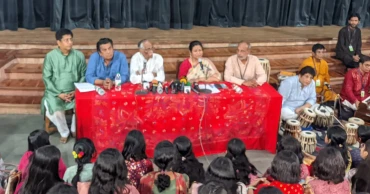
Cultural organisation Chhayanaut is set to welcome the Bengali New Year 1432 with its 58th edition of the traditional Pahela Baishakh celebrations at Ramna Batamul in the capital, upholding the spirit of light, liberation, and cultural unity amid growing global and national challenges.
The announcement came at a press conference held at Chhayanaut Sangskriti Bhaban in the capital’s Dhanmondi on Friday afternoon.
Chhayanaut Executive President Dr Sarwar Ali, Vice President Khairul Anam Shakil, General Secretary Laisa Ahmed Lisa, Joint Secretary Partha Tanvir Naved, and Jayanta Roy were present at the briefing.
"This will be our very first Pahela Baishakh event without our recently deceased dearest President Dr Sanjida Khatun. In this year's celebration of togetherness, we urge everyone to keep her in your best wishes," Dr Sarwar Ali said at the press conference.
Despite witnessing the erosion of values both at home and abroad, the organization believes in hope and unity. “We dream of togetherness and walking hand in hand. The day will return when we will cherish life as a community, and the journey towards a better world will succeed with love for humanity and the earth,” said General Secretary Laisa Ahmed Lisa.
This year’s theme for Chhayanaut’s celebration is “Amar Mukti Aloy Aloy” (My Liberation in Light), and the event will commence at dawn with a performance of Raag Bhairavi. The two-hour-long cultural program will feature a total of 24 performances, including nine group songs, 12 solo renditions, and three recitations.
ICCR celebrates 75 years of cultural diplomacy in Dhaka
The program has been thoughtfully curated with songs of love for light, nature, and humanity, along with patriotic and inspirational compositions to awaken self-awareness and collective consciousness—symbolizing a call for enlightenment and liberation of the Bengali community.
The entire event will be broadcast live on Chhayanaut’s official YouTube channel (youtube.com/@chhayanautbd), Facebook page (facebook.com/chhayanautbd), and on Bangladesh Television (BTV).
Law enforcement agencies and the Public Works Department are working diligently to ensure safety and discipline throughout the event. Volunteers and selected members of the Thirteenth Hussars Open Rover Group are also contributing tirelessly alongside Chhayanaut organizers. The overall stage and event design has been coordinated by Chhayanaut alumnus Sujan Chowdhury.
Demonstrating all of its vibrant and festive offerings marking the maiden dawn of the new Bengali year 1432, Chhayanaut called for sincere cooperation from all in making this year’s celebration a success.
1 year ago
São Paulo celebrates city art museum’s new Renoir exhibit
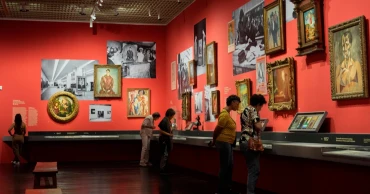
São Paulo is commemorating the opening of the new tower of its renowned art museum with a Renoir exhibition, drawing art enthusiasts to the Brazilian metropolis.
The São Paulo Museum of Art, widely known as MASP and one of the most popular cultural destinations in the country, unveiled its new 14-story tower on March 28. This expansion completes the museum’s architectural vision 77 years after its original inauguration.
The new structure, named in honour of MASP’s first artistic director, Pietro Maria Bardi, features five exhibition halls, two multipurpose spaces, a restoration laboratory, classrooms, a restaurant, and a museum store.
Thirteen paintings by French impressionist Pierre-Auguste Renoir are among the key attractions, delighting visitors. Many are also curious to see the architectural harmony between the new tower and the iconic red MASP building, located along Paulista Avenue, Brazil’s most iconic commercial boulevard.
In May, the museum is set to present an exhibition dedicated to Claude Monet, another French impressionist beloved by Brazilian audiences.
The new addition more than doubles the museum’s total area to 7,821 square meters (84,184 square feet), boosting its exhibition capacity by 66%. Its exterior, constructed with pleated and perforated metal panels, complements the original brutalist style of the existing building.
Construction began in 2019 and was fully financed by private donors, who contributed roughly 250 million Brazilian reais (around $43 million), according to MASP. The project took inspiration from vertical museum designs, similar to those found in New York City.
“MASP is the leading museum in the Southern Hemisphere when it comes to European art,” said Paulo Vicelli, the museum’s director of experience and communication. “We house over 11,000 works — Modigliani, Cézanne, van Gogh, Raphael, and other great masters, as well as prominent Brazilian artists.”
“Art can change people and cities,” he added. “Everyone who visits leaves transformed.”
Originally housed elsewhere, MASP moved to Paulista Avenue in 1968. Designed by architect Lina Bo Bardi, the building is a quintessential example of brutalist architecture, marked by exposed concrete, raw materials, and an imposing scale.
It has since become a key landmark and tourist destination in São Paulo.
“MASP has outgrown its original structure. Expanding was necessary,” said museum director Heitor Martins. “This marks a historic milestone. Now, one museum exists in two buildings.”
A subterranean passage connecting the old and new buildings is under construction and expected to be finished by November. Until then, visitors must step briefly onto busy Paulista Avenue to move between the structures.
Naira Regis de Moura, a 60-year-old visitor from Porto Alegre in southern Brazil, said she was deeply touched upon seeing the new tower. Though in town for a concert, she made time to explore the museum.
“This represents a milestone for Brazilian art,” she said.
1 year ago
ICCR celebrates 75 years of cultural diplomacy in Dhaka
The Indian Council for Cultural Relations (ICCR) celebrated its 75th anniversary on Wednesday, marking a milestone in cultural diplomacy and its enduring role in strengthening the India-Bangladesh relationship through vibrant cultural exchange.
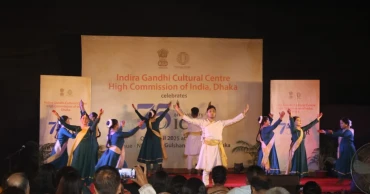
To commemorate the occasion, the Indian Cultural Centre, under the High Commission of India in Dhaka, hosted a celebratory event featuring traditional performances and reflections on the legacy of the ICCR.
Speaking at the event, Deputy High Commissioner of India in Dhaka, Shri Pawan Badhe, said the anniversary not only celebrates ICCR’s journey since its inception in 1950 but also highlights the deep-rooted cultural ties between India and Bangladesh.
“The occasion not only celebrates ICCR’s legacy but also reflects the shared cultural heritage and enduring people-to-people ties between India and Bangladesh,” he said.
Since its foundation, ICCR has played a key role in promoting India’s cultural heritage abroad through a wide range of artistic, educational, and cultural initiatives.
In Bangladesh, the Indira Gandhi Cultural Centre (IGCC) was established in Dhanmondi in 2011, followed by the Indian Cultural Centre in Gulshan in 2021.
Over the years, these centres have hosted numerous programs including classical dance and music performances, literary events, film screenings, exhibitions, and workshops, contributing to deeper artistic collaboration between the two nations.
Mangal Shobhajatra may get a new name: Farooki
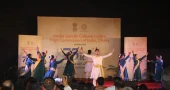
Wednesday’s event featured a special performance of 'Lai Haraoba' by members of the Manipuri community from Sylhet, trained by Indian experts. The performance was presented as a symbol of shared heritage and ICCR’s commitment to preserving traditional art forms and empowering local communities.
IGCC students also presented captivating performances in Kathak, Bharatanatyam, and Hindustani Classical Music, showcasing the cultural vibrancy nurtured through the Centre’s programs.
Beyond cultural engagement, ICCR also fosters educational ties by offering over 500 scholarships annually to Bangladeshi students pursuing higher studies in India—further strengthening the academic and people-to-people connections between the neighbouring countries.
Dignitaries, artistes, students and cultural enthusiasts attended the event.
1 year ago
Hong Kong painter explores city’s history at Art Basel
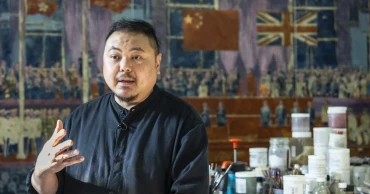
At Hong Kong’s Art Basel, artist Chow Chun-fai’s latest works transport viewers back to a defining moment in the city’s history—the 1997 handover from British to Chinese rule. His paintings, displayed at the same venue where the transition took place, revisit a time when Hong Kongers took pride in their city’s vibrancy and openness.
That era has since taken a drastic turn. China’s imposition of a national security law in 2020 has effectively silenced dissent, prompting many young professionals and artists to emigrate. However, Chow has remained in Hong Kong, continuing to document his home despite political uncertainty.
Art as a Chronicle of ChangeChow, widely recognized for his thought-provoking recreations of classic movie scenes with bilingual subtitles, presents a new collection that reflects on key moments in Hong Kong’s recent history. His paintings at Art Basel revisit major events, including the 1997 handover, trips by top Chinese leaders, and China’s selection as the host of the 2008 Olympic Games.
“While studying art, we’ve learned about artists who lived through momentous times. Since we are experiencing such a period ourselves, I will continue to learn from it,” Chow said in an interview.
His works also highlight the career of Sharon Cheung, a former journalist and now gallery director, who covered some of Hong Kong’s most defining political events. One of Chow’s paintings captures a famous 2000 exchange where former Chinese President Jiang Zemin scolded Cheung for asking “too simple, sometimes naive” questions about Hong Kong’s leadership.
City Guide to Kathmandu, Nepal for Bangladeshis
Another series, titled Panda, depicts Jiang’s lighter side. It revisits his humorous response to a 2002 U.S. press conference question about pandas, where he replied in English, “I’m sorry, I am an electrical power engineer.” Chow said he included this piece because of Hong Kong’s recent fascination with pandas, sparked by twin cubs born last year.
Art Amid Political ConstraintsOver the past two decades, Chinese leaders have become less open with Hong Kong journalists. In 2023, Beijing even canceled the premier’s annual press conference—one of the few opportunities for media interaction with top officials.
Meanwhile, Hong Kong has seen intensified political control, particularly after the 2019 anti-government protests. Pro-democracy activists have been jailed, independent media outlets shut down, and cultural institutions subjected to tighter scrutiny. In 2021, authorities amended the city’s film censorship laws on national security grounds, leading some filmmakers to stop screening their work locally. Bookstores and libraries have also begun practicing self-censorship.
Despite these challenges, Cheung and Chow remain committed to their work. “People are more cautious about expressing their thoughts, but fear won’t stop us,” said Cheung, director of SC Gallery. “Art creates space for interpretation—we’re not telling people what to think, but rather allowing them to reflect.”
Finland ranked again the world’s happiest country in 2025: What’s the secret
Chow, who has never considered leaving Hong Kong, believes that artists witnessing historical transformations have a responsibility to document them.
“Finding ourselves in this moment of change, how could I, as a creative professional, not be here to witness it personally?” he said.
Source: With input from agnecy
1 year ago
Drik holds solidarity rally in memory of martyred Palestinian children
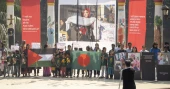
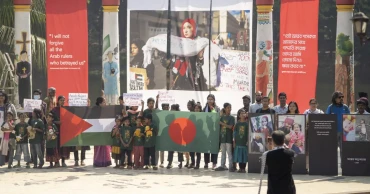
In protest against the ongoing genocide and Israeli war crimes backed by Western powers, Drik Picture Library organised a solidarity rally this morning at Rabindra Sarobar in Dhanmondi to commemorate the martyred Palestinian children.
The death toll in Gaza has surpassed 50,000, with 17,000 of the victims being children. In remembrance of these innocent lives, Drik staff expressed solidarity alongside the children from the organization "Shishuder Jonno Amra" (We for the Children).
Mangal Shobhajatra may get a new name: Farooki
The rally featured poetry by artist Farzana Wahid Shayan on Gaza’s children and a speech by eminent photographer and Drik Picture Library founding Managing Director Shahidul Alam, highlighting the brutal reality of the ongoing atrocities.
“In the same way children are playing here at this amphitheater today, children everywhere in the world should have the same freedom to play,” Shahidul Alam said in his speech. “We are meant to nurture them in such an environment. But Israeli aggression, war crimes, and genocide have shattered this reality.”
Shilpakala Academy to hold Eid celebrations 1st time ever
He emphasised the importance of standing in solidarity with Palestine and continuing the struggle for their freedom. "People around the world are protesting from their respective positions. We must also keep supporting Palestine so that when our children ask us about our role in this crisis, we can face them with dignity," he added.
The rally was attended by Drik’s friends, fellow activists, artists, photographers, and members of the public.
1 year ago

Mangal Shobhajatra may get a new name: Farooki
Cultural Affairs Adviser Mostofa Sarwar Farooki has said that the name of the New Year's Mangal Shobhajatra may be changed.
The adviser shared this information with reporters after a meeting on the national celebration of the Bengali New Year as well as the New Year celebrations of the Chakma, Marma, Tripura, Garo, and other ethnic groups at the Secretariat on Sunday.
Dr Jamil’s statements were not entirely true: Farooki
A meeting will be held at Dhaka University on Monday to finalise the new name, he added.
Farooki also said that this year’s Mangal Shobhajatra, which will involve participation from all ethnic groups, will feature new elements including colours, scents, and melodies.
He mentioned that "this time you will see new things in the Shobhajatra that will come out from the Fine Arts. You will witness these changes firsthand."
“We won’t reveal all the details yet; it’s a teaser. Those who join will see the changes for themselves,” he added.
Adviser Farooki explains suspension of theatre festival
He further said that this Shobhajatra was initially called ‘Anando Shobhajatra’, and later it became ‘Mangal Shobhajatra’. Since it has already undergone one name change, it could change again if there’s consensus. If everyone is in favour, it might not be changed.”
The adviser said this year’s Shobhajatra is no longer just for Bangalees; it is for everyone — Bangalees, Chakmas, Marmas, Garos, and others.
“We must ensure the name reflects inclusivity, so it doesn’t feel exclusive or limited to one group. We want to avoid putting anyone in a bracket,” said the adviser.
1 year ago
World Mime Day 2025 celebrated in Dhaka
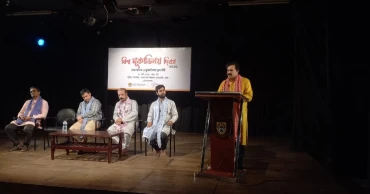
Bangladesh Shilpakala Academy (BSA) and Bangladesh Mime Federation jointly celebrated World Mime Day 2025 on Saturday with a discussion session and mime performances at BSA's Studio Theatre Hall, Segun Bagicha in the capital.
This year’s celebration carried special significance, as it marked the 102nd birth anniversary of legendary French mime artist Marcel Marceau.
The event, which commenced at 7 pm, was presided over by Soleman Mehedi, acting President and organiser of Bangladesh Mime Federation. The federation’s General Secretary Mahbub Alam delivered the welcome speech, while its former General Secretary Dhiman Saha Jewel also spoke at the event.
Prominent mime artist Zahid Ripon, a former chairman of the Bangladesh Mime Federation, and Mohammad Jasim Uddin, deputy director of the Theatre and Film Department at Bangladesh Shilpakala Academy, participated in the discussion, shedding light on the current state and future of mime art.
The speakers reflected on the contributions of pioneering mime artists in Bangladesh, including Partha Pratim Majumder, Kazi Mosharul Huda, Zillur Rahman John, Debangshu Hore, and internationally acclaimed mime artist Rizwaan Rajon, the founder of Bangladesh's modern mime movement.
Mime veteran Dewan Mamun, the first mime artist from post-independence Chattogram, was also present at the event.
Highlighting various aspects of mime art, the speakers urged for the implementation of more programmes to promote the country's mime scene.
Following the discussion, mime performances were presented by member troupes of the Bangladesh Mime Federation, including Mirror Mime Theatre, The Mummers, Shawon Mime Academy, and Mime Troupe.
Additionally, at 7:30 pm, a special production of William Shakespeare’s 'Macbeth' was showcased by theatre troupe Swapnadal at BSA's Experimental Theatre Hall, while the Silent Theatre of Chattogram celebrated the day in collaboration with the District Shilpakala Academy, Chattogram.
World Mime Day is observed globally on March 22 to honour Marcel Marceau, who was born on this day in 1923 in Strasbourg, France. Since his passing on September 22, 2007, this day has been celebrated worldwide to pay tribute to his legacy.
1 year ago
Shilpakala Academy to hold Eid celebrations 1st time ever
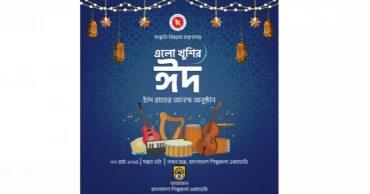
Bangladesh Shilpakala Academy (BSA) has announced on Thursday that for the first time ever, it is set to organise an Eid celebration, embracing the country’s diverse cultural heritage.
The academy will host the programme titled 'Elo Khushir Eid' at its Nandan Moncho on March 30 from 7 pm onwards, celebrating the 'Chand Raat' (night before the Eid day).
BSA has shared the poster image of the event with the media and is yet to reveal the details of the event; however, Cultural Adviser Mostofa Sarwar Farooki shared the announcement image on social media on Thursday, making the announcement of the event.
"For the first time, Shilpakala Academy is hosting an Eid celebration. Bangladesh is a land of many languages, beliefs, and religions," Farooki wrote on his Facebook.
"Everything in the diverse society we live in is a part of our culture. Bangladesh will celebrate it all! The politics of division are no longer welcome here," the cultural adviser wrote.
CA Press Secretary Shafiqul Alam and others have also shared the announcement image, and netizens on social platforms have been applauding the decision made by BSA for the first time ever.
1 year ago