arts-culture
Group art exhibition ‘The Trendsetters’ kicks off at Bhumi Gallery
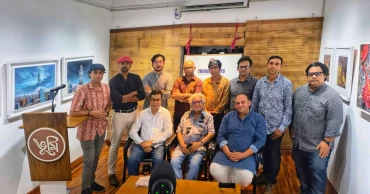
A special group art exhibition titled 'The Trendsetters' featuring works by 10 talented Bangladeshi artists has been inaugurated on Friday evening at Bhumi Gallery in the capital’s Lalmatia.
The opening ceremony began at 6:30 pm and was inaugurated by internationally acclaimed artist Monirul Islam as the chief guest.
Art connoisseur Gitanka Debdip Datta attended the ceremony as the special guest, and a number of renowned and emerging artists, art critics and art lovers were also present at the event.
Organised by Bhumi Gallery, the exhibition showcases artworks by Anukul Chandra Majumder, Azmeer Hossain, Kamal Uddin, Sadek Ahmed, Kazi Shahid, Sohag Parvez, Abdullah Al Bashir, Kamruzzoha, Shahanoor Mamun and Sourav Chowdhury.
Highlighting the exhibition’s theme, the organizers said that art reflects human thought, struggle, and society. Each generation gives rise to creative minds who challenge norms, redefine practices, and inspire others.
'The Trendsetters' presents the artistic journey of 10 promising and established young artists who are developing their own visual languages and occupying a significant space in the contemporary art scene.
The exhibition features 70 artworks in diverse styles and mediums—ranging from realism and abstraction to experimental and traditional expressions. Despite their artistic differences, all works are unified by originality, persistence, and passion.
These artists not only represent individual success but also serve as role models for emerging creators. Their works embody a strong sense of cultural identity while engaging in global artistic dialogues.
According to the gallery, 'The Trendsetters' is more than just an exhibition—it is a forward-looking initiative where bold creatives are guiding, inspiring, and becoming voices of the future. Their works demonstrate that with dedication, integrity, and creative courage, Bangladeshi art can proudly take its place on the global stage.
The 12-day exhibition will remain open to all every day from 4 pm to 9 pm until August 12.
1 year ago
Satirical site Earki’s exhibition on July Revolution opens at AFD
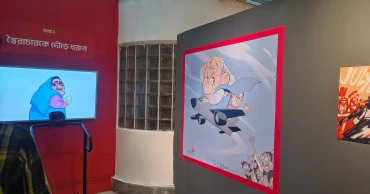
A six-day public exhibition titled ‘Bidrupe Bidroho’ (The Power of Satire) got underway at the Alliance Française de Dhaka (AFD) on Thursday evening, attracting a large and enthusiastic crowd on its opening day.
Organized by the renowned satire platform Earki, the exhibition commemorates the first anniversary of the 36-day mass uprising of July 2024, exploring satire as a powerful tool of political resistance.
Scheduled from July 31 to August 5, the exhibition revisits the creative expressions that shaped the 2024 movement, where citizens demanding justice and democracy turned to humor and wit as forms of defiance. From cartoons, memes, and graffiti to protest songs, poetry, and video installations, satire became a bold medium for voicing dissent against political oppression.
1 year ago

LEEDO, Liberation War Museum use art and documentary to elevate street children’s voices
A heartwarming showcase of creative expression by the children of Peace Home, a shelter operated by the NGO LEEDO (Local Education and Economic Development Organisation), was held on Saturday morning at the Liberation War Museum, highlighting a powerful fusion of art and literature, imagination, and social engagement.
Organised jointly by the Liberation War Museum and LEEDO, the event featured artworks developed during a series of creative workshops led by young artist and curator Rupakalpa Chowdhury, drawing inspiration from Begum Rokeya's iconic feminist utopian story Sultana’s Dream.
The programme featured the screening of the award-winning documentary Where the Kids Have No Name by Dutch filmmaker Jamillah van der Hulst, which offers an unflinching portrayal of the lives of Dhaka’s street children.
The event began at 10:30 am at the museum’s lounge and main auditorium, opening with a moment of silence and a special condolence message from Peace Home’s children in remembrance of the victims of the recent Milestone School tragedy.
Tropa Majumdar moderated the event, which included remarks from LEEDO’s Executive Director Forhad Hossain, who emphasised the importance of nurturing creativity and self-expression among marginalised children. LEEDO Peace Home Manager Sohel Rana and member Jasmin Akhter presented an overview of its activities and creative initiatives through a PowerPoint presentation.
1 year ago

Dristi Chakma’s work among top entries for global exhibition in London
Bangladeshi architect-artist Dristi Chakma has recently achieved international acclaim as one of her drawings was selected among the top entries from over 7,000 submissions in the Drawing of the Year Awards, and is currently being exhibited at London Creates 2025, a prestigious showcase hosted by Archisource in the UK capital.
The exhibition, taking place at The Truman Brewery in London, features works from some of the world’s most prominent design studios, including Foster + Partners and RSHP. Dristi’s work stands among them—marking a significant milestone for Bangladeshi representation in global architectural illustration.
In a recent Facebook post, Dristi shared her excitement, writing, “This is an absolutely proud moment for me as I’ve just stepped into London!! My drawing…has been selected as one of the top works…to be exhibited at London Creates 2025, hosted by Archisource.”
She also noted the honour of having her work selected by a distinguished jury panel that includes Narinder Sagoo MBE (Foster + Partners), Jim Heverin (Zaha Hadid Architects), Will Johnston (RSHP), Sam Conway (Hayes Davidson), Eliza Grosvenor (London Festival of Architecture), and Archisource co-founders Mansel Haynes and Emily Glynn.
The drawing, developed during her Master of Architecture studio ‘Art, Culture and Other Things’ at the University of Melbourne under the guidance of Samuel Hunter, was created in academic collaboration with Hrisheeta Singh. It is also featured in the Drawing of the Year 2025 publication, highlighting the best visual works of the year.
Dristi Chakma studied Architecture at Bangladesh University of Engineering and Technology (BUET) and earned her M.Arch from the University of Melbourne. She currently works as an architect at VITTI Sthapati Brindo Ltd, and previously served as a faculty member at the Military Institute of Science and Technology (MIST).
1 year ago
Liton Kar's ‘She, the Universe: The Infinity Within Her’ opens at AFD
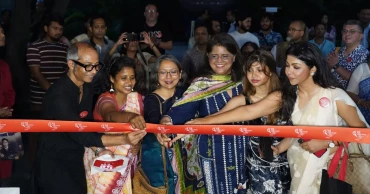
A solo art exhibition titled ‘She, the Universe: The Infinity Within Her’ by renowned Bangladeshi artist Liton Kar has commenced at La Galerie of Alliance Française de Dhaka (AFD), offering an introspective and poetic visual journey into femininity, memory, and metaphysical presence.
The opening ceremony, held at the gallery, was joined by Ekushey Padak-winning eminent artist-educator Prof Farida Zaman, alongside Mahia Juned, Additional Managing Director and CFO of City Bank PLC; Mahrukh Mohiuddin, Managing Director of University Press Limited; and mountaineer Nishat Majumdar as special guests.
Featuring 25 large-scale oil paintings, the exhibition showcases women not just as subjects, but as elemental forces—rooted in nature, dreams, and ancestral memory. The works reflect Liton Kar’s signature style that merges surrealism with grounded intimacy, interweaving symbolism, storytelling, and socio-cultural commentary.
1 year ago

Singapore tops global list for costliest luxury spending, London overtakes Hong Kong
For those who indulge in a luxury lifestyle without budget constraints, certain global cities stand out as the priciest destinations to satisfy high-end tastes. However, these lavish experiences come with substantial costs, varying significantly by location.
Findings from the ReportAccording to the latest Global Wealth and Lifestyle Report by Julius Baer, Singapore has retained its position as the world’s most expensive city for luxury spending for the third consecutive year. London has now surpassed Hong Kong to claim the second spot. The report evaluates the cost of luxury goods and services most relevant to individuals with a net worth of at least $1 million in bankable assets. This year’s study was conducted between February and March 2025, amid notable shifts in global economic trends.
Why Singapore Leads the RankingsSingapore continues to attract wealthy individuals, thanks to its political stability, economic strength, and investor-friendly environment. The city ranked highest in luxury spending categories such as designer footwear and fine jewellery. Moreover, local spending on essentials like healthcare, education, and dining also contributes to its top position. The report notes that although the global economy has adjusted to a “new normal” post-pandemic, inflation, geopolitical unrest, and rising living costs continue to influence spending patterns.
‘The Salt Path’ faces backlash amid allegations of fabrication, delaying author’s next book
London Climbs to Second PlaceLondon moved up to second place in the rankings, overtaking Hong Kong. Analysts attribute this rise partially to the strength of the British pound in the post-Brexit landscape. Other European cities also gained positions this year, including Zurich, which now ranks sixth. While Europe, the Middle East, and Africa were once considered more affordable, unfavorable currency shifts and weakening economic performance have made them more expensive for luxury living.
Top 10 Cities for Luxury ExpenditureAmong American cities, only New York retained a spot in the top 10, holding steady at number eight. Meanwhile, Mexico City fell five places to 21st, and Sao Paulo dropped seven spots to 16th, highlighting decreased luxury spending and economic instability in Latin America.
Here are the ten most expensive cities for luxury spending in 2025, according to Julius Baer:
1. Singapore2. London3. Hong Kong4. Shanghai5. Monaco6. Zurich7. New York8. Paris9. Sao Paulo10. Milan
1 year ago
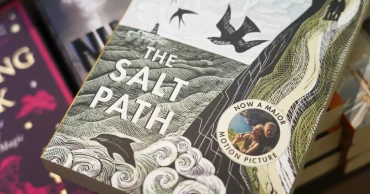
‘The Salt Path’ faces backlash amid allegations of fabrication, delaying author’s next book
The Salt Path, a widely celebrated memoir of resilience and healing, has come under intense scrutiny following allegations that key elements of the story may have been fabricated—raising questions about the integrity of the narrative and the future of both the book and its recent film adaptation.
Authored by Raynor Winn, The Salt Path recounts the journey of Winn and her husband, Moth, as they trekked 630 miles along England’s South West Coast Path after losing their home and learning of Moth’s rare terminal illness, corticobasal degeneration (CBD). The memoir resonated with millions, selling over 2 million copies, spawning two sequels, and leading to a film adaptation starring Gillian Anderson and Jason Isaacs.
However, a report published last Sunday by The Observer has challenged the veracity of the memoir. The investigation claims the couple’s real names are Sally and Timothy Walker and that their financial downfall stemmed not from a failed investment, as stated, but from allegations of embezzlement. It also alleges the couple were not actually homeless, as they reportedly owned a house in France at the time.
Stay cool with these heat-fighting gadgets and wearables
Further doubts have been cast over Moth’s medical condition. Experts interviewed by The Observer questioned whether he had CBD at all, citing his apparent recovery and lack of typical symptoms.
In response, Penguin Michael Joseph, the book’s publisher, announced on Friday that the release of Winn’s upcoming book On Winter Hill would be delayed. The decision follows growing public concern and what the publisher described as “intrusive conjecture” about the couple’s circumstances.
Winn has rejected the allegations as “highly misleading,” while admitting to “mistakes” in her business past. She released documents that she claims support Moth’s diagnosis and said the backlash had left them “devastated.”
Penguin stated that it had conducted “the necessary pre-publication due diligence” and had received no prior complaints about the book.
Eminent poet Al Mahmud’s 89th birth anniversary being celebrated Friday
As questions loom over future sales and the film’s U.S. distribution, the controversy has already begun impacting the author’s public engagements. Winn has withdrawn from her planned appearance on the Saltlines tour due to ongoing legal proceedings.
Source: Agency
1 year ago

Bangladesh Embassy in Thimphu hosts collaborative art event featuring 10 artists
A four-day art camp titled 'SPBA Bhutan Art Camp 2025' has recently commenced at the Bangladesh Embassy in Thimphu, Bhutan, bringing together eight Bangladeshi and two Bhutanese artists for a collaborative exploration of creativity and cultural exchange.
Organised by the Society for Promotion of Bangladesh Art (SPBA), the camp began on Monday (July 8) and will continue until July 12, according to a message received here on Friday.
A total of eight Bangladeshi artists — including Ekushey Padak-winning eminent artist Kanak Chanpa Chakma — are participating in the camp. The other Bangladeshi artists are Azmeer Hossain, Shahid Qazi, Suman Wahed, Saikat Hussain, Farzana Rahman Bobby, Rupshree Hajong and Gallery Cosmos Artistic Director Sourav Chowdhury.
They are joined by two promising Bhutanese artists — Ugyen Tshering Doya and Kishor Dahal.
'Alchemy of Light': Gallery Cosmos hosts workshop by Juton Chandra Roy
Highlighting the significance of the initiative, Kanak Chanpa Chakma said, “The new building of the Bangladesh Embassy in Bhutan, designed by renowned architect Rafiq Azam, calls for several paintings as part of its architectural concept. With his design and in collaboration with the embassy's overall vision, we, the eight Bangladeshi and two Bhutanese artists, are participating in this art camp.”
“We are collectively creating around 35 to 40 artworks, which will be installed in the newly constructed embassy. These works will be visible to people from both Bhutan and Bangladesh as representations of our artistic identity, and I believe this is a wonderful initiative,” she stated.
Bangladesh Ambassador to Bhutan, Shib Nath Roy, visited the camp and commended the effort, interacting with the participating artists and expressing his appreciation for the cultural collaboration.
1 year ago

Eminent poet Al Mahmud’s 89th birth anniversary being celebrated Friday
The 89th birth anniversary of Al Mahmud, one of the most prominent voices in modern Bangla poetry, is being observed on Friday with reverence and remembrance across literary circles in the country.
Born on July 11, 1936, in Brahmanbaria, Al Mahmud (full name - Mir Abdus Shukur Al Mahmud) played a pivotal role in reshaping Bangla poetry in the post-Tagore era. His acclaimed collection 'Sonali Kabin' (Golden Dowry) brought together themes of rural life, love, history, nationalism, and spirituality in a lyrical and distinctly local voice, earning him wide recognition.
In the early hours of Friday, Bangla Academy paid tribute to the late poet through a commemorative social media post. In the post, the Academy remembered Al Mahmud’s contributions to Bangla literature and noted that he had been awarded the Bangla Academy Literary Award in 1968.
The post also recalled how, following his death on February 15, 2019, his body was brought to the Academy’s Nazrul Mancha the next day for people to pay their final respects.
As part of the tribute, the Academy shared two archival photographs of Al Mahmud taken at the Academy premises, alongside a solo portrait provided by Photoseum, the photography initiative of the Ekushey Padak-winning eminent photographer and Bangla Academy Fellow Nasir Ali Mamun.
In a deeply personal reflection, Nasir Ali Mamun shared a poignant note on the aforementioned Facebook post of Bangla Academy, stating, “Even during his lifetime, Al Mahmud was forcibly erased. This story is long."
Poet Al Mahmud’s 84th birth anniversary observed
"In 1974, he was imprisoned. I, too, was in the same cell with him at Dhaka Central Jail for some days. We haven’t forgotten the brutality of the Rakkhi Bahini," Nasir Ali Mamun recalled, referencing the documentation of these events in Ahmed Musa’s book 'Itihasher Kathgoray Awami League' and in Al Mahmud’s own memoirs.
Mamun continued, “Individuals and institutions deliberately tried to erase the poet from poetry; what remains is the heavy sorrow and the history of a culture of neglect, and today, that sorrow rises with a howl. Let us celebrate the sorrowful poet Al Mahmud. Thank you, Bangla Academy.”
Throughout his career, Al Mahmud published a vast body of work including poetry, fiction, and essays. His literary voice was closely tied to the nation’s cultural and political transformations, from the Language Movement to post-independence complexities.
Despite facing political censorship and personal adversity, his poetry endured—often circulating beyond mainstream platforms.
Al Mahmud’s major publications include the poetry collections 'Lok Lokantor', 'Kaler Kalosh', 'Sonali Kabin', 'Mayabi Porda Dule Otho', 'Arobbo Rojonir Rajhash', and 'Bokul Chokh'; novels such as 'Kobi O Kolahol', 'Purusher Jobanbondi', and 'Upomohadesh'; short story collections like 'Pankourir Rokto' and 'Duhshomoy'; and his memoir 'Jiboner Jolchhobi'.
Al Mahmud’s 83rd birth anniversary
Today, Al Mahmud is remembered not only as a poet of unmatched lyrical beauty but also as a symbol of resistance against cultural marginalization. His legacy continues to shape the literary landscape of Bangladesh.
1 year ago

Simple Tsukudani recipe: A traditional japanese side dish to enjoy with hot rice
Tsukudani, a sweet Japanese side dish commonly served with hot rice, traces its origins back to the samurai era in a small neighborhood called Tsukuda in old Tokyo. In Japanese, adding “ni” to a word indicates the dish is cooked in that place.
Today, professional tsukudani is available packaged at many Asian food stores and, naturally, in the Tsukuda area itself.
A Tokyo correspondent for The Associated Press shares a basic tsukudani recipe that anyone can try at home.
Tsukudani involves simmering bite-sized pieces of meat or vegetables in a dark, sweet sauce over low heat. The ideal flavor develops after about an hour, allowing the sauce to fully infuse into the food. It is important to watch the pot carefully during cooking.
Traditionally, tsukudani is served alongside hot rice or sake, or it can be used as a filling for rice balls.
The surprising health benefits of mangoes, says nutritionist
Easy Tsukudani recipe, from AP’s Yuri Kageyama
Preparation time: One hourServings: 5
Ingredients:
· ½ cup of clams, tuna, seaweed, shrimp, meat, or other desired ingredients
· ¼ cup sliced ginger
· 2 tablespoons sugar
· ½ teaspoon salt
· 1 tablespoon mirin (sweet rice wine)
· 2 tablespoons soy sauce
· 1 teaspoon sake (rice wine)
· 2 teaspoons roasted sesame seeds
Directions:Chop the clams, tuna, seaweed, shrimp, or meat into small pieces about the size of a pea. Slice the ginger into thin pieces. Combine all ingredients in a large pot and cook over low heat for about one hour, until the liquid evaporates. Finish by sprinkling roasted sesame seeds on top.
1 year ago