others
3 more die of dengue, 512 hospitalised
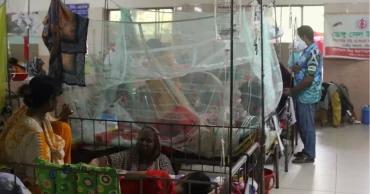
Three people died of dengue and 512 new patients were hospitalised across the country in the 24 hours until 8:00am on Tuesday.
With the latest fatalities, the dengue death toll has risen to 47 in the country this year, according to the Directorate General of Health Services (DGHS).
The new deaths were reported in Chattogram and Rajshahi divisions, it said.
During the reporting period, 532 patients were discharged from hospitals after recovery.
Since January 1 this year, a total of 14,156 dengue patients have been admitted to hospitals across the country.
Of them, 13,009 have recovered and been discharged, while 1,034 patients are currently undergoing treatment, according to the DGHS.
6 days ago

3 to die for killing vegetable trader in Faridpur
A Faridpur court on Tuesday convicted three people and sentenced them to death for killing a vegetable trader in 2012.
Judge of the Faridpur Additional Sessions Judge Court-1, Mohammad Badiuzzaman handed down the judgment.
The condemned convicts are Chan Sardar, 42, and Tara Sardar, 35, sons of Ayub Ali Sardar, and Babul Akondo, 36, son of Ziaul Haque Akondo, all of Paschim Khabaspur in Faridpur district town.
Only Babul Akondo was present in the dock during the hearing.
The court also issued arrest warrants against Chan Sardar and Tara Sardar.
According to the prosecution, Foysal Sheikh, a vegetable trader and son of Aku Sheikh of the Alipur area, was beaten and stabbed to death by the convicts over previous enmity at the under-construction building of Faridpur Medical College and Hospital on September 5, 2012.
Firoza Begum, Foysal's mother, filed a case with Kotwali Model Police Station.
Police submitted a charge sheet against four people on July 31, 2013.
One of the accused, Shahin Sardar, 22, died during the trial.
6 days ago
BFSA destroys 40kg jelly-laced shrimp at Mirpur market drive
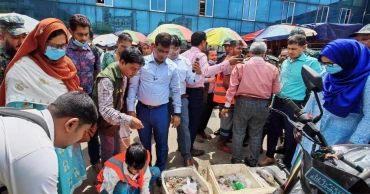
Bangladesh Food Safety Authority (BFSA) in a joint drive at Shah Ali Kitchen Market in Mirpur-1 seized and destroyed 40 kgs of shrimp laced with harmful jelly.
The drive was carried out jointly by officials from the Department of Agricultural Marketing, Dhaka North City Corporation, Department of Agricultural Extension, Department of Fisheries, and Department of Livestock Services.
During the drive, the team found various irregularities across fish, meat, poultry, vegetable and grocery shops.
Unscrupulous traders were found injecting harmful jelly into shrimp to artificially increase their weight, prompting authorities to seize and destroy the affected stock on the spot.
The team also found liver of dead goat being sold at one shop.
Following proper inspection and confirmation, the liver was seized and destroyed as well.
BFSA officials said price lists were missing at most fish, meat and vegetable shops across the market. The use of red lights at fish and meat shops, often used to make products appear fresher than they are was also observed and immediately removed, they said..
The market's shop owners' association was instructed to rectify the identified irregularities within the next 30 days, with authorities warning that failure to comply would result in legal action in future drives under relevant laws.
BFSA Deputy Director BM Ruhul Amin Rimon led the operation.
He said such joint drives, coordinated by BFSA with other relevant government departments,are conducted once every month, with Tuesday's action at Shah Ali Kitchen Market being part of that continuing series. "We will continue this activity in the public interest."
6 days ago
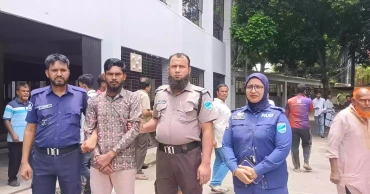
2 awarded death penalty for killing schoolboy in Manikganj
A Manikganj court on Tuesday sentenced two people to death for killing schoolboy Sohan Mia in 2021.
Manikganj District and Sessions Judge SKM Tofail Hossain handed down the punishment.
The condemned convicts are Awal Mia, son of Harun-or-Rashid of Madhabpur upazila in Habiganj district and Sagor Munshi, son of Nuru Munshi of Sadar upazila in Barishal district.Of them, Sagor tried in absentia.
The court also sentenced them to life imprisonment under another section of the case and fined them Tk 50,000 each, in default, to suffer, four years of rigorous imprisonment.
According to the prosecution, Sohan Mia, a Class IX student of BRC High School and son of Nurul Islam of Fordnagar Molla Para in Singair upazila of Manikganj, went missing on July 19, 2021.
Later, Sohan's throat-slit body was found on a road in the Khaserchar-Dhalla Bazar area.
Laily Begum, Sohan's mother, filed a case with Singair Police Station.
During the investigation, police found that the convicts had killed the schoolboy after snatching his motorcycle and mobile phone.
Police submitted a charge sheet against three people on July 30, 2021.
The trial of the other accused is being conducted by the Juvenile Court.
6 days ago

Ex- BB deputy governor SK Sur sentenced to 3 years jail
A Dhaka court on Tuesday sentenced former deputy governor of Bangladesh Bank SK Sur Chowdhury to three years’ imprisonment in a case filed by Anti-Corruption Commission (ACC).
Dhaka Second Special Judge Ayesha Nasrin passed the order, said ACC Public Prosecutor Tariqul Islam Tarik.
ACC arrested SK Sur from Segunbagicha area of the capital on January 24, 2025. Since then he was in jail.
According to the prosecution, a notice was served to SK Sur for submitting his wealth statement including all movable and immovable assets, liabilities, sources of income and property held in his own name or in the names of his dependents.
However, he failed to submit the wealth statement within the stipulated 21 working days.
As he did not submit the wealth statement within the specified timeframe, Anti-Corruption Commission (ACC) Deputy Director Nazmul Hossain filed a case against three people- SK Sur, his wife Suparna Sur Chowdhury and their daughter Nandita Sur Chowdhury on December 23, 2024.
On August 25 last year, ACC Deputy Director Md Ahsan Uddin submitted the charge sheet against him.
The court framed charges against SK Sur on November 6 last year.
During the proceedings, the court recorded the testimonies of seven prosecution witnesses.
6 days ago
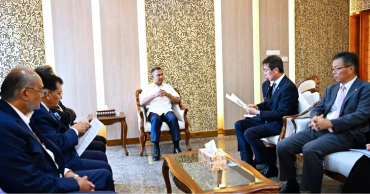
PM pushes for expanded Japanese language training, skilled workers’ recruitment
Prime Minister Tarique Rahman on Tuesday sought enhanced Japanese cooperation in human resource development and skills training, urging Tokyo to recruit more skilled Bangladeshi workers by expanding Japanese language training opportunities.
He made the call when Japan's Special Advisor to the Prime Minister Uno Yoshimasa paid a courtesy call on him at the Prime Minister's Office in the Cabinet Division at the Bangladesh Secretariat, said a release issued by the PM’s Press Wing.
During the meeting, the two sides discussed ways to further strengthen the strategic partnership between Bangladesh and Japan and elevate bilateral relations to a new level.
Tarique Rahman said Bangladesh places high importance on developing a skilled workforce to meet growing international demand.
He sought enhanced Japanese cooperation and urged the country to recruit more skilled Bangladeshi healthcare workers, agricultural workers and drivers.
The Prime Minister urged Uno Yoshimasa to expand Japanese language training opportunities for Bangladeshi workers.
He also called on Japanese companies to increase their investment in Bangladesh, assuring that the government would extend full support if Japan decides to establish another industrial park similar to the one in Araihazar, Narayanganj.
The Prime Minister also underscored the importance of working jointly to expand bilateral trade and economic cooperation between the two countries.
He stressed the need for closer collaboration between the two countries to expand trade and economic cooperation.
The meeting also reviewed progress on a number of major infrastructure projects being implemented with Japanese assistance, including the third terminal of Hazrat Shahjalal International Airport, which is scheduled to be inaugurated on December 16, and the ongoing Mass Rapid Transit (MRT) project.
6 days ago
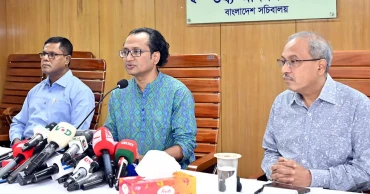
President’s Constitutional protection applies only during tenure: PM's adviser Zahed
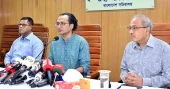
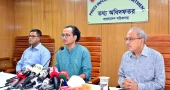
The Constitutional immunity of a President remains effective only while he or she is in office and legal action can be taken after the tenure ends, Prime Minister's Information and Broadcasting Adviser Dr. Zahed Ur Rahman said on Tuesday.
He made the remarks while responding to questions from reporters at a press briefing at Secretariat on the progress of various government activities.
Replying to a question on whether former president Mohammed Shahabuddin has been granted immunity, the adviser said that under the Constitution, no legal proceedings can be initiated against a sitting President.
"After leaving office, if necessary, legal proceedings may be initiated against a former President in connection with allegations or legal matters relating to events that occurred before assuming office or after the tenure," he said.
Dr. Zahed clarified that his remarks are not directed at the outgoing president but are intended as a general constitutional interpretation.
He expressed hope that the clarification would help remove any confusion surrounding the issue.
Responding to another question on judicial independence, the Prime Minister's adviser said the judiciary is an independent institution and not part of the government.
He said people can seek justice in all courts including the International Crimes Tribunal.
"In some cases, the government may be a party to a case, but the courts make their decisions independently. In many other cases, the government is not a party at all," he added.
6 days ago

Spanish envoy meets NCP’s Nahid, discusses reforms, bilateral ties
Ambassador of Spain to Bangladesh Gabriel Sistiaga Ochoa de Chinchetru on Tuesday met National Citizen Party (NCP) Convener and Opposition Chief Whip Md Nahid Islam at the party's central office in Banglamotor.
The discussions centred on Bangladesh's post-election political landscape, progress on constitutional reforms, and key reforms in the economy and judiciary, along with issues of mutual interest relating to Bangladesh-Spain relations.
Both sides also exchanged views on Bangladesh's economic outlook and explored opportunities to deepen economic cooperation and expand bilateral partnerships between the two countries.
The meeting concluded with both sides reaffirming their commitment to continued engagement and closer cooperation to further strengthen the longstanding relations between Bangladesh and Spain.
Following the meeting, Nahid Islam congratulated the Spanish ambassador on Spain's triumph at the 2026 FIFA World Cup.
Among others, NCP Spokesperson Asif Mahmud Shojib Bhuiyan, International Affairs Cell In-Charge Alauddin Mohammad, Joint Secretary SM Saif Mustafiz, and Central Committee Member Ashrefa Khatun were present at the meeting.
6 days ago
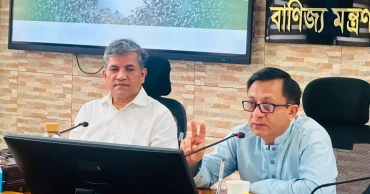
10 years' data to be analysed to predict supply risks in advance: Commerce Minister
The government is planning to introduce an artificial intelligence (AI)-based data analytics system to help ensure a stable supply of essential and sensitive commodities by identifying potential shortages in advance, Commerce Minister Khandakar Abdul Muktadir said on Tuesday.
An integrated management system is needed to analyze the country's key commodities based on whether they are locally produced, import-dependent, or supplied through a combination of domestic production and imports, he said while speaking as the chief guest at a meeting on e-commerce implementation at the Commerce Ministry.
Noting that supply disruptions are often a major reason behind price hikes in the market, the minister stressed need for advance planning to prevent sudden shortages caused by production or import constraints.
"Whether the government decides to reduce prices through subsidies is a separate issue. Our primary goal is to ensure that market instability does not arise due to supply disruptions," he said.
Regular analysis is necessary for commodities such as lentils, onions and other agricultural products by assessing domestic production, seasonal shortages, international market conditions and the production capacity of exporting countries, he said.
If lower domestic production of a commodity is anticipated in a particular year, preparations should begin even before the harvest. At the same time, the production situation and export capacity of countries from which Bangladesh imports should also be taken into consideration, he added.
"We need to know when shortages of a particular commodity may occur, which country would be the best source for imports at a given time, and where prices are comparatively favorable," he said.
To support such decisions, the minister emphasised the need for an AI-based platform capable of analyzing 10 years of market data, production trends, import-export statistics and global market conditions, said the minister.
According to him, the proposed system will significantly reduce the time required for decision-making. At present, information is collected through inter-ministerial meetings, often delaying analysis and policy decisions.
"In the past, obtaining a single piece of information required inter-ministerial meetings and hours of discussion. AI will be able to analyze a decade of data and present likely scenarios within minutes," he said.
The AI platform is expected to forecast when shortages of specific commodities may occur, identify the most suitable countries for imports, assess exporters' supply capacity and recommend the most advantageous time for procurement.
The minister said the initiative would help maintain a stable supply of essential commodities throughout the year.
The Ministry of Commerce will implement the initiative in coordination with the ministries of Agriculture, Food and other relevant agencies, with participating institutions having access to the necessary data, he said.
To improve the effectiveness of the AI system, he said, reliable data sources will be essential. In addition to government data, the platform will draw on international open-source and subscription-based databases to build a comprehensive information repository.
Although developing the system will take time initially, he said it will eventually become faster and more effective than conventional manual analysis.
"The main objective of this initiative is to strengthen our ability to make timely and accurate decisions based on reliable data. This will reinforce market management and help protect consumers' interests," he added.
The meeting also discussed the development of the country's e-commerce sector, technology-driven market management and future action plans.
6 days ago
Govt to take steps over microplastics found in toothpastes: Adviser
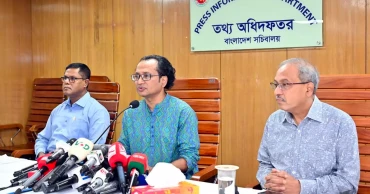
The government will take necessary steps in the public interest over the presence of microplastics in most toothpastes available in Bangladesh, Information and Broadcasting Adviser Zahed Ur Rahman said on Tuesday.
He made the remarks in response to a question at the government’s regular press briefing at the Secretariat on recent activities.
Asked whether the government would take action after detection of microplastics in most toothpastes available in the local market, the adviser said the government is taking the issue of public safety very seriously.
“Microplastics are not only found in toothpastes and they have spread like a major problem. Even if you do not use toothpaste containing them, microplastics generated from various sources have already entered our food and water,” he said.
He stressed the need for coordinated action to address the issue, saying action against toothpaste alone would not be enough to tackle the broader spread of microplastics.
He also noted that public awareness about health issues is growing, with people raising concerns about microplastics extensively on social media.
Recently, the Environment and Social Development Organization (ESDO) tested 34 toothpaste samples from 19 brands available in the Bangladeshi market.
Its study found microplastics in 26 of the samples, or around 76.5 percent. The tiny plastic particles were also detected in several toothpastes marketed for children.
6 days ago