others

Institutional reforms underway to strengthen environmental governance: Rizwana Hasan
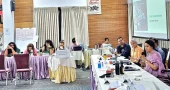
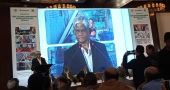
Environment Adviser Syeda Rizwana Hasan has said that Bangladesh is carrying out administrative and legal reforms, but meaningful transformation will require time, sustained effort, and political continuity.
“We are working to reform both the administration and the legal system. But when a country ranks 179 out of 180 in environmental performance, it does not rise to 50th place in a single year. That does not happen overnight,” she said while speaking at the Biennial General Meeting of Friends of the Earth International held at BRAC CDM in Savar on Wednesday.
“If Bangladesh remains persistent for five to seven years and moves even to around 73rd position, it would then be easier for an elected government to take the process further,” she added.
She mentioned that the present administration inherited a near-collapsed system—one that was neither responsive nor functioning. “Our first challenge was to make it minimally functional, and then initiate change. We have only begun that journey and are far from completion. But crucial steps have been taken, and these must continue beyond this interim period,” she said.
Speaking on accountability, she stressed that ensuring justice for victims of political violence is an immediate priority.
7 months ago
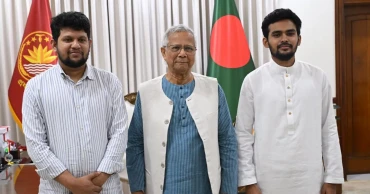
Advisers Asif, Mahfuj step down ahead of national election
Youth and Sports Adviser Asif Mahmud Shojib Bhuiyan and Information Adviser Mahfuj Alam have submitted their resignation letters.
Chief Adviser’s press secretary Shafiqul Alam briefed reporters about their resignation at the state guest house Jamuna on Wednesday evening.
The Chief Adviser accepted the resignation letters, which will take effect once the Election Commission announces the election schedule.
Election schedule to be announced Thursday evening
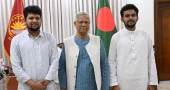
After accepting the resignations of the two former student leaders, who played a leading role in the July uprising, the Chief Adviser wished them well in their future endeavours.
“The way you led the uprising and contributed to freeing the nation from fascist rule will be remembered. I believe you will continue to play an active role in the democratic transition and its development in the future,” said Prof Yunus.
Prof Yunus said, “Today is a historic day. The interim government will always remember your contributions. I wish you a bright and prosperous future. The nation will never forget what you have given in such a short time. This is only a transition. I hope you will make even greater contributions on a broader stage in the future.”
7 months ago
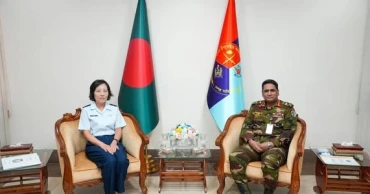
Bangladesh-US defence dialogue begins
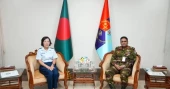
A two-day defence dialogue between Bangladesh and the United States began on Wednesday at the Bangladesh Armed Forces Division.
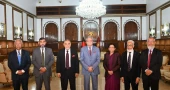
Military delegations from Bangladesh and the United States are participating in the 12th defence dialogue, said an ISPR press release.
The dialogue is considered highly significant for strengthening military cooperation between the two nations, it said.
The talks will also cover a range of issues including global and regional security, defense technology, military equipment, disaster response, peacekeeping operations, training, inspections, joint exercises, and workshops.
Brigadier General Muhammad Ali Haider Siddiqui, Director General of Operations and Plans at the Armed Forces Division is leading the Bangladesh delegation while Brigadier General Sarah Helen Russ is heading the US delegation.
Senior officials from the Ministry of Foreign Affairs, Border Guard Bangladesh, Bangladesh Coast Guard, and other agencies are also attending the discussions on behalf of Bangladesh.
The dialogue will contribute to advancing military cooperation and further consolidating the friendship between Bangladesh and the United States, it added.
7 months ago

Prospects strong for safeguarding judiciary, caretaker model: Asif Nazrul
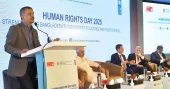
Law Adviser Dr Asif Nazrul on Wednesday expressed optimism that the country’s caretaker government system and the independence of the judiciary will remain protected even after the change of government.
“Hopefully, these two fundamental pillars of governance will stay secure and remain unchangeable,” he said while speaking at a programme marking Human Rights Day 2025 at Hotel Intercontinental in the capital.
He said the caretaker government system is already safeguarded by the Supreme Court’s verdict, while the Supreme Court Secretariat Ordinance now has the Supreme Court itself as its guardian.
“These two issues form the fundamental guarantees for advancing human rights,” he said, adding that recent legal measures—such as the National Human Rights Commission Ordinance and the Prevention of Disappearances Ordinance—will further strengthen accountability and state institutions.
He also pledged to stand with civil society in defending these laws after he leaves office.
Referring to the Police Commission Ordinance, he said that although a fully strong commission could not be established, its formation is expected to create positive pressure on the government as an independent body.
Nazrul highlighted several achievements, including the speedy trial process, expanded legal aid, and service-delivery reforms at the local level.
He urged all stakeholders to safeguard the reforms already achieved and work collectively to build a more developed Bangladesh.
Adviser to the Ministry of Housing and Industries Adilur Rahman Khan, Environment Adviser Syeda Rizwana Hasan, Legislative and Parliamentary Affairs Secretary Dr Hafiz Ahmed Chowdhury, UNDP Bangladesh Representative Stefan Liller, and Swiss Embassy Representative Alberto Giovanetti also spoke at the event.
7 months ago

Poor execution of good plans holding back poverty reduction: Adviser Salehuddin
Finance Adviser Dr Salehuddin Ahmed on Wednesday said although Bangladesh has designed many strong and promising poverty-reduction plans over the years, their implementation has remained ‘very poor’ due to inefficiency, corruption and procedural bottlenecks.
“Our plans are well-designed, but implementation is terribly weak. Because of inefficiency, corruption and legal complexities, many good initiatives never see the light of day,” he said on Wednesday at a workshop titled Rural Livelihood Transformation and Inclusive Resilience Initiatives organised by the Social Development Foundation (SDF) at a city hotel.
“The country’s poverty rate continued to decline until 2010 but started rising again after 2022. Alongside managing existing poverty, the government must now prepare strategies for those falling into poverty every day,” he added.
Praising SDF’s initiatives, Salehuddin said, “SDF’s activities began under my watch. Over the years, their work has become visible and rural women are benefiting.”
About addressing rising urban poverty, he said the pressure on cities would ease if the rural sector could be made more attractive and urbanisation more decentralised. “This will make decentralised development easier,” he observed.
The adviser also pointed to the weaknesses in beneficiary selection for social protection programmes. “Although selection has improved, coverage must expand. Stakeholder participation is crucial here,” he said.
Calling for a stronger role from NGOs, the adviser criticised their lending practices.
“NGOs provide loans of Tk 4-5 lakh to middle-income groups because they can recover the money with interest. As a result, the ultra-poor remain excluded. NGOs must bring the poorest under their lending programmes,” he said.
Finance Division Secretary Md Khairuzzaman Mozumder admitted that poverty has increased. “There is no denying that poverty has risen. While it cannot be eradicated entirely, efforts to reduce it continue.”
He said the government plans to continue working with the SDF as it used its Covid-era grants effectively and that the government plans to continue working with the organisation.
Nazma Mobarek, Secretary of the Financial Institutions Division (FID), described Bangladesh as being in a ‘critical phase’ of poverty alleviation, saying many poor families still cannot access social safety services due to planning gaps and failures in targeted implementation.
Shahriar Kader Siddiky, Secretary of the Economic Relations Division (ERD), stressed the need for incorporating climate vulnerability into SDF’s programmes. “If a beneficiary is affected by climate-induced disasters, there must be an insurance mechanism for future support,” he said.
Chairman of the Research and Policy Integration for Development (RAPID) Mohammad Abdur Razzaque, in his keynote presentation, said only 37 percent of the country’s poor receive government assistance, leaving the majority — 63 percent — outside support systems.
Similarly, he said, only 27 percent of the poor receive assistance from NGOs.
SDF Chairman Muhammad Abdul Mazid, in his remarks, said Bangladesh is undergoing a major transition and expressed the hope that the SDF will move forward in step with this transformation.
7 months ago
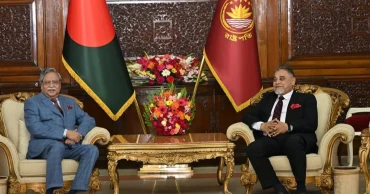
President expresses satisfaction over EC’s preparations for polls, referendum
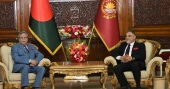
President Mohammed Shahabuddin expressed satisfaction over the preparations undertaken by the Election Commission (EC) ahead of the upcoming 13th parliamentary election and the national referendum, EC Senior Secretary Akhtar Ahmed said on Wednesday (December 10, 2025).
“The President expressed satisfaction after we informed him in detail,” Akhtar Ahmed said while talking to reporters after a meeting between Chief Election Commissioner AMM Nasir Uddin, four election commissioners and the EC Secretary with the President at Bangabhaban.
CEC briefs President on polls preparations announcement
The Secretary said they informed the President about extending the balloting hours by one hour—now set from 7:30am to 4:30pm. “When we said that we extended the balloting hour by one hour from 7:30am to 4:30pm, he termed the decision logical and expressed his satisfaction,” he said.
During the meeting, he said, they apprised the President of various preparatory activities, including the updating of electoral rolls and the registration of new political parties.
The President was also briefed on the Commission’s plan to use two types of ballot papers—one for the national election and another for the referendum—to be held simultaneously on the same day, said Akhtar Ahmed.
Election Commission to meet President Dec 10
7 months ago

CEC briefs President on polls preparations announcement
Chief Election Commissioner AMM Nasir Uddin on Wednesday briefed President Mohammed Shahabuddin on the Commission’s overall preparations to hold the upcoming parliamentary elections and the referendum .
The CEC along with other Election Commissioners met the President at Bangabhaban at noon ahead of the announcement of the schedule for the 13th national election, said a press release signed by Md Nesar Uddin Jewel, deputy secretary at the office of the president.
The President expressed satisfaction over the Election Commission’s overall preparations, it said.
Senior Secretary of the Election Commission Secretariat Md. Akhtar Ahmed; Secretary of the Public Division of the President’s Office Khan Md. Nurul Amin; and the Military Secretary to the President Major General Mohammad Adil Chowdhury were present on the occasion.
The election schedule is expected to be announced on Wednesday or Thursday.
The EC also sent a letter to BTV and Bangladesh Betar to record the Chief Election Commissioner’s (CEC) address on the same day.
7 months ago

4,200kg banned sweetener seized at Chattogram Port
The Custom House, Chattogram has seized 4,200 kilograms of prohibited artificial sweetener Sodium Cyclamate from a container at Chattogram Port.
According to an NBR press release, the intelligence wing of Chattogram Custom House conducted the operation based on secret information, with support from the Central Intelligence Cell (CIC) in Dhaka.
The consignment was imported by Ejaz Trading, a Keraniganj-based firm, which had declared the shipment as Polyaluminium Chloride.
The container carrying 22,088 kilograms of products from China arrived at the port on October 21.
Acting on intelligence alerts, Customs officers suspended the release of the consignment and conducted a physical inspection on November 6.
During the examination, officials found two different types of goods inside the container.
Samples were collected and sent to the Customs laboratory for analysis.
Laboratory tests confirmed that 17,800 kilograms matched the declared Polyaluminium Chloride while the remaining 4,200 kilograms were identified as Sodium Cyclamate — a sweetener banned in Bangladesh due to serious health risks.
Sodium Cyclamate is 30 to 50 times sweeter than sugar and is often misused in confectionery, processed food, beverages, chocolates and even baby food.
Studies have linked the substance to cancer and severe kidney and liver complications.
Customs authorities seized the undeclared sweetener under the Customs Act, 2023, and legal proceedings are underway.
The NBR saidon September 16 and October 28, Customs intercepted two other consignments totalling nearly 100 tonnes of Sodium Cyclamate at Chattogram Port.
7 months ago

Prof Yunus calls upcoming election a historic chance to shape ‘new Bangladesh’
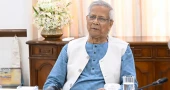
Chief Adviser Prof Muhammad Yunus on Wednesday described the upcoming national election as a historic opportunity to build a new Bangladesh, stressing that this post-uprising election must be made ‘memorable’ by ensuring it is conducted smoothly, peacefully and fairly.
“We had seen elections before. Any sane person would say that the elections held in the past were not elections but fraud,” he said while giving instructions on election preparations to Upazila Nirbahi Officers (UNOs) across the country via video conference from the State Guest House Jamuna.
All DCs and Cabinet Division officials were also connected online.
Prof Yunus emphasised that the upcoming polls are far more than routine administrative responsibilities. “This is a historic responsibility. If we can fulfill it properly, the next election day will become historic for the people as well," he said.
Prof Yunus congratulates youth hockey team on lifting Challenger title
Mentioning that the election schedule will be announced soon, Prof Yunus urged the UNOs to plan and prepare now for when, how, and what work must be done until the election is completed.
“History has given us a new opportunity. Another generation will not get this opportunity,” he said, adding, “If we can utilize it, we will be able to build a new Bangladesh. If we fail, the nation will be in trouble.”
About UNOs, he said, “Only if you fulfill your responsibilities properly will the government be able to fulfil its responsibilities successfully.”
Charting a path towards building equal society; strengthening democracy: Prof Yunus
Prof Yunus highlighted the importance of both the upcoming national election and the referendum, calling each crucial for the nation’s future. “The election is for the next five years, and the referendum is for a hundred years.”
Regarding the referendum, he said it carries the potential to permanently transform Bangladesh. “Through this, we can lay the foundation of the new Bangladesh we want to create.”
He reminded newly appointed UNOs that their primary responsibility is to organise a peaceful and participatory election. He advised them to visit all polling stations in their respective areas, consult with stakeholders, local communities, and colleagues, and make thorough preparations for “a beautiful election."
Stressing the need to raise voter awareness about the referendum, he said voters must understand that they should clearly decide whether they will vote ‘Yes’ or ‘No’.
The Chief Adviser likened election officials to midwives. “If the midwives are good, the babies born are also good,” he said, underscoring the crucial role of administrators.
He instructed officials to act creatively in handling any situation and to take effective measures to prevent misinformation and rumors.
Emphasising the participation of women in the polls, he said it must be ensured that women can come to the polling stations safely and without difficulty.
Chief Adviser’s Principal Secretary M Siraz Uddin Miah, Cabinet Secretary Dr Sheikh Abdur Rashid, Chief Adviser’s Press Secretary Shafiqul Alam, and Public Administration Secretary Md Ehsanul Haque were also present.
7 months ago
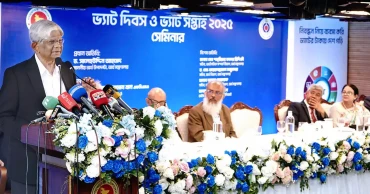
Urgent reforms needed to curb VAT leakage, expand tax net: Salehuddin
Finance Adviser Dr Salehuddin Ahmed on Wednesday underscored the urgent need to curb VAT leakage, widen both VAT and income tax coverage, and modernise Bangladesh’s tax administration.
“Bangladesh’s economic progress depends fundamentally on its ability to mobilise domestic resources rather than relying excessively on foreign loans and grants,”he said at a seminar organised at the Multipurpose Hall of the Revenue Building in the capital to mark VAT Day and VAT Week.
The Adviser stressed that VAT remains one of the most powerful and modern forms of taxation worldwide, yet Bangladesh continues to collect far less VAT as a share of GDP compared to neighbouring countries even though the economy has expanded significantly.
“There is no doubt about the need for VAT. In many countries, VAT contributes far more to national income. In our country, however, VAT collection remains extremely low compared to GDP,” he said.
The Finance Adviser pointed out that a major obstacle is VAT leakage at the retail and business levels.
“A very unfortunate reality in Bangladesh is that VAT sometimes does not reach the government’s treasury,” he said.
He called for a fundamental shift in mindset among businesses and consumers so that both parties accept VAT as a national obligation and insist on proper documentation and compliance.
He urged customers to demand VAT invoices and expect businesses to remit VAT properly. “People must be convinced that paying VAT ultimately benefits them—through improved public services,” he added.
Dr Ahmed also expressed concern about the country’s chronically low tax-to-GDP ratio, saying Bangladesh cannot fulfill its development ambitions without strengthening domestic revenues.
Priority sectors such as education, healthcare and social protection remain constrained when the state is forced to rely on external borrowing, he said.
“The biggest challenge is that our tax-GDP ratio is extremely low. Without increasing our own resources, how will we carry out development work? Loans and grants restrict our flexibility and limit our ability to prioritise the needs of our people,” he said.
“For people to pay tax willingly, the government must ensure that taxpayers receive services and trust that their money is used properly,” he said.
The Finance Adviser urged the National Board of Revenue (NBR) to move swiftly to broaden the system, modernise processes and make tax compliance more convenient.
He also suggested gradually reducing reliance on supplementary duties, increasing the share of income tax and VAT, and strengthening non-tax revenues.
“If the system is made easier and modernised, people will not hesitate to pay VAT. We must expand good practices, reduce hassle, and strengthen enforcement to ensure that VAT reaches the treasury,” he said.
He expressed optimism that if reforms continue over the next two months, a significantly modernised and streamlined system will be ready for the next government to take forward.
Through rationalisation of tax expenditures, he said that the scope of VAT has expanded, which is reflected in this year’s budget.
Revenue growth up to November has been 15%, a result the government had not even expected, he said.
“This achievement comes at a time when government expenditure especially capital spending has been curtailed. Rising revenue alongside restrained expenditure indicates that the private sector’s contribution to economic growth is increasing,” he added.
NBR Chairman Md Abdur Rahman Khan said VAT is often misunderstood—businesses believe they pay VAT, but in reality they only collect it on behalf of the government from consumers.
“They pay income tax, but VAT is not their tax; it is collected and deposited with the government. Import duties, too, ultimately fall on consumers.”
He said no advanced country relies on trade-based taxes for major revenue, and Bangladesh must shift toward domestic sources.
“Despite the potential of income tax, significant leakage exists. Ultimately, he said, most revenue should come from income tax, followed by VAT, while customs duties should play a minimal role. LDC graduation will make this shift unavoidable.”
He said the VAT system has become unnecessarily complicated and needs simplification, especially ensuring that businesses understand the VAT credit mechanism.
Finance Secretary Dr Md Khairuzzaman Mozumder, Economic Relations Division Md Shahriar Kader Siddiky, Financial Institutions Division Nazma Mobarek, FICCI Vice President Yasir Azman , ICCB president Mahbubur Rahman and Policy Research Institute chairman Dr Zaidi Sattar also spoke.
NBR Chairman Md Abdur Rahman Khan Presided over the seminar where NBR Member (VAT audit) Syed Mushfequr Rahman presented the keynote paper.
NBR Member (VAT Policy) Md Azizur Rahman delivered the welcome address.
7 months ago