usa
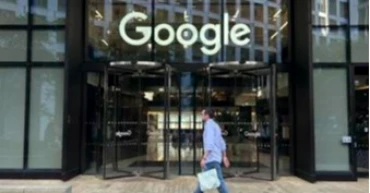
Google to battle US government in high-stakes antitrust hearing over search monopoly
Google is set to face a pivotal legal challenge on Monday as the U.S. government pushes to dismantle parts of the company, arguing that it has transformed its once-innovative search engine into an oppressive monopoly.
Over the next three weeks, a Washington courtroom will host what’s known as a “remedy hearing,” where both sides will present arguments over how to penalize Google for violating antitrust laws. Witnesses, including Google CEO Sundar Pichai, are expected to testify.
The U.S. Department of Justice is urging a federal judge to impose sweeping measures, including banning Google from securing multibillion-dollar partnerships with companies like Apple that help entrench its search dominance. The government also wants Google to share its user data with rivals and divest from its widely used Chrome browser.
This critical phase follows more than four years after the Justice Department initially sued Google, accusing it of exploiting its dominance in the online search market to suppress competition and innovation.
In a key ruling last year, U.S. District Judge Amit Mehta found that Google had engaged in anticompetitive practices, particularly by locking its search engine into popular platforms such as iPhones, PCs, and Android devices. That verdict now sets the stage for determining what corrective steps the company must take.
Since its humble origins in a garage in 1998, Google has grown into a tech giant with major influence across email, mapping, video, browsing, smartphone software, and cloud infrastructure.
Building on its legal victory, the Justice Department now argues that dramatic changes are essential to curbing Google’s market control and that of its parent company, Alphabet Inc.
“Google’s illegal conduct has created an economic goliath, one that wreaks havoc over the marketplace to ensure that — no matter what occurs — Google always wins,” the Justice Department stated in documents detailing its proposed remedies. “The American people thus are forced to accept the unbridled demands and shifting, ideological preferences of an economic leviathan in return for a search engine the public may enjoy.”
Although the proposed penalties originated under President Joe Biden’s administration, they remain supported under President Donald Trump, whose first term saw the filing of the original case. Since then, the Justice Department has framed Google’s dominance as not just an economic threat, but also one to civil liberties.
“The American dream is about higher values than just cheap goods and ‘free’ online services," the department argued in a March 7 court filing. “These values include freedom of speech, freedom of association, freedom to innovate, and freedom to compete in a market undistorted by the controlling hand of a monopolist."
Google, however, contends that the proposed remedies go too far and aren’t justified by the court’s findings. The company claims that its success stems from user preference, not monopolistic behavior.
“The ‘unprecedented array of proposed remedies would harm consumers and innovation, as well as future competition in search and search ads in addition to numerous other adjacent markets,” Google’s legal team wrote. “They bear little or no relationship to the conduct found anticompetitive, and are contrary to the law.”
The company also raised concerns over potential risks associated with the remedies, particularly the requirements to share search data and possibly divest Chrome. “The breadth and depth of the proposed remedies risks doing significant damage to a complex ecosystem. Some of the proposed remedies would imperil browser developers and jeopardize the digital security of millions of consumers."
China cautions nations against trade deals with US that could harm Beijing
This legal showdown is considered the most significant U.S. antitrust battle since the 1990s when Microsoft faced similar charges for leveraging Windows to suppress competition. That case ended with a judge ordering a partial breakup of Microsoft — a remedy later overturned on appeal.
While Google plans to appeal Mehta’s decision labeling its search business as an illegal monopoly, it cannot do so until the current remedy hearings conclude. Closing arguments are scheduled for late May, and Mehta is expected to issue a final decision by Labor Day.
The case against Google’s search business is one of several high-profile antitrust actions targeting major tech firms. Meta, the parent of Facebook and Instagram, is currently defending itself against monopoly accusations in a separate Washington D.C. trial. Apple and Amazon have also come under similar scrutiny.
Meanwhile, another recent ruling in a separate case found Google guilty of abusing its power in the digital advertising space — a decision that will lead to yet another remedy hearing, possibly later this year or in early 2026, again raising the possibility of a company breakup.
1 year ago
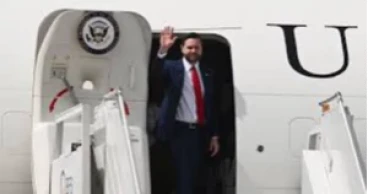
US Vice President begins 4-day visit to India for personal engagements, trade talks
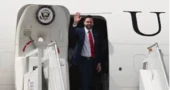
US Vice President JD Vance landed in India on Monday on a four-day trip, during which he will attend personal engagements and hold discussions focused on trade, as India aims to avoid U.S. tariffs, pursue a bilateral trade deal with Washington, and deepen its relationship with the Trump administration.
On the first day of his primarily personal visit, Vance is scheduled to meet with Prime Minister Narendra Modi. Their talks are expected to cover bilateral relations, following up on the agenda set during Modi’s February meeting with President Donald Trump in Washington.
India and the United States, which is New Delhi’s top trading partner, are currently engaged in talks aimed at finalizing a bilateral trade agreement within the year. Both countries have set an ambitious goal to more than double their trade to $500 billion by 2030—a move that could significantly enhance economic cooperation and strengthen diplomatic relations.
Vance’s inaugural trip to New Delhi comes at a time when Trump's tariff measures against several countries, including India, are on pause. It also takes place against the backdrop of an escalating trade conflict between Washington and Beijing, India’s key regional competitor.
“We are very positive that the visit will give a further boost to our bilateral ties,” Indian Foreign Ministry spokesperson Randhir Jaiswal said last week.
Upon arriving at New Delhi’s Palam airport on Monday—after a visit to Rome where he met Pope Francis on Easter Sunday—Vance was welcomed with a traditional Indian classical dance performance. He is traveling with his wife, Usha Vance, whose parents are originally from India, their children, and members of the U.S. administration. The couple is also set to tour historic sites in Jaipur and Agra.
Vance set to visit India for bilateral talks on economic, trade and geopolitical ties
India remains a key strategic partner for the United States, especially in efforts to counter China’s growing influence in the Indo-Pacific region. The country is also a member of the Quad—alongside the U.S., Japan, and Australia—which is widely viewed as a regional counterweight to China’s ambitions. Trump is expected to attend a Quad leaders’ summit in India later this year.
Modi cultivated a strong working relationship with Trump during his first term and is expected to continue deepening collaboration with the U.S.
He was among the earliest leaders to visit Washington and engage with Trump following his return to the presidency. During that trip, Modi lauded the U.S.-India “mega partnership” and launched negotiations aimed at minimizing the impact of Trump’s tariff measures.
The two leaders also expressed a shared interest in expanding defense cooperation. India has indicated its willingness to align with U.S. priorities by pledging to increase purchases of American oil, energy, and defense equipment.
Nevertheless, Trump imposed a 26% tariff on India—currently on hold—and has continued to label India a “tariff abuser” and the “tariff king.”
New Delhi is especially eager to conclude trade negotiations, as the country stands to be significantly affected by potential reciprocal tariffs from the Trump administration, particularly in sectors such as agriculture, processed foods, auto parts, advanced machinery, medical equipment, and jewelry.
1 year ago
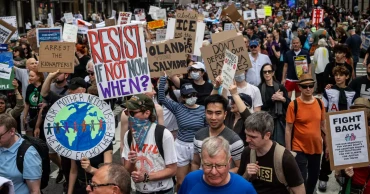
Nationwide anti-Trump protests spotlight concerns over democracy and civil rights
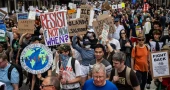
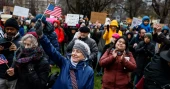
Across the United States on Saturday, demonstrators rallied in cities and towns to voice their opposition to former President Donald Trump, accusing his administration of undermining democratic values and civil liberties.
The protests spanned the country, from a march through midtown Manhattan to a gathering outside the White House in Washington, D.C. In Massachusetts, demonstrators marked the 250th anniversary of the Revolutionary War’s first battle—the “shot heard ’round the world”—with a protest at a reenactment of the Battles of Lexington and Concord.
Israeli strikes on Gaza kill more than 90 people in the last 48hrs
Among the crowd near Boston was 80-year-old Thomas Bassford, a retired mason from Maine. Accompanied by his family, including two young grandsons, he said the country is facing a dangerous moment. “This is a very perilous time in America for liberty,” Bassford said. “I wanted the boys to learn about the origins of this country and that sometimes we have to fight for freedom.”
In Denver, hundreds rallied at the Colorado State Capitol with signs supporting immigrant rights and slogans like “Hands Off!” directed at the Trump administration. Some demonstrators waved American flags held upside down—a traditional symbol of national distress.
On the West Coast, thousands marched through downtown Portland, Oregon, while in San Francisco, protesters formed the phrase “Impeach & Remove” on a beach, using their bodies to create the massive message. In Anchorage, Alaska, demonstrators carried handmade signs listing grievances, including one that read: “No sign is BIG enough to list ALL of the reasons I’m here!”
Beyond marches and rallies, protests took on various forms. Some targeted Trump adviser Elon Musk, with pickets at Tesla dealerships over his involvement in efforts to shrink the federal government. Others opted for constructive action, organizing food drives, educational events, and volunteering at community shelters.
The wave of protests comes just two weeks after similar nationwide demonstrations and reflects continued unrest among Trump critics. Organizers condemned what they described as civil and constitutional violations under the former president, including aggressive immigration policies and mass layoffs of government workers.
Echoes of Revolutionary War symbolism were present throughout the day. Protesters embraced themes of resistance, with signs reading “No Kings” and “The Feudal Age is OVER.” In Anchorage, a protester dressed in colonial-era clothing held a sign calling for the end of tyranny. In Concord, Boston resident George Bryant voiced deep concern about what he sees as a shift toward authoritarianism, holding a sign that declared, “Trump fascist regime must go now!”
For many, the day was not just a protest—it was a declaration of vigilance, unity, and a call to preserve the nation's democratic foundations.
END/UNB/AP/MA
1 year ago
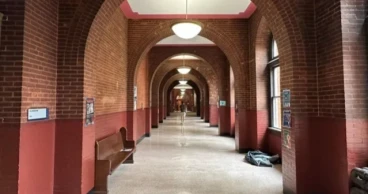
Anxiety grows at US colleges as foreign students detained, visas revoked
Over recent weeks, many international students in the US have watched a concerning pattern unfold on social media: plainclothes officers arriving without warning and taking students away in unmarked vehicles to detention centers.
These detained students, often seen in viral videos, have not been charged with any crimes.
Instead, they appear to be singled out for participating in pro-Palestinian demonstrations on college campuses.
The Trump administration has long emphasized that visas are a privilege that can be withdrawn for many reasons.
However, the extent of the current crackdown appears broader than previously believed. According to Inside Higher Ed, over 1,000 international students or recent graduates across the country have either lost their visas or had their legal status altered.
In many cases, the exact reasons for visa revocation remain unclear. Universities often discover these changes only by checking the government database that monitors international student status, reports BBC.
The combination of targeted arrests and widespread visa cancellations has created an atmosphere of fear at institutions ranging from large public universities to elite Ivy League schools. "I could be next," said a Georgetown University student who has written about the Gaza conflict. He now carries a card outlining his constitutional rights in case he’s stopped by law enforcement. Another student in Texas said he avoids going outside, even for groceries.
Some academic departments have also been affected, as foreign researchers are now hesitant to return to the US. Most students interviewed by the BBC requested anonymity, fearing media exposure could put them at risk.
The BBC reached out to the Department of Education for comment.
While some visa cancellations are reportedly tied to criminal records or minor infractions like speeding, many of those targeted have participated in pro-Palestinian protests, according to Secretary of State Marco Rubio. The crackdown is part of a broader White House effort against campus protests officials claim have endangered Jewish students and allegedly shown support for Hamas, a group designated as a terrorist organization.
Rubio stated in March, "Every time I find one of these lunatics, I take away their visas. We do it every day."
Civil liberties groups have condemned the detentions and deportation efforts as unconstitutional. Students deny any connection to Hamas and argue they are being penalized for expressing political views on the Gaza war and US policy.
At Georgetown, signs reading “protect our students” now appear in bathroom stalls, reflecting growing unease despite the usual springtime blooms.
In one case, Badar Khan Suri, a postdoctoral fellow at Georgetown, was taken by federal agents outside his Virginia home in March. Homeland Security accused him of promoting antisemitism online and having ties to a “known or suspected terrorist”—a reference to his wife’s father, a former adviser to deceased Hamas leader Ismail Haniyeh. Suri’s legal team says he barely knows his father-in-law and is being targeted because of his wife's background.
1 year ago
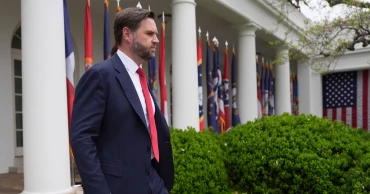
Vance to meet Modi, Meloni during trip to India and Italy with wife Usha
Vice President JD Vance and his family will travel to Italy and India this week and next to meet with leaders and visit cultural sites.
Vance's office said Wednesday his trip from Friday to April 24 will include visits to Rome and New Delhi along with the Indian cities of Jaipur and Agra.
The trip comes as Vance has taken on a prime role in the White House's engagements abroad. The Republican vice president and his wife, Usha Vance, traveled to Greenland last month, and he went to Paris and Munich in February.
President Donald Trump is expected to make his first foreign trip in May to Saudi Arabia.
In Rome this week, Vance is expected to meet with Prime Minister Giorgia Meloni, who is due to visit the White House on Thursday. Vance, who converted to Catholicism in 2019, will also meet with Vatican Secretary of State Cardinal Pietro Parolin, according to his office, and is expected to participate in ceremonies around Easter Sunday.
China's economy grows at a 5.4% annual pace in Jan-March quarter
Vance's visit to India marks his first trip to the country, which has added significance for the second family. Usha Vance is the daughter of immigrants from South India.
While in India next week, Vance is expected to meet with Prime Minister Narendra Modi, who met with Trump at the White House in February.
1 year ago
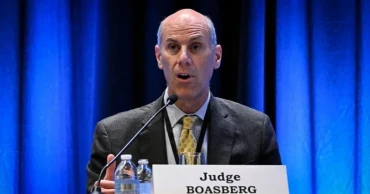
US judge says he could hold Trump administration in contempt of court
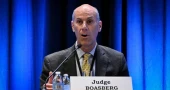
A US judge has said he could hold the Trump administration in contempt of court for "willful disregard" of an order to halt the departure of deportation flights carrying more than 200 people to El Salvador last month.
The administration had invoked a 227-year-old law meant to protect the US during wartime to carry out the mass deportation, BBC reports.
"The Court does not reach such conclusion lightly or hastily; indeed, it has given Defendants ample opportunity to rectify or explain their actions. None of their responses has been satisfactory," federal judge James Boasberg wrote.
The decision to begin contempt proceedings escalates a clash between the White House and the judiciary over the president's powers.
Harvard rejects Trump’s demands, faces multi-billion-dollar funding freeze
The administration could avoid a contempt finding, or "purge" itself of contempt, if they provide an explanation of their actions and come into compliance with the original order issued last month, Boasberg said on Wednesday.
That filing is due by 23 April, he said.
Thursday's decision comes despite the Supreme Court's later finding that Donald Trump could in fact use the 1798 Alien Enemies Act to conduct the deportations to El Salvador.
The Supreme Court's ruling against Boasberg's temporary restraining order "does not excuse the Government's violation", he said.
If the administration does not provide the requested information by the 23 April deadline, Boasberg will then seek to identify the individual people who ignored the order to stop the deportations.
He could then recommend prosecutions for those involved.
1 year ago
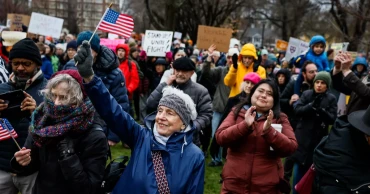
Harvard rejects Trump’s demands, faces multi-billion-dollar funding freeze
The federal government has announced it is suspending over $2.2 billion in grant funding and an additional $60 million in contracts to Harvard University following the institution's refusal to comply with the Trump administration’s directives aimed at curbing campus activism.
This funding freeze marks the seventh instance in which the Trump administration has taken such action against a leading U.S. university, primarily within the Ivy League, as part of an effort to bring institutions in line with the administration’s political stance.
Trump administration excludes smartphones, laptops from tariffs
In a letter issued to Harvard on Friday, the administration demanded extensive changes, including reforms in university governance, admissions procedures, and a review of how diversity is addressed on campus. It also called for the disbandment of certain student organisations.
Officials warned that close to $9 billion in total federal support was at risk if Harvard did not cooperate.
Harvard President Alan Garber responded on Monday, affirming the university’s position against the government’s demands.
“The University will not compromise its independence or constitutional protections,” Garber wrote in a message to the Harvard community. “No administration — regardless of political affiliation — has the authority to dictate whom private institutions admit or employ, what they teach, or what areas of research they pursue.”
Just hours later, the federal government imposed the freeze on Harvard’s funding.
Columbia University was the first to be targeted under this policy and eventually complied under threat of financial loss. Similar measures have since been taken against the University of Pennsylvania, Brown, Princeton, Cornell, and Northwestern.
The Trump administration has made it increasingly routine to use federal funding as leverage to enforce political priorities within academic institutions. Officials claim that universities have failed to address antisemitism, particularly following last year’s protests opposing Israel’s war in Gaza.
Garber stated that Harvard had already implemented significant reforms to tackle antisemitism, but argued that most of the administration's demands had little to do with that issue and instead appeared to be attempts to exert control over the university’s intellectual direction.
He warned that withholding federal funds from Harvard — a global leader in scientific and medical research — could endanger public health and the nation’s economic stability. He also said the move violated Harvard’s First Amendment rights and overstepped the bounds of Title VI, which bans discrimination based on race, colour, or national origin.
Trump admin halts $1b in federal funding for Cornell, $790m for Northwestern
Among the government’s demands were the adoption of “merit-based” admissions and hiring practices and a review of faculty, students, and leaders regarding their stance on diversity. The administration also called for a ban on face coverings on campus — seemingly aimed at pro-Palestinian demonstrators — and urged Harvard to cut ties with any student group that endorses or promotes criminal activity, unlawful violence, or harassment.
According to the federal antisemitism task force, Harvard’s refusal to comply highlighted a “troubling entitlement mentality” among elite institutions and a disregard for the responsibilities that come with federal funding.
“The continued disruption of education on campuses is unacceptable. The harassment of Jewish students cannot be tolerated,” the task force stated Monday.
Former President Donald Trump has pledged a stricter approach to combating campus antisemitism, accusing President Joe Biden of being too lenient. His administration has launched new investigations, detained foreign students linked to pro-Palestinian protests, and deported several of them.
The administration’s demands led a group of Harvard alumni to issue a letter urging the university to legally challenge what they described as unlawful efforts that undermine academic freedom and university autonomy.
“Today, Harvard took a stand for the principles, values, and freedoms that underpin higher education,” said Anurima Bhargava, one of the alumni who co-authored the letter. “Harvard reminded the world that learning, discovery, and transformative progress cannot be dictated by authoritarian force.”
The government's pressure on Harvard has triggered a wave of resistance, including a weekend protest by students and Cambridge residents, as well as a lawsuit filed Friday by the American Association of University Professors.
In their suit, the plaintiffs argue that the administration failed to follow the proper legal procedures under Title VI, which require notification to both the university and Congress before funding is withdrawn.
“These sweeping and vague demands do not aim to resolve any legal violations,” the complaint states. “Rather, they openly seek to impose political ideologies and policy preferences of the Trump administration on Harvard University and require the institution to penalise speech that it disfavors.”
1 year ago
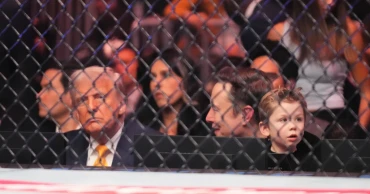
Trump receives standing ovation as enters UFC event in Miami
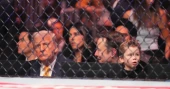
President Donald Trump entered to a standing ovation and cheers from a crowd of thousands attending a UFC event on Saturday night, shaking hands with supporters against a backdrop of fans waving his trademark MAGA hats.
Just as Trump entered, he greeted podcast host Joe Rogan, who sat to the right of the president. On the other side of Trump sat Elon Musk, billionaire and chief of the Department of Government Efficiency. Trump, who accented his dark suit with a bright yellow tie, pumped his fist in the air, prompting cheers to strains of “Taking Care of Business.”
He brought along several members of his administration and White House team, including Health and Human Services Secretary Robert F. Kennedy Jr., FBI Director Kash Patel, Director of National Intelligence Tulsi Gabbard and White House communications aides Steven Cheung and Taylor Budowich. Secretary of State Marco Rubio and U.S. Sen. Ted Cruz, R-Texas, also joined Trump for UFC 314.
Trump entered the arena with UFC President Dana White, with whom he has been close for decades. He was also accompanied by his granddaughter, Kai Trump, the daughter of Donald Trump Jr.
The Republican president is a longtime UFC fan and sports enthusiast, who has frequently attended major fights. The mixed martial arts fight at Miami’s Kaseya Center was Trump's first UFC visit since he took office in January, and it came weeks after Trump attended the Saudi-sponsored LIV golf tournament at his golf club in Miami.
In a further nod to his sports enthusiasm, Trump has also attended the Super Bowl and Daytona 500 since taking office. He sat cageside at a UFC championship fight in New York City last November, shortly after he won the 2024 election.
Trump claims ‘very good shape’ after physical, but report delayed
Aside from the president, the main event for the UFC 314 fight is a championship bout between Australian former champion Alexander Volkanovski and Brazilian fighter Diego Lopes, who are competing for the featherweight championship title. It's the fourth UFC event in Miami, in a county that supported the president by about 11 percentage points in the November election.
The president arrived in West Palm Beach on Friday for his 10th visit to South Florida since he became president, spending the evening in his Mar-a-Lago estate in Palm Beach. He flew to Miami after playing golf at his club in West Palm Beach.
“You know who’s going to win? Dana White. Dana White’s gonna win,” Trump told reporters Saturday night aboard Air Force One.
His close affiliation with UFC helped boost his 2024 presidential campaign among young male voters prior to the November election, where he made promoting hypermasculine tones a signature of the campaign.
1 year ago
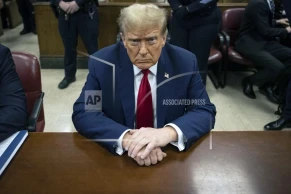
Trump claims ‘very good shape’ after physical, but report delayed
WASHINGTON (AP/UNB)- President Donald Trump underwent his annual physical on Friday and declared himself fit, saying, “I did well,” while praising his heart, soul, and cognitive performance.
However, the official medical report from White House doctors is not expected until the weekend.
Trump, 78, who became the oldest person to assume the U.S. presidency when sworn in this January, spent nearly five hours at Walter Reed National Military Medical Center. He described it as undergoing “every test you can imagine.”
“I was there for a long time,” Trump told reporters. “I think I did very well.”
Although he has frequently questioned former President Joe Biden’s health, Trump has often withheld detailed information about his own. He said he expects the doctor’s report by Sunday, but historically such disclosures have offered limited detail and glowing assessments.
White House press secretary Karoline Leavitt said a summary from the White House physician would be made public “as soon as we possibly can” and implied it would be thorough.
After the exam, Trump boarded Air Force One en route to Florida for the weekend. Midflight, he mentioned receiving “a little bit” of advice on lifestyle improvements from his doctors but didn’t share specifics.
“Overall, I felt I was in very good shape. A good heart, a good soul, a very good soul," Trump said. He added that he took a cognitive exam. “I don’t know what to tell you other than I got every answer right,” he said.
He argued that mental fitness testing is what Americans want and criticized Biden again, saying, “Biden refused to take it.”
This would be the first formal update on Trump’s health since the attempted assassination in Butler, Pennsylvania, in July. At the time, instead of releasing records, Texas Rep. Ronny Jackson — a loyal ally and former White House physician — issued a memo noting a gunshot wound to Trump’s right ear.
Trump had previously told CBS in August that he would “very gladly” release his medical records, but no documents were shared.
Although three years younger than Biden, Trump was five months older than Biden was during his first inauguration, making him the oldest person to be sworn in as president.
Like all Americans, presidents have a right to medical privacy and can choose what information to disclose. In recent decades, presidential physicals have offered the public some insight into their health, but Trump has typically offered only broad overviews.
Prior to Jackson’s July memo, the last update came in November 2023, when Dr. Bruce A. Aronwald released a letter on Trump’s social media. It stated Trump was in “excellent” health but lacked specific data like weight, blood pressure, or cholesterol levels. Aronwald said Trump had “reduced his weight” and scored exceptionally on cognitive tests.
Trump previously received treatment at Walter Reed for COVID-19 in 2020. Although his physician described an optimistic outlook, then-chief of staff Mark Meadows later said some of Trump’s vital signs were “very concerning.” Later reports indicated Trump was more seriously ill than initially acknowledged.
In another instance, a 2019 visit to Walter Reed for a physical wasn’t disclosed in advance, breaking with protocol. The White House later called it a “planned interim checkup” that had been kept private due to scheduling.
Trump’s cognitive ability became a talking point in 2020 when he recited “Person. Woman. Man. Camera. TV” during an interview to demonstrate his mental sharpness. When asked about the same test on Air Force One this Friday, he replied, “It’s a pretty well known test.”“Whatever it is, I got every one — I got it all right,” he said.
1 year ago
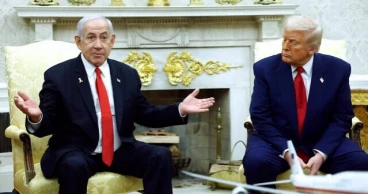
53% of Americans have unfavorable view of Israel, compared to 42% in 2022
A growing number of Americans now view Israel unfavorably, with more than half expressing distrust in Israeli Prime Minister Benjamin Netanyahu’s leadership, according to a new Pew Research Center survey.
The poll, conducted from March 24 to 30 among 3,605 U.S. adults, found that 53% of Americans now have an unfavorable opinion of Israel, a sharp rise from 42% in 2022. The shift crosses political and generational lines.
Among Republicans, negative views of Israel rose to 37%, up from 27% two years ago. Among Democrats, unfavorable sentiment surged to 69%, compared to 53% in 2022. Younger Americans, regardless of party affiliation, are particularly critical: 71% of Democrats under 50 and 50% of Republicans under 50 now view Israel unfavorably.
‘Shame on you all’: Indian-American engineer resigns over Microsoft’s Israel ties
The survey also showed a widening trust gap when it comes to Netanyahu. Over half (52%) of respondents said they have little or no confidence in him to handle global affairs appropriately, compared to 32% who expressed confidence. Among Democrats, trust in Netanyahu is especially low — just 15% said they believe he will do the right thing, compared to 51% of Republicans.
Even among American Jews, views on Netanyahu are divided: 53% said they lack confidence in him, while 45% expressed support. White evangelical Protestants were the only U.S. religious group where a majority expressed confidence in the Israeli leader.
The poll also explored attitudes toward former President Donald Trump’s controversial proposal to have the U.S. take control of the Gaza Strip. A strong majority — 62% — opposed the idea, including 49% who said they “strongly oppose” it. Only 15% supported the proposal, which Trump floated again during a recent meeting with Netanyahu.
Bangladesh condemns Israeli killings, human rights violations in Gaza
Despite the low support, nearly half of Americans (46%) believe Trump is likely to pursue the policy if re-elected. Within the Republican Party, 44% oppose the idea, while 27% support it.
Public interest in the ongoing Israel-Hamas conflict appears to be waning. Just 54% of Americans said the war is personally important to them, down from 65% in January. However, the issue remains deeply significant to U.S. Jews, with 93% calling it important and 74% labeling it “very important.”
Israel seizes 50% of Gaza by destroying land to extend buffer zone
The Pew findings align with a February Gallup poll that also documented declining favorability toward Israel, reflecting broader shifts in public sentiment following the events of October 7, 2023, and the subsequent Gaza conflict.
Source: With inputs from agencies
1 year ago