Others

Pam Bondi to face closed-door questioning over Epstein files
Former Attorney General Pam Bondi is testifying before House lawmakers investigating Jeffrey Epstein’s sexual abuse cases, a long-awaited appearance that brings fresh scrutiny of the administration’s botched release of the Epstein case files.
Bondi was defiant in previous public testimony when she was confronted by lawmakers about the Epstein investigation. It’s unclear whether she’ll bring the same approach Friday, now that she is no longer in charge of the Justice Department. The session will be held behind closed doors.
The transcribed interview will give lawmakers a chance to dig for information on the Trump administration’s handling of the Epstein files and other related matters, including the prison sentence of his former girlfriend and confidant, Ghislaine Maxwell. The Justice Department moved Maxwell to a prison camp in Texas last August.
“I think she absolutely could clear up many missing pieces if she wanted to,” said Rep. Yassamin Ansari, an Arizona Democrat on the House Oversight Committee. “Now it’s a question of whether or not she is willing to be transparent.”
Lawmakers are trying to find out what decisions prosecutors have made about investigating Epstein associates, how the Justice Department handled the congressional mandate to release the Epstein case files and whether President Donald Trump was involved in the process.
Bondi, who revealed this week that she is being treated for thyroid cancer, has stayed within Trump’s orbit even after being ousted from her job in early April.
Trump appointed her to a White House panel on artificial intelligence this week, and Bondi will be accompanied Friday by Justice Department officials, including Harmeet Dhillon, who heads the department’s Civil Rights Division, acting as her counsel.
Democrats say that arrangement is a conflict of interest.
A spokesperson for the Justice Department said the officials were there to help lawmakers understand the department’s process for releasing the case files.
Bondi was central to the Epstein sagaBondi has been central to the political firestorm over Epstein, initially raising expectations for the full release of what’s known as the Epstein files, only to later backtrack. That reversal prompted Congress to step in and pass a law requiring the release.
Bondi faced even more backlash when the Justice Department’s release of the files was delayed and then included personal information of several potential victims. She has insisted in congressional hearings that she was trying to follow the law.
The House Oversight Committee, meanwhile, has been conducting a wide-ranging investigation into Epstein that spans multiple presidential administrations.
The interview format is already contentiousBondi was subpoenaed by the committee in March in a bipartisan vote, but she tried to head off that demand by holding a closed-door meeting with lawmakers that same month. The maneuver only added to the enmity between Bondi and Democrats on the committee.
Bondi’s departure from the Justice Department also raised doubts about the enforcement of the congressional subpoena. After the committee’s Democrats maneuvered to press for a civil contempt of Congress resolution against Bondi, she agreed to sit for a transcribed interview rather than a sworn deposition.
Democrats on the Oversight panel have criticized that arrangement, saying that it allows Bondi to decline to answer questions. They have also pressed the Republican chair of the committee, Rep. James Comer, to record the interview on video.
“A failure to film and release a video of Ms. Bondi’s testimony would present a grave injustice to the American people and survivors of Epstein’s crimes,” the committee’s top Democrat, Rep. Robert Garcia, wrote to Comer.
Comer has said he is allowing Bondi to sit for a transcribed interview rather than a deposition as an incentive to cooperate. Previously, he had enforced a subpoena on former President Bill Clinton and former Secretary of State Hillary Clinton after they resisted the demand. Both of their depositions were video-recorded.
Still, Comer said Bondi could face prosecution if she lies to Congress. He said the committee would also release a transcript of the interview.
“Hopefully that will be good enough,” he said.
2 months ago

Over 50,000 U.S. youth visit China for exchanges, study since 2023
China has hosted more than 50,000 young Americans for exchanges and study visits, hitting the five-year target set in 2023, the Ministry of Education announced Friday.
The U.S. young visitors, from the country's 50 states and Washington, D.C., reached across China's 31 provincial-level regions as well as Hong Kong and Macao special administrative regions.
They participated in activities as diverse as learning languages, summer and winter camps, sports competitions, and academic studies for credits or degrees.
The exchanges bridged information gaps, strengthened goodwill and contributed to stable, healthy and sustainable bilateral ties, said an official from the international cooperation department of the education ministry.
The ministry also encourages efforts from both public and private sectors to scale-up exchanges and turn short-term engagements into robust, long-term partnerships.
2 months ago

Man arrested after stabbing three people at Swiss train station
A man was arrested after stabbing and injuring three people at a train station in the Swiss city of Winterthur on Thursday, police said.
The incident occurred shortly after 8:30 am, according to Zurich regional police. The suspect, identified as a 31-year-old Swiss national, is currently in custody, and authorities are investigating the motive behind the attack.
The victims all Swiss citizens aged 28, 43 and 52 were taken to nearby hospitals. Officials have not yet disclosed the extent of their injuries.
Winterthur, a city of around 123,000 people, is located in northeastern Switzerland, close to Zurich, the country’s largest city.
2 months ago
Plans for Gaza international force face uncertainty as troop pledges stall
A planned International Stabilization Force for Gaza, once announced with strong optimism by the United States, is now facing major uncertainty as promised troop contributions fail to materialize.
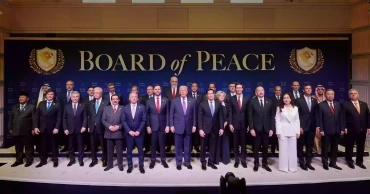
The 20,000-member force was unveiled in February at the first meeting of former US President Donald Trump’s Board of Peace. A US general assigned to lead the mission had said it would help bring long-term peace and stability after the devastating Israel–Hamas war.
However, three months later, the force has yet to take shape, as none of the five countries that initially pledged troops have sent meaningful contributions.
Efforts to support a fragile ceasefire have also slowed. Hamas has refused to disarm, while Israel has expanded its control in parts of Gaza and continued military strikes, which it says are aimed at militants but have also caused civilian casualties.
The recent conflict involving Iran has further complicated the situation, making it politically difficult for Arab and Muslim countries to openly cooperate with the US and Israel. Rising global energy prices have also added economic pressure on potential contributors.
Indonesia puts largest troop pledge on hold
Indonesia, which had pledged the largest contribution of around 8,000 troops, has suspended its plan indefinitely. Around 1,000 troops were expected to be deployed in April, followed by more in June.
Indonesia’s decision has been seen as a major setback for the initiative. Other pledged contributors include Morocco, Kazakhstan, Kosovo and Albania.
Indonesian officials said the suspension was due to unclear implementation plans and a lack of progress from Washington. They also pointed to rising tensions in the Middle East as a major concern.
Officials in Jakarta said shifting regional dynamics and the ongoing US–Iran conflict had slowed down the entire peace initiative, leaving both the Board of Peace and the stabilization force effectively on hold.
Public and political concerns in Indonesia
Analysts say domestic opinion in Indonesia may also have influenced the decision. The war in Gaza and wider Middle East tensions remain unpopular among the Indonesian public, and rising prices linked to global instability have added to economic concerns.
Experts also noted that many Indonesians are skeptical about whether the peace plan can truly improve conditions in Gaza.
Indonesia has previously lost peacekeepers in Lebanon during clashes involving Israel and Hezbollah, which has further reduced public support for overseas military deployments.
Disagreements over ceasefire progress
US officials linked to the Board of Peace say the main obstacle to progress is Hamas’s refusal to disarm. They argue that the stabilization force cannot begin operations until the second phase of the ceasefire is agreed, which would include Hamas laying down weapons and Israel gradually withdrawing from parts of Gaza.
Israeli forces currently control about 60% of the territory.
Officials supporting the plan say armed groups must be removed before reconstruction can begin, warning that stability is impossible while militias remain active.
Hamas blames Israel for delays
Hamas, however, says Israel has repeatedly violated the ceasefire and is responsible for delays in implementing the agreement. The group also accuses US officials of taking Israel’s side.
Local health authorities say more than 880 Palestinians have been killed since the ceasefire began, although Israel says its strikes were in response to violations of the truce.
According to mediators, Hamas is also demanding Israeli withdrawal from areas captured after the ceasefire began. Egypt has been acting as a key broker in the negotiations.
Several countries that pledged troops have reportedly said they will not deploy forces unless there is clear agreement on Hamas disarmament.
Limited commitments so far
Some countries have only offered limited support. Kazakhstan says it will focus on humanitarian assistance, including medical teams. Albania has said its involvement remains under discussion, while Kosovo has indicated it is in the final stages of preparation to send a small number of troops. Morocco has not provided further details.
So far, no participating country has confirmed that troops are on the ground.
Future still uncertain
Despite the setbacks, some analysts believe Indonesia could still reconsider its position in the future, depending on diplomatic progress.
Observers say Indonesia’s leadership may still want to maintain strong ties with the United States while balancing domestic concerns and regional tensions.
2 months ago
US launches fresh strikes on Iran as Trump says Tehran ‘running out of options
The United States carried out fresh “defensive” strikes against Iran on Wednesday, as President Donald Trump claimed Tehran is “running out of options” in ongoing negotiations and said upcoming midterm elections will not pressure him into a quick deal.
According to US officials, American forces intercepted and destroyed four Iranian one-way attack drones near the Strait of Hormuz, considering them a potential threat. The officials, who spoke on condition of anonymity, said US troops also targeted a drone control site in Bandar Abbas that was preparing to launch another drone.
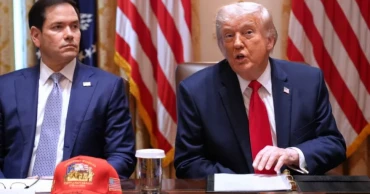
The latest military actions came as Trump expressed confidence during a Cabinet meeting that progress is being made toward ending the nearly three-month-long conflict, although negotiations remain uncertain.
The president is aiming for an agreement that would reopen the strategically vital Strait of Hormuz and allow him to claim that Iran’s nuclear capabilities have been significantly reduced. Such an outcome could help him justify ending a war that has faced political criticism at home.
However, the proposed deal leaves several key issues unresolved and has drawn criticism, even from some of Trump’s Republican allies. Critics argue that Iran’s leadership could emerge from the conflict weakened but still empowered.
With midterm elections approaching and concerns growing over rising fuel prices and living costs, some Republicans worry about the political impact. But Trump dismissed suggestions that the elections would influence his decisions.
“They thought they could wait me out because of the midterms,” Trump said. “I don’t care about the midterms.”
He acknowledged that negotiations are still ongoing but remained optimistic. “They want a deal badly,” he said. “We’re not satisfied yet, but we will be or we’ll have to finish the job.”
Earlier this week, the Pentagon confirmed similar “defensive” strikes targeting Iranian missile sites and boats suspected of laying naval mines. The US has said it is acting cautiously due to a fragile ceasefire that has been in place for weeks.
Republican concerns over deal terms
Despite Trump’s optimism, differences remain between Washington and Tehran on several major issues. Senior Republican lawmakers, including Senators Roger Wicker, Lindsey Graham and Ted Cruz, have expressed concern that the deal may be too favorable to Iran.
Some critics say the proposed agreement resembles the nuclear deal negotiated under former President Barack Obama a deal Trump had previously withdrawn from.
Under the current proposal, Iran would give up its stockpile of highly enriched uranium in exchange for relief from economic sanctions. Officials say details on how the uranium would be handled are still under discussion, with options including dilution or transfer to a third country.
However, Trump said he would not be comfortable with Russia or China taking control of Iran’s uranium stockpile.
According to the International Atomic Energy Agency, Iran currently possesses about 440.9 kilograms of uranium enriched up to 60% purity, close to weapons-grade levels. Iran has not publicly agreed to surrender this material.
Uncertainty over Israel and Lebanon
Another unresolved issue is whether the ceasefire would include Israel’s ongoing military operations against Hezbollah in Lebanon. Iran has insisted that Lebanon be included in any agreement.
The US proposal appears to leave room for interpretation, supporting a broader ceasefire while also recognizing Israel’s right to defend itself against immediate threats.
Clashes between Israeli forces and Hezbollah fighters continue in southern Lebanon, with Israeli troops advancing further north.
Analysts warn that any sanctions relief could allow Iran to rebuild its military strength and support allied groups like Hezbollah and Hamas.
Push to expand Abraham Accords
Trump has also called for expanding the Abraham Accords — agreements aimed at normalizing relations between Israel and several Muslim-majority countries — to include nations such as Saudi Arabia, Kuwait, Qatar and Pakistan.
“We are strongly encouraging them to join,” Trump said.
However, experts say this goal may be difficult to achieve. Saudi Arabia, for example, has maintained that recognition of Israel depends on a clear path toward establishing a Palestinian state — something Israel currently opposes.
Trump raised the issue during recent talks with Middle Eastern leaders, though reactions reportedly varied. While some officials described the response as muted, others said certain allies showed interest in the proposal.
2 months ago
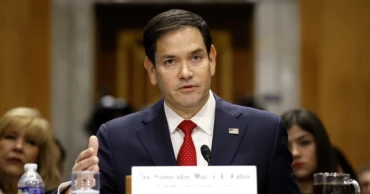
‘Diplomacy always first option’ on Iran: Rubio
Asked to give an update on negotiations, US Secretary of State Marco Rubio said he felt “there’s been some progress” on discussions with Iran and said the “next few hours and days” would yield more information.
Seated at Trump’s right hand, the country’s chief diplomat stressed that, while the president has “other options” if talks don’t yield the U.S.’ desired outcome, Rubio added, “We prefer the negotiated, diplomatic route, and we’re going to give it every chance to succeed.”
Trump said Rubio had been “all over the place” in recent days. The secretary of state returned to the U.S. last night after a five-day trip that included stops in Sweden and India.
2 months ago

Faith, Sacrifice, and Unity: The essence of Hajj and Eid al-Adha
Every year, millions of Muslims travel to Mecca in Saudi Arabia to perform the Hajj, one of the holiest acts of worship in Islam. The pilgrimage brings together believers from different countries and cultures in a shared spiritual journey marked by prayer, devotion and religious rituals.
This year’s Hajj comes amid regional uncertainty linked to the fragile ceasefire surrounding the Iran conflict and wider tensions in the Middle East. Earlier this year, some Muslims performing Umrah — often called the minor pilgrimage — faced travel disruptions caused by the conflict, leaving several stranded in Saudi Arabia.
The Hajj is one of Islam’s five pillarsHajj is the annual Islamic pilgrimage to Mecca and is considered a religious duty for every Muslim who is financially and physically capable of undertaking the journey at least once in their lifetime. Many believers, however, aspire to perform it multiple times.
The pilgrimage is one of the Five Pillars of Islam, alongside the declaration of faith, daily prayers, charity and fasting.
2 months ago
Israel says it killed new Hamas military leader in Gaza
Israel said on Wednesday that it had killed the newly appointed head of Hamas’ military wing in an airstrike in Gaza City, less than two weeks after his predecessor was also killed.
Israeli Defense Minister Israel Katz and the military said Tuesday’s airstrikes targeted Mohammed Odeh, who they claim was killed in the operation.
Relatives of a man named Mohammed Odeh confirmed he died in the strike but did not verify whether he held a senior Hamas military position. Hamas has not issued any statement on the incident.
Katz described him as “one of the masterminds” behind the October 7, 2023 attacks on Israel and said this was the fourth time Israel had eliminated the head of Hamas’ armed wing since that assault. The previous commander, Izz al-Din al-Haddad, was reportedly killed on May 16.
At least three people were killed and 12 others injured in the strike, which took place on the eve of Eid al-Adha, a major Islamic holiday.
In a post on X, Katz vowed continued action against those involved in the October 7 attacks, saying they would be “eliminated everywhere” and that Hamas would not retain any governing or military control.
Israeli Prime Minister Benjamin Netanyahu also reiterated that Israel would continue targeting anyone linked to the 2023 Hamas attack, as he prepares for upcoming elections.
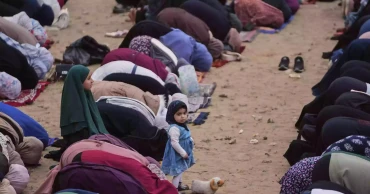
The strike came at a difficult time for Gaza residents, as Muslims marked Eid al-Adha under ongoing conflict and displacement. Many families in the territory are living in tents or temporary shelters after widespread destruction, with humanitarian conditions worsening.
Eyewitnesses in Khan Younis and Gaza City said Eid celebrations were minimal, with widespread grief overshadowing the holiday. “This is not Eid… we’re dead,” said one displaced resident, describing the heavy toll of the ongoing war.
Another displaced woman said the joy of Eid had disappeared due to the loss of loved ones, adding that the celebration now feels empty for many families.
A ceasefire between Israel and Hamas, agreed last October, remains fragile. Despite it, Israeli strikes have continued, with Palestinian health authorities reporting hundreds of deaths since it began. Israel says its operations respond to Hamas violations or threats.
The war began after the October 7, 2023 Hamas attack that killed about 1,200 people in Israel and saw 251 others taken hostage. Gaza’s health ministry says more than 72,700 Palestinians have since been killed, though it does not separate civilians from fighters.
2 months ago
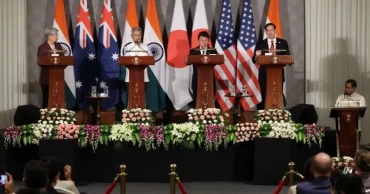
Quad stresses regional energy security initiatives in Indo-Pacific
Quad, a diplomatic partnership between the United States, Australia, India, and Japan committed to fostering a free and open Indo-Pacific, has highlighted the importance of regional initiatives to strengthen energy resilience.
In a statement released by the governments of Australia, India, Japan, and the United States of America on Tuesday on the occasion of the Quad Foreign Ministers’ Meeting in New Delhi, they also mentioned important regional initiatives such as India’s support to energy security in South Asia, Japan’s Partnership on Wide Energy and Resources Resilience (POWERR Asia).
The countries highlighted Australia’s support to energy security in Southeast Asia and the Pacific, including through the $2 billion Southeast Asia Investment Financing Facility, Australian Development Investments and support for the ASEAN Power Grid, as well as financial assistance to Pacific island countries (including AUD30 million in budget support to Fiji).
The United States, Australia, India, and Japan are united by a common vision for a free and open Indo-Pacific, underpinned by robust economic and energy systems.
Recognizing shifts in the global energy landscape and escalating geopolitical complexities, the countries are accelerating collaboration to ensure energy stability and security.
"We recognize impacts of disruptions to global markets, particularly in relation to oil, gas, and petrochemical products as well as essential goods and critical downstream derivatives such as fertilizers, fall heavily on the Indo-Pacific region. Our leaders have expressed a clear collective intent to cooperate on energy security and resilience," said the countries in a joint statement.
They reiterated their strong commitment to ensure well-functioning, stable, transparent, secure and resilient energy markets.
The countries reaffirmed the importance of resilient and diversified supply chains, including energy products and other downstream commodities.
They reinforced the importance of secure and uninterrupted trade flows, including the safety of navigation and the protection of critical maritime routes and infrastructure, as essential to global economic stability and energy security.
The countries reiterated the importance of ensuring unimpeded freedom of navigation and uninterrupted flow of global commerce, including in the Strait of Hormuz, and opposing any restrictive measures hampering the flow of commercial vessels.
They recognized their shared commitment to maintain open trade flows of energy products.
To this end, the United States, Australia, India, and Japan will work to identify areas of cooperation for the Quad Initiative on Indo-Pacific Energy Security in technology, management, policy, international market analysis, and emergency response exercises through an engagement plan.
This group effort would aim to recognize and leverage the unique resources and capabilities of each country’s energy sector, including to strengthen their respective strategic petroleum systems.
"We will work with our partners in the Indo-Pacific to help strengthen regional energy resilience," they said in a joint statement shared by the US Department of State.
To achieve this, the Quad will convene a Quad Fuel Security Forum to coordinate high-level discussions and facilitate cooperation.
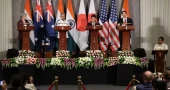
Foreign ministers from Australia, India, Japan and the United States announced new initiatives on Tuesday on maritime security, port infrastructure and energy to boost cooperation in the Indo-Pacific to counter concerns about China’s growing influence, reports AP.
The announcements by the group of nations known as the Quad came after talks in New Delhi between India’s Foreign Minister Subrahmanyam Jaishankar, U.S. Secretary of State Marco Rubio, Japanese Foreign Minister Toshimitsu Motegi and Australian Foreign Minister Penny Wong.
Speaking after the meeting, Rubio announced a new Indo-Pacific maritime surveillance initiative to integrate the four countries’ surveillance capabilities and strengthen real-time information sharing across the region. He said the Quad would work with Fiji to upgrade port infrastructure in the Pacific islands, marking its first joint regional infrastructure project.
The ministers also launched an Indo-Pacific energy security initiative aimed at strengthening regional fuel and energy supply chains, with the U.S. set to host a Quad fuel security forum later this year, Rubio said.
“We are deeply committed to this partnership. It is a linchpin in a cornerstone of our global strategy as a nation,” he said.
Separately, India and the U.S. signed a deal to strengthen cooperation on critical minerals as global concerns grow over reliance on China-dominated supplies.
2 months ago

US deports thousands of Cubans, Venezuelans to risky conditions in Mexico: HRW
The United States has deported nearly 13,000 Cubans, Venezuelans and other migrants to Mexico, where many face serious risks including cartel violence and lack of basic support, according to a new report by Human Rights Watch released Wednesday.
Although Mexico has accepted such deportations before, the report says those sent under the Trump administration are often older and had lived in the US for many years. This makes it harder for them to find jobs and increases their need for medical care.
The findings are based on more than 50 interviews conducted in the southern Mexican cities of Tapachula and Villahermosa. The report comes as US authorities have expanded immigration enforcement as part of a wider mass deportation drive.
As a result, people who were not previously targeted — including Cubans who had lived in the US for decades — are now being deported. Since countries like Cuba and Venezuela often refuse or limit return flights, many migrants are instead sent to Mexico under special arrangements.
A Human Rights Watch researcher described the situation as extremely difficult, especially for older people who are suddenly removed from their lives and left in an unfamiliar and sometimes dangerous environment without proper support.
Cubans make up the largest group among those deported, with more than 4,300 sent to Mexico. Many had lived in the US since the 1980s or 1990s, often holding green cards before losing their legal status.
The report says over half had some form of criminal record, but only a small portion were linked to violent crimes, while about a quarter had no criminal history at all.
Most were detained during routine immigration check-ins, while others were picked up at workplaces or public places. None were given a chance to appear before a judge to challenge their deportation to Mexico, even when they expressed safety concerns.
Once in Mexico, many are sent to southern areas with limited job opportunities, poor access to healthcare and high levels of crime. The process to seek refugee status is also complicated, leaving many stuck without clear legal status.
Aid workers say shelters are now seeing older deportees, including people in their 80s — a shift from the younger migrants usually arriving.
Human Rights Watch has urged both the US and Mexico to make their deportation agreements public and ensure proper legal procedures are followed. It also called on Mexico to provide healthcare and legal pathways for those unable to return home, and on the US to halt such deportations until safeguards are in place.
2 months ago