Foreign-Affairs
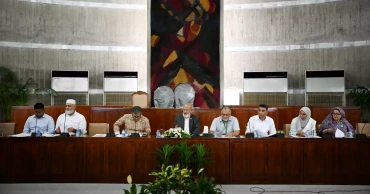
Bangladesh-China Parliamentary Friendship Group holds first meeting
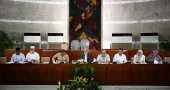
The first meeting of the Bangladesh-China Parliamentary Friendship Group of the 13th Parliament was held at the Jatiya Sangsad on Tuesday with its Chairman Dr Khandaker Mosharraf Hossain, MP, in the chair.
During the meeting, they discussed the longstanding friendly relations between Bangladesh and China and reviewed the importance of China in the current geopolitical context.
They also discussed strengthening the strategic partnership between Bangladesh and China, exchanging bilateral visits by parliamentary delegations and increasing investment to help reduce the trade deficit between the two countries.
Members of the group BNP lawmakers Md. Shohidul Islam, Md Hasan Rajib Prodhan, Jahrat Adib Chowdhury and Mahmuda Habiba, Jamaat lawmakers Muhammad Nazibur Rahman and Mohammad Moslehuddin Farid and NCP lawmaker Md. Abul Hasnat attended the meeting.
Senior officials of the Parliament Secretariat and the Foreign Affairs Ministry were present, said a release.
6 days ago
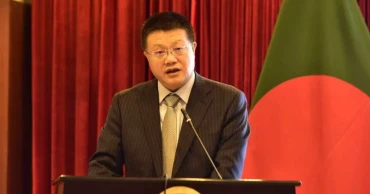
China eyes tangible benefits through cooperation with Bangladesh
Chinese Ambassador to Bangladesh Yao Wen has said China will continue to provide necessary assistance and support to Bangladesh, ensuring that the outcomes of bilateral cooperation bring tangible benefits to the peoples of both nations.
"China is willing to work hand in hand with Bangladesh to turn this project into another landmark of China-Bangladesh cooperation," he said during an on-site inspection of the China-aid Burn Unit at Chittagong Medical College Hospital on Monday.
Ambassador Yao said the Chinese side attaches great importance to the implementation of this project.
During the visit, Ambassador Yao met with Mayor of Chattogram City Corporation (CCC) Dr Shahadat Hossain, Abu Sufian, MP and Director of Chittagong Medical College Hospital Brigadier General Mohammed Taslim.
Ambassador Yao also provided ‘constructive suggestions’ on the project's progress and held a meeting with the Chinese management and technical teams, the Chinese Embassy in Dhaka said.
Dr Shahadat and other Bangladeshi officials expressed their heartfelt gratitude to China for its concrete support for the development of Bangladesh and the improvement of people's livelihoods, and expressed their expectation of achieving more results through bilateral cooperation.
6 days ago

Committed to ‘lawful, clean, efficient’ visa services for Bangladeshis: China
Ahead of the 140th China Import and Export Fair (Canton Fair), the Chinese Embassy in Dhaka has encouraged Bangladeshi participants to follow the visa arrangements, announced by the Embassy, noting that the Embassy is committed to ‘lawful, clean and efficient’ visa services.
“Locally employed staff are strictly prohibited from claiming to influence visa decisions or guarantee visa issuance for personal gain,” said the embassy, stressing that any violation will be dealt with in strict accordance with applicable rules and disciplinary regulations.
To facilitate the participation of Bangladeshi visitors in the Canton Fair, whose onsite exhibition will be held in three phases in Guangzhou from October 15 to November 4, the Embassy announced the visa arrangements on Tuesday.
Applicants for a Canton Fair visa are only required to submit the official invitation letter for the 140th Canton Fair, which is the sole mandatory application document.
“Incomplete or inaccurate visa application forms will result in the application being returned. To avoid delays, additional costs and disruption to travel plans, please complete the online visa application form carefully, fully and accurately,” said the Embassy.
China said forging or altering invitation letters, providing false information or submitting fraudulent application documents may result in visa refusal and may affect future visa applications.
Applicants have been advised not to entrust others or agencies with completing the application form on their behalf.
The Embassy said it has not authorised any agency or individual to provide visa services.
Visa issuance, including the visa category, validity, duration of stay and number of entries, will be determined by the Embassy in accordance with relevant regulations and each applicant's individual circumstances.
Applicants have also been advised to beware of fraudulent claims such as "guaranteed visa", "no visa, no fee", "inside connections" or "special channels."
6 days ago
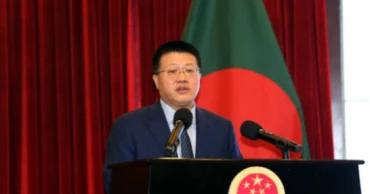
CEIZ to help Bangladesh boost its export capacity, generate employment: Ambassador Yao
Chinese Ambassador to Bangladesh Yao Wen has said the Chinese Economic and Industrial Zone (CEIZ) will help Bangladesh improve its industry and supply chains, boost export capacity and generate local employment as the construction of the CEIZ in Anwara, Chattogram formally began.
"China stands ready to work with Bangladesh to press ahead with the Zone’s construction efficiently, attract more high-quality enterprises, and build a landmark project under high-quality Belt and Road cooperation," he said while attending the groundbreaking ceremony of the Chinese Economic and Industrial Zone in Chattogram.
The Ambassador attend the groundbreaking ceremony of the Chinese Economic and Industrial Zone (CEIZ) on Monday and met with representatives of Chinese enterprises intending to settle in the Zone.
Ambassador Yao said the groundbreaking of the CEIZ marks a key step to deliver the outcomes of Prime Minister Tarique Rahman’s visit to China.
Finance and Planning Minister Amir Khosru Mahmud Chowdhury, Home Minister Salahuddin Ahmed, State Minister for Land and Chittagong Hill Tracts Affairs Mohammed Helal Uddin, Executive Chairman of the Bangladesh Economic Zones Authority (BEZA) Chowdhury Ashik Mahmud Bin Harun, local dignitaries, residents and representatives of Chinese companies attended the ceremony.
The CEIZ is a flagship project for Bangladesh to attract foreign investment and advance industrialization.
Officials expressed hope to expand practical bilateral cooperation via the Zone, address the country’s development bottlenecks and deliver benefits to local people.
CEIZ, one of the key projects underpinning industrial, trade and investment cooperation between Bangladesh and China, is being developed on approximately 800 acres of land.
Implemented under a Government-to-Government (G2G) initiative, the economic zone will play an important role in attracting large-scale Chinese investment to Bangladesh, supporting export-oriented industrialisation, generating employment and developing modern industrial infrastructure.
The initiative followed the Memorandum of Understanding signed between the two countries during the visit of Xi Jinping, President of China, to Bangladesh in 2016.
Once implemented, the project is expected to attract approximately USD 1.3 billion in investment and create more than 100,000 jobs, BIDA said.
CEIZ is seen as a major milestone in developing Chattogram as a modern industrial and logistics hub and advancing Bangladesh-China economic cooperation.
Li Changgui, Vice President of China Road and Bridge Corporation (CRBC), the developer of CEIZ, and Wang Benqian, Chairman of Bangladesh CEIZ Company Limited (BCCL), also addressed the event.
Around 70 representatives of Chinese businesses, comprising existing and potential investors in Bangladesh across a range of sectors, joined the ceremony.
Several sub-lease agreements were signed at the event, and the CEIZ One Stop Service Centre was inaugurated. The formal commencement of construction was marked through a ceremonial tree plantation.
Li Changgui said, “Today’s groundbreaking marks a new phase in the project and carries new missions and responsibilities. CRBC will work closely with all partners to fully advance the construction and operation of the zone, striving to build CEIZ a key platform for bilateral industrial cooperation, a major destination for international investment, and a model zone of mutual benefit. We aim to make new and greater contributions to the common development of both countries.”
Finance Minister Amir Khasru Mahmud Chowdhury said, “All of us are working towards one thing. That is investment. It is the only thing that is going to drive the development. It is the only thing that is going to create employment. And it is the only thing that is going to lead to the trillion dollar economy in 2034."
He said today's development of China's economic and industrial zone is the building block towards the ambition that this government has for the future of Bangladesh's economy.
Home Minister Salahuddin Ahmed said, “To our foreign and domestic investors, let me be clear. Bangladesh is open for business and we mean business. Today's groundbreaking is not just the start-up construction, it is the founding of a lasting economic bridge between Bangladesh and China. Together, let us build a zone that affects new standards of living, drives sustainable growth and creates a prosperous future for the generations to come.”
BEZA Executive Chairman said after the Prime Minister's visit to Beijing and Dalian in June, more than 30 Chinese companies have committed roughly half a billion dollars to a site that, as of this morning, is still open ground.
"Typically, opening a factory or getting a licence from your machinery in Bangladesh takes roughly six months to a year. We have already committed that within the next three months, we will roll out a process within which you will be able to get it done within 14 days. That is a material shift from what you have seen for decades in Bangladesh.”
On 17 June 2026, the Cabinet Committee on Economic Affairs approved the Development Agreement and Land Lease Agreement with Bangladesh CEIZ Company Limited, established to implement the project.
The Bangladesh Economic Zones Authority (BEZA) will hold a 30 per cent stake in the company, while China Road and Bridge Corporation (CRBC) will hold 70 per cent.
As BEZA’s equity contribution, the 50-year lease value of the acquired land has been incorporated as equity, while the developer will contribute its share in cash.
The capital will be used for internal development, infrastructure construction and operation of the zone.
To ensure a world-class industrial environment at CEIZ, the Supporting Infrastructure Project for Chinese Economic and Industrial Zone was approved by the Executive Committee of the National Economic Council (ECNEC) on 16 June 2026.
According to the Development Project Proposal (DPP), the total project cost is approximately Tk 41.89 billion.
Of this, around Tk 24.67 billion is expected to be financed through foreign loan assistance and approximately Tk 17.22 billion through Government of Bangladesh funding.
The foreign financing component is proposed to be secured under the Preferential Buyer’s Credit (PBC) facility of the Export-Import Bank of China.
Implementation of the infrastructure project will provide CEIZ with the international-standard supporting infrastructure required for industrial operations, including gas, electricity, water, waste management, transport and jetty facilities.
A tripartite agreement has already been signed among BEZA, Chattogram WASA (CWASA) and CRBC to ensure water supply to the zone.
The project implementation period has been set from January 2027 to December 2031. Its proximity to the Karnaphuli Tunnel, Chattogram Port and Shah Amanat International Airport gives the zone significant locational and connectivity advantages, BIDA said.
6 days ago
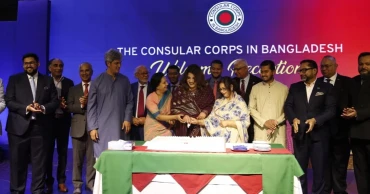
Act as strong envoys for investment, help create new opportunities for Bangladesh: Shama Obaed tells Consular Corps
State Minister for Foreign Affairs Shama Obaed Islam has shared five expectations from the members of the Consular Corps in Bangladesh (CCB) and urged them to become strong ambassadors for investment and help create new opportunities for trade and business.
"Promote partnership in technology, education, innovation, and skilled employment. Help expand Bangladesh's engagement with emerging regions, particularly Africa, and strengthen people-to-people connections, and help the world better understand the real Bangladesh," she said while speaking at a reception on Monday night.
Hosted by the Executive Committee of the CCB in honour of the State Minister for Foreign Affairs, the reception brought together an eminent gathering of ambassadors, high commissioners, heads of diplomatic missions, honorary consuls, representatives of international organizations, senior government officials, business leaders, and other guests, underscoring the strong and enduring partnership between Bangladesh and the international diplomatic community.
State Minister for Ministry of Housing and Public Works Ahammad Sohel Monzoor, State Minister for the Ministry of Planning Zonayed Saki, State Minister for Women and Children Affairs Farzana Sharmin Putul and State Minister for Expatriates’ Welfare and Overseas Employment and Nurul Haque Nur.
7 days ago
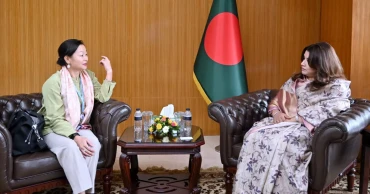
Food security must go hand in hand with climate resilience: Shama Obaed
State Minister for Foreign Affairs Shama Obaed Islam on Monday said food security must go hand in hand with eco-friendly agriculture and climate resilience.
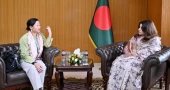
She made the remarks when Resident Representative and Country Director of the World Food Programme (WFP) in Bangladesh Coco Ushiyama called on her at the Ministry of Foreign Affairs.
The state minister also called for sustained international support to ensure uninterrupted food and nutrition assistance for the Forcibly Displaced Myanmar Nationals – known as Rohingyas.
She thanked WFP for its continued assistance for the Rohingyas temporarily sheltered in Bangladesh amid prevailing resource constraints, according to the Ministry of Foreign Affairs.
Shama Obaed expressed appreciation for WFP’s long-standing cooperation with Bangladesh and its support for food security, nutrition, social protection and humanitarian assistance.
She also commended WFP’s contribution to the School Meals Programme in Bangladesh and emphasised the importance of capacity-building to strengthen national food security.
7 days ago
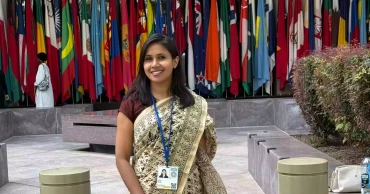
Govt appoints Umme Marufa as 1st secretary (press) in Kolkata Mission
The government has appointed journalist Umme Marufa as first secretary (press) at the Bangladesh Deputy High Commission in Kolkata, India, on a contractual basis.
The Ministry of Public Administration issued a gazette notification on Monday confirming her one-year contractual appointment, effective from the date of her joining.
Umme Marufa is currently working as a special correspondent for the television network News24.
Earlier, Md Tariqul Islam Bhuiyan, better known as Tarique Choyon, resigned from his post as the first secretary (press), citing personal and professional reasons.
"I resigned from the Bangladesh Deputy High Commission in Kolkata due to personal and professional reasons," he said in a post on his verified Facebook account on Wednesday.
Tarique Choyon said he spent a wonderful year and a half in Kolkata and tried to fulfil his assigned responsibilities diligently.
"I intend to write a book in the future about my professional life, office, colleagues, and friends in Kolkata. Everyone, please pray for me. May Allah help us all," he said.
7 days ago
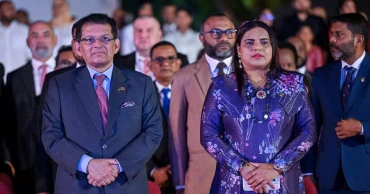
Dhaka, Malé reaffirm enduring friendship, enhanced bilateral collaboration
Bangladesh and the Maldives have reaffirmed their longstanding friendship, underscoring the strong people-to-people ties and close cooperation that have formed the foundation of their bilateral relationship over the years.
During the first official visit of Foreign Minister Dr Khalilur Rahman to Malé from July 25 to 27, the two countries reviewed their existing bilateral cooperation and discussed opportunities to further strengthen collaboration in areas of mutual interest, including health, education, trade and investment, tourism, labour and human resource development, and cooperation in regional and multilateral fora.
The two countries also exchanged views on regional and international developments and reaffirmed their shared commitment to enhancing cooperation in support of the mutual interests and prosperity of both nations.
Foreign Minister Dr Khalilur attended the 61st Independence Day Parade of the Republic of Maldives on Sunday at Republic Square in Malé as the special guest of the Government of Maldives.
He was received at the venue by Maldives Foreign Minister Iruthisham Adam.
The parade featured a ceremonial march-past and impressive displays by various branches of the Maldives National Defence Force, showcasing the country's discipline, heritage and national pride on the occasion of the 61st anniversary of the Independence of the Republic of Maldives.
Following the parade, Dr Khalilur attended a vibrant cultural programme highlighting the rich traditions and cultural heritage of the Maldives.
The Independence Day celebrations concluded with a spectacular fireworks display, the Ministry of Foreign Affairs said on Monday.
He also planted a Christina (Syzygium campanulatum) tree at Lonuziyaarai Park in Malé under the Five Million Trees Project launched by President Dr Mohamed Muizzu.
7 days ago

Japan standing with Bangladesh in wake of recent floods, landslides
Japan has expressed solidarity with Bangladesh following the recent floods and landslides that caused deaths and affected communities in different parts of the country.
In a statement, the Embassy of Japan in Bangladesh extended its deepest condolences to the families of those who lost their lives in the disasters and expressed sincere sympathy to all those affected.
“We wish the injured a swift recovery and hope that those displaced can return safely to their homes and communities as soon as possible,” the embassy said.
Japan has worked in Bangladesh for many years to strengthen the country’s resilience against floods, cyclones and other natural disasters, it said.
“However, the recent flood reminded us that more has to be done to achieve zero-casualties,” the embassy said.
Japan also renewed its “unwavering commitment” to working closely with the Government and people of Bangladesh, international organisations and NGOs to further strengthen disaster preparedness, emergency response, recovery and long-term resilience.
8 days ago
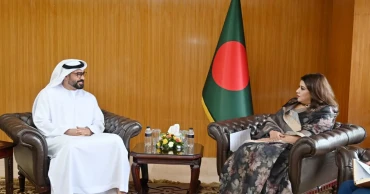
Bangladesh, UAE seek efforts to expedite negotiations on proposed CEPA
Bangladesh and the United Arab Emirates (UAE) on Sunday underscored the importance of expediting negotiations on the proposed Comprehensive Economic Partnership Agreement (CEPA), which would provide a robust framework for enhancing bilateral economic and commercial cooperation.
Both sides also agreed to activate the Joint Business Council and to convene its meeting at a mutually convenient time.
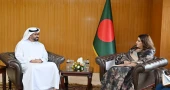
Ambassador of the United Arab Emirates (UAE) to Bangladesh Abdulla Ali Abdulla AlHmoudi called on State Minister for Foreign Affairs Shama Obaed Islam and the two sides held fruitful discussions on a broad range of issues of mutual interest with a view to further strengthening the longstanding and friendly relations between Bangladesh and the UAE.
The State Minister expressed concern over the challenges currently faced by Bangladeshi expatriates in the UAE and sought the Ambassador's support in addressing these issues.
8 days ago