foreign-affairs

Bangladesh delegation to leave for Doha Tuesday to convey condolences at ex-Qatari Emir's death
A Bangladeshi delegation, led by Speaker Hafiz Uddin Ahmad, is scheduled to leave for Doha on Tuesday to express Bangladesh’s solidarity and convey condolences to the Emir of Qatar, the Royal Family and the brotherly people of Qatar at the death of country's former Emir Sheikh Hamad bin Khalifa Al Thani.
As a mark of respect for the late former Qatari Emir, the Bangladesh government will also observe a half-day state mourning on Thursday, officials said.
Former Qatar emir Sheikh Hamad bin Khalifa Al Thani dies at 74
Meanwhile, Local Government, Rural Development and Co-operatives Minister Mirza Fakhrul Islam Alamgir on Monday signed the condolence book opened at the Embassy of Qatar in Gulshan following the death of the former Qatari Emir, on behalf of the Bangladesh government.
As the government's senior-most minister, Mirza Fakhrul signed the condolence message, paying tribute to the late former Emir, the Ministry of Foreign Affairs said.
Prime Minister's Adviser on Foreign Affairs Humaiun Kobir was present on the occasion.
In the condolence message, the minister expressed profound shock and sorrow at the death of the former Qatari Emir.
He also conveyed deep condolences and heartfelt sympathy to the government, the Royal Family and the brotherly people of Qatar on behalf of the government and the people of Bangladesh.
Bangladesh highly values its long-standing, close, cordial and brotherly relations with Qatar, Mirza Fakhrul said.
Earlier, Prime Minister Tarique Rahman expressed profound sorrow at the death of Sheikh Hamad bin Khalifa Al Thani.
"I am deeply saddened to hear of the passing of Sheikh Hamad bin Khalifa Al Thani, former Emir of the State of Qatar and your beloved father," he wrote in a condolence message to Qatar’s Emir Sheikh Tamim bin Hamad Al Thani.
The Prime Minister also extended his heartfelt condolences to the Royal Family, the government and the brotherly people of Qatar.
21 days ago

US invested over $1m in Bangladesh heritage preservation: US Ambassador
US Ambassador to Bangladesh Brent T. Christensen on Monday said the United States has invested more than $1 million through the Ambassador’s Fund for Cultural Preservation (AFCP) to support heritage conservation projects in Bangladesh over the past 25 years.
The US Ambassador made the remarks during a meeting with Cultural Affairs Minister Nitai Roy Chowdhury at the latter’s office at the Secretariat.
The two sides discussed strengthening Bangladesh-US people-to-people ties, educational exchanges, arts, literature and shared cultural values, said a PID handout.
During the meeting, both dignitaries discussed a wide range of issues aimed at strengthening the long-standing friendly people-to-people ties, educational exchanges, arts, literature, and the vibrant shared values between Bangladesh and the United States.
The US Ambassador highlighted the latest grant of $2 lakh 35000 under the AFCP.
With this latest funding, the total US investment in cultural preservation in Bangladesh has surpassed $1 million, supporting 13 major projects over the last 25 years.
Among the prominent AFCP-funded projects, the ongoing restoration of the Mughal-era Musa Khan Mosque at Dhaka University was highly lauded.
This project aims to restore the mosque's authentic Islamic architectural features, create a digital archive, and provide practical conservation training to young architects.
Other notable projects include the restoration of the 17th-century Shankhari Bazar in Old Dhaka, preservation of structural segments at Lalbagh Fort, and modernising the Varendra Research Museum.
The fund has also supported the documentation of Bangladesh’s intangible cultural heritage, such as Baul songs, Jamdani weaving, and ancient metal casting techniques.
The Ministry of Cultural Affairs highlighted the prospect of the holistic development of the historic Panam City in Sonargaon.
Extensive discussions were also held on the feasibility of organising a joint 'US-Bangladesh Cultural Festival', collaborative show of events, and structured Cultural Artist Exchange programs.
Regarding the draft of the Bilateral Cultural Cooperation Agreement forwarded by Bangladesh, the US Ambassador noted that it is currently undergoing necessary administrative and legal procedures, and the US side is keen to expedite it once official clearance is obtained.
Sharing the US 'Library of Congress' extensively archives world literature, the Ambassador said that they are highly interested in collecting and preserving the literary masterpieces of Bangladesh’s National Poet Kazi Nazrul Islam.
Senior officials of the Ministry of Cultural Affairs and the Mission were also present during the meeting.
21 days ago
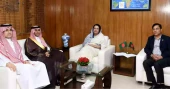
Saudi support sought to cut Hajj travel costs for Bangladeshi pilgrims
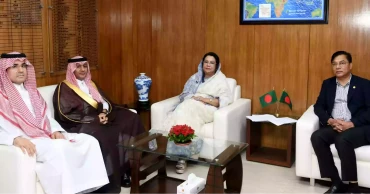
Civil Aviation and Tourism Minister Afroza Khanam on Monday sought Saudi Arabia's cooperation in reducing the overall cost of Hajj for Bangladeshi pilgrims by lowering taxes and charges on Hajj air travel.
She came up with the request during a courtesy call by Saudi Ambassador to Bangladesh Dr. Abdullah ibn Dhafer ibn Ubayya, on Civil Aviation and Tourism Minister Afroza Khanam and State Minister M Rashiduzzaman Millat at the Ministry of Civil Aviation and Tourism at the Bangladesh Secretariat.
Hajj 2027 pre-registration: What documents do pilgrims need?
She said such a move would significantly ease the financial burden on thousands of Bangladeshi pilgrims every year.
In response, the Saudi envoy assured that the matter would receive positive consideration and reaffirmed Saudi Arabia's commitment to extending all possible cooperation.
21 days ago

Hasina will have to go to jail if surrenders, says Shama Obaed
The government on Monday reiterated that former prime minister Sheikh Hasina would be taken into custody if she surrenders, as efforts continue to secure her extradition to Bangladesh.
"If she surrenders, the existing law will be followed. She will have to go to jail. The law will take its own course," State Minister for Foreign Affairs Shama Obaed Islam told reporters at the Ministry of Foreign Affairs.
Shama Obaed said Hasina's recent remarks from abroad appear intended to encourage Awami League leaders and activists who have either gone into hiding or fled the country. "I see no other reason," she said.
She said Hasina has already been convicted and that the decision on where and when she surrenders rests entirely with her.
Bangladesh has formally requested India to extradite Hasina under the bilateral extradition treaty.
Wherever she surrenders - whether in India or Bangladesh - she will have to go to jail first, Shama Obaed said, adding that the government has no reason to respond to statements made by a convicted person.
She said Bangladesh is making sustained diplomatic efforts to bring Hasina back to face trial, although acknowledging that the extradition process takes time.
Three ministries, including the Ministry of Foreign Affairs, have been pursuing the matter since the new government assumed office in February, building on efforts initiated under the interim government.
The government believes the people of Bangladesh want Hasina to be extradited.
Meanwhile, International Crimes Tribunal Chief Prosecutor Md Aminul Islam recently urged Hasina to refrain from any political activities that could further destabilise the country, saying Bangladesh wants her immediate return.
"Whether you come in December or January is your decision. But we want you tomorrow. Therefore, do not stage any stunts or create further instability in the country," he said on Saturday while responding to reports that Hasina plans to return to Bangladesh in December.
India, meanwhile, reiterated in April that it is examining Bangladesh's extradition request through its judicial and domestic legal processes.
"There is a request... the request is being examined as part of ongoing judicial and internal legal processes," Indian Ministry of External Affairs spokesperson Randhir Jaiswal told reporters in New Delhi, adding that India would continue to engage constructively with all stakeholders on the matter.
On April 8, Bangladesh renewed its request for the extradition of Hasina and former Home Minister Asaduzzaman Khan Kamal, both of whom have been sentenced to death by the International Crimes Tribunal.
"We will continue to seek her extradition through a transparent judicial process. It has been discussed and will be dealt with through a transparent judicial process," Prime Minister's Foreign Affairs Adviser Humayun Kabir told reporters in Dhaka.
21 days ago
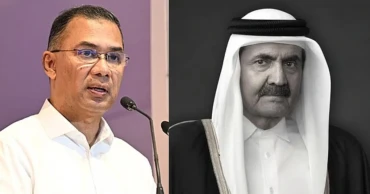
PM mourns death of former Qatari Amir
Prime Minister Tarique Rahman has expressed profound sorrow over the death of Qatar's former Amir Sheikh Hamad bin Khalifa Al Thani.
In a condolence message to Qatar's Amir, Sheikh Tamim bin Hamad Al Thani, he wrote: "I am deeply saddened to hear of the passing of Sheikh Hamad bin Khalifa Al Thani, former Amir of the State of Qatar and your beloved father."
The Prime Minister also extended his heartfelt condolences to the Royal Family, the Government and the brotherly people of the State of Qatar.
He said Sheikh Hamad bin Khalifa Al Thani was a visionary statesman whose distinguished leadership transformed Qatar into a modern, prosperous and globally respected nation.
His enduring contributions to regional peace, economic development, education and international cooperation will be remembered with profound respect, he added .
Bangladesh greatly values its close and fraternal relations with the State of Qatar, which have been nurtured over the decades through mutual trust, shared values and enduring people-to-people ties, said the prime minister.
"At this moment of profound grief, my thoughts and prayers are with Your Highness, the Royal Family and the brotherly people of the State of Qatar," the Prime Minister said.
He also prayed to Almighty Allah (SWT) to grant the departed soul Jannatul Ferdous and to bestow patience, strength and solace upon Your Highness and the bereaved members of the Royal Family.
21 days ago
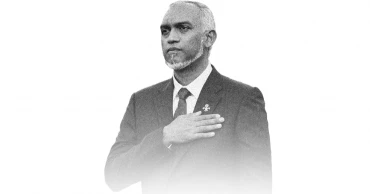
Maldives President conveys condolences over flood, landslide casualties in Bangladesh
President of Maldives Dr Mohamed Muizzu has extended their deepest sympathies and condolences to Prime Minister Tarique Rahman, the government, and the people of Bangladesh as they confront the severe impacts of the ongoing monsoon floods and landslides.
He conveyed the message on behalf of the government and the people of the Maldives.
"Our thoughts and prayers are with the families who have tragically lost their loved ones and with all those whose livelihoods have been disrupted," said the President of Maldives.
He said the Maldives stands firmly in solidarity with Bangladesh during this challenging period.
The President wished safety, strength, and a swift recovery to all affected communities in Bangladesh.
21 days ago
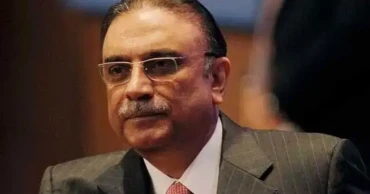
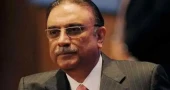
Pakistan President mourns Bangladesh flood, landslide victims
Pakistan President Asif Ali Zardari on Sunday expressed grief over the tragic loss of lives and widespread destruction caused by the devastating floods and landslides in Bangladesh.
In a condolence message, he said that Pakistan stands firmly with the Government and the people of Bangladesh at this difficult time.
The President extended his heartfelt condolences to the bereaved families and prayed for the speedy recovery of the injured and the well-being of all those affected.
The flood situation in seven districts across the country's southeastern and northeastern regions has worsened due to continuous heavy rainfall, upstream water flow, and landslides, leaving 51 people dead so far.
22 days ago

Bangladesh to send PM’s Defence Adviser to BIMSTEC NSA meeting in New Delhi
Despite the recent incident involving Prime Minister’s Adviser Dr Zahed Ur Rahman in New Delhi, Bangladesh, the current chair of the Bay of Bengal Initiative for Multi-Sectoral Technical and Economic Cooperation (BIMSTEC), will participate in the BIMSTEC National Security Advisers' meeting scheduled to be held in India.
Prime Minister’s Defence Adviser Brig. Gen. (Retd.) Dr AKM Shamsul Islam will represent Bangladesh at the meeting, and his participation has already been communicated to the Indian government through diplomatic channels, a diplomatic source told UNB.
India’s handling of the visit will be viewed as an "important consideration" for future high-level visits and other official engagements between the two countries, the source said.
The fifth BIMSTEC National Security Advisers' Meeting will be hosted by India and is scheduled to take place in New Delhi on July 16.
Officials at the Ministry of Foreign Affairs said Bangladesh, as the current BIMSTEC chair, is obliged to participate in the meeting.
They said Bangladesh will closely monitor whether the host country, India, maintains international diplomatic norms and protocol during Shamsul Islam’s visit.
The Indian government has already been informed about the visit, and New Delhi has been requested to extend appropriate support to the Bangladesh delegation, including Shamsul Islam.
Bangladesh has recently described India’s explanation regarding the return of Prime Minister’s Adviser on Policy and Strategy Affairs Dr Zahed Ur Rahman from New Delhi as "unsatisfactory", saying the incident at Delhi airport was both "unwanted and regrettable".
"The Indian authorities were duly informed in advance through diplomatic channels that Dr Zahed would lead the Bangladesh delegation to the Indian Ocean Rim Association (IORA) meeting. However, the incident involving him at the Delhi airport is unwanted and regrettable," a spokesperson for the Ministry of Foreign Affairs (MoFA) told UNB.
The spokesperson said the remarks made by the official spokesperson of India’s Ministry of External Affairs (MEA) regarding the incident had been noted.
"The explanation regarding the return of Prime Minister’s Adviser Dr Zahed from Delhi airport is not satisfactory," the MoFA spokesperson said.
22 days ago
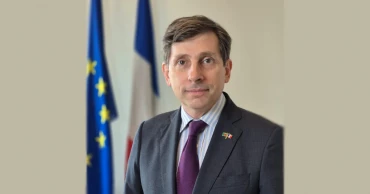
French team’s impressive performance can boost Bangladesh's football aspirations: Envoy
French Ambassador to Bangladesh Jean-Marc Séré-Charlet on Sunday expressed optimism that the World Cup and the French team's impressive performance will be inspiring and create a sense of motivation among young Bangladeshis who want to play football and raise the standard of their team.
“This is what happened in France with players like Michel Platini or Zinedine Zidane, who inspired entire generations. For example, Mbappé was 7 years old when France reached the World Cup final in 2006, and that undoubtedly inspired him to persevere,” he told UNB in an exclusive interview ahead of the semi-final against Spain.
The French envoy said he believes that this is what France can bring, and he thinks Bangladesh will gradually enter major competitions and develop a high-quality team because there is incredible enthusiasm and a love for football in this country.
Asked how football helps strengthen cultural ties between Bangladesh and France, the Ambassador said he believes that the French national team's excellent performance in the World Cup has helped showcase France and highlight the positive aspects of his country.
The Ambassador said a united, dynamic French team, full of imagination and skill, with players of exceptional quality, some of whom are truly outstanding, but also with a strong team spirit.
“And I think that reflects the values of France, a country that values solidarity. You know that our national motto includes the words "liberty, equality, fraternity." We rarely talk about the last word, but it's important. There is a real sense of brotherhood within this team. They support each other in difficult times,” he mentioned.
The French envoy said Mbappé, who is the captain, puts himself at the service of the team. “I believe this is a truly beautiful message, and I think it will encourage our Bangladeshi friends even more to come and visit France.”
Highlighting the very strong sporting competition between two friendly nations - France and Spain – the French Ambassador expressed optimism that Bangladesh will gradually enter major competitions and develop a high-quality team because there is incredible enthusiasm and a love for football in this country.
“I'm excited that France is playing against Spain; these are always very intense and spectacular matches. I remember the final of Euro 1984, where France, with Michel Platini, narrowly defeated Spain led by Luis Arconada. It was the first France-Spain match I watched,” he said.
France stand on the brink of a third successive FIFA World Cup final, but must first overcome Spain in what promises to be a mouth-watering semi-final between two of world football's most accomplished sides on Wednesday.
Sporting Competition
Responding to a question, the French Ambassador said that, in reality, he does not think France and Spain are rivals.
“I believe there's very strong competition, a sporting competition, between them. France and Spain are two friendly nations, two neighbouring countries. We know each other very well, and we respect each other, both in life and in football,” he said, noting that the Spanish team is very impressive and has excellent players. “So, we are very thrilled to be facing such a team in the semi-final.”
Asked how the Ambassador is personally preparing for the France-Spain semi-final, he said, “Very simple: I prepared by getting my phone and calling my friend Gabriel (Gabriel Maria Sistiaga Ochoa de Chinchetru), who is the Spanish ambassador in Dhaka. We decided to watch the match together.”
To the many fans of the French national team in Bangladesh, the French envoy said he would especially like to thank them for their support and trust.
The Ambassador said France strives to bring beautiful play, talent, team spirit, and solidarity to the game.
“It's important, beyond the result, that the game is enjoyable to watch. I believe that the ability to surprise, to ignite a match and what we call 'French flair' are part of the DNA of this team. So, I would like to thank you for this enthusiasm, and I want to say, naturally, that I am sure the French team will try its best and put on a great show. And I hope the Blues will win, of course!” he said.
If France reaches the final, the French envoy said they will gather the entire French community and watch the match together.
“Why not go and watch it at the University of Dhaka, where I know there's an absolutely incredible atmosphere during matches, and the spectators show a great deal of respect for both teams?” he said.
22 days ago
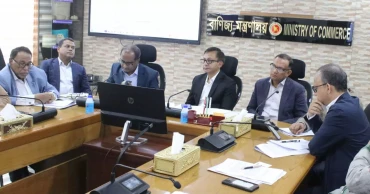
CCB delegation meets Shama Obaed; highlights honorary consuls’ role in economic diplomacy
A delegation of the Consular Corps in Bangladesh (CCB) on Sunday paid a courtesy call on State Minister for Foreign Affairs Shama Obaed Islam at the Ministry of Foreign Affairs, highlighting the role of honorary consuls in advancing Bangladesh’s economic diplomacy.
The delegation was led by CCB President and Honorary Consul General of Mongolia Nasreen Fatema Awal.
It included Honorary Consul of Ireland Masud Jamil Khan, Honorary Consul General of Yemen K M Mozibul Hoque, Honorary Consul of the Republic of Cyprus Shahab Sattar, Honorary Consul of Portugal Shakhawat Hossain, Honorary Consul of the Republic of Croatia Kazi Shah Muzakker Ahmadul Hoque Ishmam, Honorary Consul General of Greece Faruque Hassan, Honorary Consul of the Oriental Republic of Uruguay Mostafa Quamrus Sobhan and Honorary Consul of the Kingdom of Eswatini Morshedul Alam Chaklader.
22 days ago