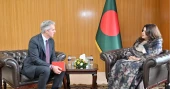
foreign-affairs
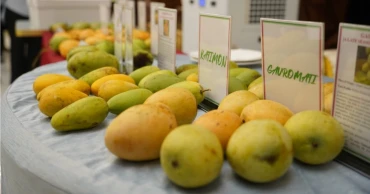
Rich diversity of Bangladeshi mangoes showcased in Kathmandu
Bangladesh Embassy, Kathmandu on Sunday hosted "Bangladesh Mango Delicacy," a mango festival with Bangladeshi late variety mangoes at UTSAV Kunja, a grand banquet hall in Kathmandu.
The event celebrated the rich heritage, exceptional quality, and diverse flavours of Bangladeshi mangoes and promoted Bangladesh's growing potential in the export of fresh fruits and value-added agro-products.
Ambassador Md Golam Sarwar, Secretary General of the SAARC Secretariat graced the occasion as Guest of Honour and Ambassador Gahendra Rajbhandari, Joint Secretary of South Asia Division of Foreign Ministry of Nepal, joined the event as Special Guest on behalf of the Foreign Secretary of Nepal.
The event was attended by the members of the diplomatic corps, senior officials of the Government of Nepal, representatives of the business community, leading importers, members of the media, and other invited guests.
Ambassador Md Shafiqur Rahman highlighted Bangladesh's recent achievements in the agriculture and agro-processing sector.
8 days ago
Investors' confidence being rebuilt through harmonisation of fiscal, monetary policies: Dr Titumir
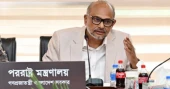
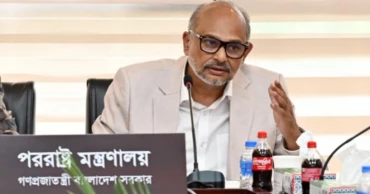
Prime Minister’s Finance and Planning Adviser Dr Rashed Al Mahmud Titumir on Sunday said investors' confidence is being rebuilt through the close harmonisation of fiscal and monetary policies.
He identified the autonomy of the central bank, a stable long-term tax structure, and forensic financial audits, undertaken to identify non-performing loans and underpin a comprehensive bank recapitalisation plan, as the three technical pillars underpinning Bangladesh’s transition to a rule-based, competitive investment environment.
The adviser was speaking at a roundtable titled “The Capital Dialogue”, hosted by the Ministry of Foreign Affairs in its conference room.
The event brought together senior representatives of foreign missions in Dhaka, development partners, and financial institutions.
The discussion was convened as a continuation of the “Roadmap for Trade, Growth & Economic Diplomacy Conference 2026”, held on June 13.
In her opening remarks, State Minister for Foreign Affairs Shama Obaed Islam reaffirmed the present government’s firm commitment to revitalise the national economy.
The Finance and Planning Adviser to the Prime Minister outlined the government’s short, medium, and long-term plans to transform Bangladesh into a $1 trillion economy by 2034.
8 days ago

DMP's police escort facility withdrawn for 18 ministers, freeing up resources
Police escort facilities provided by the Dhaka Metropolitan Police (DMP) have been withdrawn for 18 top members of the current cabinet following a high-level government decision, effective from July 20.
However, police escort arrangements for the remaining six ministers and one adviser (of ministerial rank) will continue as before, according to sources concerned.
Previously, all full ministers were entitled to the police escort facility from DMP.
DMP Protection Division Deputy Commissioner Md. Shahriar Alam told UNB that a total of 88 police personnel assigned to the security of the 18 ministers, along with the vehicles used for the purpose, have been withdrawn in line with the government directive.
Replying to a question, he said the move would reduce pressure on the DMP's vehicles and manpower, allowing the redeployed personnel and vehicles to be used for other urgent security and protection duties.
According to the DMP Protection Division, escort or protection vehicles are police vehicles that lead ministers' convoys during their movements. Each escort vehicle is usually staffed by a five-member police team.
The DC of the DMP' Protection division said the DMP implemented the decision following an instruction from the high-ups of the government.
The concerned sources, however, said police security and protection would continue to be provided to all ministers during official tours outside Dhaka whenever necessary.
The Daily Star first reported on the withdrawal on Sunday.
8 days ago
Bangladesh, Maldives discuss direct shipping link to facilitate bilateral trade, connectivity
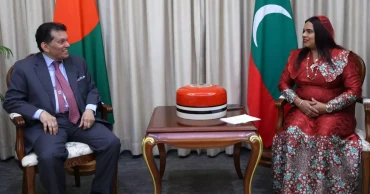
Bangladesh and the Maldives on Sunday discussed ways to further strengthen relations between the two countries through enhanced cooperation in migration and expatriate welfare, tourism, education, health, the blue economy, and maritime connectivity.
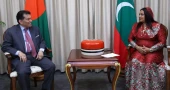
Foreign Minister Dr Khalilur Rahman held a bilateral meeting with Maldivian Foreign Minister Iruthisham Adam in Malé and exchanged views on possible high-level visits and the establishment of a direct shipping link to facilitate bilateral trade and connectivity.
8 days ago
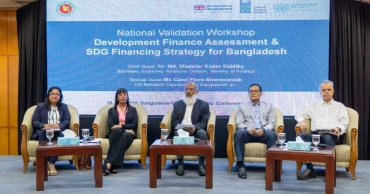
Bangladesh needs about USD 421 billion in extra funding in 5 years to attain SDGs
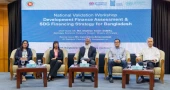
Bangladesh will need about USD 421 billion in extra funding over the next five years to attain Sustainable Development Goals (SDGs), according to a new government assessment unveiled on Sunday at a national workshop in Dhaka.
The Economic Relations Division (ERD), with support from the United Nations Development Programme (UNDP) and the UN Resident Coordinator’s Office in Bangladesh, organised the aforementioned ‘National Validation Workshop on the Development Finance Assessment (DFA) and SDG Financing’.
The workshop reviewed findings from the DFA, a global tool that helps align financing policies, institutions, and financial flows with national development priorities and also discussed Bangladesh’s updated SDG Financing Strategy.
Feedback from the workshop will help finalise both the DFA and the Financing Strategy, said the UNDP.
ERD Secretary Md Shahriar Kader Siddiky said the remaining period of SDGs up to 2030 will be challenging. “The financing gap is large, the time available is limited, and the global environment remains uncertain. Nevertheless, I remain confident that Bangladesh can make meaningful progress.”
“What we now need is a clear set of priorities, coordinated action, better governance and effective implementation,” he added.
UN Resident Coordinator in Bangladesh Carol Flore-Smereczniak highlighted the significance of domestic resource mobilisation at this moment in Bangladesh’s development journey.
“In today’s world, opportunities for development financing are diminishing. This is an opportunity for Bangladesh to increase its domestic investment in the SDGs, by increasing the tax-to-GDP ratio and by encouraging the private sector to make SDG-aligned investments,” she said.
ERD Additional Secretary and the chair of the event A.H.M. Jahangir stressed the need for a joined-up financing plan as Bangladesh prepares to graduate from LDC status.
Speaking for UNDP, Sonali Dayaratne, Deputy Resident Representative, underscored the need for stronger financing policies and partnerships to close the funding gap.
“The financing gap to meet national development targets has further widened. The government can deploy public resources to leverage and derisk private investments. The challenge is of economic governance. Getting it right requires building a financial ecosystem that is grounded in the application of transparent rules and regulations for all,” she said.
Presenting the findings, Dr Selim Raihan, Professor of Economics at the University of Dhaka, outlined Bangladesh's changing financing landscape and options for raising more money from public and private sources.
He presented the USD 421 billion estimate for FY2026–FY2030, noting most of it will need to come from domestic public and private finance, climate finance and international partnerships.
The workshop was supported by the UNDP Climate Finance Network (CFN) Programme, funded by the UK’s Foreign, Commonwealth & Development Office (FCDO).
It brought together government officials, development partners, banks, academics, and civil society to discuss the findings of the two studies to better plan the financial roadmap to achieve the SDGs.
8 days ago
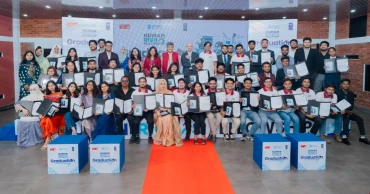
40 young human rights defenders complete course to advance SDG 16 in Bangladesh
Forty young human rights defenders from Bangladesh have completed a fellowship marking their transition from learners to community advocates committed to protecting rights and advancing Sustainable Development Goal (SDG) 16 on peace, justice and strong institutions.
Supported by the government of Switzerland, the fellowship led by the United Nations Development Programme (UNDP) equipped the young leaders to promote human rights awareness, encourage safe reporting of violations and inspire civic action.
During the programme, they conducted 241 orientation sessions and reached 4,129 young people across every district of Bangladesh, said UNDP on Sunday.
Held on July 25, in Gazipur, the graduation ceremony brought together fellows, trainers and UNDP representatives to reflect on the programme’s achievements, share stories from communities and discuss how youth-led human rights education can be expanded across the country.
The ceremony included an impact presentation, reflections from fellowship alumni, certificate distribution and discussions on the future of the fellowship model.
The fellowship built on a series of Human Rights Orientation Sessions that introduced 287 young people to foundational human rights concepts.
From 151 applicants, 40 fellows were selected and trained through an intensive Training of Trainers programme before leading 241 online orientation sessions across Bangladesh. Through these sessions, they directly reached 4,129 young people from across the country.
Dragan Popovic, Senior Programme Advisor for Governance at UNDP Bangladesh, at the closing event said “These fellows have demonstrated that young people are not only beneficiaries of human rights education. They can also be educators, advocates and trusted voices within their communities. Their work shows how knowledge, when combined with leadership and local action, can contribute to a stronger culture of human rights.”
One of the fellows from the Chittagong Hill Tracts shared, “The fellowship gave us more than knowledge. It gave us the confidence and practical skills to speak about human rights, engage our communities and help others understand where they can seek support when their rights are violated.”
The initiative forms part of UNDP’s broader efforts to support human rights defenders and strengthen cooperation among young advocates, civil society, the media and national institutions.
Implemented through the Strengthening Institutions, Policies and Services (SIPS) Project with support from Switzerland, it contributes to building accountable and inclusive institutions, strengthening public oversight, and advancing human rights, gender equality, peace and justice in Bangladesh.
Among others Mahmudul Hasan, Project Manager, UNDP, Sousan Suha, Youth Engagement Analyst also spoke at the concluding event.
8 days ago
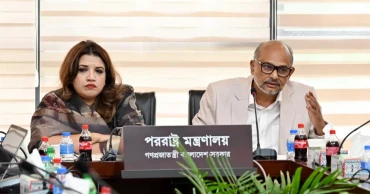
Govt steps up efforts to attract required investment for $1 trillion economy: Shama Obaed
State Minister for Foreign Affairs Shama Obaed Islam on Sunday said the government has intensified its efforts and is trying to bring in the foreign investment the country needs to achieve the goal of elevating Bangladesh to a one-trillion-dollar economy by 2034.
“Lots of countries are already talking to us about how they can invest in different sectors. So, that is an ongoing discussion. Many investors are already contacting BIDA (Bangladesh Investment Development Authority), working with them, working with the Commerce Ministry,” she told reporters at the Ministry of Foreign Affairs, noting that China, Japan, America, and different countries are ready for investment and that they are having these investment talks.
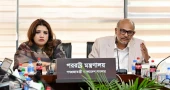
The State Minister briefed the reporters after a closed-door roundtable on “Roadmap for Trade, Growth and Economic Diplomacy-2026: The Capital Dialogue” held in the afternoon at the Ministry.
Prime Minister’s Finance and Planning Adviser Dr Rashed Al Mahmud Titumir, among others, joined the roundtable discussion.
8 days ago
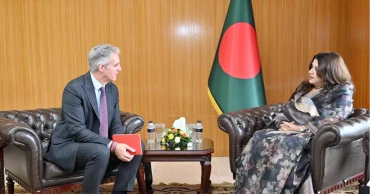
State Minister seeks stronger Bangladesh-IFRC partnership on climate resilience
State Minister for Foreign Affairs Shama Obaed Islam on Sunday underscored the importance of enhanced collaboration between the Ministry of Foreign Affairs and IFRC in advancing climate resilience initiatives with special attention to women and children.
Head of Delegation of the International Federation of Red Cross and Red Crescent Societies (IFRC) to Bangladesh Alberto Bocanegra paid a farewell call on the State Minister for Foreign Affairs at her office and discussed the issues.
Bocanegra briefed the State Minister on the IFRC’s key humanitarian activities and achievements during his tenure in Bangladesh, highlighting the organization’s support in disaster preparedness, climate resilience, health services and assistance to displaced populations.
He expressed his sincere appreciation for the continued support and constructive cooperation extended by the Government of Bangladesh throughout his tenure.
Shama Obaed congratulated Bocanegra on the successful completion of his tenure and commended his leadership of the IFRC in Bangladesh.
She appreciated the IFRC’s longstanding partnership with Bangladesh since the Liberation War and its valuable contributions to emergency response and humanitarian assistance.
The State Minister particularly expressed appreciation for the IFRC’s sustained support during natural disasters, including floods, cyclones and other climate-induced emergencies as well as its assistance to the Rohingya humanitarian response.
State Minister Shama Obaed wished Bocanegra every success in his future assignments and expressed confidence that the close partnership between Bangladesh and the IFRC would continue to grow under the leadership of his successor as well.
8 days ago
Tatvamasi initiative unites art, climate justice and disability inclusion through public engagement
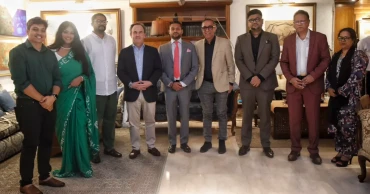
A new public art initiative, Tatvamasi, aims to connect art, climate justice and disability inclusion by engaging diverse communities in co-creating a large-scale public installation that amplifies the voices of climate-vulnerable and marginalised people.
Tatvamasi Circle, a Green Drink gathering hosted by Masud Jamil Khan, Honorary Consul of Ireland in Bangladesh, and curated by GenLab at the Honorary Consulate of Ireland in Dhaka, brought together representatives from the diplomatic community, development organisations, civil society, academia, culture, conservation, media and the private sector on Friday.
Spanish Ambassador to Bangladesh Gabriel Sistiaga Ochoa de Chinchetru also attended the event.
Green Drink is GenLab's signature dialogue platform designed to foster discussions on climate, environment and nature through ideas, creativity and storytelling, said a press release.
Opening the event, Masud Jamil Khan said Tatvamasi reflects the shared responsibility of people in shaping a sustainable future through art and dialogue.
8 days ago
Partnerships should reinforce Bangladesh's national priorities: Adviser Titumir
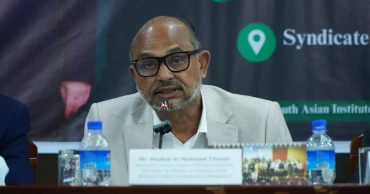
Prime Minister’s Finance and Planning Adviser Dr Rashed Al Mahmud Titumir on Sunday said partnerships are most meaningful when they reinforce national priorities, placing Bangladesh's development and people's welfare at the centre of every collaboration.
Referring to the principle of “Bangladesh First”, he emphasised that Bangladesh must pursue its own self-reliant development journey while engaging with China on the basis of mutual respect, national interest, and economic sovereignty.
He was speaking as the chief guest at a seminar organised by the South Asian Institute of Policy and Governance (SIPG) at North South University (NSU).
The seminar, titled “Bangladesh-China Relations: Enhanced Trust and New Direction”, brought together policymakers, diplomats, scholars, China experts, media representatives, faculty members, and students to discuss how Bangladesh could transform the renewed momentum from Prime Minister Tarique Rahman’s recent Beijing visit into concrete gains in diplomacy, trade, connectivity, education, technology, and regional cooperation.
Dr Titumir welcomed Chinese partnerships in multimodal transportation, the Chinese Economic Zone in Chattogram, Mongla Port expansion, and the proposed Kunming-Chattogram connection, while calling for deeper society-to-society cultural exchanges.
Foreign Secretary Asad Alam Siam reflected on the positive trajectory of Bangladesh-China relations and highlighted recent milestones, including agreements, protocols, media cooperation, and collaboration in agriculture, water security, supply chains, technology, and multilateral forums.
He stressed that the real task ahead was to convert commitments and investments into high-impact projects backed by strong institutional accountability and aligned with Bangladesh’s national interest.
The seminar also discussed the proposed Bangladesh-China-Myanmar connectivity framework, BCM+I, the Teesta and northern river management issues, the Rohingya crisis, Myanmar’s instability, Bay of Bengal geopolitics, Indo-Pacific competition, and Bangladesh’s need to avoid overdependence on any single partner.
8 days ago