bangladesh

Worker’s body recovered from elevator shaft in Demra
Police have recovered the body of a construction worker from the elevator shaft of an under-construction building in the Muslim Nagar area of Demra.
The deceased was identified as Abdus Salam Sheikh, 25, a resident of Dattakanda village under Chauhali upazila of Sirajganj.
Salam had been working and living at the under-construction building, named Friendship Enterprise, on Badsha Mia Road in Demra.
Demra Police Station Sub-Inspector Mohammad Ahsan Habib said police recovered Salam’s body from the building after receiving information.
The SI said initial investigation found marks of injuries on different parts of Salam’s body.
The body was sent to the morgue of Dhaka Medical College Hospital for autopsy on Wednesday afternoon.
The exact cause of death will be known after receiving the autopsy report, he said.
19 minutes ago
Dhaka calls for collective action to make right to development a reality
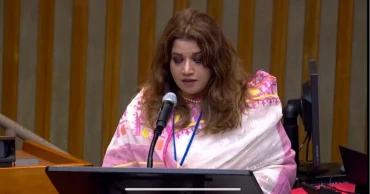
State Minister for Foreign Affairs Shama Obaed Islam has said the realisation of the right to development requires the commitment, responsibility and collective action of all nations.
She made the remarks while speaking at a high-level event on the right to development held at UN Headquarters in New York on September 23.
The event was convened by the President of the 81st Session of the UN General Assembly and Bangladesh Foreign Minister Dr. Khalilur Rahman during the high-level week.
It marked the 40th anniversary of the adoption of the UN Declaration on the Right to Development, which recognises development as an inalienable human right and calls for inclusive, sustainable and participatory development.
The State Minister highlighted the government’s pro-people development agenda including the Family Card and Farmer Card initiatives.
She also underscored the role of women and youth as partners in development and the vision of a “Rainbow Nation” where no one is left behind.
Shama Obaed proposed a few priorities that include a fairer global financial architecture, predictable and equitable development and climate finance, equitable access to technology and AI, and a legally binding framework to turn the right to development into accountability.
The event brought together Member States and stakeholders to reaffirm the right to development and advance shared prosperity, said the Ministry of Foreign Affairs.
51 minutes ago
Rohingyas: UNGA President says global community must not allow attention to fade
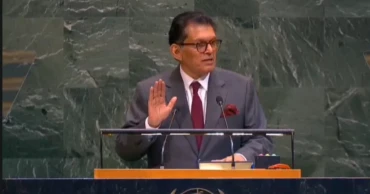
President of the United Nations General Assembly (UNGA) Dr Khalilur Rahman has expressed concern that familiar patterns of violence and persecution continue to cast a long shadow across Rakhine state and the rest of Myanmar, noting that the Rohingya crisis is not over.
The Assembly President underscored the importance of sustained political attention to keep the Rohingya crisis high on the international agenda.
Predictable humanitarian assistance, he said, would also remain critical.
At a high-level side event on the Rohingya crisis in New York on Wednesday, he joined discussions highlighting the urgency of achieving durable solutions to protracted displacement, including through conditions for safe, voluntary, dignified and sustainable return.
After years of displacement, the UNGA President said the international community must not allow attention to fade.
"We must sustain political attention, support refugees and host communities, pursue accountability and ensure that the Rohingya themselves have a meaningful voice in shaping the conditions for their safe return home," he said.
Describing the situation in Myanmar, Dr Rahman said civilians face indiscriminate attacks, air strikes, arbitrary arrest and detention, torture, enforced disappearances, forced recruitment, destruction of homes and civilian infrastructure, and the denial of humanitarian assistance.
Nine years after the mass displacement of the Rohingya from Myanmar, their situation remains one of the world's most protracted and complex refugee crises, marked by years of persecution and uncertainty over the prospect of returning home.
Against this backdrop, senior UN officials renewed calls for a durable solution that would enable Rohingya refugees to return home safely and with dignity, while ensuring justice and accountability.
UN High Commissioner for Refugees Barham Salih, a keynote speaker at a high-level event held on the sidelines of the 81st session of the General Assembly, reminded participants that nearly 1.2 million (over 1.3 million) Rohingya refugees remain in Bangladesh.
“An entire generation is growing up in exile…Conflicts continue in Myanmar. Conditions for voluntary, safe, and dignified, and sustainable return do not exist at the moment.”
In August 2017, Myanmar's military launched a crackdown in the country's western Rakhine state, forcing hundreds of thousands of Rohingya Muslims to flee across the border into Bangladesh, where the vast majority remain refugees, according to the United Nations.
The Secretary-General's Special Envoy on Myanmar, Julie Bishop, lamented that for children born in 2017, displacement now encompasses their entire childhood.
“It's estimated that over 30,000 children are born into the camp each year.”
The envoy said women and girls living in the camps face growing risks of gender-based violence, including from armed groups and criminal networks, while access to protection services is declining. "The young are losing hope."
UN officials commended Bangladesh for its extraordinary hospitality and generosity but cautioned that the international community cannot stand by while the country continues to host the world's largest refugee settlement.
“When funding disappears, needs do not disappear with it. There is less food, less education, fewer opportunities, greater pressure on health and other essential services, and more desperation for families,” the UNHCR chief said.
Without prospects for a safe and dignified future, Rohingya refugees face increasing risks of exploitation, trafficking, forced conscription and dangerous sea journeys.
Growing Cost of Displacement
In his address, Prime Minister of Bangladesh Tarique Rahman drew attention to the growing costs of prolonged displacement, both for the Rohingya and for host communities.
“Prolonged uncertainty and disruption are creating new challenges and security risks, including human trafficking, migrant smuggling, drug trafficking, and other transnational crimes," he said.
The Prime Minister thanked international partners for their support but stressed that generosity cannot become an excuse for political inaction.
“Nor can Bangladesh be expected to shoulder this responsibility indefinitely. The crisis originated in Myanmar; its solution lies in Myanmar,” he said.
UN officials also pointed to the genocide case before the International Court of Justice (ICJ), brought by The Gambia against Myanmar, stressing that justice must be an integral part of any lasting solution and that momentum towards accountability must not be lost.
Hope Beyond Survival
“Victims deserve to see that we, as an international community, are doing our utmost to avoid a repeat of past horrors,” UNGA President Dr Rahman said.
UNHCR Salih said refugees deserve a future that goes beyond survival.
Drawing on his conversations with Rohingya refugees, he said many continue to hope for a return home, but that return must mean more than simply crossing a border, he said.
“It means returning with rights, being able to move freely, to go to school, to work, to access services, the ability to live alongside other communities without fear,” and have a pathway to citizenship.
“Our responsibility is to help make that future possible,” the UNHCR chief added.
2 hours ago
Bangladesh eyes further expansion of cooperation with China: Moyeen Khan
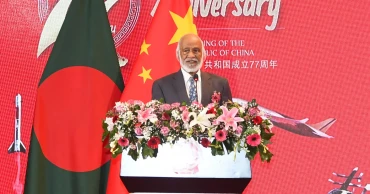
Local Government, Rural Development and Cooperatives Minister Dr Abdul Moyeen Khan has said Bangladesh-China relations have come a long way and are now poised for further expansion across trade, investment, infrastructure, energy, technology and people-to-people contacts.
“Our ties span trade, development, infrastructure, energy and industry, and, last but not the least, people-to-people contact,” he said.
The minister made the remarks as the chief guest at a reception in Dhaka on Wednesday evening marking the 77th anniversary of the founding of the People’s Republic of China.
Chinese Ambassador to Bangladesh Yao Wen delivered the welcome remarks at the reception, which was attended by senior political leaders from both the ruling and opposition parties, ministers, senior government officials, diplomats stationed in Dhaka, business leaders, civil society representatives and senior journalists.
The LGRD Minister said Bangladesh looks to the next decade with the expectation of further expanding cooperation with China.
“Bangladesh looks forward to the next decade of further expansion of our cooperation - not only in the area of trade and commerce, but also in the area of friendship and culture,” he said.
The minister emphasised that future partnerships should not only deliver large-scale infrastructure but also empower people and strengthen small businesses.
“Small traders can be the best ambassadors between two countries,” he added.
Recalling Prime Minister Tarique Rahman’s recent visit to China, Dr Moyeen said the visit had opened the way for transformative projects and described it as a milestone in bilateral relations.
“The substantive discussions that were held in China and the forward-looking proposals that emerged from those discussions make us happy. That visit was a milestone in our bilateral relationship,” he said.
Dr Moyeen said Bangladesh looks forward to elevating its partnership with China and building a shared future for the younger generations of the two countries.
“But between the two countries, we have travelled a long way towards where we are today, and I think this friendship has to be built by taking into account modern times, our technology, our diplomacy and our politics,” he said.
Dr Moyeen also praised China’s development experience over the past 77 years, saying it offers an important example of transformation in the modern world.
“China has provided one of the most striking examples of development in our modern history,” he said, referring to the country’s transformation despite its enormous population and the level of economic development from which it started.
He said Bangladesh, with its limited land and large population, shares an important development priority with China - improving the lives of people who are less privileged.
“Our priority is also the same: that we want to uplift the rights of the people in society who are not so privileged,”Moyeen Khan said, while noting that the political philosophies of the two countries may be different.
The minister said Bangladesh remains eager to learn from China’s experience in infrastructure development, technology, innovation and large-scale urbanisation.
“At the same time, we believe that government-to-government cooperation must provide opportunities and create opportunities for more and more people,” he said.
The minister stressed the importance of greater exchanges among students, businesspeople, journalists and professionals, saying such contacts can help deepen mutual understanding and widen the scope of future cooperation.
“People-to-people contact, exchanges of students as well as businesspeople can change the pace of our countries,” he said.
He also thanked Chinese Ambassador Yao Wen for his role in advancing Bangladesh-China friendship and promoting cooperation in trade, investment, infrastructure, energy, healthcare and people-to-people exchanges.
“I would like to recognise the Ambassador personally for his tireless work in advancing the friendship between the two countries,” Dr Moyeen said.
Dr Moyeen extended Bangladesh’s best wishes to the government and people of China for continued peace, prosperity and wellbeing.
“May the friendship between Bangladesh and China continue to flourish, bringing greater progress to our peoples in both countries, and lasting stability to our friendship in this region and in the globe,” he said.
Recalling a well-known saying, he concluded, “please go as far as China if you want knowledge.”
The minister also congratulated the Chinese government and people on the 77th anniversary of the founding of the People’s Republic of China.
3 hours ago
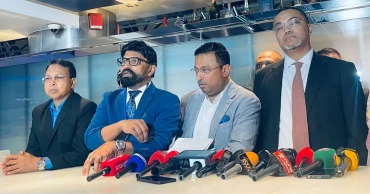
PM discusses Middle East tensions, safety of Bangladeshi workers with Iran President
Prime Minister Tarique Rahman has met Iranian President Masoud Pezeshkian and discussed the Middle East conflict and the safety of Bangladeshi workers, while seeking Iran’s cooperation in facilitating the movement of Bangladeshi vessels and containers through the Strait of Hormuz.
The meeting was held on the sidelines of the 81st UN General Assembly in New York on Wednesday.
State Minister for Foreign Affairs Humaiun Kobir and Prime Minister’s Adviser Mahdi Amin briefed journalists on the meeting at a press briefing later in the day at the Hyatt Grand Central New York hotel.
Kobir said the Prime Minister called for an early resolution of the conflict through diplomacy, stressing its potential impact on Bangladesh, particularly on Bangladeshi expatriate workers and the country’s energy security.
Bangladesh has a significant number of workers and professionals in the Middle East, and any prolonged conflict in the region could have an impact on the country, he said.
The state minister also said Bangladesh raised the issue of containers and vessels being held up amid the tensions around the Strait of Hormuz and sought Iran’s cooperation in facilitating their safe movement once the situation improves.
“We called for a quick resolution through diplomacy,” he said, adding that the Iranian President listened to Bangladesh’s concerns and took note of them.
Kobir said Bangladesh maintains a neutral position and is prepared to play a constructive role in promoting peace and stability if there is an opportunity.
“Bangladesh can become a soft-medium influence for good, for peace and stability in the world,” he said.
The state minister said Bangladesh has important partners across the Middle East, and some of them have encouraged Bangladesh to use its neutral position to communicate with parties involved in the conflict.
He said Bangladesh does not necessarily need to take a visible mediation role, but can engage as a friend of the region and contribute to peace and stability through diplomatic channels.
“The UN is a neutral venue,” Kobir said, referring to the meeting with the Iranian President at the UN Headquarters.
He said the Prime Minister used the opportunity to discuss both the conflict and Bangladesh’s national interests, including the possible impact of the situation around the Strait of Hormuz on the country’s energy supply and trade.
The state minister said Bangladesh wants an early and peaceful resolution to the conflict through diplomacy, as a prolonged crisis could have wider regional and international consequences.
Mahdi said the meeting also focused on regional stability, the safety of Bangladeshi workers in the broader Middle East and issues related to regional and international peace.
He said the Prime Minister emphasised Bangladesh’s national interests, particularly the safety and well-being of its expatriate population.
The meeting took place as part of Prime Minister Tarique Rahman’s engagements on the sidelines of the 81st UN General Assembly.
3 hours ago
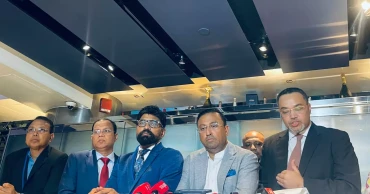
Biman signs deal to buy 11 more Boeing aircraft
Biman Bangladesh Airlines has signed an agreement with US aircraft manufacturer Boeing to buy 11 more aircraft as Bangladesh moves to expand its aviation sector and open new routes, Prime Minister’s Adviser Mahdi Amin said on Wednesday.
“A significant signing ceremony was held with Boeing today [Wednesday], where Biman Bangladesh Airlines signed an agreement to purchase 11 more Boeing aircraft,” he said at a press briefing at the Hyatt Grand Central New York.
Mahdi said Biman Chairman Rumee A Hossain signed the agreement on behalf of the national flag carrier.
He said Bangladesh is buying aircraft based on its own requirements as the aviation sector is expanding. “We buy aircraft based on our needs. We want to expand our aviation sector, and for that we need aircraft,” he said.
The adviser said Bangladesh has a long-standing commercial relationship with Boeing, while discussions with Airbus could also take place based on the country’s requirements.
“The two companies that provide good aircraft are Boeing and Airbus. We will buy from Boeing or Airbus according to our needs. No one will force us to buy either,” he said.
State Minister for Foreign Affairs Humaiun Kobir said the signing ceremony was significant as several senior US government officials attended the event.
US Secretary of Commerce Howard Lutnick, Deputy Secretary of State Christopher Landau, Under Secretary of Commerce William Kimmitt, Assistant Secretary of State for South and Central Asian Affairs Paul Kapur and Special Representative for Commercial and Business Affairs Vinay Chawla attended the ceremony.
Kobir said the presence of the senior US officials demonstrated the importance of Bangladesh-US relations.
He said the participation of senior officials from the US Commerce and State Departments showed that the two countries are looking at expanding trade and investment while strengthening bilateral relations.
Referring to President Donald Trump’s recent letter to Prime Minister Tarique Rahman, the state minister said the US President had expressed his appreciation for Bangladesh’s decision to purchase Boeing aircraft and conveyed confidence in the country’s future under Tarique Rahman’s leadership.
He said the Boeing agreement was also important from the perspective of expanding Bangladesh’s aviation sector and strengthening economic ties with the United States.
Mahdi said the Boeing delegation later held a courtesy meeting with Prime Minister Tarique Rahman.
In April, Bangladesh signed a deal with Boeing to purchase 14 aircraft for Biman in a deal valued at $3.7 billion, described as the airline’s biggest-ever aircraft order.
In a letter to Prime Minister Tarique Rahman on September 1, Trump thanked him for the decision to purchase Boeing aircraft and said Boeing would not let Bangladesh down.
Mahdi said technical assessments and discussions were also underway on possible future aircraft purchases, including from Airbus, based on Bangladesh’s requirements.
He said Bangladesh is expanding its aviation sector, planning new routes and will need additional aircraft to meet growing demand.
Kobir said Bangladesh will continue to assess its requirements before making further aircraft purchases, adding that the government wants to ensure that its aviation expansion serves the country’s interests.
The Boeing signing was among a series of activities during Prime Minister Tarique Rahman’s four-day visit to New York to attend the 81st session of the UN General Assembly.
The signing ceremony was attended by Brad McMullen, Boeing senior vice president of Commercial Sales and Marketing, and Rumee A Hossain, chairman of Biman Bangladesh Airlines, Civil Aviation and Tourism Minister M Rashiduzzaman Millat, Kobir, Mahdi, Invest Bangladesh Authority Chairman Chowdhury Ashik Mahmud Bin Harun, Howard Lutnick and Christopher Landau on the sidelines of the United Nations General Assembly.
4 hours ago
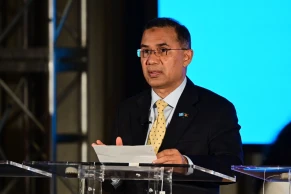
UNGA81: PM calls for urgent global action on climate crisis, predictable finance
Prime Minister Tarique Rahman on Wednesday called for five urgent global actions to tackle climate change and ensure a just and equitable transition, including meeting the 1.5-degree Celsius target and ensuring predictable climate finance.
“Collective action based on “Common But Differentiated Responsibilities and Respective Capabilities” is imperative…We call for 5 urgent actions,” he said.
Tarique made the call while addressing a high-level meeting on “Climate Action and the Just Transition” at the UN Headquarters in New York.
Outlining the five urgent actions, the Prime Minister first called for achieving the 1.5-degree Celsius global warming limit through global emission cuts, as set out in the Paris Agreement.
Second, Tarique called for predictable and accessible finance for adaptation in climate-vulnerable countries.
Third, he urged greater access to climate-smart technologies to enable a just and equitable climate transition.
Fourth, Tarique stressed the need for expanding renewable energy through accessible finance, capacity-building and technology transfer.
And fifth, he called for full implementation and regular replenishment of the Loss and Damage Fund.
“Bangladesh seeks partnerships that help us implement our plans. Let us act together to build a safer and more sustainable future for generations to come,” the Prime Minister added.
Tarique said Bangladesh contributes less than 0.5 percent of global greenhouse gas emissions but is among the most climate-vulnerable countries.
He said Bangladesh could lose 12 to 18 percent of its coastal areas to sea-level rise by the end of this century, affecting the livelihoods of tens of millions of people.
“Climate change has caused loss and damage equivalent to 1% of our GDP. Our food security is at serious risk,” Tarique said.
The Prime Minister said Bangladesh had allocated nearly $3.19 billion in its budget for climate adaptation but warned that the country risked severe damage without international support.
He said Bangladesh plans to plant 250 million trees over five years and dig around 20,000 kilometres of rivers and canals, alongside the Padma Barrage and Teesta Barrage Master Plan, to retain water, reduce flood risks, revive wetlands and recharge groundwater.
The government also aims to generate 20 percent of the country's electricity demand from renewable sources by 2030, Tarique said.
Bangladesh is promoting green industries, including jute products, eco-friendly transport, waste-to-energy and circular economy initiatives, while developing a national carbon market, he said adding that, “But we cannot succeed in isolation.”
The high-level meeting was held at the Trusteeship Council Chamber of the UN Headquarters as part of the Prime Minister's engagements during the 81st session of the UN General Assembly.
9 hours ago
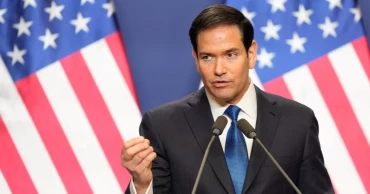
US announces new visa restriction policy for those who engage in or facilitate birth tourism
The United States on Wednesday said it will not allow foreigners to exploit its immigration system and violate the sanctity of US citizenship, announcing a new visa restriction policy for those who engage in or facilitate birth tourism.
Foreign commercial birth tourism networks have exploited the US immigration system to sell US citizenship for profit, US Secretary of State Marco Rubio said in a press statement.
These networks advertise and coach foreign nationals to lie on US visa applications and collect tens of thousands of dollars to arrange births on American soil for the sole purpose of obtaining US citizenship.
"Today, I am announcing a new visa restriction policy under Section 212(a)(3)(C) of the Immigration and Nationality Act," Rubio said.
This policy targets individuals who knowingly engage in, have engaged in, or facilitate birth tourism to the United States, including owners, operators, and managers of commercial birth tourism facilitation networks, visa “fixers” who coach applicants to commit fraud, foreign medical providers who knowingly abet and facilitate such travel and the fraudulent use of our Medicaid system, and other individuals who support, abet, and enable commercial birth tourism.
"The Trump Administration is using every tool at our disposal to defend the integrity of US citizenship, protect American public benefits and US taxpayers from exploitation, and safeguard our national security," said the US Secretary of State.
By restricting visa issuance of those who both engage in and profit from this fraud, he said they are sending a clear message.
This visa restriction policy is pursuant to Section 212(a)(3)(C) of the Immigration and Nationality Act.
Certain family members may also be covered by these restrictions, according to the US Department of State.
12 hours ago
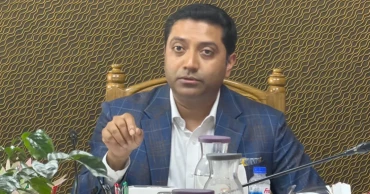
Skilled workforce key to sustainable development: Bobby Hajjaj
State Minister for Primary and Mass Education Bobby Hajjaj has said skilled and capable human resources are a fundamental pillar of sustainable development, stressing the need to effectively connect education with employment, entrepreneurship and economic growth.
He made the remarks while addressing as the chief guest a discussion titled “From Classroom to Economy”, organised by the Bangladesh Consulate General in New York.
The event, moderated by Consul General Muhammad Mozammel Haque, brought together government policymakers, university representatives, employers and Bangladeshi expatriate professionals residing in New York.
Addressing Bangladeshi students and professionals from various US universities, Bobby Hajjaj emphasised that education should not remain confined to acquiring academic degrees but must prepare youth for real-world challenges and future job market demands.
He highlighted the necessity of building an integrated continuum spanning from education to skill development, skill to employment, and employment to economic productivity.
The state minister also underscored the importance of leveraging the expertise and global experience of expatriate Bangladeshi professionals to advance national human resource development and foster international knowledge exchange.
The speakers said in the current global economic context, integrating education with job-oriented skills is becoming increasingly important.
In this regard, they stressed the need to further strengthen cooperation among the government, educational institutions, the private sector, employers and expatriate Bangladeshis.
The discussion explored various possibilities for linking education and skills development with employment and economic progress. Participants emphasised the importance of coordinated initiatives to develop Bangladesh’s young generation into skilled, productive human resources equipped for the future job market.
The discussion also highlighted that such dialogues could create new opportunities for cooperation and knowledge-sharing among relevant stakeholders in the future, with a view to building an effective bridge between education, skills and employment for human resource development in Bangladesh.
12 hours ago
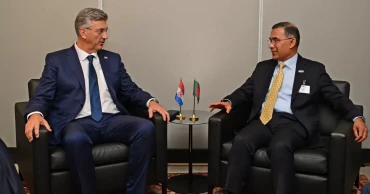
PM, Croatian counterpart discuss expanding economic, trade ties
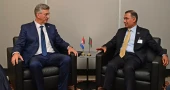
Prime Minister Tarique Rahman and Croatian Prime Minister Andrej Plenković have discussed ways to further strengthen bilateral ties between Bangladesh and Croatia, with a focus on expanding economic cooperation, trade and investment, skilled manpower, education and technology.
The two leaders had a meeting on Wednesday at the UN Headquarters in New York on the sidelines of the 81st session of the United Nations General Assembly, said Prime Minister’s Assistant Press Secretary Md Nazmul Haque Khan.
They also discussed ways to further strengthen the friendly relations between the two countries and enhance cooperation in areas of mutual interest.
The two sides stressed the need to expand cooperation in economic relations, trade and investment, skilled manpower, education, technology and other potential areas.
12 hours ago