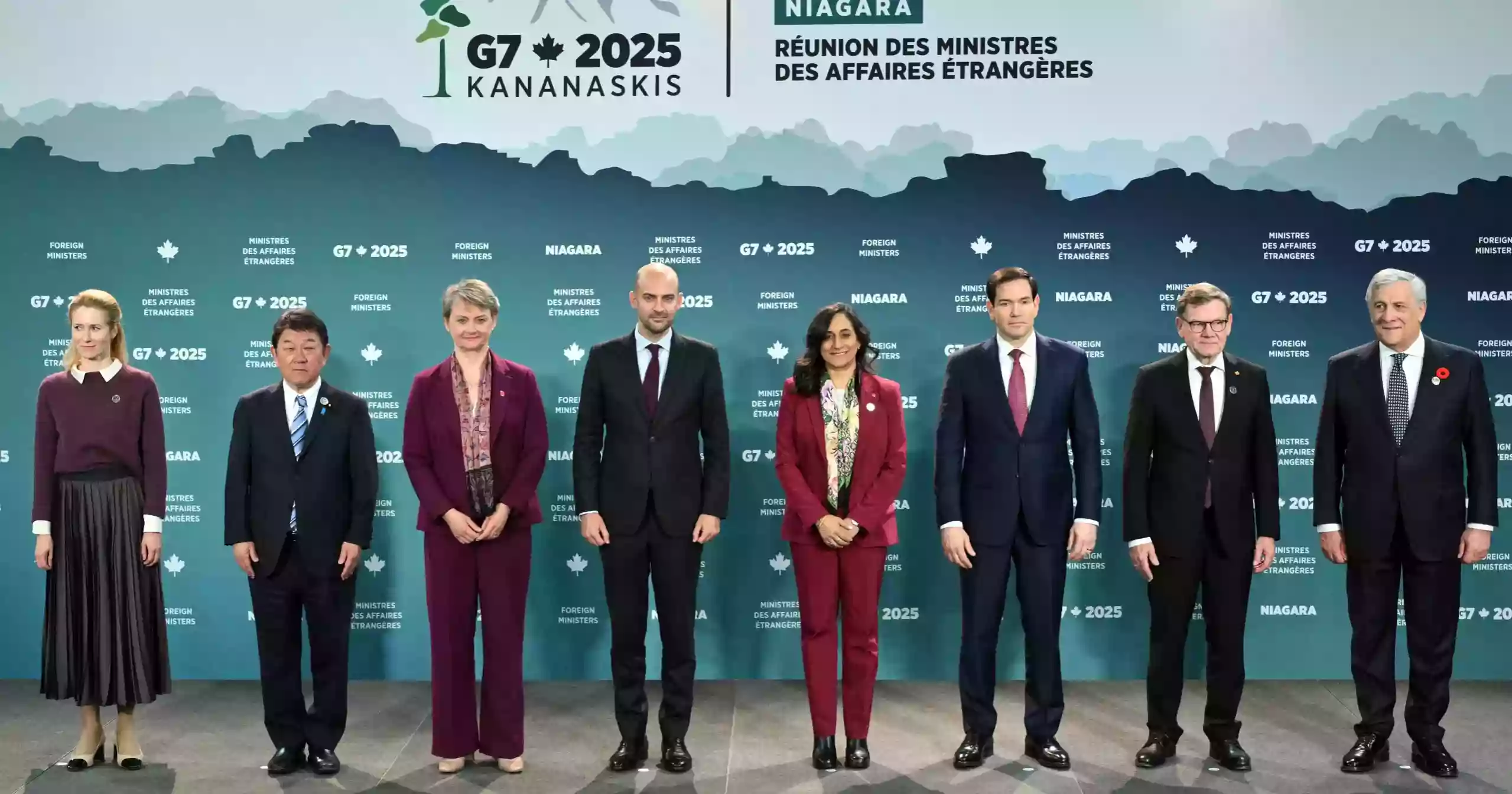
Foreign ministers from the Group of Seven (G7) industrialized nations are meeting in southern Ontario this week as trade and defense tensions escalate between the United States and its traditional allies, including Canada, alongside growing uncertainty over U.S. President Donald Trump’s Gaza ceasefire plan and efforts to end the Russia-Ukraine war.
Canadian Foreign Minister Anita Anand, who is hosting the meeting of G7 counterparts from the U.S., Britain, France, Germany, Italy and Japan, told The Associated Press that maintaining cooperation “across a range of issues” remains essential despite trade pressures.
“We’re tackling a range of critical issues with one main focus: putting the safety and security of Americans FIRST,” U.S. Secretary of State Marco Rubio said in a social media post ahead of the talks.
Anand also invited top diplomats from Australia, Brazil, India, Saudi Arabia, Mexico, South Korea, South Africa and Ukraine to join portions of the two-day meeting. Key agenda items include promoting long-term peace and stability in the Middle East and reaffirming commitment to Trump’s proposed Gaza ceasefire plan.
On Wednesday morning, the ministers are scheduled to meet with Ukraine’s foreign minister. The U.K. announced ahead of the talks that it would contribute 13 million pounds ($17 million) to help repair Ukraine’s energy infrastructure ahead of winter. The funds will support power, heating and water system repairs, as well as humanitarian assistance.
“President Putin is trying to plunge Ukraine into darkness and cold,” U.K. Foreign Secretary Yvette Cooper said, adding that Britain’s aid aims to “keep the lights and heat on.” Canada has made a similar pledge in recent weeks.
SoftBank sells Nvidia stake for $5.8 billion to boost investments in OpenAI
Canada’s tenure as G7 host this year has been overshadowed by strained relations with Washington, largely due to Trump’s tariffs on Canadian imports and renewed friction over defense spending demands. Trump has pressed NATO allies — all G7 members except Japan — to spend 5% of GDP on defense. While some have agreed, others, including Canada and Italy, remain far below that benchmark. Anand said Canada plans to reach the target by 2035.
Differences within the G7 also persist over the Israel-Hamas war, with Britain, France and Canada supporting recognition of a Palestinian state, even without a peace deal. Meanwhile, several allies have taken a harder stance on Moscow’s aggression in Ukraine than Trump has.
The meeting near the U.S. border follows Trump’s abrupt suspension of trade talks with Canada after Ontario’s provincial government ran an anti-tariff ad campaign in the U.S. Prime Minister Mark Carney has since apologized and expressed readiness to resume negotiations.
Anand said she will meet separately with Secretary Rubio to discuss bilateral and global issues, though trade matters fall under a different U.S. official’s purview. “Every complex relationship has numerous touch points,” she said. “There’s continued work to be done — both on trade and beyond — and that’s where Secretary Rubio and I come in.”
China’s exports dip 1.1% in October as shipments to US plunge 25%
U.S. officials said Rubio will focus on halting the wars in Gaza and Ukraine, as well as maritime security, Haiti, Sudan, and cooperation on critical minerals. Canada’s priorities include Arctic security, the Ukraine war, and Haiti. A working lunch will center on energy and the supply of critical minerals vital to modern technologies and defense industries — a key area of U.S.-Canada cooperation.
Source: AP