Exchange rate
Bangladesh Bank keeps policy rate at 10pc, reaffirms flexible exchange rate
Bangladesh Bank on Tuesday unveiled its monetary policy for the July-December period, retaining the policy rate at 10 percent while seeking to curb inflation.
Governor Mostaqur Rahman announced the monetary policy for the first half of the new fiscal year at a press conference held at the central bank.
Bangladesh Bank (BB) will firmly stick to its flexible, market-determined exchange rate regime to protect the country's external sector from international shocks, expand exports, and optimize remittance inflows, official sources said.
Unveiling the new Monetary Policy Statement (MPS) for the July–December period of the fiscal year FY2026-27, Mostaqur Rahman reiterated that the market-driven exchange mechanism remains a vital strategic pillar for the country's macroeconomic stability.
3 months ago
'Significant work remains' in reforming financial, fiscal, and exchange rate sectors: IMF
The International Monetary Fund (IMF) has emphasized that Bangladesh requires extensive reforms across three critical sectors, including financial, fiscal, and foreign exchange.
According to the global lender, significant work remains to be done in each of these areas to ensure economic stability.
Krishna Srinivasan, Director of the IMF's Asia and Pacific Department, made these remarks on Thursday while responding to questions from Bangladeshi journalists at a press conference in Washington, D.C. The briefing was attended by media representatives from India, Nepal, Sri Lanka, and South Korea, among other nations.
The briefing took place on the sidelines of the World Bank-IMF Spring Meetings, which commenced on April 13 and are scheduled to conclude on April 18. A 14-member Bangladeshi delegation, led by Finance and Planning Minister Amir Khosru Mahmud Chowdhury and Bangladesh Bank Governor Md. Mostaqur Rahman, is currently attending the meetings.
Reflecting on his visit to Bangladesh on March 24, where he met with Prime Minister Tarique Rahman and the Finance Minister, Srinivasan shared his impressions of the new government's capacity for reform.
"I visited Bangladesh and held meetings with the Prime Minister and other high-level officials. We discussed the challenges ahead," Srinivasan stated.
"I noted that a government with a strong majority has the opportunity to undertake ambitious reform agendas. They have listened to our suggestions; now we must wait and see how they respond," he opined.
The IMF Director expressed concern over Bangladesh's revenue collection performance. "In terms of revenue mobilization, Bangladesh has not performed well. It remains at a low level and has seen further deterioration over the last three years," he noted.
Regarding the release of the next loan tranche, he mentioned that discussions are ongoing, and updates would be provided in due course.
Highlighting the situation in Sri Lanka, Srinivasan pointed out that under its IMF-supported program, the country has made significant strides in increasing its tax-to-GDP ratio over the last three years, gradually building financial buffers. He noted that Sri Lanka is now in a relatively better position to support citizens affected by energy price shocks.
Srinivasan warned that because Bangladesh has a small revenue base, the government faces greater pressure when trying to provide social safety nets. "The people of Bangladesh are suffering. Therefore, it is crucial that whatever resources Bangladesh possesses are utilized with maximum target-based efficiency," he urged.
He advised Bangladesh to focus on increasing revenue collection while addressing other barriers in the financial sector to boost both short-term and long-term growth. Like other Asian nations, Bangladesh has been impacted by global energy shocks, and Srinivasan concluded that policy support and program discussions are active, with the outcome depending on how effectively these dialogues progress.
5 months ago

Central bank buys $120m in two days to steady exchange rate
After a hiatus of nearly two months, Bangladesh Bank (BB) has resumed purchasing US dollars from commercial banks through auctions to maintain stability in the foreign exchange market and keep the exchange rate under control.
Bangladesh Bank spokesperson Arif Hossain Khan said the central bank bought $50 million from four commercial banks on Thursday at a cut-off rate of Tk 122.75 per dollar. This followed a purchase of $70 million at Tk 122.70 per dollar on Wednesday.
With these transactions, the central bank has purchased a total of $120 million so far in April.
In the current fiscal year FY2025–26, the total dollar purchase by the central bank stands at $5.61 billion.
A high-ranking official of the central bank said banks were verbally instructed earlier this week to purchase remittance dollars at a maximum rate of Tk 122.90.
However, by buying dollars at a slightly lower rate through the auction, the central bank sent a clear signal to the market that its goal is to stabilise the rate around Tk 122.75.
The market has recently felt some pressure due to geopolitical tensions, particularly surrounding US-Iran tensions, causing some banks to acquire dollars at higher rates.
However, central bank officials expect the situation to normalize soon, leading to a potential dip in the exchange rate.
5 months ago
Middle East crisis pushes dollar rate to Tk 123 for import LCs
The ongoing crisis in the Middle East has begun to impact Bangladesh's foreign exchange market, driving up the price of the US dollar for both remittance procurement and import payments.
On Tuesday, commercial banks were seen purchasing remittance at a maximum rate of Tk 122.90 per dollar. Consequently, the exchange rate for settlement of import letters of credit (LCs) has climbed to Tk 123, according to banking sources.
Just a week ago, the dollar rate for imports stood at approximately Tk 122.50. The recent jump of nearly 50 paisa per dollar has sparked concerns among businesses.
"Banks are capitalizing on the war situation in the Middle East," an importer told the media on Tuesday.
"The sudden hike in the dollar rate is increasing our import costs, the impact of which will eventually be felt by consumers,’ he said.
Banking officials noted that uncertainty caused by the conflict has led foreign remittance houses to demand higher rates. While remittance dollars were previously available at Tk 122, the rate has now neared Tk 123 per dollar.
Bangladesh Bank’s latest exchange rate report reflects this upward trend. The average price of the dollar, which was Tk 122.33 on March 3, has now risen to Tk 122.58.
A top official of a private commercial bank stated that the central bank has issued an informal message to banks to ensure the rate does not cross the Tk 123 threshold for now.
"However, if the pressure of import liabilities increases and supply remains tight, the price may rise further," the official said, adding that the central bank might need to provide dollar support from the national reserves to stabilize the market.
Industry experts emphasized that moving toward a fully market-based exchange rate is crucial to increasing the supply of greenbacks in the local market.
7 months ago
Bangladesh Bank caps exchange rate spread at Tk 1
Bangladesh Bank has introduced a maximum exchange rate spread of Tk 1 - meaning the difference between the buying and selling rates of a foreign currency cannot exceed Tk 1, to ensure uniformity and transparency in exchange rate practices.
The Foreign Exchange Policy Department of the central bank issued a circular in this regard on Thursday.
The circular stated, “The application of unusual spreads by Authorized Dealers (ADs) between buying and selling rates of foreign currency results in discriminatory currency arrangements and multiple currency practices.”
To address this issue, ADs are now required to apply a maximum of Tk 1 as spread between buying and selling while each AD shall apply spot rate uniformly irrespective of the size for all buying transactions of a business day.
Similarly, uniform spot rate shall also be maintained for all selling transactions of a business day, it added.
The central bank also issued instructions to display the exchange rates on digital screens at AD branches and on their official websites to ensure visibility for customers.
BB eases forex rules for July-August victims’ treatment abroad
ADs have also been instructed to report their daily foreign exchange transactions to Bangladesh Bank following the procedures outlined in relevant guidelines, including the Guidelines for Foreign Exchange Transactions-2018, FE Circular Letter No 06/2022 and FE Circular No 38/2024.
Non-compliance with these regulations will result in punitive measures, including financial penalties, under the Foreign Exchange Regulation Act, 1947 and the Bank Company Act, 1991, the circular stated.
1 year ago
Bangladesh Bank steps in to stabilise exchange rates
As the country’s foreign exchange market is facing turmoil due to surging dollar demand, Bangladesh Bank has come up to identify key causes and implement corrective measures, according to officials.
To stabilise the situation, they said, Bangladesh Bank has taken the following steps:
Exchange Rate Cap:
The bank has set a maximum exchange rate of Tk 123 per dollar for remittance collection. For cross-currency transactions, the calculated rate cannot exceed this limit.
BB drafting separate rules for Islamic banking; ‘bankers divided’
Data Monitoring System:
A dashboard has been implemented to monitor market data closely, ensuring greater transparency and control.
The central bank’s measures aim to alleviate the current crisis and restore stability to the dollar market.
According to the officials, the central bank attributed the ongoing dollar market volatility to several interconnected factors.
Number of Tk 1 crore and above account holders drops after political changeover: BB report
The central bank says one major cause is the increased demand for dollars at the end of the financial year. December often sees a spike in loan repayments and other financial obligations, creating added pressure on the foreign exchange market.
Compounding this is the central bank’s recent suspension of dollar sales to meet IMF-mandated targets. This decision has restricted the supply of dollars in the interbank market, further widening the gap between demand and supply.
Besides, Bangladesh’s downgraded credit rating has disrupted correspondent relationships with foreign banks. This has made it more challenging to issue UPAS (Usance Payable at Sight) letters of credit, defer payment maturities, and maintain the inflow of offshore banking loans.
The situation has been aggravated by a directive from Bangladesh Bank mandating the repayment of foreign debts by December, adding additional pressure to the market.
Another significant factor is the role of aggregators and intermediaries in remittance collection. Their monopolistic practices have destabilised exchange rates, contributing to the ongoing turmoil.
A mismatch in dollar inflows and outflows by commercial banks has further complicated the situation, exacerbating instability in the dollar market.
1 year ago

Market-based interest rate, unified exchange rate from July: Bangladesh Bank
Bangladesh Bank will be returning to market-based interest rate from July with the announcement of the next half-yearly monetary policy statement, which will cover the first six months of the 2023-24 fiscal.
The central bank will also set a unified foreign exchange rate for all sectors, as per the guidelines of the International Monetary Fund (IMF).
Also Read: Despite many challenges, Bangladesh remains one of the fastest growing economies in Asia-Pacific: Visiting IMF team
Md Mezbaul Haque, executive director and spokesperson of Bangladesh Bank, said this today (Sunday) in a press briefing.
The IMF team ended their visit Sunday, having arrived in Dhaka on April 25, to discuss the progress of implementation of the joint action plan for the $4.7 billion IMF loan for Bangladesh.
After the discussion with the IMF delegation, Haque briefed reporters regarding the discussions on Sunday.
Also Read: Bangladesh’s GDP growth rate will overtake China’s in current fiscal year, IMF predicts
Meanwhile the IMF team has expressed satisfaction regarding the progress of reforms in different sectors, the spokesperson said.
Explaining the introduction of a unified exchange rate, he said that a single foreign exchange rate does not mean that the buying and selling rate of the dollar will be the same.
Now there are several exchange rates, but if the difference between them is within 2 percent, the exchange rate can be said to have a single exchange rate.
Also Read: IMF satisfied with progress of BBS’ GDP and inflation data updated under new method
Apart from this, calculation of forex reserves according to the IMF's Balance of Payments and Investment Position Manual (BPM-6) will also be announced in the next monetary policy, Mezbaul said.
The next IMF delegation will visit Bangladesh in October. Some of the reform measures to be carried out under the terms of the loan to Bangladesh are expected to be achieved by September.
The IMF has already disbursed the first instalment of the sanctioned loan. Mezbaul said that the recently concluded visit of the IMF team has nothing to do with receiving the second instalment of the loan.
3 years ago

IMF-Bangladesh Bank meeting prioritizes unified exchange rate and competitive lending rate
A visiting delegation of the International Monetary Fund (IMF) on Tuesday met with the Bangladesh Bank (BB) Governor and discussed updated financial factors along with the progress of reform in the sectors.
A five-member delegation headed by Rahul Anand, IMF Bangladesh Mission Chief, started meeting with the BB officials in the morning on Tuesday, which ended at 3.0 pm.
Md Mezbaul Haque, executive director, and BB spokesperson told reporters that the IMF team discussed updated information on various economic factors with the several departments of BB including the progress in the use of the IMF's loan.
He also said that the visit was a routine process of the IMF's work and the BB participated in the meeting on behalf of the state.
Sources close to the meeting said among the issues prioritized in the discussion are efforts to unify multiple exchange rates, making lending interest rates market-oriented, and the process of calculating foreign reserves under the IMF definition.
During its (IMF) April 25 to May 2 visit the mission will hold meetings with the officials of the Ministry of Finance's Finance Division, Financial Institutions Division, Economic Relations Division (ERD), Bangladesh Bank, and National Board of Revenue (NBR), sources said.
Bangladesh applied to the IMF for a loan to stabilize the economy amid dwindling forex reserves and agreed to pursue reforms on certain issues.
Read more: Bangladesh receives 1st instalment of IMF’s $4.7 billion loan: BB spokesperson Before and after receiving the first $476.2 million tranche in February, Bangladesh took several steps to reform the structure of its financial sector and its policies, including reducing subsidies by raising the price of power and gas, and fuel.
The foreign exchange crisis in Bangladesh eased after the global lender released the first installment of a $4.7 billion loan. After then, World Bank and Japan International Cooperative Agency
The IMF approved about $3.3 billion for Bangladesh under the Extended Credit Facility ECF) and the Extended Fund Facility (EFF) and about $1.4 billion under the Resilience and Sustainability Facility.
Read more: BB set to announce new monetary policy
3 years ago

Remittance fell in Sep due to exchange rate volatility: Bangladesh Bank
Bangladesh Bank spokesperson Md. Serajul Islam on Tuesday blamed the extreme volatility in the forex market in recent months on the global strength of the dollar against almost all currencies.
“Not only in Bangladesh but also in neighboring countries, the price of the US dollar has increased. In many South Asian countries, it is higher than it is in Bangladesh,” he said.
Serajul Islam, also executive director of the BB, said this in a briefing for a group of reporters on decreasing remittances and export earnings in the last month.
The inward remittance flow in September may have fallen due to the situation over the exchange rate, with a significant volume being diverted to the kerb market in search of a higher rate for the dollar, he believed.
Year on year, Bangladesh's inward remittances dropped by 10.84 percent to $1.54 billion in September, the third month of the 2022-2023 fiscal, from $1.72 billion in the same month last year. It was the lowest inflow of remittances in 7 months.
The drop was even steeper, almost 25 percent, in comparison to the previous month (August 2022).
It followed a decision by banks on September 11 to pay a maximum of Tk 108 for each dollar to foreign exchange houses (like MoneyGram and Western Union, through which most expats send money). Prior to that, they had offered exchange houses up to Tk 115 for a dollar.
The Association of Bankers, Bangladesh (ABB) and Bangladesh Foreign Exchange Dealer’s Association (BAFEDA) were tasked to come up with the rate by the central bank, as an alternative to Bangladesh Bank frequently intervening in the market to set the rate, usually by selling dollars to support an artificially overvalued rate for taka.
Read: Sept saw 25% drop in remittance, bankers blame fixed exchange rate
But the “strongest dollar in a generation”, witnessed over the last year or so and likely to persist well into the foreseeable future, was starting to make the prevailing system very expensive to maintain for Shapla Chattor. The new system, meanwhile, would seem to be still going through 'teething problems.'
Serajul Islam however said today that the price of the US dollar "is normalizing with the initiative of the central bank".
"Bangladesh Bank should not provide any dollar support to the market. BAFEDA and ABB are also playing a role in overcoming the dollar crisis. Currently, the volatility of the dollar has also decreased somewhat," he said.
The spokesperson said Bangladesh has to emphasize this issue by increasing export income.
“To that end, businessmen have to work to establish Bangladesh as a brand in the global market. If we can do this, this crisis will end quickly,” he added.
4 years ago
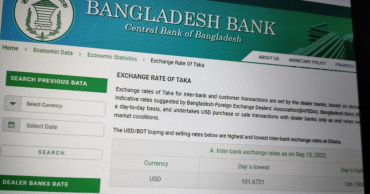
BB web portal shows US dollar exchange rate Tk106, though BB rate Tk96
Bangladesh Bank (BB) suddenly changed the US dollar rate at the interbank exchange rate on Tuesday.
The central bank says that the selling price of the dollar in interbank transactions on Tuesday was Tk106.15. And in the interbank transaction, the purchase price of the dollar is Tk101.67.
But it is not the central bank rate, it is the dollar trading rate between the banks themselves. The price at which banks trade dollars is called the interbank rate.
Read: Uniform rate: Tk 108/dollar max for remittance, Tk 99/dollar for export income from tomorrow
Recently, the price at which the central bank used to buy and sell dollars was referred to as the interbank rate. The BB has been publishing that price on the website.
But today (Tuesday) the central bank suddenly changed the price. Last Sunday, the selling price of the dollar was shown at Tk95 on the website. Yesterday (Monday), the price of the dollar was increased by Tk1 to Tk 96.
Today (Tuesday) the selling price of the dollar is shown on BB’s website as more than Tk106. And the purchase price is showing around Tk102.
However, even today, the BB has sold $4.5 crore from forex reserves at the rate of Tk96.
Read: Illegal dollar trade: BB summons account details of 28 exchanges
The central bank officials say that the price at which banks will buy and sell dollars will be the interbank rate. That will be published on the website. But the central bank will not sell at this rate.
The BB Executive Director and Spokesperson Md Sirajul Islam told UNB, "The price of the dollar was increased to Tk 96 yesterday. Even today the central bank sold dollars at this price.”
He is not aware why the price of dollars is being shown so high on the website.
4 years ago