Environment Pollution
Lack of coordination dooms govt drive against polythene, single-use plastics
The government’s much-hyped move to curb the use of polythene bags and single-use plastics has floundered, with experts blaming the failure on the lack of a coordinated and comprehensive approach.
They said such efforts will never succeed unless the government simultaneously regulates the import, marketing, storage and processing of plastic particles and ensures the availability of proper alternatives in sufficient quantities.
Though the interim government began enforcing a no-more-polythene-bag policy in super shops from October 1, 2024, and extended it to all kitchen markets from November 1, 2024, the move made no impact beyond super shops.
Environment pollution and public health expert Prof Dr Liaquat Ali stressed the importance of forming a multi-sectoral or inter-ministerial body comprising the ministries of environment, health, commerce, education, information, textiles and jute and home to combat the use of single-use plastics effectively.
“I think the initiative to stop the use of polythene bag and single-use plastics has failed due to lack of a coordinated initiative,” he told UNB.
Dr Liaquat Ali observed that the use of polythene bags or single-use plastics is on a gradual rise. “No scattered initiative will be a success here. I think this has been a failed initiative. Interventions must be simultaneous across all relevant sectors, from import, production and consumption,” he added.
Echoing the same, environmental activist architect Iqbal Habib said the campaign against polythene bags and single-use plastic products cannot succeed without coordinated restrictions on import, marketing, storage and production and intervention in recycling alongside making affordable proper substitutes available in the market and strict enforcement of laws.
“The government did not impose a blanket restriction on import and processing of plastic particles, citing their use in RMG and other export-oriented sectors. But removing polythene is impossible without imposing simultaneous restrictions at all levels,” he said.
HC wants to know about effective measures to curb Dhaka’s air pollution
About alternatives, he said the copyright of the biodegradable ‘Sonali Bag’ (Jute Polymer) is still restricted. Besides, some entrepreneurs showed interest in producing substitutes from corn, potato and banana fibre, BSTI has not approved them yet, he added.
Noting that polythene is being used in all sorts of packages, Iqbal Habib said this government has no dare to control 40-50 business oligarchs in using polythene.
Bangladesh Poribesh Andolon (BAPA) General Secretary Alamgir Kabir blamed the failure of the anti-polythene initiative on the lack of affordable and accessible alternatives in the market. “This initiative didn’t see light beyond super shops due to lack of suitable substitutes. It has failed,” he said.
Referring to a research report, he said some 2.5 crore polythene bags are dumped daily in Dhaka alone, resulting in serious environmental, health and economic consequences.
He suggested that the government subsidise eco-friendly alternatives and consider purchasing the copyright of the Sonali Bag for mass production.
In September 2024, Environment, Forest and Climate Change Adviser Syeda Rizwana Hasan announced that super shops must stop using polythene and polypropylene shopping bags from October 1, 2024 as well as a nationwide anti-polythene drive in all kitchen markets from November 1, 2024 as part of a phased enforcement of the polythene ban.
The Adviser also said the government would strictly enforce the ban on production, storage, transportation, marketing and use of polythene to completely stop its use in the country.
But like previous attempts, this fight against polythene appears to be heading towards failure.
The polythene bags were first banned in 2002 and the people refrained from using them for some days, fearing punishment. But they started using polythene again due to the lack of suitable alternative bags.
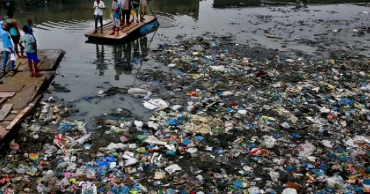
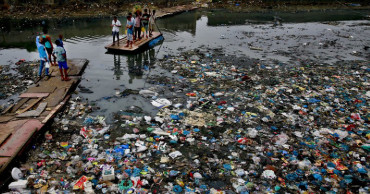
Bangladesh is now facing an alarming surge in plastic waste, fueled by the failure to recycle disposable items like bags, bottles, straws, and packaging materials, many of which end up in landfills and water bodies.
Builders in Dhaka fined for violating air pollution rules
Unregulated Plastic Production
Plastic industries also contribute considerably to the growing mismanaged plastic waste in Bangladesh. There are about 5,000 plastic manufacturers operating in Bangladesh, employing about 1.2 million individuals (BIDA, 2021).
According to another research, Bangladesh's annual per capita plastic consumption in urban areas tripled to 9.0 kg in 2020 from 3.0 kg in 2005.
Of the 977,000 tonnes of plastic consumed in 2020, only 31 percent was recycled.
1 year ago

Global pollution kills 9 million people a year, study finds
A new study blames pollution of all types for 9 million deaths a year globally, with the death toll attributed to dirty air from cars, trucks and industry rising 55% since 2000.
That increase is offset by fewer pollution deaths from primitive indoor stoves and water contaminated with human and animal waste, so overall pollution deaths in 2019 are about the same as 2015.
The United States is the only fully industrialized country in the top 10 nations for total pollution deaths, ranking 7th with 142,883 deaths blamed on pollution in 2019, sandwiched between Bangladesh and Ethiopia, according to a new study in the journal The Lancet Planetary Health. Tuesday’s pre-pandemic study is based on calculations derived from the Global Burden of Disease database and the Institute for Health Metrics and Evaluation in Seattle. India and China lead the world in pollution deaths with nearly 2.4 million and almost 2.2 million deaths a year, but the two nations also have the world’s largest populations.
When deaths are put on a per population rate, the United States ranks 31st from the bottom at 43.6 pollution deaths per 100,000. Chad and the Central African Republic rank the highest with rates about 300 pollution deaths per 100,000, more than half of them due to tainted water, while Brunei, Qatar and Iceland have the lowest pollution death rates ranging from 15 to 23. The global average is 117 pollution deaths per 100,000 people.
Pollution kills about the same number of people a year around the world as cigarette smoking and second-hand smoke combined, the study said.
“9 million deaths is a lot of deaths,” said Philip Landrigan, director of the Global Public Health Program and Global Pollution Observatory at Boston College.
Read: Brick kilns threaten environment & cause health hazards in south-western Bangladesh
“The bad news is that it’s not decreasing,” Landrigan said. “We’re making gains in the easy stuff and we’re seeing the more difficult stuff, which is the ambient (outdoor industrial) air pollution and the chemical pollution, still going up.”
It doesn’t have to be this way, researchers said.
“They are preventable deaths. Each and every one of them is a death that is unnecessary,” said Dr. Lynn Goldman, dean of the George Washington University School of Public Health, who wasn’t part of the study. She said the calculations made sense and if anything. was so conservative about what it attributed to pollution, that the real death toll is likely higher.
The certificates for these deaths don’t say pollution. They list heart disease, stroke, lung cancer, other lung issues and diabetes that are “tightly correlated” with pollution by numerous epidemiological studies, Landrigan said. To then put these together with actual deaths, researchers look at the number of deaths by cause, exposure to pollution weighted for various factors, and then complicated exposure response calculations derived by large epidemiological studies based on thousands of people over decades of study, he said. It’s the same way scientists can say cigarettes cause cancer and heart disease deaths.
“That cannon of information constitutes causality,” Landrigan said. “That’s how we do it.”
Five outside experts in public health and air pollution, including Goldman, told The Associated Press the study follows mainstream scientific thought. Dr. Renee Salas, an emergency room doctor and Harvard professor who wasn’t part of the study, said “the American Heart Association determined over a decade ago that exposure to (tiny pollution particles) like that generated from the burning of fossil fuels is causal for heart disease and death.”
4 years ago

Mongla Port Authority Bill proposes tougher punishment for polluting environment
The ‘Mongla Port Authority Bill, 2021’ was placed in Parliament on Saturday with a provision for tougher punishment for polluting the environment.
State Minister for Shipping Khalid Mahmud Chowdhury placed the Bill and it was sent to the respective Standing Committee for further scrutiny. The Committee was asked to submit its report within two months.
The bill will abolish the Chalna Port Authority Ordinance 1976 as it was promulgated during a military regime.
As per the bill, the punishment for harming the environment by polluting water, land and coast has been raised to one-year imprisonment or a fine of Tk 5 lakh or both. The fine is Tk 50,000 in the existing ordinance.
Also read: Mongla port: Harbouring the future of Bangladesh
According to a new provision incorporated in the bill, the punishment for dodging toll, fee and other charges of the port will invite a one-year jail term or a fine of Tk 1 lakh or both.
If anyone defies the law, he will be sentenced to six months in jail or be fined Tk 2 lakh or by both. The punishment is only a six-month jail and a fine of Tk 50,000 in the existing ordinance.
Besides, some new terminologies like ‘inland water vessel’, ‘terminal’, ‘berth’, container freight station and ‘lease’ have been incorporated in the bill.
Also read: Mongla Port: Tk754 crore deal signed for dredging of inner bar area
According to the bill, there will be a seven-member board to run the port. The number of the board members is now four in the existing ordinance.
The port authority can declare the restricted port area through a special order.
5 years ago

Public health issues like air pollution, environment not getting due attention
Speakers at a webinar urged the authorities concerned to pay more attention to public health issues like air pollution, environment pollution that makes a cost every year.
5 years ago

8 Savar tanneries fined for polluting environment
The Department of Environment (DoE) on Wednesday fined eight tanneries at Savar Tannery Industrial Estate Tk 21lakh for polluting the environment.
6 years ago

6 entities fined for keeping construction materials on roads
Two mobile courts of Dhaka North City Corporation (DNCC) on Sunday fined six entities on charges of polluting the environment by keeping construction materials on roads and footpaths in the city’s Uttara area.
6 years ago
1 crore saplings to be planted across 482 upazilas for ‘Mujib Borsho’
Environment, Forest and Climate Change Minister Md Shahab Uddin said on Monday that one crore saplings will be planted simultaneously in 482 upazilas across the country on June 5 as part of ‘Mujib Borsho’ celebrations.
6 years ago
Keep track of your plastic wastes online
A web application to track plastic wastes was launched in Bangladesh recently by ‘Dataful’, a data journalism initiative.
6 years ago