Oxfam
Digital platform launched to connect Bangladeshi diaspora with country's development priorities
Bridge to Bangladesh, a first-of-its-kind digital platform comprising a website and mobile app, has been launched to connect the global Bangladeshi diaspora with the country's development priorities.
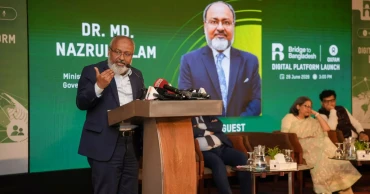
Oxfam launched the digital platform, bridgetobd.org, at an event in Dhaka on Sunday.
The event was attended by senior government officials, representatives of civil society and international organizations, diaspora leaders, and journalists.
An initiative of Oxfam in Bangladesh, the platform enables more than 2.4 million Bangladeshis living abroad to contribute knowledge, mentorship, skills, advocacy, innovation, philanthropy, investment linkages, and professional expertise through verified Bangladeshi organizations and individuals.
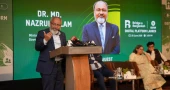
Speaking at the launch, Secretary at the Ministry of Foreign Affairs Dr Md Nazrul Islam said Bangladeshi diaspora members are eager to contribute to the country's development and that building trust and sustainable engagement is essential.
He also said the government's long-awaited diaspora policy is in its final stage and is expected to be approved soon.
Highlighting the importance of stronger diaspora engagement, Dr Nazrul said many investors are coming to Bangladesh, but they could not invest because of a trust deficit.
"And also, they could not really connect and did not receive adequate facilities or services from different government entities. Therefore, deregulation and the reform of government services are essential for increasing transparency," he said.
Dr Nazrul stressed the need for regulatory reforms, greater transparency, and better facilitation through Bangladesh's overseas missions.
3 months ago
Oxfam, Fair Pay Foundation to promote responsible business, equality in tea industry
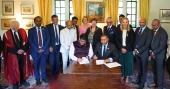
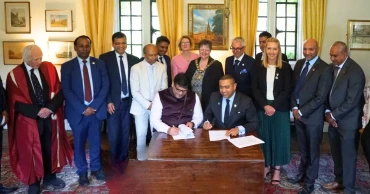
Oxfam and the Fair Pay Foundation (FPF) have signed a Memorandum of Understanding (MoU) in Oxford, UK which is seen as a step towards transforming the tea industry and uplifting the lives of marginalised workers.
This "strategic partnership" aims to build a global movement for fairness, ethical business, equality, and justice in labor-intensive industries—starting with tea plantations in Bangladesh.
Policy makers, business personalities, academicians, Bangladeshi diaspora members of the UK joined the MoU signing event on May 19.
Signed by Sir Sheikh Aliur Rahman KGOR OBE, Ambassador and Chairman of the Fair Pay Foundation, and Ashish Damle, Country Director of Oxfam in Bangladesh, this MoU sets the foundation for the development of a Model Tea State, Oxfam said on Tuesday.
Gold price increased by Tk 1364 per bhori from Sunday
The model will showcase fair remuneration, ethical & responsible business, decent working conditions, climate-smart practices, gender justice, and economic resilience.
“The signing of this MoU is more than a ceremonial agreement. It is a commitment to restoring dignity, equality, and opportunity for one of the most exploited labor forces in the world,” said Sir Sheikh Aliur Rahman KGOR OBE, Chairman of the Fair Pay Foundation.
As part of the partnership, Oxfam and FPF will collaborate to implement a comprehensive roadmap to operationalize the Model Tea State in Bangladesh.
This includes conducting in-depth social architecture and power analyses, assessing market opportunities, promoting eco-tourism, introducing renewable energy solutions, improving housing and health infrastructure, and amplifying the voice and agency of women workers through leadership platforms.
Dr Halima Begum, Chief Executive of Oxfam GB, emphasised the transformative potential of this collaboration.
SAFE HVACR & Cold Chain Expo: Haier to present new horizon in indoor climate control technology
"Today’s partnership towards Fair Pay as a movement shows that when we say we stand with marginalised communities, we mean it. With our investment in the Model Tea State, we are helping to build a future where workers and owners are partners, with shared ambitions and values.”
1 year ago

NRBC Bank, OXFAM, Bangladesh sign deal to enhance microcredit
NRBC Bank and OXFAM, Bangladesh will work together for welfare of the marginal people through micro credit, creating cashless village facility and online marketplace for small entrepreneurs.
NRBC Bank and OXFAM signed a memorandum of understanding (MoU) in this regard on Monday.
Golam Awlia, Managing Director and CEO of NRBC Bank and Ashish Damle, Country Director, OXFAM, Bangladesh signed the MoU on behalf of their respective sides.
Also read: WFP, Oxfam, Green Delta Insurance join hands to protect labourers
The objective of the project is to alleviate poverty and injustice and create scope for them up with fourth industrial revelation by ensuring their access to financial and technological ecosystems.
Kazi Md. Talha, Additional Managing Director, Kabir Ahmed, DMD, Harunur Rashid, CFO, Kazi Safayet Kabir, Head of FI, Mohammad Soeb Iftekhar, head of economic inclusion & Justice, Sonia Tahera Kabir, business development manager of OXFAM, Bangladesh were among others, present at the function.
Also read: ACC signs MoU with Oxfam to strengthen anti-graft activities
4 years ago
Bangladesh ranks 113 on CRII index
Bangladesh has ranked 113 on the Commitment to Reducing Inequality (CRII) Index 2020.
6 years ago
.jpg)
WFP, Oxfam, Green Delta Insurance join hands to protect labourers
The United Nations World Food Programme (WFP), Oxfam Bangladesh and Green Delta Insurance Company Ltd have launched a new insurance scheme to protect casual agricultural labourers in Bangladesh from floods during this monsoon.
6 years ago
.jpg)
Covid-19: Vaccines, tests, treatment should be patent-free
Oxfam has urged governments and pharmaceutical companies to guarantee that vaccines, tests, and treatments will be patent-free and equitably distributed to all nations and people.
The agency made the call on Thursday, ahead of the World Health Assembly next week. The virtual meeting on Monday will be attended by health ministers from 194 countries.
Vaccinating the poorest half of humanity – 3.7 billion people - could cost less than the 10 biggest pharmaceutical companies make in four months, Oxfam said on Thursday.
The Gates Foundation has estimated that the cost of procuring and delivering a safe and effective vaccine to the world’s poorest people is $25 billion.
Last year, the top ten pharmaceutical companies made $89 billion in profits – an average of just under $30 billion every four months.
Oxfam warned that rich countries and huge pharmaceutical companies – driven by national or private interests – could prevent or delay the vaccine from reaching vulnerable people, especially those living in developing countries.
The EU has proposed the voluntary pooling of patents for coronavirus vaccines, treatments, and tests in their draft resolution for the World Health Assembly.
If made mandatory and worldwide, this would ensure that all countries could produce, or import low cost versions, of any available vaccines, treatments, and tests.
Leaked Documents
Oxfam said leaked documents reveal that the Trump administration is trying to delete references to pooled patents and insert strong language on respecting the patents of the pharmaceutical industry.
This would give pharmaceutical companies exclusive rights to produce, and set prices for any vaccines, treatments and tests they develop – even if taxpayer money has been used to fund their research and development.
Jose Maria Vera, Oxfam International Interim Executive Director, said providing a vaccine to 3.7 billion people could cost less than what the ten biggest pharmaceutical companies make in four months.
Anything less than guaranteeing that a vaccine is made available free of charge to all people would be obscene.
“Vaccines, tests and treatments should be distributed according to need, not auctioned off to the highest bidder. We need safe, patent-free vaccines, treatments and tests that can be mass produced worldwide, and a clear and fair plan for how they will be distributed.”
Once vaccines or treatments are developed, there is also a high risk that rich and powerful governments will outbid poorer nations and force their way to the front of the queue, as they did in the scramble for other essential medical supplies such as personal protective equipment and oxygen.
In March, drug manufacturer Gilead moved to extend the monopoly on a potential treatment for the virus, and only withdrew it after a public outcry.
Gilead has now donated a significant portion of its current supply of remdesivir to the US government, but news reports suggest the company could make significant profits from subsequent production.
Some Wall Street analysts expect Gilead to charge more than $4,000 per patient for the drug, even though the cost of remdesivir can be as low as $9 per patient.
Poor Countries
Many poor countries are unable to access essential vaccines and medicines due to patent rules which give pharmaceutical companies monopoly rights and the power to set prices well above what they can afford.
Pneumonia is the biggest killer of children under the age of five, with 2,000 children dying every day. For over a decade, millions of children have not had access to patented pneumonia vaccines manufactured by Pfizer and GlaxoSmithKline due to its high cost.
After years of campaigning by Médecins San Frontieres, both companies reduced their prices in 2016, but only for the very poorest countries, leaving millions of children still without access to their vaccine.
Oxfam is proposing a four-point global plan that calls for:
a) Mandatory sharing of all Covid-19 related knowledge, data and intellectual property, and a commitment to make all public funding conditional on treatments or vaccines being made patent-free and accessible to all.
b) A commitment to deliver additional global vaccine manufacturing and distribution capacity with funding from rich country governments.
This means building factories in countries willing to share and investing now in the millions of additional health workers needed to deliver prevention, treatment, and care both now and in the future.
c) A globally agreed, equitable distribution plan with a locked-in fairness formula so that supply is based on need, not ability to pay.
Vaccines, treatments, and tests should be produced and supplied at the lowest cost possible to governments and agencies, ideally no more than $2 a dose for a vaccine, and provided free at the point of delivery to everyone that needs it.
d) A commitment to fix the broken system for the research and development of new medicines. The current system puts pharmaceutical profit above the health of people across the world meaning many needed put unprofitable medicines never get developed, and those that do are too often priced out of reach for the poorest countries and people.
Vera said, “Delivering an affordable vaccine for everyone will require unprecedented global cooperation. Governments must rip up the rulebook and prioritise the health of people everywhere, over the patents and profits of pharmaceutical corporations. Governments must ensure that no one is left behind.”
The Gates Foundation estimated the cost of producing and distributing a vaccine and has confirmed that this cost relates to the production and distribution in low and lower middle income countries only.
Oxfam believes that vaccines should ideally be produced and supplied for no more than $2 per dose.
This is a reasonable challenge to set given that new complex vaccines for big killers like pneumonia are already available for this price.
6 years ago
Save stranded people in Bay of Bengal, Andaman Sea: Humanitarian agencies
Eighteen humanitarian agencies called on governments in the region to save lives of stranded asylum seekers in the Bay of Bengal and Andaman Sea.
6 years ago
ACC signs MoU with Oxfam to strengthen anti-graft activities
International agency Oxfam and the Anti-Corruption Commission (ACC) have signed a Memorandum of Understanding (MoU), aiming to strengthen anti-corruption activities in the country.
6 years ago