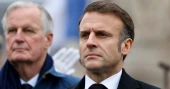
President Emmanuel Macron
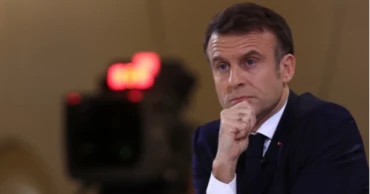
Macron signals France could recognise Palestinian state soon
President Emmanuel Macron has suggested that France may recognise a Palestinian state "in the coming months." Speaking to France 5 television on Wednesday, Macron said he hoped to formalise the recognition at a United Nations conference on the Israel-Palestine conflict, which France will co-chair with Saudi Arabia in June.
“We must move towards recognition, and we will do so in the coming months,” Macron stated. “I’m not doing it to please anyone. I’ll do it because at some point it will be right,” he added.
Varsen Aghabekian Shahin, Palestine’s Minister of State for Foreign Affairs, welcomed the news, calling it “a step in the right direction in line with safeguarding the rights of the Palestinian people and the two-state solution.”
However, Israel has opposed any unilateral recognition of Palestinian statehood. Israeli Foreign Minister Gideon Saar warned that such a move would only strengthen Hamas.
“A ‘unilateral recognition’ of a fictional Palestinian state, by any country, in the reality that we all know, will be a prize for terror and a boost for Hamas,” Saar wrote on X. “These kind of actions will not bring peace, security and stability in our region closer – but the opposite: they only push them further away,” he added.
At least 60,000 children malnourished in Gaza as Israeli aid blockade continues
So far, Palestine has been recognised as a sovereign state by 146 out of 193 UN members, including Armenia, Slovenia, Ireland, Norway, Spain, and several Caribbean nations. Despite this, key Western countries like the United States, Australia, the United Kingdom, and Germany have yet to grant recognition.
Macron believes that recognition of Palestine could lead to a “collective dynamic” in which some Middle Eastern countries might recognise Israel. At present, countries such as Saudi Arabia, Iran, Iraq, Syria, and Yemen do not recognise Israel.
By recognising Palestine, Macron explained, France could take a clearer stance against countries like Iran, which deny Israel’s right to exist, and strengthen its commitment to regional security.
On a recent trip to Egypt, Macron held talks with President Abdel Fattah el-Sisi and Jordan’s King Abdullah II, making it clear he was strongly opposed to any displacement or annexation in Gaza and the Israeli-occupied West Bank.
With inputs from AL Jazeera
1 year ago
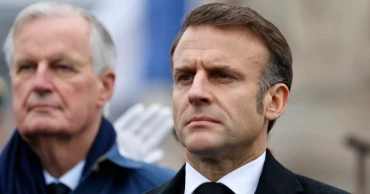
Macron to address France after no-confidence vote ousts govt
French President Emmanuel Macron will deliver a national address on Thursday, following a historic no-confidence vote in the National Assembly that ousted Prime Minister Michel Barnier and left France without a functioning government, reports AP.
Macron is expected to focus on addressing the political crisis and may announce a new prime minister to lead the fractured parliament. Barnier, whose tenure lasted just three months—the shortest of any modern French prime minister—resigned Thursday morning at the Elysée Palace, as required by the constitution. The no-confidence motion passed with 331 votes in the National Assembly.
For the first time Macron recognizes 1944 Thiaroye killings as massacre
Urgency to Act
Macron now faces the challenge of appointing a leader capable of managing a minority government in a divided parliament. Yaël Braun-Pivet, president of the National Assembly and a member of Macron’s party, urged swift action, emphasising the need for a leader who can unify and prioritise passing a new budget bill. French media reports suggest a shortlist of centrist candidates, though no names have been confirmed.
The president’s delay in appointing Barnier after June’s legislative elections—over two months—has raised concerns about potential setbacks in selecting a replacement.
Calls for Macron’s Resignation
The no-confidence vote has emboldened opposition leaders, with some demanding Macron’s resignation. Manuel Bompard, leader of the far-left France Unbowed party, argued that stability requires Macron to step down. Far-right National Rally leader Marine Le Pen did not explicitly call for his resignation but warned of growing pressure on the president.
Macron in Morocco after his Western Sahara change brings a 'new honeymoon'
Macron has rejected these calls, stating his commitment to serve until 2027, as mandated by the constitution, which does not require a president to step down after their government is ousted. Legislative elections cannot be held until July, adding to the political uncertainty.
Economic Concerns
The political turmoil has raised fears over France’s economy, with its debt projected to reach 7% of GDP next year without reforms. Analysts warn that Barnier's ousting may increase French interest rates, exacerbating the country’s debt issues. Moody’s cautioned that the government’s fall diminishes the likelihood of addressing public finances and deepens political gridlock.
Macron’s address, set for 8 p.m. local time, is expected to outline plans to tackle economic challenges and chart a path forward for the next government.
1 year ago
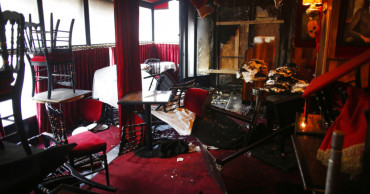
Splits in France's strike movement trigger fears of violence
A French government minister warned that seditious groups bent on violence were hijacking the protest movement against pension reform that has gripped the country, after a fire Saturday damaged a renowned Paris restaurant patronized by President Emmanuel Macron.
6 years ago