tremor

Japan issues tsunami alert after 7.6 quake
A powerful earthquake with a preliminary magnitude of 7.6 struck northeastern Japan late Monday night (December 08, 2025), prompting a tsunami warning for wide stretches of the Pacific coastline, according to the Japan Meteorological Agency (JMA).
The quake struck at 11:15 p.m. local time at a depth of 50 km and registered upper 6 on Japan’s seismic intensity scale of 7 in the hardest-hit areas, the agency said.
Read more: Earthquake: Matlab Bridge crack triggers fears as thousands cross every day
Tsunami warnings have been issued for coastal regions of Hokkaido, Aomori and Iwate prefectures, where waves as high as 3 meters are expected. The epicenter was located off the eastern coast of Aomori at 41.0 degrees north latitude and 142.3 degrees east longitude.
A tsunami advisory was also issued for Miyagi and Fukushima prefectures following the strong tremor. Authorities urged residents in the warned areas to move to higher ground immediately as aftershocks are likely.
Read more: Earthquake Alerts: Best Free Mobile Apps in 2025-26
10 months ago

Earthquake Alerts: Best Free Mobile Apps in 2025-26
When the ground tremor occurs without warning, safety issues often feel incomplete until mobile apps for earthquake alerts enter the picture. Bangladesh, with its long-known vulnerability to seismic pressure, has a particular stake in fast, reliable alerts. Technology is quietly reinforcing hope here, offering ordinary phone users a chance to react milliseconds earlier. Such tools may not erase the threat, yet they help people face it with clearer information and steadier nerves. Let's explore the top reliable earthquake warning apps for smartphones that could shape preparedness strategies heading into 2025-26.
Top Free Earthquake Warning Apps for Android and iOS Devices
A new wave of seismic tools is reshaping how people prepare for sudden ground shifts. Here’s a quick look at the mobile apps, built to deliver faster alerts and clearer information when it counts.
MyShake Earthquake Alerts
Earthquake early warnings often feel abstract until the ground actually moves, which is why the system built into ‘MyShake’ tends to stand out. Developed at the UC Berkeley Seismological Laboratory, it sends notifications for magnitude-4.5-and-up quakes a few seconds before the shaking reaches you. This is a narrow window, yet often enough to steady yourself or move away from danger.
Read more: Top 10 Smartphones Debuting in December 2025
The app has been around since February 12, 2016, and runs on both Android 9+ and iOS 12+, a broad range that keeps it accessible. Some users argue that the lead time varies a bit depending on their location. But that’s the nature of seismic networks rather than a flaw in the tool itself.
Android: https://play.google.com/store/apps/details?id=edu.berkeley.bsl.myshake
IOS: https://apps.apple.com/app/id1467058529
My Earthquake Alerts
People lean on quick post-event information more than full early warning systems, which is exactly where ‘My Earthquake Alerts’ finds its purpose. Released back on May 3, 2015, by JRustonApps B.V., it focuses on notifying users moments after an earthquake occurs.
The alerts aim for speed and clarity rather than prediction. It’s compatible with Android 7+ and iOS 15+, giving it wide appeal among everyday users. Clean, reliable data is always helpful when there are no extra layers of scientific detail.
Read more: 10 Popular Room Heater Models for Bangladeshi Homes within 10000 Taka in 2025-26
However, some might wish for pre-shaking alerts, yet the app’s strength lies in simplicity and fast reporting.
Android: https://play.google.com/store/apps/details?id=com.jrustonapps.myearthquakealerts&hl=en
IOS: https://apps.apple.com/us/app/my-earthquake-alerts-feed/id975709372
LastQuake
For those who prefer understanding the broader picture rather than relying on automated alarms, LastQuake offers something different. Offered by EMSC-CSEM and shaped directly by seismologists, it gathers reports from witnesses, often the first to feel a tremor.
The information-centric approach uses mobile technologies to collect photos, videos, and rapid questionnaires. Though it doesn’t function as a traditional alert system, it does allow personalised notifications based on magnitude, distance, and even voice alerts.
Read more: How to Get Traffic Updates in Dhaka: Useful Apps and Sources
Running on Android 7+ and iOS 11+, and active since June 18, 2014, it has built a reputation as a crowd-powered window into how earthquakes unfold in real time.
Android: https://play.google.com/store/apps/details?id=org.emsc_csem.lastquake&hl=en
IOS: https://apps.apple.com/us/app/lastquake/id890799748
Android Earthquake Alerts System
Many Android users never realise their phones already carry a built-in seismic tool, one that sits quietly in the background until needed. That system, known as the ‘Android Earthquake Alerts System’, arrived in Bangladesh on July 19, 2022.
It was shaped with input from seismology researchers at UC Berkeley, the same group behind ‘MyShake’. It works with most Android models running Android 5.0 or later, using the phone’s own accelerometers to sense early tremors and warn people within range.
Read more: Best Free Bangladeshi Online Doctor Apps for Android, iOS
Alerts appear only for magnitude-4.5-and-above quakes, which keeps the noise down but leaves room for debate about smaller, still-felt events.
Anyone wanting to activate it can do so through Settings < Location < Advanced < Earthquake Alerts.
QuakeFeed Earthquake Alerts
iPhone users tend to take a different route, often turning to a dedicated platform such as ‘QuakeFeed’, released by Artisan Global LLC. Despite launching only in 2021, it has built a following by offering a broad spread of free features. It spans from worldwide quake mapping to hazard tracking for wildfires, hurricanes, volcanoes, and smoke.
Read more: DNCC Smart Parking App: How to Utilise Smart Parking
The app supports iOS 15 and up, and focuses on customisation, nearby alerts, regional filters, a 3D globe, satellite and street maps, and a fault-line layer for those who like to dig deeper. Some may find the interface a bit crowded, yet the range of tools makes it flexible for both casual users and detail-seekers.
IOS: https://apps.apple.com/us/app/quakefeed-earthquake-alerts/id403037266
Pilling Up
These popular mobile apps for earthquake warnings are proof of how seriously digital preparedness is moving towards 2025-2026. The built-in Android quake alerts system still stands apart for its speed and freedom from third-party dependencies. Tools like MyShake, My Earthquake Alerts, and LastQuake help both Android and iOS users stay informed, while QuakeFeed rounds out the lineup for those on iOS alone. All in all, these apps continue widening the scope of how communities brace for the next earthquake.
Read more: Find Bus Routes in Dhaka with 6 Android Apps
10 months ago
Dhaka shakes again as mild quake strikes Narsingdi
A mild earthquake jolted Dhaka and nearby areas early Thursday (December 04), according to the Bangladesh Meteorological Department (BMD).
BMD reported that the 4.1-magnitude quake struck at around 6:14am, with its epicentre in Shibpur upazila of Narsingdi, about 38 kilometres northeast of the BMD Seismic Observatory and Research Centre in Agargaon.
No casualties have been reported so far.
Mild earthquake jolts Dhaka, adjacent areas again
The Euro-Mediterranean Seismological Centre placed the epicentre 33 kilometres east-northeast of Tongi and three kilometres north of Narsingdi, at a depth of 30 kilometres.
A stronger earthquake, measuring 5.7 in magnitude, had earlier shaken Dhaka and several regions on November 21, also originating from Narsingdi.
Since then, several minor tremors have been recorded across the country, most with epicentres in Narsingdi.
Read more: Ceiling And Wall Cracks After An Earthquake: When To Worry
10 months ago
Mild earthquake jolts parts of Bangladesh
A mild earthquake was felt in parts of Bangladesh including Chattogram early Tuesday (December 02).
The tremor measuring 4.9 on the Richter scale was recorded at 12:55am, said meteorologist Shahnaj Sultana of Bangladesh Meteorological Department (BMD).
Read more: Ceiling And Wall Cracks After An Earthquake: When To Worry
The epicentre was in Mingin of Myanmar 431 km southeast of BMD Seismic Centre in Agargaon, she said.
10 months ago
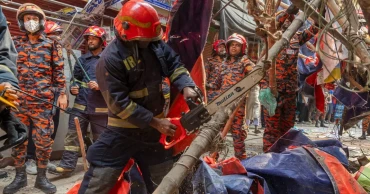
Bangladesh Earthquake: Fire Service issues 8 safety guidelines
Several earthquakes including one measuring 5.7 on the Richter scale, have been felt in different parts of Bangladesh including the capital Dhaka over the last two days.
This has spread panic among people in Dhaka city and surrounding districts.
Fire Service and Civil Defence Department has urged people in the country to stay calm and follow eight essential safety measures during an earthquake.
What to do during an earthquake:
• Do not panic, stay calm and steady. If you are on the ground floor, quickly move outside to an open space.If you are in a multi-storey building, follow the Drop–Cover–Hold method: Drop down, cover under a sturdy table or desk and hold on firmly or take shelter beside a column or under a beam. If possible, protect your head with a pillow, cushion or similar object.• Do not use lifts during an earthquake. Once the shaking stops, immediately switch off electrical and gas connections.• Stay away from balconies, windows, bookshelves, almirahs, wooden furniture or any hanging heavy objects. Keep a torch, helmet, essential medicines and a whistle within reach for emergency use.• If you are outdoors, stay in an open area away from trees, tall buildings and electric poles.• If you are inside a vehicle, stop it away from overbridges, flyovers, trees and electric poles. Remain inside the vehicle until the shaking subsides.• After a major tremor, aftershocks may follow. Stay away from damaged buildings, bridges and infrastructure, as further shaking may cause additional collapses and casualties.• Collective awareness and preparedness can reduce the scale of damage.
Read more: Ceiling And Wall Cracks After An Earthquake: When To Worry
Emergency hotline number:
For emergency assistance, contact the Fire Service and Civil Defence hotline: 102.
10 months ago
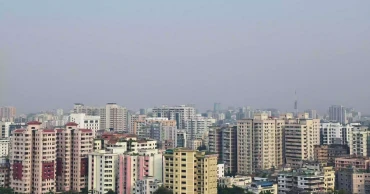
Dhaka can’t withstand major quake; 95% of its buildings unplanned: Experts
Dhaka, one of the world’s most densely populated megacities, may face a catastrophic humanitarian disaster if struck by a major earthquake, leading geologists and engineers have warned.
Multiple assessments indicate that more than eight lakh of the capital’s 21.45 lakh buildings could collapse if a quake of magnitude 7 or higher hits the region.
Poor enforcement of the national building code, unauthorised construction, flawed designs and decades of lax oversight have placed the city among the most earthquake-vulnerable capitals in the world, according to the experts.
A Warning Jolt
On November 21, Dhaka and surrounding districts experienced severe shaking from a magnitude-5.7 earthquake. At least 10 people were confirmed dead and more than 100 injured.
A magnitude-3.3 aftershock struck Narsingdi area the following morning and evening, heightening concerns that a larger and more destructive quake may be imminent.
Bangladesh’s leading geologists say the quake was not an isolated event, but a precursor to something more dangerous.
‘Plate Lock Has Opened’
Dr Syed Humayun Akhter, former professor of geology at the University of Dhaka and former vice-chancellor of Bangladesh Open University, told UNB that the earthquake originated along the boundary of the Burma Plate in the east and the Indian Plate in the west. “This plate boundary had been locked for many years. The magnitude-5.7 event has unlocked it,” he said.
Read more: Ceiling And Wall Cracks After An Earthquake: When To Worry
According to him, Bangladesh narrowly avoided a far worse disaster. “We are fortunate the quake was not magnitude 7 or 7.5. But such a major earthquake may happen in the near future.”
Research shows that the region has accumulated enough tectonic stress to trigger a quake as powerful as magnitude 8.2 to 9, Dr Akhter added. “Only a tiny amount of that energy was released this time.”
He said Friday’s shaking was among the strongest felt in recent memory, with a shallow depth of just 10 kilometres—making it far more damaging.
Bangladesh Sits on Three Active Plates
Dr Anwar Hossain Bhuiyan, professor at the University of Dhaka’s Department of Geology, explained that Bangladesh lies near the junction of three major tectonic plates—the Indian, Burmese and Eurasian plates—making earthquakes inevitable.
The country’s subsurface is composed largely of soft sedimentary rocks that amplify shaking. When the natural frequency of the ground matches the vibration frequency of buildings, the effects are devastating, he warned.
Dhaka’s Buildings Are Not Ready
A 2022 Urban Resilience Project by Rajuk painted an alarming picture:
Total buildings in Dhaka: 21,45,000At risk of collapse: Over 8,00,000 (40%)High-rise buildings: Over 75,000—most built without meeting minimum standardsBetween 2006 and 2016, around 95,000 buildings were constructed in the capital. Shockingly, only 4,147 had Rajuk approval, meaning 95.36% were unauthorised or built without approved designs.
Construction by untrained masons, design alterations mid-construction and widespread unauthorised development have pushed the city to the brink of a structural disaster, experts say.
Govt closely monitoring earthquake aftermath in Bangladesh: Chief Adviser
Rajuk Responds: ‘Accountability Being Strengthened’
Rajuk Chairman Engineer Md Riazul Islam told UNB that the agency is trying to bring long-neglected accountability back into the system. So far, 3,382 illegal or non-compliant buildings have been identified.
Following Friday’s quake, all Rajuk officials’ leave was cancelled and teams were sent to inspect cracked or damaged structures.
New Plan: Colour-Code At-Risk Buildings
Rajuk officials said international-grade technology will soon be introduced for mandatory building fitness assessments. Under the new plan, buildings will be marked in different colours based on structural safety—illegal, vulnerable or earthquake-resistant—to allow residents to immediately understand which structures are habitable.
Oversight Failures Compound the Risk
Md Abdul Latif Helali, former chief engineer of Rajuk, said building standards are routinely ignored. “A magnitude-5.7 earthquake already caused cracks in many buildings. A magnitude-7 quake would create unimaginable devastation.”
He revealed that sophisticated equipment purchased under the World Bank-funded Urban Resilience Project—worth hundreds of crores—remained unused due to bureaucratic apathy. A proposed trust to assess disaster-resilient buildings in Mohakhali is also stalled in administrative hurdles.
‘Dhaka Will Be Unmanageable After a Major Quake’
BUET’s former professor M Shamimuzzaman Bosunia warned that despite some improvement in preparedness, the government simply does not have the capacity to manage the aftermath of a major earthquake.
“Gas and electricity lines will ignite fires. Water and sewage systems will collapse. Survivors won’t even find a safe route to evacuate. Dhaka will become unliveable,” he said.
What You Should Do During Earthquake
Strongest Shaking in Recent Times
Rubaiyat Kabir, acting head of the Bangladesh Meteorological Department (BMD) Earthquake Monitoring Centre, said the 5.7-magnitude quake was the strongest in decades. While smaller quakes of magnitude 4 to 5 have been recorded elsewhere in the country in recent months, those originated outside Bangladesh.
“This region has a history of large earthquakes. A major quake can occur at any time, but predicting the exact moment is impossible,” he added.
BMD Director (in-charge) Md Mominul Islam said Dhaka’s weak soil prolongs shaking.
He said the first 72 hours after any earthquake are the most critical. Two aftershocks following Friday’s quake were normal, he said, but the sequence serves as a stark reminder of the country’s high seismic risk.
Incapable Fire Service
Former Director General of Fire Service and Civil Defence Brigadier General (retd) Ali Ahmed Khan told UNB that while the force has some preparedness, its capacity is far from adequate for a major disaster.
“More trained volunteers are urgently needed. Hospitals must have adequate emergency facilities and blood bank reserves,” he said.
Bangladesh earthquake death toll rises to 10; scores injured
10 months ago
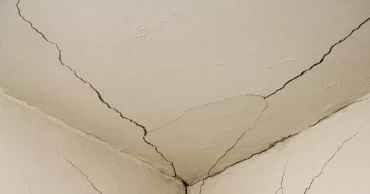
Ceiling And Wall Cracks After An Earthquake: When To Worry
Dealing with cracks on ceilings or walls after earthquakes is a long-standing issue for common people. Depending on the magnitude of the tremors, damage can range from tiny clefts to extensive spaces across walls and ceilings. Even after the tremors stop, there is a risk of bigger accidents from the cracks that have formed. In most cases, victims are unsure which of those could actually be deadlier. Let’s discuss the different types of post-earthquake structural damages and cracks to clear up confusion and take the right action with caution.
Earthquake Cracks That Don’t Mean Trouble
Be it in living or workplaces, seismic damage to property and furniture can come in many forms. But not all of these are severe enough to cause bigger accidents. Here are some signs you want to look for.
Hairline Cracks
These are very thin, pen- or spiderweb-like lines that appear on plaster or paint. These surface spots are formed when the plaster on the surface becomes flexible due to shaking. They are not harmful and can be easily repaired.
Moreover, apart from seismic activity, these are also caused by normal house settlement, temperature change, and humidity fluctuations.
Read more: Post-Earthquake Cautions: Do’s & Don’ts
Splits in Structural Joints
Weak spots emerge after a long time where the ceiling is directly connected to the wall. In most cases, this situation does not arise due to structural reasons.
Interior Wall Stress Marks
These walls typically don’t bear any load, acting as partitions. Unlike pillars, these walls do not support the building.
11 months ago
Aftershocks continue as 3rd quake jolts Narsingdi, adjacent districts
The third mild earthquake, considered an aftershock of Friday’s powerful tremor, was felt in parts of Narsingdi and nearby districts on Saturday evening, heightening concern among residents.
According to the United States Geological Survey (USGS), the latest quake, measuring 4.3 on the Richter scale, struck at 6:06 pm (local time). Its epicenter was located 11 kilometres west of Narsingdi at a depth of 10 kilometres.
Earlier in the morning, another aftershock was felt in Narsingdi's Palash upazila.
According to the Bangladesh Meteorological Department (BMD), the quake, measuring 3.3 on the Richter scale, was recorded at 10:36 am. Its epicentre was located about 29 km west of the BMD Seismic Centre in Agargaon.
However, no damage or casualties were reported, officials said.
Read more: Ceiling And Wall Cracks After An Earthquake: When To Worry
Friday’s 5.7-magnitude earthquake, which hit several parts of Bangladesh, left at least 10 people dead and dozens injured.
Of the casualties, four were reported in Dhaka, five in Narsingdi — the epicentre — and one in Narayanganj.
11 months ago
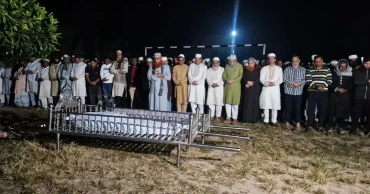
2 Narsingdi earthquake victims laid to rest in Kishoreganj
Two people who died during Friday's (November 21) earthquake in Narsingdi were laid to eternal rest at their village home in Kishoreganj district on Saturday.
The deceased were identified as Delwar Hossain Ujjal, 37 and his son Omar Faruk, 12, residents of Gabtoli in Narsingdi district town.
The first namaz-e-janaza of the duo was held at Jameya Kashemia Kamil Madrasah in Gabtoli area in Narsingdi on Friday midnight where additional deputy commissioner of Narsingdi Abu Taher Mohammad Samsuzzaman, BNP district unit BNP President Khairul Kabir Khokon and others were present there.
Later, the bodies was taken to Hossainpur upazila of Kishoreganj district where the 2nd janaza was held and they were buried.
Additional deputy commissioner of Narsingdi Abu Taher, said five people were killed in the earthquake and the local administration provided Tk 25,000 each to the family members of each deceased.
Earlier on Friday, a six-storey building collapsed on the adjacent house of Delwar Hossain during an earthquake in Gabtoli area of Narsingdi district town, leaving Delwar, his son Omar and daughter Tasfia injured.
Read more: Ceiling And Wall Cracks After An Earthquake: When To Worry
Later, they were taken to Narsingdi Sadar Hospital from where Delwar and Omar were referred to Dhaka Medical College and Hospital.
Delwar died on way to Dhaka while Omar died at Dhaka Medical College and Hospital.
11 months ago
What You Should Do During Earthquake
A magnitude 5.7 earthquake struck Dhaka and some other parts of Bangladesh on the morning of 21 November 2025, sending tremors through the capital and surrounding districts.
Strong shaking was felt across Dhaka, Gazipur, Narayanganj, and nearby areas.
In Old Dhaka (Armanitola), a portion of a building partially collapsed. At least 3 people were reported killed, according to police.
People in Dhaka described panic, rushing out of homes and offices, and helping children and elderly to safety.
Read more: 10 Most Earthquake-prone Countries around the World
What to Do During an Earthquake
Here are some critical safety steps to follow if another quake strikes:
1. If You Are Indoors
• Stay inside — do not run outside while the building is shaking.
• Drop, Cover, and Hold On — get under a sturdy desk or table and hold on.
• If no furniture is nearby, move against an interior wall or into a hallway.
• Stay away from windows, fireplaces, and heavy furniture or appliances, which could fall.
• Avoid the kitchen, as items like dishes and pots can fall and injure you.
2. If You Are Outside
• Move to an open area, away from buildings, power lines, chimneys, and anything that might collapse.
3. If You Are Driving
• Carefully pull over, but do not stop under or on a bridge or overpass, or beneath trees, signposts, or power lines.
• Stay inside your vehicle until the shaking stops.
• When you resume driving, be alert for road damage, fallen rocks, and other hazards.
5. If You Are Near the Ocean
• Follow tsunami safety guidelines — move to higher ground if necessary and listen to local authorities.
Read more: Post-Earthquake Cautions: Do’s & Don’ts
Why This Matters Now
This quake is a serious wake-up call. Dhaka is densely populated, and although buildings swayed rather than fell en masse, even moderate earthquakes can trigger panic, structural damage, or worse. Expert geologists warn that preparedness and quick, informed responses are crucial to minimizing harm.
Take-Home Message: Stay calm, stay safe, and follow earthquake safety rules — they can save lives.
(With inputs from USGS)
11 months ago